

Free Money Worksheets for Kindergarten Through 3rd Grade
Get 30 days of free worksheet downloads
Key Takeaways
- Coin identification is introduced in kindergarten, where students learn each coin's name, value, and appearance - with the dime's small size despite high value being the most common point of confusion.
- The recommended teaching order for coins is penny, dime, nickel, then quarter - starting with the two whose names align most intuitively with their values.
- Counting mixed coins requires students to switch skip-counting sequences mid-count, so the standard strategy is to always start with the highest-value coin and work down.
- Making change is best taught using the count-up strategy - starting from the purchase price and counting up to the amount paid - which mirrors real-world cashier practice and avoids borrowing across the decimal point.
- Second grade is the primary year for money in Common Core math, covering dollar amounts, equivalent coin representations, and introductory change-making.
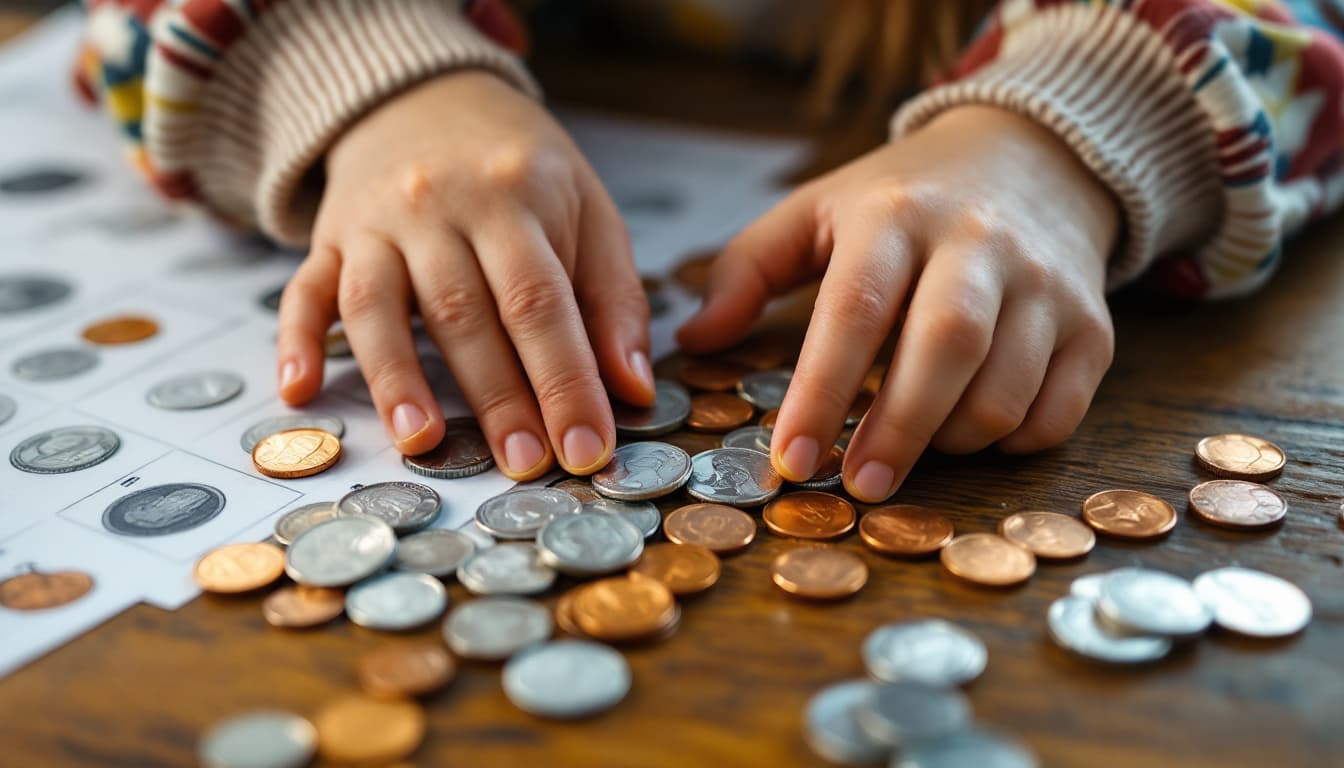
Money is one of those math topics where the real world helps enormously. Kids who have counted actual change, received an allowance, or paid for something at a store have an intuitive head start on money worksheets.
For kids without that experience, the worksheets themselves need to carry more weight. Here's how the concept builds across grades.
Kindergarten Money Worksheets
Kindergartners learn to identify coins by name and appearance.
Skills covered:
- Name each coin: penny, nickel, dime, quarter
- Know the value of each coin: 1 cent, 5 cents, 10 cents, 25 cents
- Match the coin to its name
- Recognize front and back of each coin
The main challenge: dimes are the smallest coin but not the smallest value. This runs counter to what kids expect from physical objects, where bigger usually means more.
A useful trick: pennies are copper-colored. Everything else is silver. That's one reliable visual distinction.
Good worksheet formats:
- Circle the coin: "Circle all the dimes."
- Match: draw a line from the coin to its name and value
- Label the coin and write its value
- Sort coins by type
Explore our kindergarten money worksheets.
1st Grade Money Worksheets
First graders identify coins and count small amounts.
Counting coins of one type. How much is 4 dimes? Students skip-count by 10s: 10, 20, 30, 40. Four dimes = 40 cents.
Mixed coins (within a small amount). Usually pennies and nickels, or pennies and dimes, before mixing all four.
Comparing amounts. "Maria has 3 nickels. Luis has 12 pennies. Who has more?" (15 cents vs. 12 cents)
The key skill here is switching skip-counting sequences. Students count quarters by 25s, dimes by 10s, nickels by 5s, then pennies by 1s. Mixing them in one collection means they need to mentally track which sequence they're on.
Strategy for counting mixed coins: always start with the highest value coin. Count all quarters first, then dimes, then nickels, then pennies.
Free 1st Grade Money Worksheets


Explore our 1st grade money worksheets.
2nd Grade Money Worksheets
Second grade is the main year for money in Common Core math.
Counting larger amounts. Including dollar bills alongside coins. Students use the dollar sign and decimal point: $1.35.
Equivalent amounts. "Show 75 cents three different ways using coins." Multiple representations deepen understanding.
Comparing amounts. "Which is more: $0.89 or $0.98?" (Place value applied to money)
Introduction to making change. "You have $1.00 and you spend $0.65. How much change do you get?" Students use subtraction or count-up strategies.
Free 2nd Grade Counting Money Worksheets


The most useful strategy for making change is counting up: start at the price, count up to the amount given. $0.65 to $0.70 is 5 cents. $0.70 to $1.00 is 30 cents. Total change: 35 cents. This mirrors what cashiers actually do and avoids borrowing across the decimal.
Explore our 2nd grade money worksheets.
3rd Grade Money Worksheets
Third graders apply money to multi-step word problems.
Multi-step problems. "Jamal bought a book for $3.25 and a pencil for $0.75. He paid with a $5 bill. How much change did he get?" (Two operations: addition + subtraction)
Comparing problem-solving strategies. "How would you solve this with mental math? How would you solve it by writing it out?"
Larger amounts. Problems involving amounts over $10.
The challenge at this level is the multi-step structure. Students need to read the problem, identify what they're solving, choose operations, and check whether their answer is reasonable. This is a reading comprehension skill as much as a math skill.
Explore our 3rd grade money worksheets.
How to Practice Money at Home
Use real coins. No worksheet replaces the physical experience of handling and counting actual money. Keep a jar of change. Count it together.
Play store. Put price tags on objects around the house. Give your child coins to "buy" things. Make change.
Let them pay for small things. When you're at a store and the total is manageable, let your child hand over the money and count the change.
Connect to saving goals. "You want that toy that costs $8. You have $3.50. How much more do you need to save?" Real motivation makes math stick.
Keep Reading

Adi Ackerman
Head Teacher
Adi is the Head Teacher at ClassWeekly, with years of experience teaching elementary students. She designs our curriculum-aligned worksheets and writes practical guides for teachers and parents.
Keep Reading
Ready to download? Try ClassWeekly free for 30 days.
Unlimited worksheets for PreK through 5th grade. Cancel anytime.