
How to Teach Money to Kindergartners
Get 30 days of free worksheet downloads
Key Takeaways
- Introduce coins one at a time over at least a week, not all four on the same day, so children have time to learn each name and value before adding the next.
- The dime-vs-nickel size confusion is the most common misconception and must be addressed directly, because kids naturally assume bigger means more valuable.
- Hands-on exploration with real coins before any worksheets builds the sensory foundation that makes coin identification stick.
- A classroom store is the most effective single activity for kindergarten money lessons because it combines identification, value, and real-world context.
- Counting mixed coins is typically a first or second grade skill - kindergarten focus should stay on naming coins and knowing individual values.

Ask a kindergartner which coin is worth more, a nickel or a dime, and there's a solid chance they'll point to the nickel. Because it's bigger. And honestly? That logic makes complete sense if you're five. Nobody told them that bigger doesn't mean more.
Money is one of those math topics that kids think they already understand because they see it all the time. But there's so much real confusion hiding underneath. This guide walks through how to introduce coins in a way that's hands-on, clear, and actually fun.
Table of Contents
- Start With Real Coins, Not Worksheets
- Introduce One Coin at a Time
- Tackle the Dime-vs-Nickel Size Confusion Head-On
- Teach Coin Values With Anchor Points
- Practice Sorting Coins
- Connect Money to Real Life Every Day
- Set Up a Classroom Store
- Skip the Complicated Counting for Now
- Use Movement and Games
- FAQ
1. Start With Real Coins, Not Worksheets
Before anything goes on paper, your kiddos need to hold the actual coins. The feel, the size, the weight, the shine vs. the dull copper. That physical experience is the foundation that makes everything else make sense.
Bring in a bag of real mixed coins. Let students explore. Ask: "What do you notice? How are these different from each other?"
Activities:
- Pass around one of each coin and let every child hold them before you say any names
- Sort coins by color (copper vs. silver) as a first step
- Look at the pictures on each coin: "Who do you see on this one?"
- Compare size by laying coins on a piece of paper and tracing around them
- Ask: "Which coin do you think is worth the most? Why do you think that?"
That last question almost always reveals the "bigger = more valuable" misconception right away. Surface it early so you can address it directly.
Free Kindergarten Money Worksheets


2. Introduce One Coin at a Time
Don't introduce all four coins on the same day. Spread it out over at least a week, maybe two. One coin per day (or per 2-3 days) gives the information room to settle.
Suggested order:
- Day 1-2: Penny (1 cent, copper, Abraham Lincoln)
- Day 3-4: Nickel (5 cents, silver, Thomas Jefferson)
- Day 5-6: Dime (10 cents, silver, smallest coin, Franklin Roosevelt)
- Day 7-8: Quarter (25 cents, silver, largest of the four, George Washington)
Each day: see it, name it, say its value, find it in the coin collection, draw it.
Activities:
- Create a coin journal: one page per coin with a rubbing, the name, and the value
- Make a "coin of the day" anchor chart that grows each day
- Play "find the penny" (or whichever coin you're learning) in a pile of mixed coins
- Trace each coin and color it correctly (copper for penny, silver for the rest)
- Say the names in a chant: "Penny, one cent. Nickel, five cents. Dime, ten cents. Quarter, twenty-five cents."
The chant sounds silly but it works. I've had students still saying it under their breath in first grade.
3. Tackle the Dime-vs-Nickel Size Confusion Head-On
This one deserves its own section because it is the most common and persistent mistake.
Kids see a nickel and a dime side by side and almost always think the nickel is worth more because it's bigger. This doesn't go away on its own. You have to name it directly.
Try this: "Here's something that seems weird. The dime is worth MORE than the nickel, even though it's smaller. Money doesn't work like blocks or toys where bigger means more. Money has its own special rules."
Activities:
- Make a comparison chart: big coin vs. little coin, then the VALUE column that "surprises" them
- Use the story hook: "The dime is magic. It's small but mighty."
- Hold a nickel in one hand and a dime in the other. Which is worth more? Check your coin chart.
- Sort coins by size, then sort them again by value. Notice how the order changes.
- Practice saying: "The dime is small but it's worth ten cents, which is MORE than the nickel."
Repeat this comparison at least a dozen times over several lessons. It takes a while to override the "bigger = more" instinct.
4. Teach Coin Values With Anchor Points
Instead of trying to memorize four random numbers (1, 5, 10, 25), give each coin an anchor.
- Penny = 1. One cent. One finger. One penny buys one cent.
- Nickel = 5. Five fingers on one hand. Count by fives.
- Dime = 10. Ten fingers. Two hands. Count by tens.
- Quarter = 25. This one is hardest. Use 25 tally marks or 25 cubes to show what 25 looks like.
Activities:
- Physically count out pennies to match each coin's value: "Show me 10 pennies. That's the same as one dime."
- Build coin value with cubes or counters: lay 5 cubes next to a nickel, 10 cubes next to a dime
- Use a number line and hop to each coin's value from zero
- Draw hands to show penny (1 finger), nickel (one hand), dime (two hands)
- Repeat the "penny bridge" regularly: "How many pennies equal a nickel? A dime?"
The penny-to-coin exchange is really powerful. When a child trades 10 pennies for one dime and sees it's the same amount, that's a real understanding moment.
Grab the kindergarten money worksheets for printable coin identification and value matching pages.
5. Practice Sorting Coins
Sorting is a skill kindergartners already know from math and science. Apply it to coins and they feel competent right away.
Start with simple sorts, then build complexity.
Sorting activities:
- Sort by color (copper vs. silver)
- Sort by size (smallest to largest)
- Sort by name (penny pile, nickel pile, dime pile, quarter pile)
- Sort by "less than 10 cents" vs. "10 cents or more"
- Sort by whose face is on the front (Lincoln, Jefferson, Roosevelt, Washington)
Activities:
- Give each student a set of plastic play coins and a sorting mat with four labeled sections
- Do coin sort races: "How fast can you sort these into the right piles?"
- Introduce "odd one out": put three pennies and one nickel in a group. "Which one doesn't belong?"
- Sort a handful of coins and then count how many of each type you have
- Graph the results: which coin do we have the most of?
Sorting feeds right into counting, which is your next step. Keep the two activities connected.
6. Connect Money to Real Life Every Day
Money is one of those topics where the real-world connection is obvious and available, so use it.
When our kiddos see money being used at home, in a store, at the vending machine, it reinforces everything you're teaching in the classroom.
Activities:
- Ask students to bring in one coin from home (parent permission noted) and share which coin it is
- Look at price tags in a classroom "store" setup and identify which coins you'd need
- Bring in a clear piggy bank and add coins throughout the unit so students can watch it fill up
- Discuss: "When do grown-ups use money? When do you use money?"
- Read picture books about money: "Curious George and the Ice Cream" or "A Chair for My Mother" spark great conversations
At home: next time you get change back at a store, let your child sort the coins and name them. Five minutes of real-life practice is worth a whole worksheet.
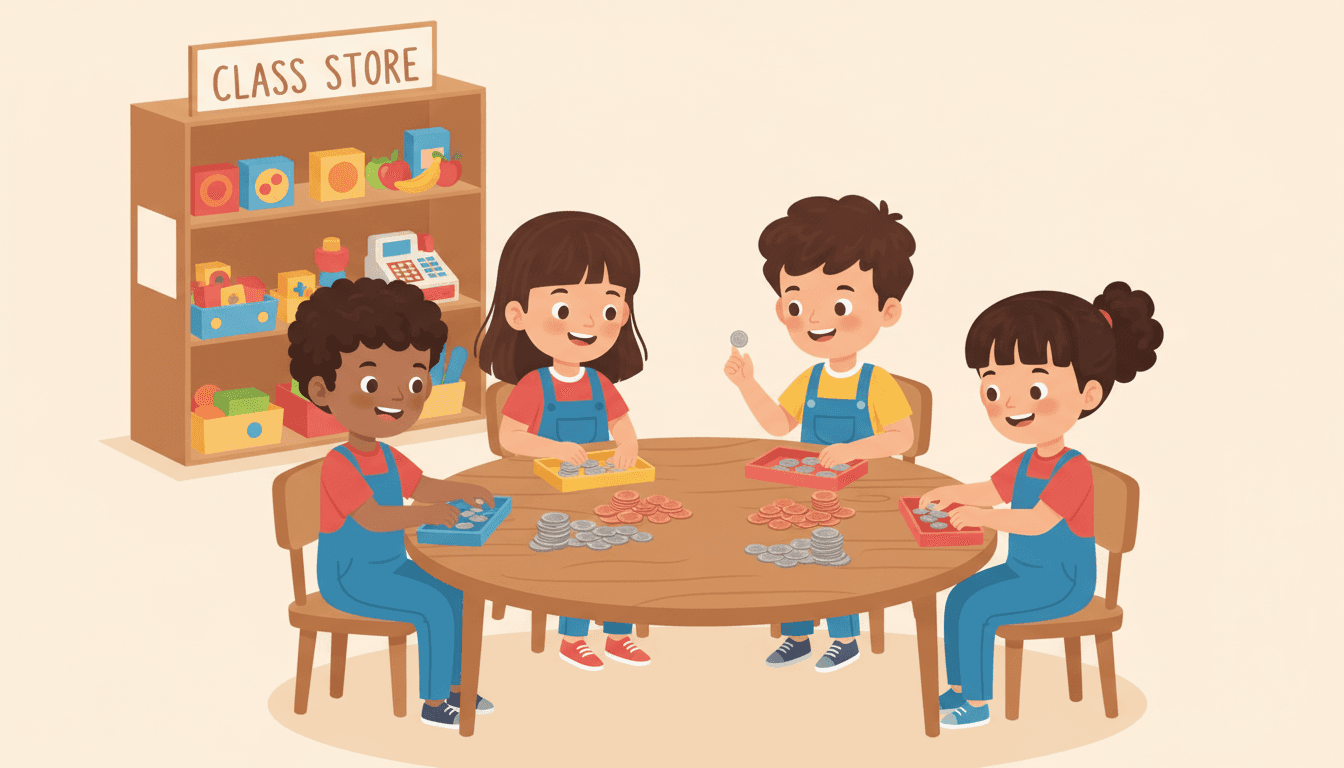
7. Set Up a Classroom Store
A classroom store is the most fun and effective money activity for kindergarten. Full stop.
Set up a "store" with classroom items labeled with prices (1 cent, 5 cents, 10 cents, 25 cents). Give each student a small handful of play coins. Let them "shop."
How to run it:
- Keep prices to single coin values at first (things that cost exactly 1 penny, 5 cents, etc.)
- Assign a "cashier" job that rotates through students
- Have the cashier say: "That costs 5 cents. Do you have a nickel?"
- Later, add prices that require two coins of the same type (2 pennies = 2 cents)
- Celebrate every successful transaction
Tips:
- Use small toys, stickers, erasers, or pictures of items as "merchandise"
- Label prices with both the numeral and the coin image to start
- Let students be the cashier, not just the shopper
- Run the store for 15-20 minutes maximum. Any longer and it gets chaotic.
- Debrief afterward: "What did you buy? How much did it cost? Which coin did you use?"
This activity hits identification, value, and real-world connection all at once. It's worth the setup time.
8. Skip the Complicated Counting for Now
Here's an honest moment: trying to count mixed coins in kindergarten is often too much, too soon. Most kindergarten standards focus on coin identification and individual coin values, not "how much is this pile of mixed coins worth?"
That skill gets addressed more in first and second grade.
If you have students who are ready to add coins together, wonderful. But for most of the class, the goal is:
- Name the coin correctly
- Say its value
- Match equal values (5 pennies = 1 nickel)
Don't rush past identification into addition. The foundation matters more.
What IS appropriate in kindergarten:
- Counting a set of the same coin (3 nickels = 15 cents, using skip counting)
- Showing a given amount using one type of coin
- Identifying which is worth more between two coins
- Matching coin names to coin images
9. Use Movement and Games
As always with kindergarten: if they can move, they will remember more.
Games that work:
- Coin toss sorting: Toss a coin into the air, catch it, name it and say its value before it counts
- Coin memory: Memory game with coin image on one card and coin name/value on the matching card
- Coin bingo: Each card has coin images. Call out "nickel!" and students cover a nickel.
- Penny drop: Drop coins into cups labeled with coin names. Try to land each coin in its correct cup.
- Show me the coin: Call out a value. Students hold up the correct coin from their coin set.
Activities:
- Do coin rubbings with real coins and crayons, then label each rubbing
- Draw the front and back of each coin from memory
- Make a coin book: one page per coin, with a drawing, the name, and the value
- Play "I have, who has?" with coin names and values
- Sort play money during free center time
FAQ
Should I use real coins or play coins in the classroom? Both have value. Real coins are better for initial exploration because students can feel the actual size and weight differences. Play coins (plastic sets) are better for sorting and games because you have multiples of each and no one takes them home. Use real coins to introduce, play coins to practice.
My student keeps calling the dime a "little nickel." How do I help? This is super common. Keep a reference chart visible at all times: coin image, coin name, coin value. When they use the wrong name, don't correct sharply. Just say: "Let's check our chart. What does it say this one is called?" Repetition with the reference tool builds independence.
At what point should students be counting mixed coins? Most kindergarten standards don't require counting mixed coins. If your curriculum includes it, introduce it at the end of the unit for students who have mastered identification and single-coin counting. For most kiddos, that's a first-grade skill.
Are there good picture books for teaching money? Yes. "Bunny Money" by Rosemary Wells, "A Dollar for Penny" by Julie Glass, and "The Penny Pot" by Stuart Murphy are all great for kindergarten. They tell stories that involve counting and spending, which makes the math feel purposeful.
Keep Reading
- How to Teach Comparing Numbers to Kindergartners
- How to Teach Data and Graphing to Kindergartners
- How to Teach Measurement to Kindergartners
Conclusion
Money is one of those kindergarten topics that has an immediate, tangible "why" behind it. Our kiddos see money in the real world. They want to understand it. That motivation is your biggest teaching tool.
Go slowly. One coin at a time. Let them touch and sort before they count. Name the dime-nickel confusion directly. And when you're ready for something more structured, the kindergarten money worksheets at ClassWeekly have everything from coin identification to simple value matching, in a format your littles can actually use.
You're building real-world math skills here. That's worth taking seriously and having fun with at the same time.

Adi Ackerman
Head Teacher
Adi is the Head Teacher at ClassWeekly, with years of experience teaching elementary students. She designs our curriculum-aligned worksheets and writes practical guides for teachers and parents.
Keep Reading
Ready to download? Try ClassWeekly free for 30 days.
Unlimited worksheets for PreK through 5th grade. Cancel anytime.