
Comparing Numbers in Kindergarten: Greater and Less Than
Get 30 days of free worksheet downloads
Key Takeaways
- Start with comparison language kindergartners already know (more, less, same) before introducing any symbols or numerals.
- Use concrete manipulatives like blocks, counters, and balance scales before moving to pictorial or abstract representations.
- Teach greater than, less than, and equal to as vocabulary first - students should be fluent with the words before seeing the symbols.
- The alligator strategy works well as a memory hook, but pair it with conceptual understanding so it does not become a crutch.
- Most kindergartners move from concrete to abstract comparison by spring, and the progression should be gradual with no rush to remove manipulatives.

How to Teach Comparing Numbers to Kindergartners
You show a five-year-old two groups of blocks, seven in one pile and four in the other, and ask which is more. They point to the right one immediately. Then you write "7 > 4" on the board and watch their face go blank.
That's the gap at the heart of comparing numbers in kindergarten. The concept is intuitive. The symbolic representation is not. Your job is to build a bridge between the understanding they already have and the formal notation that school requires.
Table of Contents
- Start with What They Already Know
- Comparing Groups (Concrete Stage)
- Connecting Groups to Numbers
- Introducing Greater Than and Less Than
- The "Alligator" Strategy (and Why It Works)
- Introducing the Equal Sign
- Using Number Lines to Compare
- The Symbols: Teaching Less Than, Greater Than, and Equal
- Common Confusions and How to Address Them
- Moving from Concrete to Abstract
1. Start with What They Already Know
Kindergartners come to school with comparison language already in their brains. They know "more," "less," "bigger," "smaller," "same." Your first job is to activate that knowledge and tie it to math.
Don't open with symbols. Open with situations.
Honestly, the first few tries might feel awkward. That's normal.
Activities:
- "Who has more crayons?" Compare two students' crayon boxes in front of the group. Use the words "more" and "fewer."
- Read a picture book that involves comparing quantities. "Which animal collected more food?" Talk about it naturally.
- Morning meeting: compare attendance. "More students are here today than yesterday. How do we know?"
- Ask kiddos to compare things at home: "Does your family have more chairs or more tables?" Share at circle time.
Free Comparing Numbers Worksheets for Kindergarten


2. Comparing Groups (Concrete Stage)
Before numbers mean anything symbolically, students need to compare actual groups of objects. This is the concrete stage, and skipping it causes confusion later.
The goal here is simple: look at two groups, decide which has more, which has fewer, or whether they're the same.
Activities:
- One-to-one matching. Line up red blocks in one row, blue blocks in another. Match them up side by side. The row that sticks out past the end has more.
- Counting and comparing. Count each group. Write the numbers. Which number is bigger?
- More/fewer sorting mats. Two labeled sections on a mat: "more" and "fewer." Students place picture cards in the right section relative to a target number.
- Grab and compare. Each student grabs a handful of counters, counts them, and compares with a partner. Who has more? How many more?
- Real objects from the classroom. Compare a cup of pencils to a cup of crayons. Compare a stack of books to a stack of papers. Making it tangible keeps engagement high.
3. Connecting Groups to Numbers
Once students can reliably compare groups by looking and counting, connect that process to numerals. The group doesn't change, but now it has a number label.
This step matters because you want students to understand that a number represents a quantity, and comparing numbers means comparing what those quantities actually are.
Activities:
- Number cards with dot representations. Show a card with the numeral 5 on one side and five dots on the other. Compare two cards by looking at the dots first, then the numerals.
- Ten frames side by side. Fill two ten frames with different numbers of counters. Which frame has more? Count and label with numerals.
- Number towers. Use linking cubes to build towers for each number. Compare towers by height. Taller tower = more cubes = bigger number.
- Picture comparison. Show two sets of objects (six apples, three oranges). Students write the number for each set, then circle the bigger number.
4. Introducing Greater Than and Less Than
Now you introduce the vocabulary: greater than and less than. Use these words before you use any symbols. The words should feel natural before the symbols appear.
Model your language deliberately. Say "seven is greater than four" and "four is less than seven" many times, in many contexts, before introducing the written form.
Activities:
- Greater than/less than hand signals. Teach students a gesture for each: thumbs up and big arms spread wide for "greater than," hands close together for "less than." Use them during whole-group comparisons.
- Sentence frames. Give students a written frame: "___ is greater than ___." They fill it in using number cards.
- Number of the day comparison. Pick a number each morning. Students write one number that is greater and one that is less.
- Stand up/sit down. Call out two numbers. If the first is greater than the second, stand up. If less, sit down. If equal, do a little wiggle. (They love the wiggle.)
5. The "Alligator" Strategy (and Why It Works)
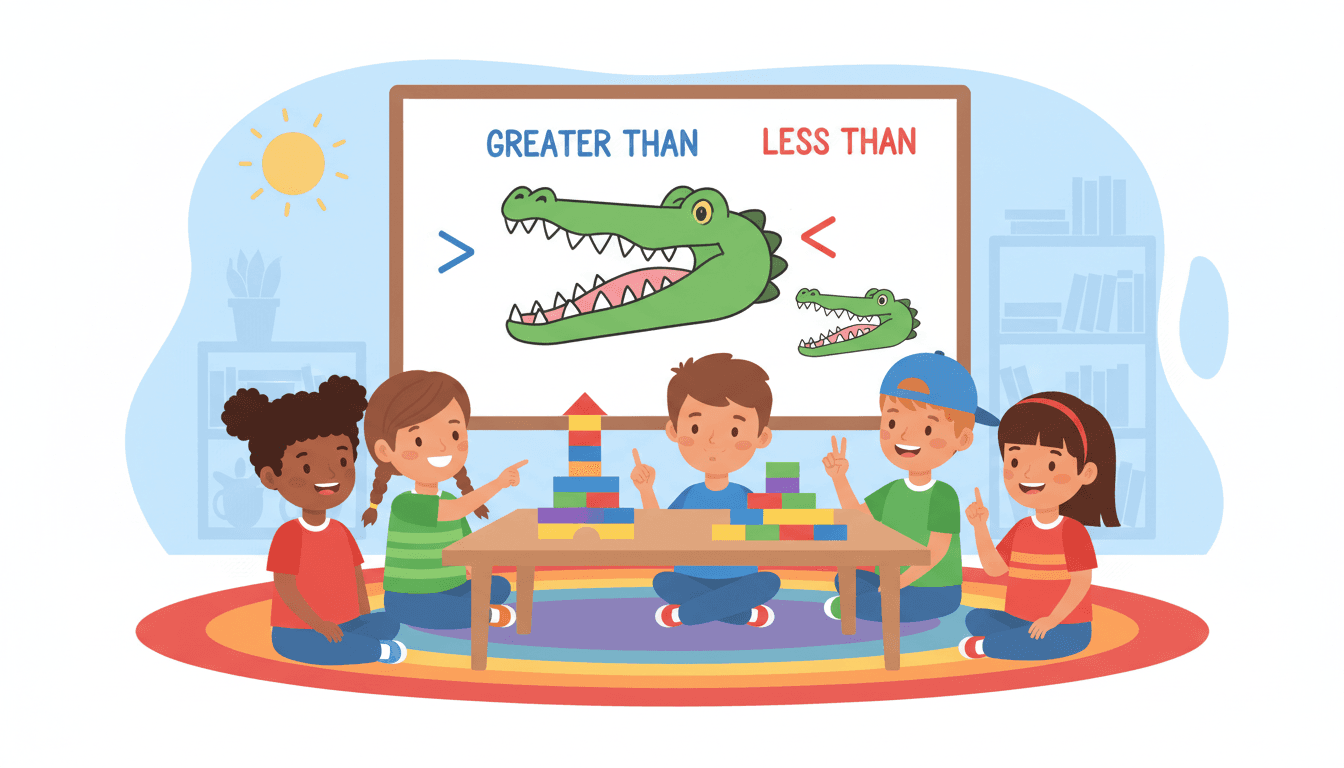
Almost every kindergarten classroom uses the alligator strategy: the greater than and less than symbols look like an open mouth, and the mouth always opens toward the bigger number because the alligator is hungry and wants to eat the most.
I'll be honest: some math educators don't love this strategy because it's a trick rather than a concept. They have a point. But for five-year-olds who need a hook to remember which symbol is which, it works, and it works well. Just pair it with genuine conceptual understanding so it doesn't become a crutch.
Activities:
- Draw the alligator. Students draw eyes and teeth around the greater-than or less-than symbol to make it look like a mouth. They draw this themselves; it sticks better than seeing it on a poster.
- Feed the alligator. Students place number cards on either side of a large alligator cutout. The mouth opens toward the bigger group.
- Alligator card game. Two students flip number cards simultaneously. The student whose number is greater "eats" both cards using the alligator rule.
- Check the direction. After writing a comparison, students ask: "Is the mouth open toward the bigger number?" If yes, it's correct. This self-check habit is valuable.
6. Introducing the Equal Sign
Equal to is often the trickiest concept. Students understand more and less pretty naturally, but equal requires understanding that two different-looking quantities can be the same.
Avoid introducing the equal sign only in the context of addition (2 + 2 = 4) because that teaches students that "equals" means "the answer goes here." Instead, introduce it as a balance: both sides are the same.
Activities:
- Balance scale. Put five blocks on each side of a balance scale. It balances. That's what equal means: both sides balance.
- Same amount, different arrangement. Show five red blocks in a line and five blue blocks in a pile. Same number, different look. Equal.
- Equal cards. Students match pairs of cards that show the same number in different representations (dots, numerals, objects).
- Sorting symbols. Give students cards with greater-than, less-than, and equal written on them. They place the right card between two number groups.
7. Using Number Lines to Compare
A number line is one of the most powerful tools in early math because it makes the relationship between numbers visual and spatial. On a number line, further right always means greater. This is a concept students can internalize with practice.
Activities:
- Walk the number line. Tape a large number line on the floor. Call out two numbers and have students stand on each one. Who's further right? That number is greater.
- Hop and compare. Students start at one number and hop right to reach another. If they hop right, the second number is greater. If they hop left, it's less.
- Mark and compare. Students mark two numbers on a printed number line and draw an arrow from the smaller to the larger.
- Clothespin number line. Clip a clothespin on two numbers. The clip further to the right wins.
8. The Symbols: Teaching Less Than, Greater Than, and Equal
Once students are fluent with the vocabulary and the concepts, it's time to teach all three symbols together: the less-than, greater-than, and equal symbols. Present them as a set, not in isolation.
The key to preventing confusion is consistent, structured practice comparing the same pairs multiple ways.
Activities:
- Symbol sort. Give students comparison number sentences with the symbols already filled in. They sort them into three piles: greater than, less than, equal to.
- Write the symbol. Flash two numbers on a card. Students write the symbol that belongs between them on their whiteboard.
- Fix it. Write intentionally wrong comparison sentences (e.g., 3 > 7). Students identify and correct the error.
- Three-way match. Students match a number comparison (6 and 4), a symbol (less-than, greater-than, equal), and a words card ("greater than") as a set.
For printable practice pages with all three symbols in structured formats, these kindergarten comparing numbers worksheets include concrete, pictorial, and abstract versions all in one download.
9. Common Confusions and How to Address Them
Confusing the two symbols. This is the most common issue. The visual similarity trips kids up constantly. The alligator anchor helps, but some students need more. Try writing one symbol in red and one in blue consistently until it clicks. Have them say "the open end faces the bigger number" every single time they write one.
Saying "less than" when they mean "fewer." Technically, "fewer" applies to countable objects and "less" to uncountable quantities, but in early elementary, "less than" is used for both. Don't correct this one.
Treating equal as "the same object" not "the same amount." A student might say four red blocks are not equal to four blue blocks because they look different. Go back to the balance scale and emphasize: equal means the same number, not the same thing.
Forgetting to count before comparing. Some students just guess based on which pile looks bigger. Require them to count and label both quantities before placing any symbol.
10. Moving from Concrete to Abstract
The progression from blocks and counters to numbers on paper should happen gradually. Don't pull the manipulatives too fast.
A reasonable sequence:
- Compare real objects (no numbers written)
- Compare pictures of objects with numbers labeled
- Compare numbers with pictorial support (dot cards, ten frames)
- Compare numerals only
Most kindergartners reach step four by spring of the year. Some get there earlier, some later. Both are fine.
Activities:
- Exit tickets. At the end of a lesson, students complete one comparison problem independently. Use this to track where each student is in the progression.
- Small group pull. Students still in the concrete stage need more hands-on work. Pull them in small groups for additional manipulative practice while others work independently.
- Partner work. Pair a student who's reached the abstract stage with one who's still at the pictorial stage. Teaching someone else deepens understanding.
FAQ
When do I introduce comparing two-digit numbers? In most kindergarten standards, the focus is on numbers 0-20. Comparing two-digit numbers beyond 20 is typically a first-grade skill. Introduce it at the end of the year only if your early finishers are ready.
My students keep forgetting which symbol is which. What else can I try? Muscle memory helps. Have students trace each symbol in the air, in sand, or on a partner's back while saying its name. Kinesthetic practice plus verbal label plus visual symbol all together is more effective than visual practice alone.
Is it okay to use the alligator strategy for the whole year? Yes, as long as students genuinely understand what greater than and less than mean. The strategy is scaffolding. If it helps them access the concept, use it. Revisit the conceptual foundation periodically to make sure the symbol and the meaning stay connected.
How do I handle students who already know this material? Extend by comparing three numbers, comparing numbers to 100, or asking them to write their own comparison problems. Challenge them to find examples of comparisons in the real world and photograph or draw them.
Keep Reading
- How to Teach Data and Graphing to Kindergartners
- How to Teach Measurement to Kindergartners
- How to Teach Money to Kindergartners
Conclusion
Comparing numbers is one of the foundational skills of number sense, and kindergarten is exactly the right time to build it well. When you start with what students already understand intuitively, move through the concrete and pictorial stages deliberately, and introduce symbols only after the concepts are solid, your kiddos end up with real understanding rather than symbol-matching tricks.
The goal is for a student to look at 8 > 5 and think "eight is a bigger number than five, that makes sense" rather than "the mouth opens toward the eight, so I put that symbol." Both kids get the right answer, but only one of them actually understands math.
For structured practice at every stage, grab these kindergarten comparing numbers worksheets. They move from pictures to numerals and include all three symbols.
You've got this, and so do your kiddos. 🐊

Adi Ackerman
Head Teacher
Adi is the Head Teacher at ClassWeekly, with years of experience teaching elementary students. She designs our curriculum-aligned worksheets and writes practical guides for teachers and parents.
Keep Reading
Ready to download? Try ClassWeekly free for 30 days.
Unlimited worksheets for PreK through 5th grade. Cancel anytime.