
Fun Division Tricks That Help Kids Learn Faster
Get 30 days of free worksheet downloads
Key Takeaways
- Divisibility rules for 2, 5, and 10 rely on the last digit, while rules for 3 and 9 require adding all the digits together - these are patterns rooted in how our base-10 number system works, not arbitrary tricks.
- The halving strategy lets kids divide by 4 in two steps and by 8 in three steps, making mental math with even numbers much faster than traditional long division.
- Fact family triangles show students that division is just multiplication in reverse - knowing 7 × 8 = 56 instantly gives them 56 ÷ 8 = 7 and 56 ÷ 7 = 8.
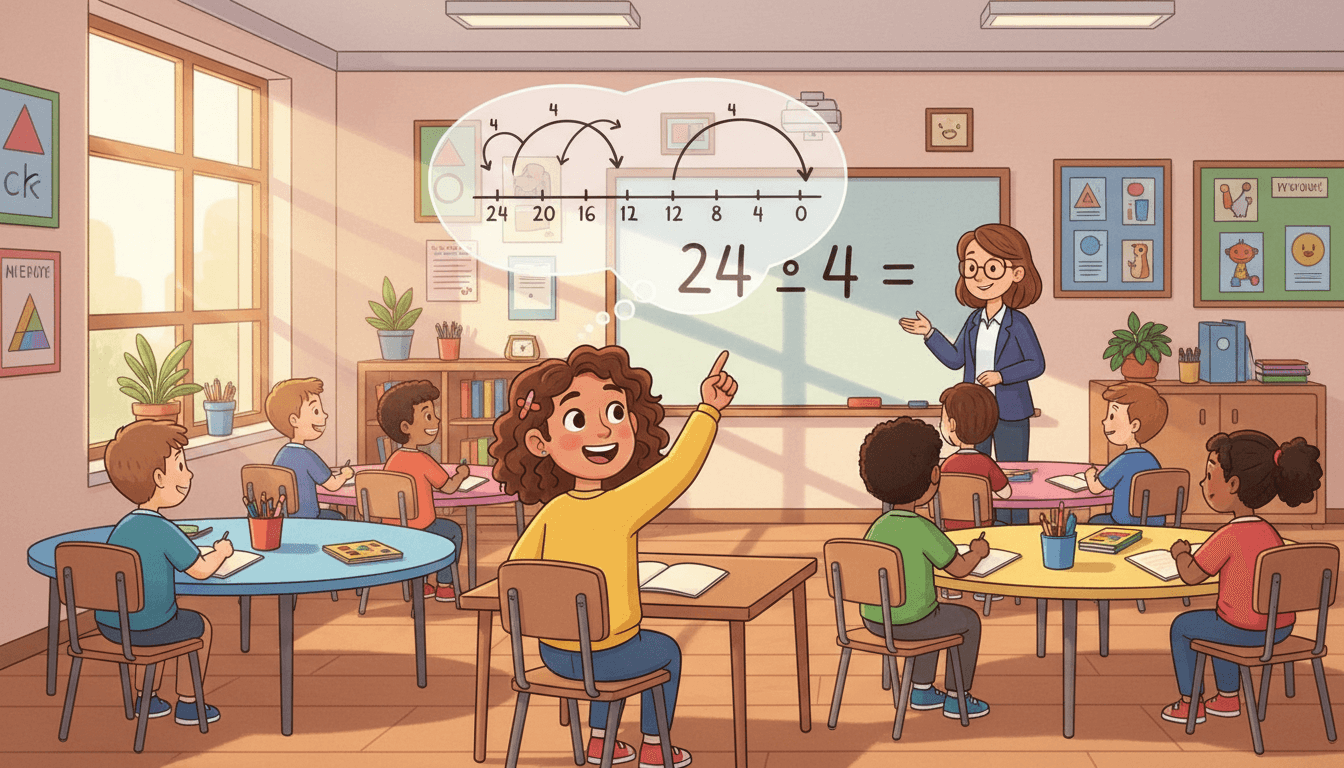
- Skip counting backward on a number line turns division into repeated subtraction, giving visual learners a concrete strategy before they move to abstract recall.
- Teaching kids to multiply back and check their division answer builds a self-correction habit that prevents errors from becoming ingrained patterns.

Kids love shortcuts. Tell a third grader there's a trick to figuring out if a number divides evenly, and suddenly math becomes a treasure hunt. The thing is, these aren't really tricks at all. They're patterns. And patterns are the heart of mathematics.
So here's a collection of division strategies that actually stick. They're the kind of thing your students will use without even thinking about it once the patterns click into place.
Why Division "Tricks" Actually Work (They Are Patterns, Not Magic)
Let's be honest about the word "trick." When we teach kids a shortcut for division, we're not teaching them to cheat math. We're teaching them to notice patterns that mathematicians have used for centuries.
Take the rule that any number ending in 0 or 5 is divisible by 5. That's not a magic trick. It's a consequence of how our base-10 number system works. When kids learn these patterns, they're building real number sense, not just memorizing steps.
Frame it as detective work. Tell your students they're "math detectives looking for clues." The clues are patterns in the numbers. The case they're solving? Whether one number divides evenly into another. This framing turns what could feel like rote memorization into something genuinely fun.
And the best part: once kids start seeing division patterns, they start noticing patterns everywhere in math. That's the real payoff. These "tricks" are actually training wheels for mathematical thinking.
Free 3rd Grade Division Worksheets


Divisibility Rules Every Kid Should Know
These are the big five rules your students should have in their back pocket. Start with the easy ones and build up.
Divisible by 2: The number ends in an even digit (0, 2, 4, 6, or 8). Ask your kiddos: "Is 346 divisible by 2?" They just check the last digit. It's 6, so yes. Done.
Divisible by 5: The number ends in 0 or 5. Simple. Kids pick this one up fast because they already know skip counting by 5s.
Divisible by 10: The number ends in 0. This is the easiest one, and it's a great confidence builder. Start here if your students need a win.
Divisible by 3: Add up all the digits. If that sum is divisible by 3, the original number is too. For example, 123: 1 + 2 + 3 = 6. Is 6 divisible by 3? Yes. So 123 is divisible by 3. This one feels like real magic to kids.
Divisible by 9: Same idea as the rule for 3, but the digit sum needs to be divisible by 9. Take 729: 7 + 2 + 9 = 18. Is 18 divisible by 9? Yes. So 729 ÷ 9 works out evenly.
Make it a game. Write a big number on the board and have students race to figure out which numbers (2, 3, 5, 9, 10) divide into it evenly. Call it "Divisibility Bingo" or "Pattern Detectives." The competitive energy gets them practicing without even realizing it.
The Halving Strategy for Quick Division
This one is probably the most useful mental math strategy your students will ever learn. It builds on something they already know: finding half.
Dividing by 2 is just finding half. Most kids can halve numbers pretty quickly. 48 ÷ 2 = 24. No problem.
Dividing by 4? Half it twice. Take 48 ÷ 4: half of 48 is 24, half of 24 is 12. So 48 ÷ 4 = 12. Two simple steps instead of one harder one.
Dividing by 8? Half it three times. 48 ÷ 8: half of 48 is 24, half of 24 is 12, half of 12 is 6. So 48 ÷ 8 = 6.
See the pattern? Every time you double the divisor, you add one more halving step.
This strategy works beautifully with even numbers. It gets trickier with odd numbers, so let your students practice with even numbers first until the halving feels automatic. Then you can introduce what happens when you get a remainder.
Practice idea: Give students a "halving chain" starting with a big even number like 96. They write: 96 → 48 → 24 → 12 → 6 → 3. Then ask: "What did you just divide by to get from 96 to 6?" (Answer: 16, or 2 four times.) This builds intuition for powers of 2.
Skip Counting Backward: Division on a Number Line
Your students have been skip counting since kindergarten. They just didn't know it was division.
Here's how it works. Take 35 ÷ 7. Start at 35 on a number line and count backward by 7s: 35, 28, 21, 14, 7, 0. How many jumps did you make? Five. So 35 ÷ 7 = 5.
This is really just repeated subtraction with a visual tool. And for students who struggle with abstract division facts, it's incredibly powerful. They can see the answer forming as they count the jumps.
Draw it out. Give each student a blank number line (or have them draw one). Mark 0 on the left and 35 on the right. Then draw arched arrows jumping backward by 7. Number each jump. The number of jumps is the answer.
This connects directly to what your students already know about relating multiplication and division. If 5 jumps of 7 land you at 35, then 5 × 7 = 35 and 35 ÷ 7 = 5. Same fact, different direction.
A few tips for making this work:
- Start with smaller dividends (under 50)
- Use divisors your students can skip count fluently (2s, 5s, 10s first, then 3s, 4s)
- Let them use a physical number line before doing it mentally
- Gradually remove the number line as confidence builds
Fact Families: The "Reverse Multiplication" Trick
This is honestly the fastest division strategy there is. And it's not really a trick at all. It's just using what you already know.
When a student sees 56 ÷ 8, teach them to flip the question: "What times 8 equals 56?" If they know their multiplication facts, the answer pops up: 7. Done.
Fact family triangles make this connection visual. Draw a triangle. Put the product (56) at the top. Put the two factors (7 and 8) at the bottom corners. From those three numbers, your students can write four facts:
- 7 × 8 = 56
- 8 × 7 = 56
- 56 ÷ 7 = 8
- 56 ÷ 8 = 7
The message to keep reinforcing: "If you know your times tables, you already know division." This is the single most important idea in third grade division. Period.
For students who need more practice with division facts, start with the easier families (2s, 5s, 10s) and build toward the trickier ones (6s, 7s, 8s). Speed comes after understanding.
Partner activity: Give pairs a stack of cards with products on them (12, 18, 24, 36, 42, 48, 54, 56, 63, 72). They flip a card, write all four facts in the family, and check each other's work. Fast, simple, effective.
Common Mistakes When Kids Use Shortcuts
These strategies are powerful, but kids will trip over a few predictable things. Knowing what to watch for saves everyone frustration.
Applying divisibility rules incorrectly. The most common one: students check the digit sum rule (for 3 and 9) but apply it to 2, 5, or 10. Remind them that the "add up the digits" trick only works for 3 and 9. For 2, 5, and 10, you just look at the last digit.
Over-relying on one strategy. Some kids fall in love with skip counting backward and try to use it for everything, even when a fact family would be ten times faster. Encourage flexibility. Ask: "Which strategy would be quickest for this problem?" That question alone builds mathematical thinking.
Confusing "divisible by" with "divided by." This is a vocabulary issue, but it trips kids up. "24 is divisible by 6" means 6 goes into 24 evenly. "24 divided by 6" is the operation that gives you 4. They're related but not the same thing, and kids mix them up in word problems all the time.
Forgetting that halving doesn't work neatly with odd numbers. A student tries to halve 35 to divide by 2 and gets confused. Teach them to check first: "Is the number even? Then halving works great. Odd? You'll get a remainder, and that's okay."
Not checking their work. The beauty of the fact family approach is that checking is built in. If 56 ÷ 8 = 7, then 7 × 8 should equal 56. Teach kids to multiply back as a habit. It catches errors before they become patterns.
Keep Reading
- How to Teach Division to Third Graders
- How to Teach Multiplication to Third Graders
- Third Grade Math: Everything Parents and Teachers Need to Know
Practice Activities to Make These Tricks Stick
Knowing a trick and owning a trick are two different things. Here's how to move your students from "I sort of get it" to "I can do this in my sleep."
"Divisibility Detectives" game. Write a three-digit number on the board. Students work in teams to test every divisibility rule they know (2, 3, 5, 9, 10) and report their findings. Award points for correct answers and bonus points for explaining the pattern. Rotate the "detective leader" each round.
Speed rounds with choice. Flash a division problem. Students solve it using any strategy they want, but they have to name their strategy out loud: "I used halving," or "I flipped it to multiplication." This builds awareness of their own problem-solving toolkit.
Number line races. Pairs of students get the same division problem. One solves it with skip counting backward on a number line. The other uses fact families. They compare answers and discuss which method felt faster. No wrong answers here, just growing flexibility.
Halving chains. Start with a large even number (128, 96, 64). Students halve repeatedly and record the chain. Then they write division equations for each step. It's surprisingly satisfying, and it reinforces powers of 2 without ever using that term.
Printable practice pages with mixed strategies. Once your students have several strategies in their toolkit, they need practice that mixes them up. Targeted practice pages that include divisibility checks, halving problems, number line division, and fact family work keep everything fresh. The key is variety, so students learn to choose the right tool for each problem.
One important rule: make sure your students understand the math before you ask them to go fast. Timed activities are great for building fluency, but only after comprehension is solid. Speed without understanding just creates anxiety.
These tricks aren't about cutting corners. They're about helping kids see that division is full of beautiful, reliable patterns. Once your students start noticing those patterns, they'll carry that confidence into fractions, long division, and every math challenge that comes next 😊

Adi Ackerman
Head Teacher
Adi is the Head Teacher at ClassWeekly, with years of experience teaching elementary students. She designs our curriculum-aligned worksheets and writes practical guides for teachers and parents.
Keep Reading
Ready to download? Try ClassWeekly free for 30 days.
Unlimited worksheets for PreK through 5th grade. Cancel anytime.