
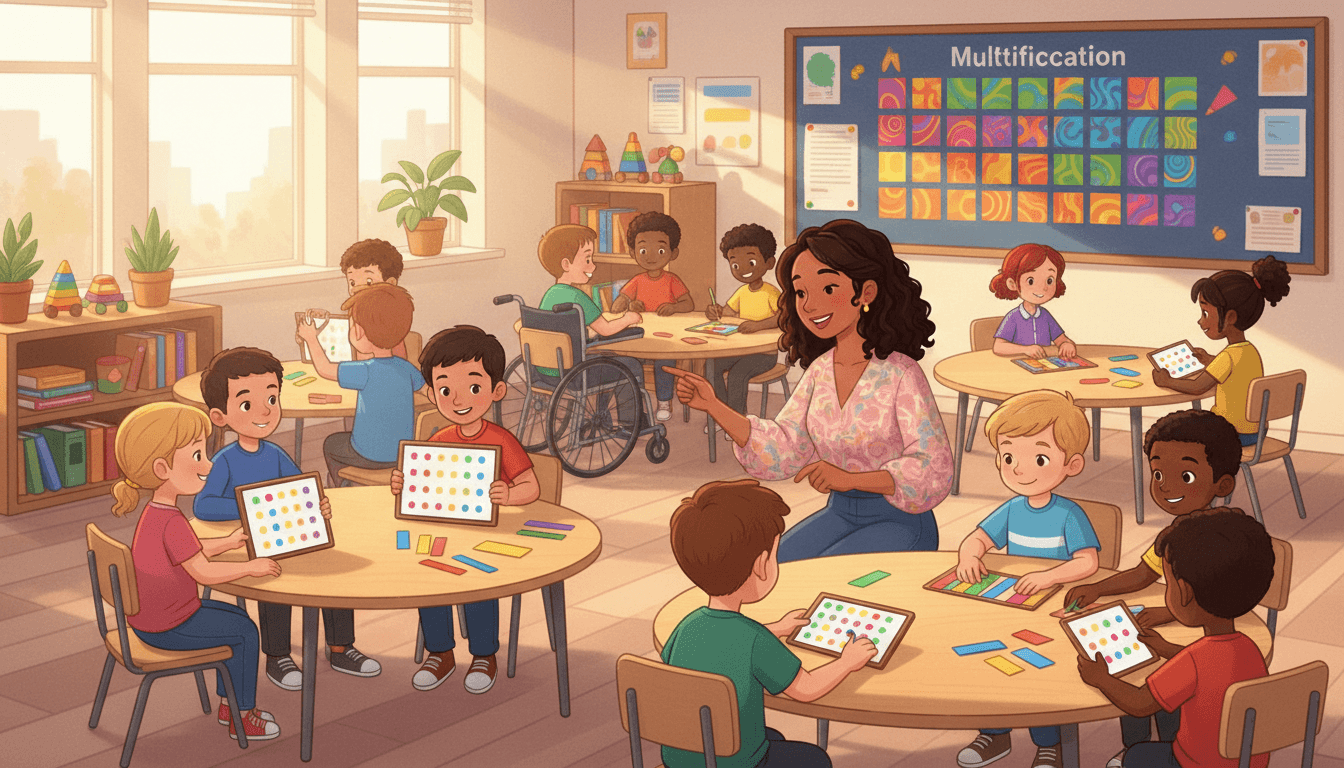
Third Grade Math: What Parents and Teachers Need
Get 30 days of free worksheet downloads
Key Takeaways
- Third grade introduces multiplication, division, and fractions simultaneously, making it one of the biggest cognitive leaps in elementary math.
- Multiplication facts are best learned by starting with 2s, 5s, and 10s, then progressing to 3s, 4s, and 6s before tackling 7s, 8s, and 9s.
- Fractions must be understood as numbers on a number line, not just pizza slices - a common misconception is that a larger denominator means a larger fraction.
- Two-step word problems require planning, executing steps in order, and tracking information, which is genuinely challenging for 8-year-olds.
- Area measurement in third grade directly connects multiplication to geometry, reinforcing fact fluency through spatial reasoning.
Third grade is the year math changes.
Not a little bit. A lot. Your child goes from adding and subtracting to multiplying and dividing. From working only with whole numbers to suddenly seeing fractions for the first time. The thinking gets more abstract, the problems get more layered, and the expectations jump significantly.
If you're a parent reading this because your third grader is struggling, take a breath. This is genuinely one of the hardest transition years in elementary math. It's not your child. It's the curriculum. The leap is real.
But the good news? Third graders are resourceful little humans. With the right support, the right strategies, and enough practice, they rise to it. Here's what to expect and how to help.
The Big Leap: What Makes Third Grade Math Different
In K through 2nd grade, math was mostly about counting, adding, and subtracting. Third grade introduces two entirely new operations (multiplication and division) and a new number type (fractions). That's a lot of "new" in one year.
Here's what the year covers:
- Multiplication and division within 100
- Understanding fractions as numbers (not just "parts of a pizza")
- Multi-digit addition and subtraction within 1,000
- Area and perimeter
- More complex word problems (often multi-step)
- Representing data and solving problems with scaled graphs
The cognitive shift is significant. Multiplication requires thinking in groups rather than individual units. Fractions require understanding that numbers exist between whole numbers. Both of these concepts demand abstract reasoning that wasn't required before.
Why this matters for parents: If your child breezes through first and second grade math, third grade might be the first time things feel hard. That's not a sign of trouble. It's a sign that the work is genuinely challenging. Normalize it: "This is supposed to feel harder. That means you're learning bigger things."
Free 3rd Grade Multiplication Worksheets


Multiplication and Division Facts
Multiplication is the star of the show in third grade. By the end of the year, your child is expected to know all multiplication facts through 10 x 10 from memory.
That sounds like a lot of memorization, and it is. But memorization without understanding is fragile. Your child needs to build the concept first, then practice until the facts become automatic.
How multiplication understanding builds:
- Equal groups: 3 groups of 4 = 12 (3 × 4 = 12). Start here with physical objects.
- Arrays: 3 rows of 4 = 12. Visual, organized, and connects to area later.
- Skip counting: Count by 4s: 4, 8, 12. Your child has been doing this since first grade without realizing it was multiplication.
- Properties: The commutative property (3 × 4 = 4 × 3) cuts the memorization work roughly in half.
Division is multiplication's partner. Once your child knows 6 × 7 = 42, they can solve 42 ÷ 7 = 6 by asking "what times 7 equals 42?"
Activities that build fact fluency:
- Use arrays of stickers, tiles, or drawn dots. "How many are in 5 rows of 6?"
- Practice multiplication facts with printable practice pages once the concept is solid.
- Play multiplication war with cards (each player flips two, multiply, highest product wins).
- Work on one fact family at a time: 3s this week, 4s next week. Don't try to learn everything at once.
- Connect to division practice through fact families.
The order that works best: Start with 2s, 5s, and 10s (easiest patterns). Then 3s, 4s, and 6s. Save 7s, 8s, and 9s for last (by then, most of those facts are already covered by the earlier groups through the commutative property).
Fractions: A First Introduction
Fractions are probably the most misunderstood topic in elementary math. And honestly, the way we teach them (pizza slices, only pizza slices, always pizza slices) doesn't help.
In third grade, your child needs to understand that fractions are numbers. Not just "parts of a whole," but actual numbers that live on the number line, right alongside 1, 2, and 3.
What third graders learn about fractions:
- A fraction represents equal parts of a whole (1/4 means 1 out of 4 equal parts)
- Fractions can name points on a number line (1/2 is exactly halfway between 0 and 1)
- Comparing fractions with the same denominator (3/8 vs. 5/8) or same numerator (2/3 vs. 2/5)
- Equivalent fractions (1/2 = 2/4 = 3/6)
- Whole numbers can be expressed as fractions (3 = 3/1 = 6/2)
Where kids get stuck:
- Thinking the bigger denominator means a bigger fraction (1/8 seems bigger than 1/4 because 8 is bigger than 4, but the pieces are actually smaller)
- Not understanding that the parts must be equal (cutting a sandwich into two uneven pieces doesn't make halves)
- Only seeing fractions as pizza slices and never as numbers on a line
Activities that build real understanding:
- Use fraction strips or fraction bars. Cut paper into halves, thirds, fourths, sixths, and eighths. Compare them physically.
- Draw number lines and locate fractions. Where does 3/4 live? It's between 0 and 1, closer to 1.
- Fold paper into equal parts. "Fold this paper into thirds. Color 2/3. What fraction is NOT colored?"
- Measure with fractions. "This marker is between 3 and 4 inches. It's about 3 and 1/2 inches long."
Don't rush fractions. Third grade is the introduction. Your child will work with fractions intensely in fourth and fifth grade. Right now, the goal is understanding what a fraction is, not performing operations with them.
Place Value With Larger Numbers
Third graders work with numbers up to 1,000 and sometimes beyond. This means rounding to the nearest 10 and 100, adding and subtracting within 1,000 (often with regrouping across multiple place values), and understanding that each place is 10 times the value of the place to its right.
Key skills:
- Round numbers to the nearest 10 and 100
- Add and subtract within 1,000 using strategies and algorithms
- Fluently add and subtract within 100 (this should be automatic by now)
- Use place value understanding to multiply one-digit numbers by multiples of 10 (6 × 70 = 420)
Activities:
- Play "round it" with prices at the grocery store. "This costs $3.47. What's that rounded to the nearest dollar?"
- Practice mental math with multiples of 10: "What's 5 × 30?" (Think: 5 × 3 = 15, then add a zero: 150.)
- Estimate before solving. "Will 347 + 289 be more or less than 600? How do you know?"
If your child still struggles with basic addition and subtraction facts, this is where it really starts to slow them down. Multi-digit problems require holding several steps in working memory while also recalling facts. Fluency with the basics frees up brainpower for the harder thinking.
Word Problems Get More Complex
In third grade, word problems take a big step up. They're often two-step problems now, meaning your child has to solve one problem to get the information they need for the second problem.
Example: "Emma has 3 bags with 8 stickers in each bag. She gives 7 stickers to her friend. How many stickers does she have left?"
Step 1: 3 × 8 = 24 (find total stickers) Step 2: 24 - 7 = 17 (subtract what she gave away)
Common difficulties:
- Figuring out which operations to use
- Knowing when a problem requires one step versus two
- Getting lost in the words and missing the actual question
How to help:
- Teach your child to read the problem twice. First time for the story. Second time for the math.
- Circle the question. What are they actually being asked?
- Have them retell the problem in their own words before solving.
- Draw a picture. Third graders who draw models (bar diagrams, arrays, simple illustrations) solve word problems more accurately than those who jump straight to numbers.
Measurement and Data
Third grade measurement builds on second grade with more precision and new concepts.
New this year:
- Area: Counting square units inside a rectangle (and eventually using the formula: length × width). This connects beautifully to multiplication and arrays.
- Perimeter: Adding up all the sides of a shape. Sounds simple, but problems that give area and ask for perimeter (or vice versa) are tricky.
- Time: Telling time to the nearest minute. Solving elapsed time problems ("If the movie starts at 2:15 and ends at 4:00, how long is it?").
- Liquid volume and mass: Measuring in liters, grams, and kilograms.
Activities:
- Find the area and perimeter of rooms in your house. Use a tape measure for real-world math.
- Use square sticky notes to cover a book and count the area.
- Practice elapsed time with real schedules: "Your soccer practice starts at 4:30 and ends at 5:45. How long is practice?"
- Weigh objects on a kitchen scale. Compare in grams.
Area is a particularly important topic because it connects multiplication to geometry. When your child sees that a 5 × 8 rectangle contains 40 square units, they're seeing multiplication as a spatial concept, not just a math fact.
Common Third Grade Math Struggles
Multiplication fact fluency. Some kids pick up facts quickly. Others need months. Both are normal. Use short, daily practice (5 minutes max) rather than long, infrequent cram sessions.
The shift from additive to multiplicative thinking. Addition is about combining. Multiplication is about groups of groups. That conceptual shift takes time. If your child keeps adding when they should multiply, they're not being careless. They're still bridging the gap.
Fraction misconceptions. "Bigger denominator = bigger fraction" is incredibly common and hard to undo. Always go back to visual models when confusion arises.
Two-step word problems. The executive function required to plan two steps, execute them in order, and track the information is genuinely challenging for eight-year-olds. Patience and modeling are the best medicine.
Math anxiety showing up for the first time. Third grade is when some kids start saying "I'm not a math person." Please, please push back on this gently. Math ability isn't fixed. The brain grows. Skills develop. Nobody is born unable to multiply.
Keep Reading
- Fun Division Tricks That Help Kids Learn Faster
- How to Teach Division to Third Graders
- How to Teach Multiplication to Third Graders
- Communicating With Parents Without Adding Another Job
Practice Activities That Build Fluency
For multiplication and division:
- Flashcards in short bursts (2 minutes, focus on facts they don't know yet)
- "Around the world" classroom games
- Multiplication bingo
- Writing fact families for given sets of three numbers
For fractions:
- Cooking with measuring cups (halves, thirds, fourths are everywhere in recipes)
- Cutting paper into equal parts and labeling the fractions
- Comparing fraction strips side by side
For word problems:
- Write your own word problems and trade with a partner
- Use real scenarios: "We have 24 students and 6 tables. How many at each table?"
- Draw bar models before writing equations
For overall math confidence:
- Math journals where your child writes about what they learned and what confused them
- Celebrate mistakes as learning moments, not failures
- Short daily practice beats long weekend sessions every time
Third grade math is hard. Not "kind of" hard. Actually hard. The concepts are more abstract, the expectations are higher, and the pace is faster. But every third grader who comes out the other side with solid multiplication facts, a genuine understanding of fractions, and confidence in problem-solving is set up beautifully for the years ahead. Stay the course. Keep it hands-on. And remind your kiddos that struggling with math doesn't mean they're bad at it. It means they're growing 😊

Adi Ackerman
Head Teacher
Adi is the Head Teacher at ClassWeekly, with years of experience teaching elementary students. She designs our curriculum-aligned worksheets and writes practical guides for teachers and parents.
Keep Reading
Ready to download? Try ClassWeekly free for 30 days.
Unlimited worksheets for PreK through 5th grade. Cancel anytime.