
Counting Activities for Preschoolers
Get 30 days of free worksheet downloads
Key Takeaways
- Rote counting (reciting numbers) and rational counting (counting actual objects with one-to-one correspondence) are two distinct skills that must both be developed in preschoolers.
- One-to-one correspondence - touching each object once while saying one number word - is the foundational skill for all early counting, and egg carton or sticker activities are especially effective for building it.
- Cardinality is the understanding that the last number counted names the whole group; ask 'How many?' after every counting activity to build this concept deliberately.
- Number recognition should come before number writing - preschoolers can identify a written '5' before they can form it on paper, and reversals are completely normal through age 5.
- Counting can be woven into daily transitions, snack time, and outdoor walks for 20+ minutes of practice per day without any formal lesson time.
Counting is the very first math skill, and it starts earlier than most people realize. Long before a preschooler writes a single number, they're building the foundation of number sense through songs, play, and daily routines.
But here's the thing. A child who can recite "one, two, three, four, five" doesn't necessarily understand what those numbers mean. Saying the words is one skill. Knowing that "five" represents a quantity of five things is something else entirely.
That gap is where teaching comes in.
Where Counting Starts (It Is Earlier Than You Think)
Counting begins as a social activity. A two-year-old who says "one, two, three, go!" at the playground is counting. They probably have no idea what "one" and "two" mean yet. But they've learned the rhythm and the sequence from hearing adults use it.
This is rote counting, and it's the first stage. The child memorizes the number words in order, like lyrics to a song. Most three-year-olds can rote count to at least 10, and many can go higher. It's impressive to hear, but it doesn't tell you much about their math understanding.
The real mathematical thinking starts when a child connects those number words to actual quantities. When they point to three crackers on their plate and count "one, two, three" with one word per cracker, that's a breakthrough moment. That's when counting stops being a song and starts being math.
Your job as a teacher is to bridge that gap. And the bridge is built with objects, fingers, and lots of repetition.
Free Counting Objects Worksheets


One-to-One Correspondence: The Foundation
One-to-one correspondence is the understanding that each object gets counted exactly once. One touch, one number word. It sounds obvious, but it's genuinely hard for three and four-year-olds.
Watch a preschooler count a row of five blocks. Many of them will skip a block, count a block twice, or say number words faster than their fingers move. Their mouths are ahead of their hands. This is normal. The coordination between pointing and saying takes practice.
Touching and counting. Line up objects in a row. Have the child touch each one as they count. Physically moving each object to a separate "counted" pile helps too. "You counted it, so move it over here." The physical separation makes the one-to-one match visible.
Counting with purpose. "Can you give me three crayons?" This is harder than counting a group of three, because the child has to count and stop at the right number. It requires one-to-one correspondence plus cardinality (knowing that the last number they said tells them how many).
Egg carton counting. Put small objects (buttons, pom-poms, dry beans) in a bowl. Give the child a six-cup egg carton. They put one object in each cup while counting. The carton structure prevents double-counting because each cup only holds one thing. This is a simple tool that works every time.
Sticker counting. Give the child a strip of paper with boxes drawn on it. They put one sticker in each box while counting. The boxes create the one-to-one structure, and kids will do this activity over and over because, well, stickers.
Don't rush past one-to-one correspondence. It's the skill that makes everything else in early counting possible.
Rote Counting vs Rational Counting
These are the two types of counting, and it helps to know the difference.
Rote counting is reciting the number sequence from memory. "One, two, three, four, five, six, seven, eight, nine, ten." It's verbal. It doesn't require any objects or understanding of quantity. A child can rote count while staring at the ceiling.
Rational counting (also called meaningful counting) is counting actual things, one number per object, and understanding that the last number represents the total. It requires one-to-one correspondence and cardinality.
Both matter. Rote counting gives your kiddos the language of numbers. Rational counting gives them the meaning.
Here's a quick test of cardinality: after a child counts five bears, ask "How many bears are there?" A child who understands cardinality will say "five" immediately. A child who doesn't will start counting again from one. That re-counting tells you they haven't yet grasped that the last number in the sequence names the whole group.
How to build cardinality. After every counting activity, ask "How many?" Make it a routine. Count four blocks. "How many blocks?" Count six raisins. "How many raisins?" Over time, the child will learn that the question "how many" is answered by the last number they said. That connection is huge.
Counting Songs and Rhymes
Songs and rhymes are probably the most natural way to practice rote counting with preschoolers. The melody and rhythm make the number sequence stick.
Counting up songs. Any song that counts from 1 to 10 (or 1 to 20) gives your students repeated exposure to the number sequence. Pair the song with finger movements or object manipulation when possible. Singing while holding up fingers connects the verbal sequence to quantity.
Counting back songs. These are harder and just as important. Counting backward is the foundation for subtraction. Look for songs that start with a number and count down (five little ducks, ten in the bed). Use finger puppets or felt board figures so kids can see the quantity decreasing as the song progresses.
Number chants during transitions. "Let's count to 20 while we clean up." "Let's count to 10 while we walk to the door." These micro-practices add up. A child who counts to 20 six times a day during transitions has 30 extra counting practice rounds per week without a single formal lesson.
Skip counting introduction. By late Pre-K, some children are ready for skip counting by 2s or 10s. If a child can comfortably count to 20, try introducing "2, 4, 6, 8, 10" as a chant or song. Don't push this. It's an extension for kids who are ready, not an expectation for all preschoolers.
Hands-On Counting Activities
Preschoolers learn through their hands. Every counting activity should involve touching, moving, building, or sorting real objects.
Counting collections. Give each child a small bag of interesting objects (buttons, shells, small toys, pasta shapes). They dump out the bag and count everything. How many? Write the number on a sticky note. Then organize the collection by type and count each group. This is open-ended and endlessly engaging.
Snack math. During snack time, ask kids to count their goldfish crackers, apple slices, or pretzels before eating. "You have eight crackers. Can you eat two? How many are left? Count and check." Snack math is motivating because the reward is built in.
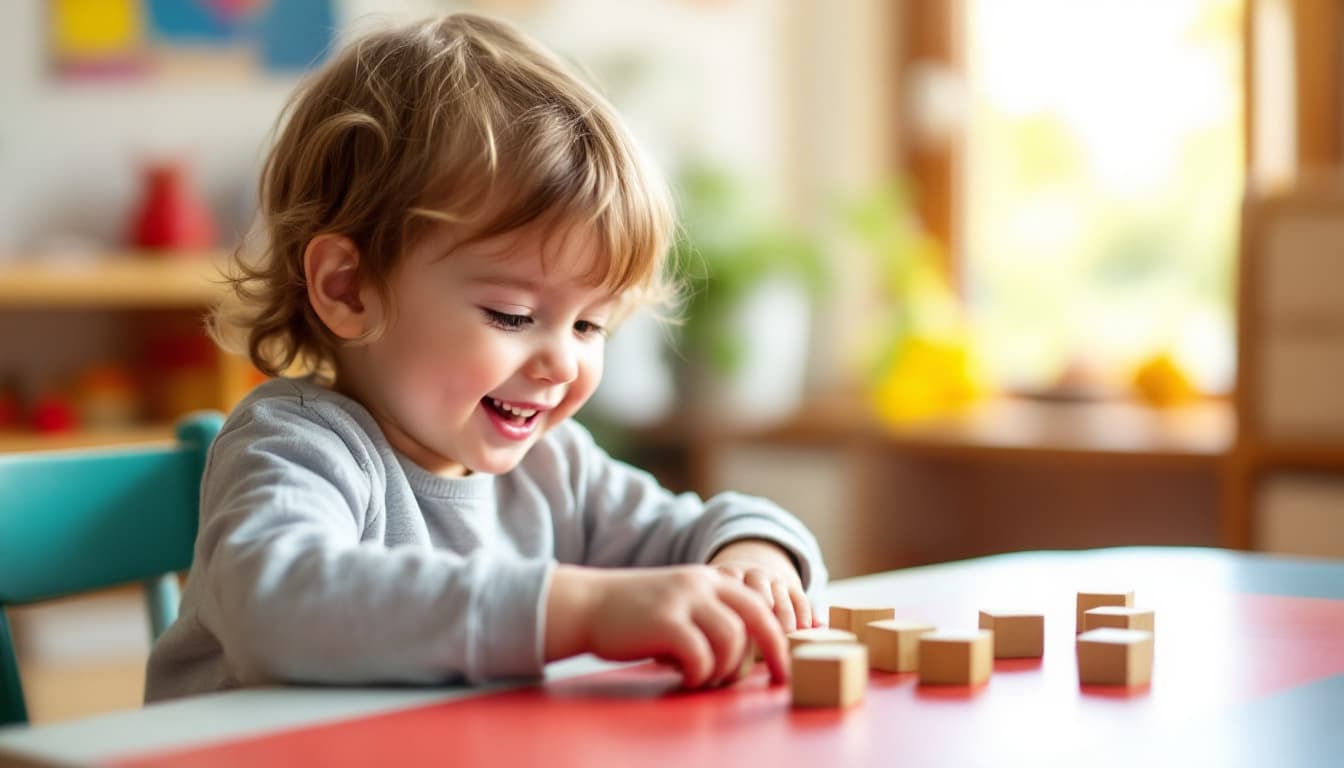
Building towers. "Can you build a tower with exactly six blocks?" This requires counting while building, which is a two-hand coordination challenge. When the tower falls (and it will), they get to count and build again.
Nature counting walks. Go outside. Count rocks, leaves, sticks, birds, clouds. The variety keeps it interesting, and it shows kids that math lives everywhere, not just in the classroom.
Dice games. Roll a large die. Count the dots. Take that many objects from a pile. Even the simplest board games that involve rolling and moving a piece build counting skills. The die provides the number, and the game provides the motivation.
When to Introduce Written Numbers
Most preschoolers can learn to recognize written numerals (seeing a "5" and knowing it means five) before they can write them. Recognition first, writing second.
Number recognition (ages 3-4). Start with the numbers 1 through 5. Use number cards, magnetic numbers, and number puzzles. Point out numbers in the real world: house numbers, speed limit signs, elevator buttons, page numbers. "Look, that says 3. You're 3 years old! Same number."
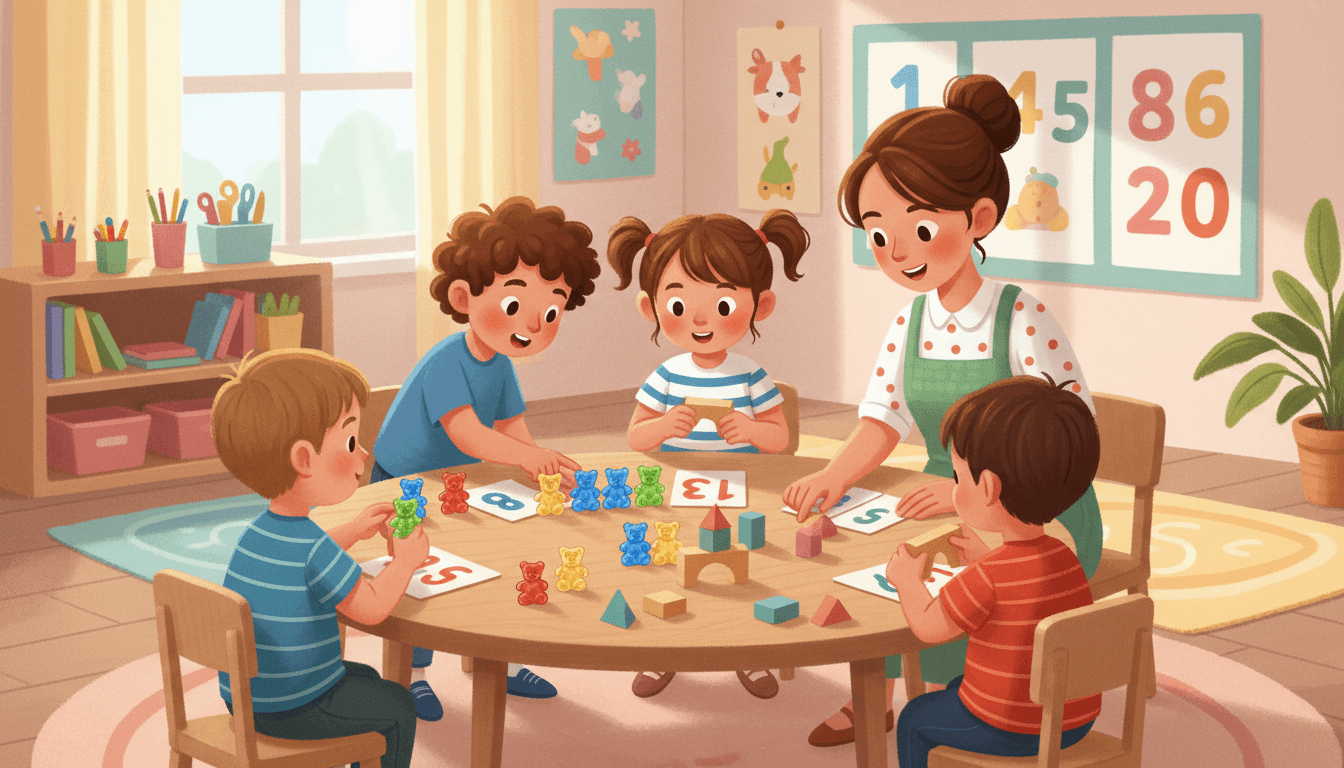
Number matching. Put number cards on the table. Next to each one, the child places the matching quantity of objects. The card says 4. They put four bears next to it. This connects the symbol to the quantity.
Number writing (ages 4-5). Most preschoolers start writing numbers in the later Pre-K year. Start with large motor activities: writing numbers in sand, painting numbers with water on the sidewalk, forming numbers with play dough. Fine motor control for pencil-on-paper number writing usually comes closer to kindergarten.
Common reversal: Many preschoolers write numbers backward. A backward 3 or a backward 5 is completely normal at this age. Gently correct it, but don't make it a big deal. Reversals typically resolve by first grade.
The most important thing: don't skip the concrete counting stage and jump to written numbers. A child who can write a perfect "7" but can't count seven objects hasn't learned math. They've learned handwriting. The understanding of what seven means has to come first.
Keep Reading
- Pre-K Math Activities: Building Number Sense Before Kindergarten
- How to Teach Number Sense to Kindergartners: Activities That Build Real Understanding
- Number Activities for Pre-K: Counting, Sorting, and Early Math
Practice Pages for Little Counters
Practice pages for preschoolers should be heavy on pictures and light on text. At this age, the best pages involve:
Count and color. A row of objects with a number. The child colors the correct quantity. "Color 4 apples."
Count and match. A picture of some objects on one side, numbers on the other. Draw a line from the picture to the matching number.
Count and circle. Several groups of objects. "Circle the group that has 5."
Dot-to-dot. Connect the dots in number order to reveal a picture. This practices number sequence and fine motor skills at the same time.
Here's a realistic daily counting routine for Pre-K:
Morning circle (5 minutes). Count how many students are present. Count to 20 together. Practice counting backward from 10.
Center time (10 minutes). Counting collections, dice games, or printable practice pages at a math center.
Snack time (2 minutes). Count snack items. Casual "how many" questions.
Transitions (1 minute each). Count while lining up, waiting, or cleaning.
That's 20 minutes of counting practice woven into the day, and most of it doesn't feel like formal instruction.
The preschoolers who build a strong counting foundation now will walk into kindergarten ready for addition, subtraction, and place value. They won't just know the number words. They'll understand what those words mean. And that understanding is what number sense is all about.

Adi Ackerman
Head Teacher
Adi is the Head Teacher at ClassWeekly, with years of experience teaching elementary students. She designs our curriculum-aligned worksheets and writes practical guides for teachers and parents.
Keep Reading
Ready to download? Try ClassWeekly free for 30 days.
Unlimited worksheets for PreK through 5th grade. Cancel anytime.