
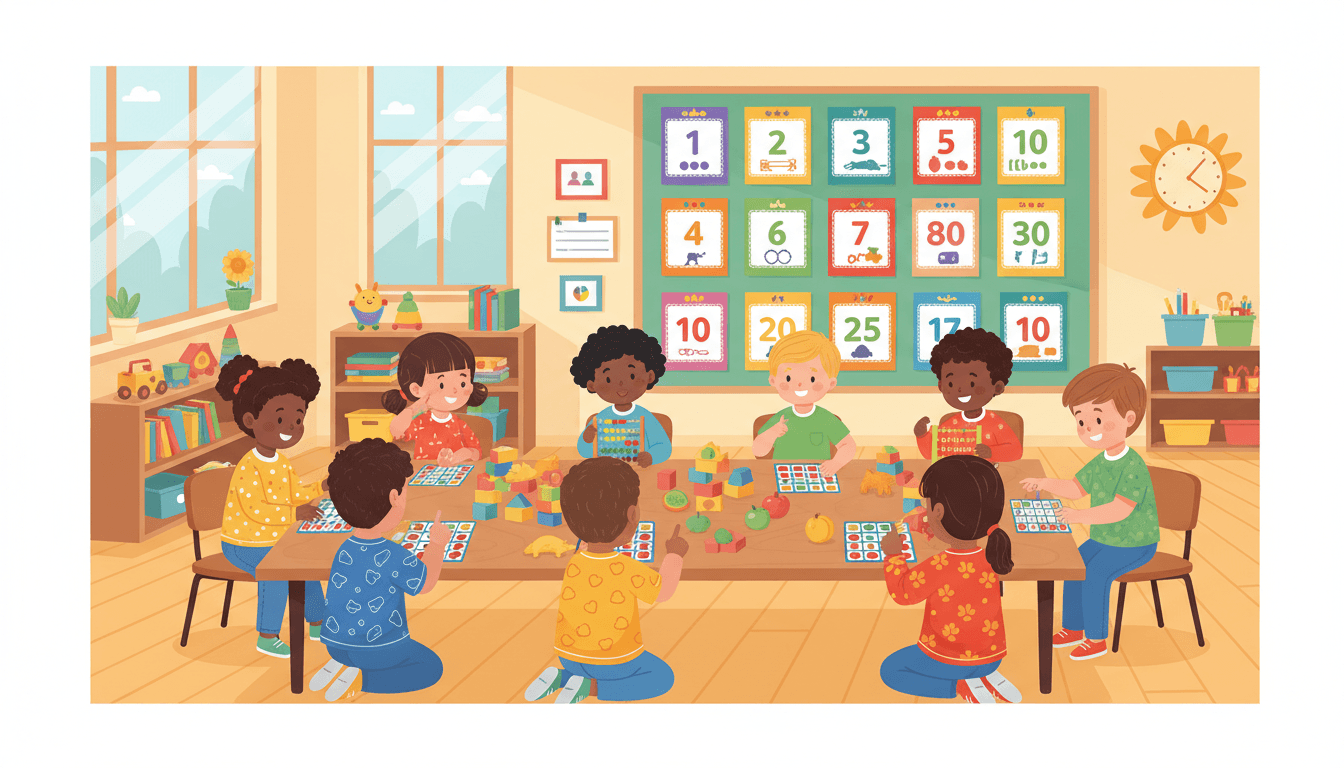
Number Sense in Kindergarten: 10 Counting Activities
Get 30 days of free worksheet downloads
Key Takeaways
- Number sense is distinct from counting - it means understanding quantity, order, and relationships between numbers, not just reciting the counting sequence.
- Subitizing (recognizing quantities instantly without counting) can be built through daily dot card flash activities and ten frame routines, and it directly supports later addition and subtraction.
- One-to-one correspondence must be taught explicitly by having students physically move or touch each object as they count, using structured tools like ten frames or egg cartons.
- Ten frames are one of the most powerful kindergarten math tools because they give every number a visual shape, making comparison, addition, and mental math more intuitive.
- Short, frequent number sense routines embedded throughout the school day - counting attendance, comparing snack quantities, using the calendar - are more effective than isolated lessons.
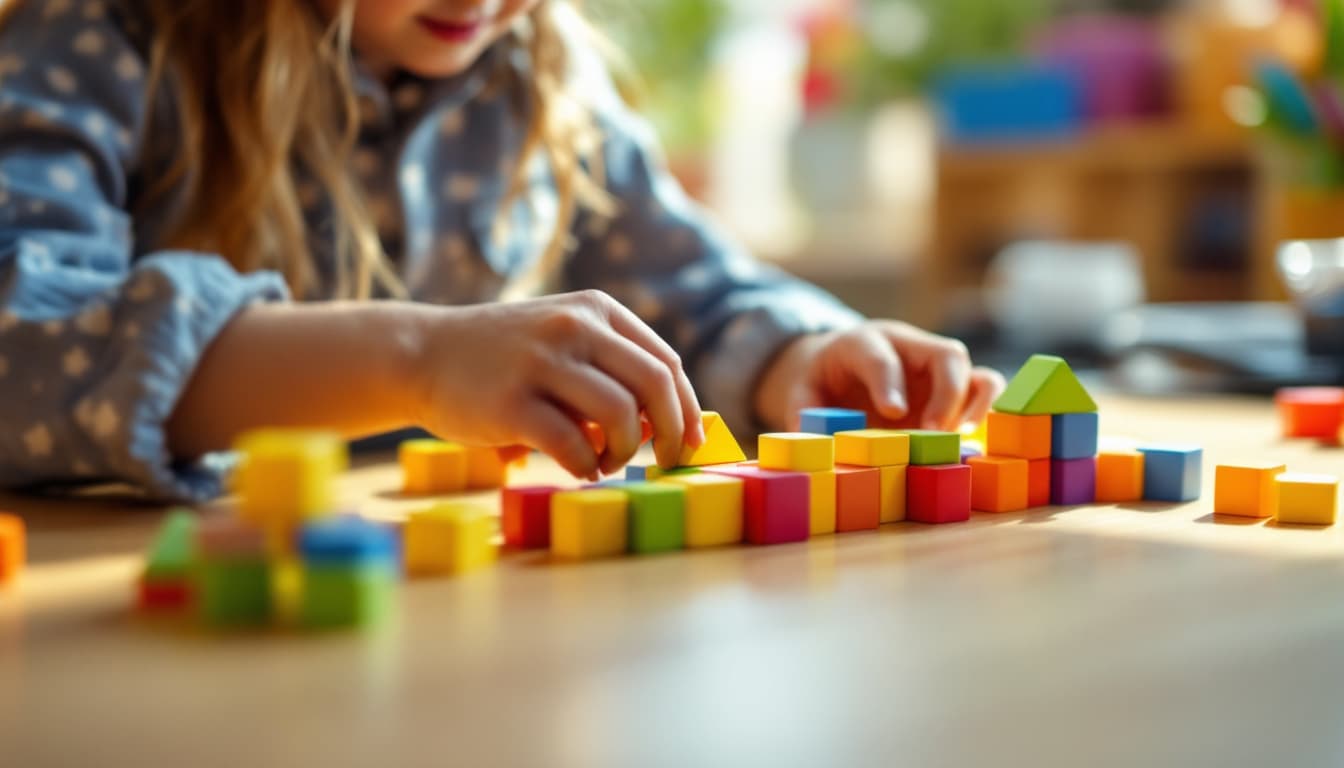
How to Teach Number Sense to Kindergartners: Activities That Build Real Understanding
You ask how many apples are in the bowl, and your student counts them carefully: one, two, three, four, five. You move the apples into a different arrangement and ask again. They count all five again from the beginning.
Number sense is not the same as counting. Counting is a procedure. Number sense is understanding: knowing that five is five no matter how the objects are arranged, knowing that five is more than four, knowing that five can be broken into two and three, knowing roughly where five falls on the number line. These ideas seem obvious to adults, but for five-year-olds, they are genuinely new and require lots of different experiences to build.
The kiddos who develop strong number sense in kindergarten become the students who can reason through math rather than just memorize procedures. Building that foundation is some of the most important work you'll do all year.
Here are 10 practical ways to teach number sense to kindergartners:
- Count Everything, All Day Long
- Build One-to-One Correspondence With Hands-On Practice
- Teach Subitizing (Seeing Quantities Without Counting)
- Practice Counting to 100 as a Daily Routine
- Build Number Recognition for 0-20
- Help Students Understand Number Order
- Use Ten Frames to Structure Number Thinking
- Compare Numbers Using "More," "Less," and "Equal"
- Decompose Numbers in Many Different Ways
- Connect Number Sense to Everyday Contexts
1. Count Everything, All Day Long
The most powerful thing you can do for number sense is make counting a constant backdrop to the school day. Not a separate lesson. Not a worksheet. A running commentary on quantity that happens throughout the day, every day.
How many students are here? How many chairs are empty? How many books are in this stack? How many steps to the door? You don't need a formal lesson for any of this. You need a habit of noticing and naming quantities wherever they appear.
Try these activities:
- Morning count: Count the number of students present each morning as part of your attendance routine. Track it on a visible chart. "Is today more or fewer than yesterday?"
- Count the line: As students line up, count them aloud together. Then ask questions: "How many students are ahead of you? How many are behind you?"
- Object counting jars: Fill small jars with different quantities of objects (buttons, pebbles, beans). Place them at a math center. Students count, record, and compare.
- Count during transitions: Count steps to the bathroom, tiles on the floor in the hallway, windows in the room. Transitions become micro-math moments.
- Counting collections: Give students a bag with a collection of similar objects (pennies, small stones, paper clips). They count, sort, and record. Counting collections is a rich number sense routine with a strong research base.
Counting is the foundation everything else is built on. The more your kiddos count, in different contexts, with different objects, the stronger that foundation becomes.
Free Numbers Counting Worksheets for Kindergarten


2. Build One-to-One Correspondence With Hands-On Practice
One-to-one correspondence is the understanding that each object in a group is counted once, and only once. It sounds automatic, but it's actually a skill that young learners have to develop. You've seen it: a child touches an object twice, or skips one, or loses track of where they started. That's one-to-one correspondence still developing.
Without it, counting is unreliable. A student might count six objects and say there are eight. The act of counting doesn't yet map to accurate quantity.
Not sure this works for every learner, but it's worth trying.
Try these activities:
- Touch and move: Teach students to physically move each object as they count it, from one side of the table to the other. The motion creates a reliable one-to-one match.
- Count with tapping: Students tap each object once while saying one number aloud. Practice the "one tap = one number" rule explicitly.
- Counting mats: Give students a mat with numbered spaces (like a ten frame or an egg carton). They place one object in each space while counting. The structure enforces correspondence.
- Counting with partners: One student counts while a partner watches and checks. Did they touch each one? Did they count each one once? Partners catch errors in a low-stakes way.
- Line them up: Before counting, students arrange objects in a straight line. The line structure makes it easier to track what's been counted and what hasn't.
One-to-one correspondence develops at different rates. Some children come in with it solid. Others will work on it for months. Daily hands-on counting practice is what moves them forward.
3. Teach Subitizing (Seeing Quantities Without Counting)
Subitizing is the ability to recognize a quantity instantly, without counting. Most adults do this automatically with small groups of objects. You see three dots on a die and you know it's three without thinking about it. That's subitizing.
For kindergartners, subitizing up to 5 (and eventually up to 10 with structured arrangements) is a foundational number sense skill. It builds a mental image of quantity that supports both counting and addition.
There are two types: perceptual subitizing (instantly recognizing a small group of randomly arranged objects) and conceptual subitizing (recognizing a larger group by seeing it as smaller sub-groups: 5 and 3 on a ten frame = 8).
Try these activities:
- Dot card flash: Flash a dot card for 2-3 seconds. Students hold up the number of fingers to show the total without counting. "Don't count. Just look." Start with 1-5, expand to larger structured arrangements.
- How do you see it?: After a dot card flash, ask students to explain how they saw the group. "I saw two groups of two." "I saw a row of three and one more." This makes their thinking visible and teaches other students new strategies.
- Dice subitizing: Roll a die, students call out the total. Then use two dice: can they see the two groups and combine them without counting all?
- Ten frame subitizing: Flash a ten frame card. Students name the total. A full row of five is visually obvious, which helps students subitize 6, 7, 8, 9 by seeing "five and some more."
- Rekenrek activities: A rekenrek is an arithmetic rack with two rows of ten beads (five red, five white per row). Push a group to one side and ask students to name the total without counting. The structure supports subitizing beautifully.
4. Practice Counting to 100 as a Daily Routine
Kindergarten students are expected to count to 100 by the end of the year (K.CC.A.1). But more importantly, they should understand the structure of our number system: tens and ones, the patterns that repeat, the way counting forward connects to bigger quantities.
The most effective way to build this is through a daily counting routine that happens at the same time, every day, throughout the year.
Try these activities:
- Count the days of school: Track how many days have passed with a pocket chart showing individual sticks. When you reach 10, bundle them with a rubber band. This builds a visual connection between counting and grouping by tens.
- Counting jar/chain: Add one link to a paper chain (or one bead to a string) each day. When you reach 10, use a different color link or a knot. Students can see the growing quantity and the ten-groups within it.
- Count to 100 chant: A rhythmic, musical daily count to 100 (or to whatever number you're on) becomes automatic through repetition. Vary it by whispering, clapping, stomping on multiples of 10.
- Hundreds chart activities: Use a large hundreds chart for daily reference. Students follow along during the count, notice patterns in the columns and rows, and identify numbers when called upon.
- Skip counting introduction: Once students can count to 30 fluently, begin counting by tens: 10, 20, 30. This preview of the number system's structure builds future place value understanding.
Counting to 100 should feel like a community ritual by mid-year, something your kiddos could do in their sleep. That automaticity is the goal.
5. Build Number Recognition for 0-20
Counting and recognizing numbers are related but distinct skills. A student might be able to count to 20 fluently but still hesitate when they see the numeral 14 written on a page. Number recognition requires that students connect the written symbol to the quantity it represents.
Kindergartners are expected to read and write numbers 0-20 (K.CC.A.3). Recognition should come before writing, and both should be tied to actual quantities.
Try these activities:
- Number of the week: Focus deeply on one number for a week. Build it with manipulatives, find it in the environment, write it, draw it, put it on the number line.
- Number recognition games: Use bingo cards, concentration/memory games, and flashcard activities with numerals 0-20. These are perfect for centers and partner work.
- Number hunts: Give students a number card (say, the numeral 7) and ask them to find that number everywhere they can in the classroom: on the clock, on book spines, on calendar pages.
- Numeral tracing: Students trace numerals with a finger, then a pencil. Pairing the written form with verbal formation language ("start at the top, curve around...") ties recognition to production.
- Match the numeral to the quantity: Give students a numeral card and ask them to build the matching quantity with blocks, draw that many dots, or find a matching picture card.
For structured numeral recognition and writing practice, our kindergarten counting worksheets cover 0-20 with a variety of formats.
6. Help Students Understand Number Order
Knowing that numbers come in a specific order, that 6 comes after 5 and before 7, and that bigger numbers come later in the counting sequence, is a key part of number sense. This understanding connects to the number line, to comparison, and to the foundations of addition and subtraction.
Try these activities:
- Number line walks: Use a number line on the floor (masking tape works perfectly). Students walk forward to count up, walk backward to count down. Physical movement on the number line makes order visceral.
- Fill in the missing numbers: Give students number sequences with one or more blanks. "4, 5, ___, 7, ___." They fill in what's missing. Start with small sequences, expand gradually.
- Number order puzzles: Students arrange numbered cards (or puzzle pieces) in order from 0 to 10, then 0 to 20. Mixing up the cards first makes the ordering an active decision.
- Before and after: Given any number, students name the number that comes before and the number that comes after. "What comes before 8? What comes after 8?"
- Hundreds chart puzzles: Cut up a hundreds chart into sections. Students reassemble it, using their knowledge of number order and the chart's structure to place pieces correctly.
Number order is also where you can introduce the vocabulary of position: "first," "second," "third." These ordinal numbers connect to everyday sequence and come up constantly in classroom routines.
7. Use Ten Frames to Structure Number Thinking
The ten frame is one of the most powerful tools in early math education, and it belongs in your kindergarten classroom from the very start of the year. A ten frame is simply a rectangle divided into ten equal spaces (two rows of five).
Why does it work? Because it gives every number a visual shape. Five fills the top row completely. Six is a full top row plus one. Nine is everything except one missing spot. Students who have worked extensively with ten frames develop mental images of quantities that support estimation, addition, and number comparison.
Try these activities:
- Fill the frame: Students place counters on a ten frame to represent a number you call out. Then they name the number and discuss: "How many are filled? How many are empty?"
- Ten frame flash: Flash a completed ten frame card. Students identify the number shown. Start slowly, speed up as recognition improves.
- Build a number two ways: Students build the same number on a ten frame in two different arrangements, exploring the idea that 7 can look different but still be 7.
- Double ten frames for numbers to 20: A double ten frame (two ten frames stacked) extends the tool to numbers 11-20. Students see that "thirteen" is one full ten and three more.
- Ten frame number talks: Display a ten frame for 5-10 seconds. Ask: "How many? How did you see it?" Students share strategies. This is a whole-class number sense routine that takes 5 minutes and builds huge.
8. Compare Numbers Using "More," "Less," and "Equal"
Number comparison, knowing that 7 is more than 5 and fewer than 9, is a foundational number sense skill that feeds directly into measurement, data, and computation. Kindergartners are expected to compare groups (K.CC.C.6) and written numerals (K.CC.C.7).
The language matters: more than, fewer than, greater than, less than, equal to. Use all of these terms consistently so students build flexible vocabulary for comparison.
Try these activities:
- Compare two groups: Give students two groups of objects. They count each group, then decide which is more, which is less, or if they're equal. Use sentence frames: "_____ is more than _____."
- Comparison mat: A simple mat with two sections and an arrow in the middle. Students build two groups, fill in the numbers, and use the arrow to point to the bigger group.
- More, fewer, or equal sort: Give students pairs of number cards. They sort pairs into "more," "fewer," and "equal" categories.
- Crocodile greater than/less than: The classic "hungry crocodile" who always faces the bigger group. Draw the symbol as a mouth facing the larger number. Students draw their own alligators when comparing two written numbers.
- Class data comparisons: After collecting any class data (how many students prefer apples vs. oranges?), compare the quantities. Real data makes comparison feel purposeful.
Honest note: the distinction between "fewer" (for countable things) and "less" (for uncountable amounts) is hard for kindergartners and for many adults. Use "fewer" when comparing groups of countable objects, but don't make this a major issue at this stage. The comparison concept matters more than the precise vocabulary.
9. Decompose Numbers in Many Different Ways
Number decomposition is the ability to break a number into parts. Seven can be 5 and 2, or 6 and 1, or 3 and 4. This flexibility is at the heart of number sense, and it's also what makes mental math possible.
Kindergartners work with decomposition primarily through hands-on activities and visual models. The goal is for students to see that any number has multiple ways of being made.
Try these activities:
- Two-color shake: Give students a cup with 5 two-color counters. They shake the cup, spill the counters, and record how many landed red and how many landed yellow. Repeat multiple times to discover all the ways to make 5.
- Number bond mats: Students use manipulatives on a number bond template (a whole circle at top, two part circles below). They explore different ways to decompose a number into two parts.
- Break apart sticks: Give students a stick of 6 snap cubes. They break it somewhere, count each part, and record the decomposition. Break it a different way. Repeat.
- Decomposition dot cards: Show a dot card with 8 dots arranged in two groups of different colors. Students identify the two parts and record the decomposition.
- Which ways make ___?: Give students a target number (like 6). They use tiles or counters to find as many ways as possible to split it into two parts. Display all the ways on a class chart.
When kiddos understand that numbers can be taken apart and put back together in multiple ways, they're building the mental flexibility that makes all of math easier 😊
10. Connect Number Sense to Everyday Contexts
Number sense grows fastest when it's connected to real life. When your little ones see that counting, comparing, and quantity thinking are useful outside of math time, they practice these skills naturally and constantly.
Every routine in your day is a number sense opportunity.
Try these activities:
- Weather data: Tally how many sunny days, cloudy days, and rainy days in a month. Count the tallies, compare the groups. Which kind of day happened most?
- Library book count: Each week, count how many library books your class has checked out. Is it more or less than last week?
- Snack math: Before eating, pose a quick comparison: "You have 7 raisins. Your neighbor has 5. Who has more? How many more?"
- Calendar patterns: Use calendar time to build number sequence, count the days of the month, and identify patterns in the calendar structure.
- Measurement comparisons: Even without formal measurement tools, compare heights, lengths, and weights informally. More, less, the same.
When kiddos see you counting, estimating, and comparing quantities throughout the day, they get the message that number sense is a life skill, not just a school skill.
Frequently Asked Questions
What does "number sense" mean for kindergartners?
Number sense in kindergarten means understanding what numbers represent and how they relate to each other. It includes being able to count accurately, recognize numerals 0-20, compare quantities, understand number order, break numbers into parts, and subitize small groups. It's the difference between a student who can rattle off the counting sequence and one who genuinely understands quantity.
What counting skills should kindergartners have by the end of the year?
By year's end, kindergartners should count to 100 by ones and tens, count forward from any given number (not just from 1), write numerals 0-20, count objects to 20 with accurate one-to-one correspondence, and compare written numerals within 10. These expectations come from Common Core standards K.CC.A.1 through K.CC.C.7.
How do you teach one-to-one correspondence to kindergartners?
The key is making counting physical. Students should touch or move each object as they count it, so the physical action and the spoken number happen simultaneously. Using structured tools (like egg cartons, ten frames, or counting mats) helps students track what's been counted. Partner counting, where one student counts and another watches for accuracy, also builds the habit.
What is subitizing and why does it matter?
Subitizing is recognizing a quantity instantly without counting. It matters because it builds mental images of numbers that support later computation. A student who can "see" 7 as a full five-frame row plus two more will understand 7 + 3 = 10 much more intuitively than one who has never developed that visual. Daily dot card flash activities and ten frame work build subitizing skills over time.
Keep Reading
- How to Teach Addition to Kindergartners: Hands-On Activities That Build Understanding
- Teaching Counting to Preschoolers: Activities That Build Number Sense
- Pre-K Math Activities: Building Number Sense Before Kindergarten
Wrapping Up
Number sense is not a single skill to check off a list. It's a growing, deepening understanding that develops across hundreds of counting and reasoning experiences in your classroom. Some of your kiddos will arrive with strong informal number sense already. Others will need lots of time and many different entry points.
The activities in this guide aren't extras. They are the instruction. When you count attendance together, flash a dot card during a transition, or pose a quick comparison at snack time, you are teaching number sense. Small, frequent, varied experiences are exactly how this understanding grows.
For printable practice materials your students can use today, explore our full collection of kindergarten counting worksheets. They cover counting to 20, number recognition, ten frames, number order, and more.
Happy teaching!

Adi Ackerman
Head Teacher
Adi is the Head Teacher at ClassWeekly, with years of experience teaching elementary students. She designs our curriculum-aligned worksheets and writes practical guides for teachers and parents.
Keep Reading
Ready to download? Try ClassWeekly free for 30 days.
Unlimited worksheets for PreK through 5th grade. Cancel anytime.