
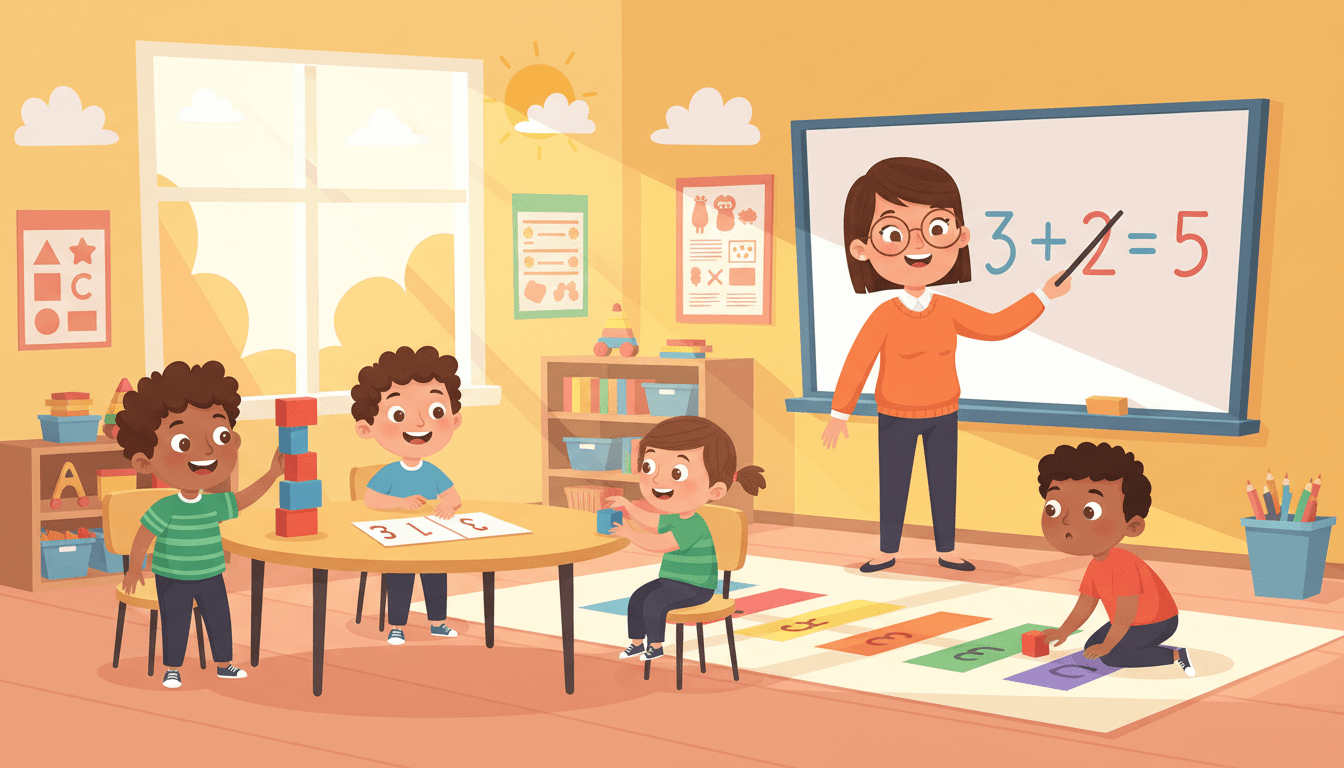
Addition in Kindergarten: 10 Hands-On Activities
Get 30 days of free worksheet downloads
Key Takeaways
- Introduce putting-together concepts with physical objects before showing the plus sign symbol
- Use manipulatives like counters, snap cubes, and fingers every day in kindergarten addition
- Teach counting on from the larger number as a key step beyond counting all from one
- Connect addition to real stories using student names to make the math personally relevant
- Teach the equals sign as meaning same as, not just where the answer goes
How to Teach Addition to Kindergartners: Hands-On Activities That Build Understanding
You write "2 + 3 = ___" on the board, and your student starts counting from one. Every single time.
It's not that they can't do addition. It's that no one has shown them yet that they can start from 2 and count up three more, or that they can hold groups of objects in their mind without having to rebuild from scratch. Teaching addition to kindergartners isn't about getting answers on a page. It's about building a mental model of what addition actually means, and that takes time, concrete experience, and a lot of different entry points.
The good news: kiddos this age are natural adders. They figure out that two cookies plus one more cookie is three cookies well before they ever see a plus sign. Your job is to connect that intuitive understanding to the symbols, vocabulary, and strategies they'll use for the rest of their math lives.
Here are 10 practical ways to teach addition to kindergartners:
- Build the Concept Before Introducing the Symbol
- Use Manipulatives Every Day
- Teach Counting On (Not Always From One)
- Connect Addition to Real Stories
- Introduce the Plus Sign and Equals Sign Meaningfully
- Practice Adding Within 5 First
- Build to Adding Within 10
- Use Visual Models (Ten Frames and Number Bonds)
- Teach the Commutative Property Through Play
- Keep Connecting Addition to Everyday Life
1. Build the Concept Before Introducing the Symbol
The most common mistake in early addition instruction is introducing the + symbol before students have a concrete understanding of what adding actually means. The symbol is just a shorthand. The idea has to come first.
Start by talking about "putting together" and "adding to." Use the language of addition before you show the notation. "We have 2 red apples and 3 green apples. When we put them all together, how many apples are there?" That's addition. No symbols required yet.
Try these activities:
- Two-group sorting: Give students a collection of objects (blocks, counters, crayons). They make two separate groups, then push them together and count the total. "You had 4 and 3. Now you have how many?"
- Story problems without numbers: Tell simple verbal stories that involve combining quantities. "There were some frogs on a log. More frogs jumped on. Now how many are there?" Students act it out or use objects to solve.
- Part-part-whole mats: Give students a simple mat divided into "Part," "Part," and "Whole." They use manipulatives to fill in the parts, then figure out the whole.
- Joining groups in the room: Use classroom objects. "There are 2 pencils here and 3 pencils there. Let's put them together. How many now?"
When the concept of putting together is solid, the + symbol becomes a helpful shortcut rather than a confusing mystery.
Free Kindergarten Addition Worksheets


2. Use Manipulatives Every Day
This cannot be overstated. Kindergartners need to physically handle objects as they add. The manipulation of real, countable things is how the abstract idea of addition becomes concrete. Fingers, counters, cubes, beans, bears, buttons: any small object works.
Some teachers worry about students becoming too dependent on manipulatives. For kindergarten, that concern is premature. Concrete tools are the foundation. Abstract work comes later, and it comes faster for students who had thorough concrete experience first.
That said, every classroom is different.
Try these activities:
- Two-color counters: These are flat discs that are red on one side and yellow on the other. Students flip a handful, count the reds, count the yellows, and find the total. Simple and visual.
- Snap cubes: Students build a tower of 4 blue cubes and 2 red cubes, then count the total tower. The colors make the two addends visible even after combining.
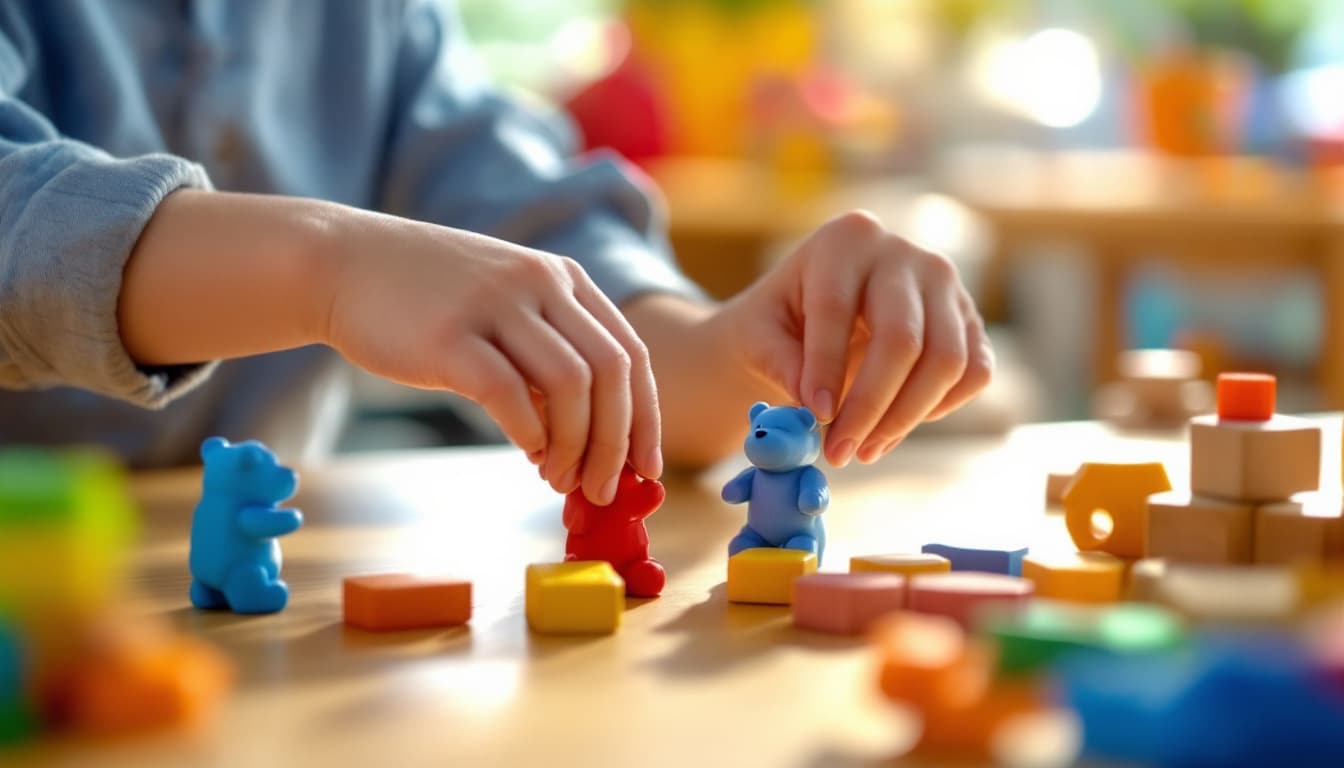
- Counting bears or animals: Sort colored bears into groups, then push them together and count. The variety and color keep the activity engaging.
- Tens frames with counters: Place counters in the two rows of a ten frame as you build addition equations. The structured grid helps students see the total without recounting from one every time.
- Fingers as manipulatives: Fingers are always available and always the right size. Show one number on one hand, another on the other hand. Count all fingers together.
Our kindergarten addition worksheets are designed to be used alongside physical manipulatives, with visual models that mirror what students build with real objects.
3. Teach Counting On (Not Always From One)
Counting all (starting from 1 every time) is the first addition strategy most students use naturally. It works, but it's slow. Counting on is the next step: starting at one number and counting forward from there.
If a student has 5 blocks and gets 2 more, they don't need to start at 1. They can say "five... six, seven." That's counting on, and it's a significant conceptual leap. It requires understanding that the first number represents a quantity they don't have to recount.
Try these activities:
- Covered objects: Put 4 blocks under a cup so students can't see them. Tell them "there are 4 under the cup." Give them 3 more visible blocks. "How many altogether?" To find out, they have to start at 4 and count on: "four... five, six, seven."
- Number line counting on: Use a large floor or wall number line. Students stand on the starting number and jump forward to add. Physical movement makes the strategy visible.
- Counting on with fingers: Students hold up fingers to represent the second addend and count on from the first number. "Start at 6. Count on 3 more." (Seven, eight, nine.)
- Dot card combinations: Show a dot card with 5 dots arranged clearly. Add 2 loose counters beside it. "What do you know? What do you need to count on?"
- Roll and count on: Students roll a die to get the starting number, then flip a card to see how many to count on. A game structure makes repetition feel natural.
Not every child will transition to counting on at the same time. Some will cling to counting all for much longer than others. That's okay. Keep modeling counting on and they'll shift when they're ready.
4. Connect Addition to Real Stories
Word problems get a bad reputation, but for kindergartners, stories are actually the most natural context for addition. Before symbols mean anything, "Sarah had 3 stickers and her mom gave her 2 more" makes complete sense.
Embedding addition in story contexts helps students understand what the operation means and when to use it, not just how to execute it.
Try these activities:
- Classroom story problems: Use your students' names and real objects in your classroom. "Jaylen has 2 pencils. Mia gives him 3 more. How many does Jaylen have?" Personal relevance increases engagement.
- Act it out: Small groups act out simple addition stories using real objects or their own bodies. One student is the first group, more students join to be the second group, count the whole group together.
- Story problem mats: Give students a two-section mat. They use manipulatives to represent each part of the story before solving.
- Draw the story: Students draw a picture of the addition story, then write the equation it represents. This bridges narrative to symbolic.
- Story problem starters: "There were ___ dogs at the park. ___ more dogs came. How many dogs are there now?" Students fill in their own numbers and share.
Math is most meaningful when it lives in context. Even as you move toward abstract equations, keep coming back to stories.
5. Introduce the Plus Sign and Equals Sign Meaningfully
When kiddos have enough concrete experience adding objects, the + and = symbols can be introduced as a notation for what they already know how to do. Not before.
The plus sign means "put together" or "add to." The equals sign means "is the same as" or "has the same value as," not just "the answer goes here." This distinction matters enormously for later math. Students who think = means "write the answer" struggle with equations like 3 + ___ = 7 or 5 = 2 + 3.
Try these activities:
- Build the equation with cards: After students solve an addition problem with manipulatives, lay out number cards and symbol cards to build the equation: [4] [+] [3] [=] [7]. The act of building it makes the notation active rather than passive.
- Equation sort: Show students several equations. Some have = in the right spot, some don't. Students sort them into "makes sense" and "doesn't make sense."
- Balance scales: Use a physical balance or draw a balance scale. Placing objects on both sides and making them balance shows what "equals" really means.
- Read equations aloud: After writing an equation, read it as a sentence. "Four plus three equals seven" or "Four and three is the same as seven." Reading the language reinforces the meaning.
The equals sign especially deserves slow, careful attention. Students who understand equality rather than just the "answer arrow" are set up for much stronger algebraic thinking later.
6. Practice Adding Within 5 First
There's a reason the Common Core standard K.OA.A.5 specifically targets "fluent" addition and subtraction within 5. Fluency within 5 is the foundation for everything that follows. Students who have to work hard to answer "2 + 2" will struggle when the numbers get bigger.
Adding within 5 means working with small, manageable quantities where students can see and feel the relationships clearly. The goal is automaticity, not just accuracy.
Try these activities:
- Five frame activities: A five frame is a single row of five boxes. Students fill it with counters to represent addition within 5 and see visually how the numbers relate.
- Finger math within 5: Quick, daily finger practice. "Show me 1 + 3 on your fingers." Fast and physical.
- Dot card flash: Flash two dot cards (totaling 5 or less) for just a few seconds. Students say the total without counting. This builds toward subitizing and automatic recognition of small sums.
- Addition war (within 5): Students flip two cards each. Whoever has the higher total wins the round. Using only cards numbered 0-5 keeps it within range.
- Five-frame roll: Students roll a die (1-5), place that many counters in a five frame, roll again (adjusted so total is 5 or less), add more counters, and count the total.
Kindergarten addition worksheets include adding within 5 activities with picture support and ten frames.
7. Build to Adding Within 10
Once students are comfortable and fairly fluent within 5, you expand the range to within 10. Adding within 10 is the primary addition standard for kindergarten (K.OA.A.2), and it's where most of the year's addition work happens.
The ten frame is your best tool here. Ten frames provide a visual structure that makes quantities within 10 easy to see and compare.
Try these activities:
- Ten frame fill: Students fill a ten frame using two different colors of counters to represent two addends. The completed ten frame shows the total visually.
- Make ten: A foundational strategy. Which pairs of numbers make 10? (1+9, 2+8, 3+7, 4+6, 5+5.) Use ten frames to find and memorize these pairs. They appear constantly in later math.
- Double ten frame: Use two connected five frames. Students build both addends and count the combined total.
- Addition within 10 dice games: Roll two dice and add the numbers. Record the equation. Play multiple rounds for repetition.
- Number bond rainbows: Draw a number at the top (like 8). Draw an arc from 0 to 8, another from 1 to 7, another from 2 to 6. Each arc shows one pair that makes 8. The visual makes the decomposition of numbers clear.
8. Use Visual Models (Ten Frames and Number Bonds)
Visual models are bridges between concrete manipulatives and abstract equations. Two models are especially important in kindergarten addition: ten frames and number bonds.
Ten frames organize quantities in rows of five, making it easy to see relationships between numbers and to recognize when a group is close to or at 10. Number bonds show how a whole number is composed of two parts, building part-part-whole understanding.
Try these activities:
- Ten frame cards for addition: Create or use pre-made ten frame cards. Students match two cards that add up to a target number.
- Number bond mats: A number bond is a simple diagram: a circle at the top (the whole) connected to two circles below (the parts). Students fill in two parts, then find the whole. Or fill in the whole and one part, find the missing part.
- Draw the model: When solving an addition problem, students draw the ten frame or number bond before writing the equation. This slows down the process and ensures understanding rather than just answer-getting.
- Number bond sorts: Give students completed and incomplete number bonds. They complete the missing values.
- Ten frame digital activities: Many interactive whiteboard apps include virtual ten frames. Projecting these during a lesson lets the whole class see the visual while you model.
Visual models aren't crutches. They're tools that make mathematical thinking visible. Even students who could "just add" benefit from using them because they build the mental images that support later computation.
9. Teach the Commutative Property Through Play
"Commutative property" sounds fancy for kindergarten, but the idea is simple: 3 + 4 gives you the same answer as 4 + 3. You don't need the vocabulary. You need the understanding.
When kiddos discover that the order doesn't change the total, it cuts the number of addition facts they need to learn roughly in half. That's a huge cognitive shortcut.
Try these activities:
- Flip it and check: Students solve an addition equation (4 + 2 = 6), then flip the numbers (2 + 4 = ?) and discover it's the same. Do this multiple times with different pairs.
- Two-way ten frame: Build 3 + 5 on a ten frame using two colors. Then rebuild it as 5 + 3. Same ten frame, same total, different arrangement.
- Turn-around cards: Make addition flashcards in pairs (3+4 on one card, 4+3 on the other). Students sort matching pairs and notice they have the same sum.
- Story swap: Tell a story (3 children joined 5 children at the table). Then swap the story (5 children were joined by 3 children). Does the total change? Students discover the answer themselves 😊
- Class anchor chart: Create a "flipped facts" chart where students contribute pairs they've discovered. Build it together as a class over several weeks.
10. Keep Connecting Addition to Everyday Life
The best way to make addition stick is to make it feel real. When kiddos see addition in their daily lives, the skill becomes more than a school task. It becomes a way of understanding the world.
Every day in your classroom holds natural addition opportunities. Don't let them pass by unused.
Try these activities:
- Daily attendance math: "Fourteen children are here today. Two more just walked in. How many children are at school now?" Real numbers, real context.
- Snack addition: If students have crackers or other snack items, pose quick addition questions. "You have 4 crackers. I'm going to give you 2 more. How many will you have?"
- Art supply counting: When distributing materials, narrate the addition. "I'm putting 3 crayons here and 2 more here. How many crayons is that table getting?"
- Sports score connections: For sports fans in your class, connect to scores. "The home team scored 3 goals in the first half and 2 in the second. How many goals total?"
- Calendar addition: "It's the 7th today. How many days until the 10th?" A small, daily addition problem embedded in calendar routine.
When addition lives in stories, snacks, and school routines, it stops being an abstract math concept and starts being a useful thinking tool your little ones reach for naturally.
Frequently Asked Questions
What addition skills should kindergartners learn?
Kindergartners should develop an understanding of addition as "putting together" or "adding to." By year's end, they should be able to add within 5 fluently, add within 10 using objects and drawings, decompose numbers in multiple ways (e.g., 7 = 3 + 4 or 7 = 5 + 2), and solve simple addition word problems. These expectations align with Common Core standards K.OA.A.1 through K.OA.A.5.
When should kindergartners start learning addition?
Most kindergarten programs introduce addition concepts in the first semester, after students have built solid number sense through counting, one-to-one correspondence, and number recognition. The concrete, story-based approach comes first. Symbol notation and written equations typically follow once students have substantial hands-on experience. Some children arrive in kindergarten already adding informally; the classroom instruction formalizes and extends what they already intuit.
What manipulatives are best for teaching addition in kindergarten?
Two-color counters, snap cubes, linking cubes, counting bears, and base ten blocks (for later in the year) are all excellent. Fingers are always available and effective. Ten frames, whether physical or drawn on paper, are the most important structural tool because they make the relationships between numbers within 10 visually clear. The best manipulative is the one your students can access independently and use with purpose.
How do you help a kindergartner who keeps counting from one?
This is very common. Instead of correcting the habit directly, build a new habit alongside it. Introduce covered-object activities where students literally cannot count from one (because some objects are hidden). Use number line activities that show the starting number prominently. Model counting on repeatedly with a think-aloud. Over time, the efficiency of counting on will become apparent and students will choose it naturally.
Keep Reading
- How to Teach Number Sense to Kindergartners: Activities That Build Real Understanding
- How to Teach Ordinal Numbers to Kindergartners: Activities, Tips, and What Actually Works
- Teaching Odd and Even Numbers: Activities That Build Understanding
Wrapping Up
Teaching addition to kindergartners is really about teaching them how to think about quantity, relationship, and combining. The mechanics (knowing that 4 + 3 = 7) will come. But they come more reliably, and they stick longer, when kiddos first understand deeply what addition means.
Start concrete. Go slow. Use stories. Give your little ones lots of time to build, count, and combine before you shift their attention to the page.
For ready-to-use practice materials your students can use right now, explore our full collection of kindergarten addition worksheets. They include adding within 5, adding within 10, ten frame activities, number bonds, and more.
Happy teaching!

Adi Ackerman
Head Teacher
Adi is the Head Teacher at ClassWeekly, with years of experience teaching elementary students. She designs our curriculum-aligned worksheets and writes practical guides for teachers and parents.
Keep Reading
Ready to download? Try ClassWeekly free for 30 days.
Unlimited worksheets for PreK through 5th grade. Cancel anytime.