
First Grade Math: Skills, Activities, and What to Expect
Get 30 days of free worksheet downloads
Key Takeaways
- First grade math focuses on building number sense and understanding strategies, not just memorizing facts.
- Place value - understanding tens and ones - is the single most important foundation skill in first grade math.
- The making-ten strategy (breaking numbers to form a group of 10) is a core technique for mastering addition and subtraction within 20.
- Hands-on materials like craft sticks, counters, and real objects help six-year-olds understand abstract number concepts far better than worksheets alone.
- First graders also learn time to the hour and half-hour, non-standard measurement, basic geometry, and early fractions through equal shares.
First grade math feels like a big deal. And honestly, it is.
Your child just spent kindergarten learning to count, recognize numbers, and sort shapes. Now they're expected to actually compute things. Add numbers together. Take them apart. Understand what a "ten" really means. It's a real shift, and it happens fast.
But here's the thing most parents don't realize: first grade math isn't about getting answers quickly. It's about building number sense, the deep understanding of how numbers work together. And that takes time, patience, and a lot of hands-on practice.
Here's what you can expect, and how to help your kiddo feel confident every step of the way.
What First Grade Math Covers
The first grade math curriculum is broader than most parents expect. It's not just "learning to add." Your child will work across several big areas this year.
The core skills include:
- Addition and subtraction within 20
- Understanding place value (tens and ones)
- Comparing numbers using greater than, less than, and equal to
- Measuring lengths and organizing data
- Recognizing and describing shapes
Every state follows slightly different standards, but these topics show up almost everywhere. The Common Core State Standards (CCSS) organize first grade math into four domains: Operations and Algebraic Thinking, Number and Operations in Base Ten, Measurement and Data, and Geometry.
That sounds like a lot. And it is. But the good news is that these skills build on each other. Addition supports place value. Place value supports measurement. It's all connected, so progress in one area fuels progress everywhere else.
Free 1st Grade Addition Worksheets


Addition and Subtraction Within 20
This is the heart of first grade math. Your child will spend most of the year working on addition and subtraction facts, and the goal isn't just memorization. It's understanding.
What "within 20" actually means: Your child should be able to add and subtract any two numbers where the answer is 20 or less. So 8 + 7 = 15, or 14 - 6 = 8. By the end of the year, they should know these facts fluently.
But fluency doesn't come from flashcards alone. It comes from understanding strategies:
- Counting on: Starting from the bigger number and counting up. For 8 + 3, start at 8 and count: 9, 10, 11.
- Making ten: Breaking numbers apart to create a ten. For 9 + 4, think: 9 + 1 = 10, then 10 + 3 = 13.
- Doubles and near doubles: If your child knows 6 + 6 = 12, then 6 + 7 is just one more: 13.
- Fact families: Connecting addition and subtraction. If 5 + 3 = 8, then 8 - 3 = 5.
Activities that help:
- Use dominoes. Each domino is a built-in addition problem.
- Play "war" with cards, but instead of comparing single cards, flip two and add them.
- Practice addition facts with printable practice pages after your child understands the strategies.
- Line up toys and physically "take away" to model subtraction.
Don't rush the memorization. A child who understands why 8 + 5 = 13 (because 8 + 2 = 10 and then 3 more makes 13) will be stronger long-term than one who just memorized it.
Place Value: Understanding Tens and Ones
This might be the most underrated topic in first grade math. Place value is the foundation for everything that comes later: multi-digit addition, regrouping, multiplication. All of it.
In first grade, your child learns that the number 14 isn't just "fourteen." It's 1 ten and 4 ones. That seems obvious to us as adults, but for a six-year-old, it's a genuinely mind-bending concept.
The key ideas:
- A "ten" is a group of 10 ones bundled together
- Two-digit numbers are made of tens and ones
- The position of a digit determines its value (the 1 in 14 means 10, not 1)
- Numbers can be composed (put together) and decomposed (broken apart)
Activities that build place value understanding:
- Use craft sticks. Bundle 10 sticks with a rubber band to make a "ten." Leave loose sticks as "ones." Build numbers physically.
- Play with base-ten blocks if you have them. If not, dried pasta works great. Ten pieces of rigatoni in a bag = one ten.
- Practice writing numbers in expanded form: 35 = 30 + 5.
- Ask your child to show the same number in different ways: "Can you show me 23 using only tens? What about using only ones? What about a mix?"
Honestly, this is where a lot of parents can help the most. Just talking about numbers in terms of tens and ones during everyday life ("We need 32 napkins, that's 3 packs of ten and 2 extra") makes a big difference.
Measurement and Data
First graders start measuring things this year, but not with rulers (not yet, anyway). They use non-standard units first: paper clips, cubes, even their own hands.
What they'll learn:
- Compare the lengths of two objects using a third object ("This pencil is longer than this crayon")
- Measure objects using same-size units laid end to end
- Tell and write time to the hour and half-hour
- Organize and interpret simple data (tally charts, picture graphs)
Activities to try:
- Measure everything in the house with paper clips. How many paper clips long is the remote? The book? The cat? (Good luck with that last one.)
- Make a simple bar graph of favorite foods, colors, or animals with your child's classmates or family members.
- Practice reading clocks together. Start with the hour hand only, then add the minute hand for half-hours.
- Sort a collection of objects (buttons, coins, leaves) and count how many in each group.
Measurement is one of those topics that feels easy but actually requires careful thinking. Lining up units with no gaps and no overlaps is harder than it sounds for small hands.
Geometry in First Grade
Geometry in first grade is all about shapes, and it goes deeper than "that's a triangle."
Your child will learn to:
- Identify and describe 2D shapes (circles, triangles, rectangles, squares, trapezoids, hexagons)
- Identify and describe 3D shapes (cubes, cones, cylinders, spheres)
- Compose new shapes from smaller shapes (two triangles can make a rectangle)
- Partition circles and rectangles into two and four equal shares (halves and fourths)
That last one, partitioning into equal shares, is actually a sneaky introduction to fractions. Your child probably won't hear the word "fraction" yet, but they're building the concept.
Activities that work:
- Go on a shape hunt around the house or neighborhood. How many rectangles can you find? Circles?
- Use tangram puzzles to build larger shapes from smaller pieces.
- Fold paper to show halves and fourths. Then color them.
- Build 3D shapes with marshmallows and toothpicks. A cube needs 8 marshmallows and 12 toothpicks.
Don't skip the 3D shapes. Kids who can look at a cereal box and say "that's a rectangular prism" are building spatial reasoning skills they'll need for years.
Common Struggles and How to Help
Every first grader will hit a rough patch with math at some point. That's normal. Here are the spots where kids most commonly get stuck:
Crossing ten. Adding 8 + 5 is harder than adding 8 + 2, because you have to "break through" 10. The making-ten strategy helps here, but it takes lots of practice.
Reversing numbers. Writing 31 instead of 13 is incredibly common at this age. It's not a learning disability. It's a developmental stage. Gentle correction and practice with place value will fix it.
Subtraction feeling harder than addition. It usually does. Subtraction requires thinking backward, which is harder for developing brains. Use physical objects and counting back on a number line.
Losing track while counting. First graders often skip numbers or count the same object twice. Touch-and-count (physically touching each object while saying the number) helps build one-to-one correspondence.
Frustration with "showing work." Your child might know the answer but resist drawing pictures or writing equations. Explain that showing work helps their teacher understand their thinking, and it helps them check their own answers too.
The most important thing you can do? Stay calm. If you get frustrated, your child will absorb that frustration and start believing math is hard or scary. Keep it light. Keep it playful.
Practice Activities That Build Confidence
The best first grade math practice doesn't feel like practice. It feels like playing.
At home:
- Cook together and measure ingredients. "We need 2 cups of flour. If we already put in 1, how many more do we need?"
- Play board games that involve counting spaces (Chutes and Ladders, Sorry).
- Count coins. Start with pennies and work up to dimes (groups of ten, perfect for place value).
- Use printable practice pages for targeted skill-building after you've done the hands-on work.
In the classroom:
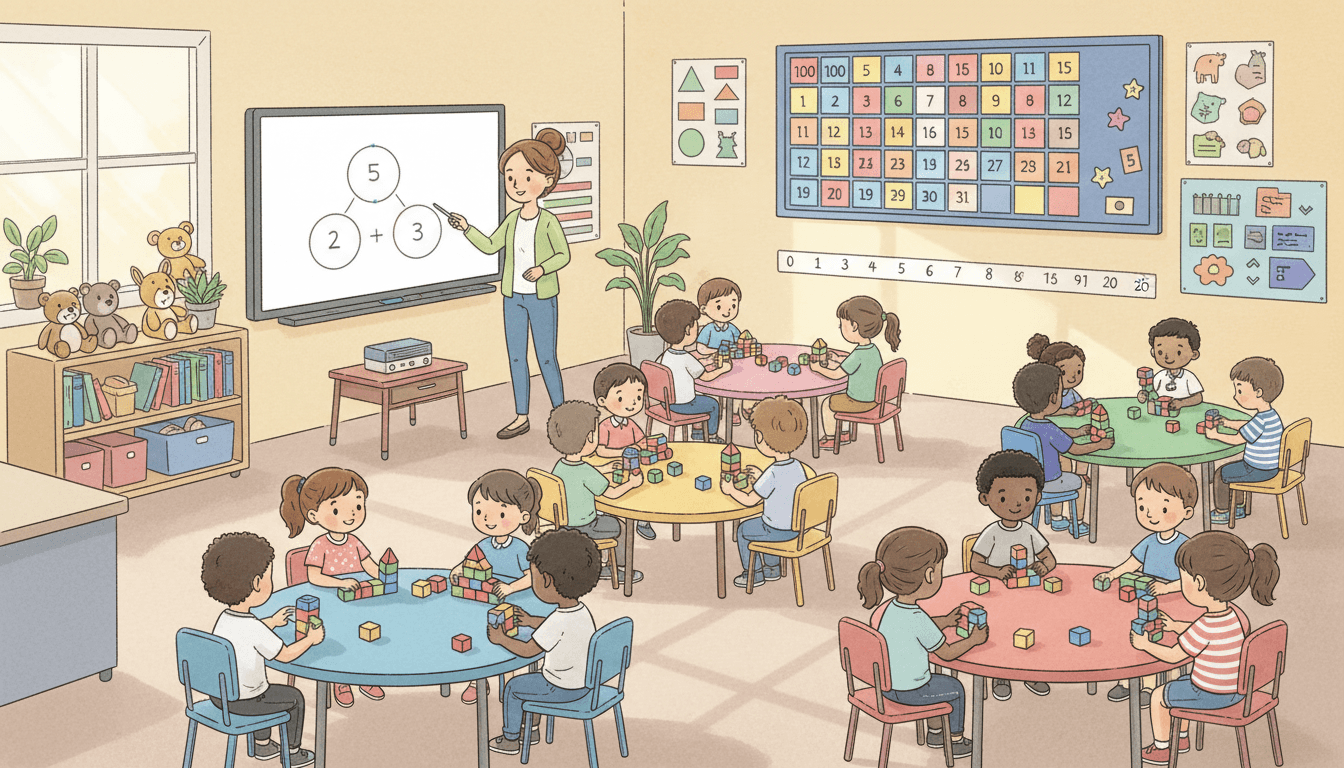
- Math stations with manipulatives (cubes, counters, number lines)
- Partner games where students quiz each other on addition facts
- "Number talks" where students share different strategies for solving the same problem
- Daily calendar math (counting days, identifying patterns in dates)
Quick daily habits:
- Ask "how many?" questions throughout the day
- Practice skip-counting by 2s, 5s, and 10s
- Read the clock together at mealtimes
- Look for patterns everywhere (tile floors, fence posts, rows of seats)
The goal at this age isn't perfection. It's comfort. A first grader who feels comfortable with numbers, who isn't afraid to try and make mistakes, is set up for success.
Keep Reading
- How to Teach Addition to First Graders: A Teacher's Guide
- Best Math Videos for Kids: Learning Through Screen Time
- Skip Counting Activities for First Grade: Making Number Patterns Fun
- Digital Math Tools for Elementary Classrooms
- Math Talk and Explaining Thinking in Elementary
How to Support First Grade Math at Home
You don't need to be a math teacher to help your first grader. You just need to be present, patient, and willing to play.
Start where they are. If your child is struggling with addition within 10, don't push to 20. Master the foundation first. It's not falling behind. It's building solidly.
Use real objects. Abstract numbers on paper are hard for six-year-olds. Buttons, coins, crackers, crayons, anything they can touch and move makes the math real.
Talk about math naturally. "We have 5 apples, and we need 3 for the pie. How many will be left?" These casual conversations build number sense without any pressure.
Read the teacher's updates. Most first grade teachers send home information about what they're working on in math. When you know the current topic, you can reinforce it casually at home.
Celebrate effort, not just answers. "I love how you tried the making-ten strategy" matters more than "You got the right answer." Growth mindset research is clear on this: praising the process builds resilience.
Don't compare. Every child develops at their own pace. Some first graders will fly through addition facts. Others will need the entire year to get comfortable with subtraction. Both are normal.
First grade math is a marathon, not a sprint. The skills your child builds this year (number sense, place value, problem-solving strategies) are the same skills they'll use through fifth grade, middle school, and beyond. Give them time. Give them practice. And give them the message that math is something they can do 😊

Adi Ackerman
Head Teacher
Adi is the Head Teacher at ClassWeekly, with years of experience teaching elementary students. She designs our curriculum-aligned worksheets and writes practical guides for teachers and parents.
Keep Reading
Ready to download? Try ClassWeekly free for 30 days.
Unlimited worksheets for PreK through 5th grade. Cancel anytime.