
Skip Counting Activities for First Grade
Get 30 days of free worksheet downloads
Key Takeaways
- Teach skip counting in order of difficulty: start with 10s (already familiar from kindergarten), then 5s (clear pattern ending in 0 or 5), and finally 2s (requires more working memory).
- Skip counting by 5s and 10s directly prepares first graders for telling time on a clock face and counting nickels and dimes.
- If a child can only recite a fixed sequence like 2, 4, 6, 8 but cannot start from a different number, they have memorized a song rather than understood the pattern.
- Physical activities like hopscotch number lines and partner clap counting combine movement and verbal repetition, which produces stronger retention than worksheets alone.
- Spending 2-3 weeks on each skip counting pattern before moving to the next prevents confusion and builds genuine fluency.
Skip counting is one of those skills that seems simple on the surface but unlocks so much in math. When a first grader can confidently count by 2s, 5s, and 10s, they're building the foundation for addition, multiplication, telling time, and counting money.
The challenge? Rote skip counting (just reciting numbers) gets boring fast. Here's how to make it stick without putting your kiddos to sleep.
Why Skip Counting Matters
Skip counting isn't just a party trick. It's deeply connected to:
- Addition fluency (2, 4, 6, 8 is the same as 2+2+2+2)
- Multiplication (skip counting by 3s is the foundation for the 3 times table)
- Telling time (counting by 5s on the clock face)
- Money (counting nickels by 5s, dimes by 10s)
- Number patterns (recognizing patterns is a core math skill)
Kids who master skip counting in first grade have an easier time with multiplication in third grade. It's that connected.
Free Skip Counting Worksheets for 1st Grade


Start With What They Know
Most first graders can already count by 10s. (10, 20, 30...) They learned it in kindergarten. Start there and build confidence before tackling 2s and 5s.
Then move to 5s. Why 5s before 2s? Because 5s have a predictable pattern that kids can see: 5, 10, 15, 20. Every number ends in either 5 or 0. Kids catch on quickly.
To be fair, some of these ideas sound simple but require real patience to implement well.
Count by 2s last. The pattern (2, 4, 6, 8, 10, 12...) is less visually obvious, and keeping track takes more working memory.
8 Activities That Make Skip Counting Fun
1. Skip Counting Songs
Songs work because melody makes numbers memorable. Search for "skip counting songs" on YouTube and you'll find dozens. Play one during transitions. By the third day, kids will be singing along.
Even better: let kids create their own skip counting songs to familiar tunes. "Twinkle, Twinkle" works perfectly for counting by 2s.
2. Hundred Chart Coloring
Give each student a hundred chart (1-100). Color every 2nd number yellow. Step back and look at the pattern. The colored squares make a visual pattern that kids can see.
Do the same for 5s (different color) and 10s (another color). Hang them up. Refer to them constantly.
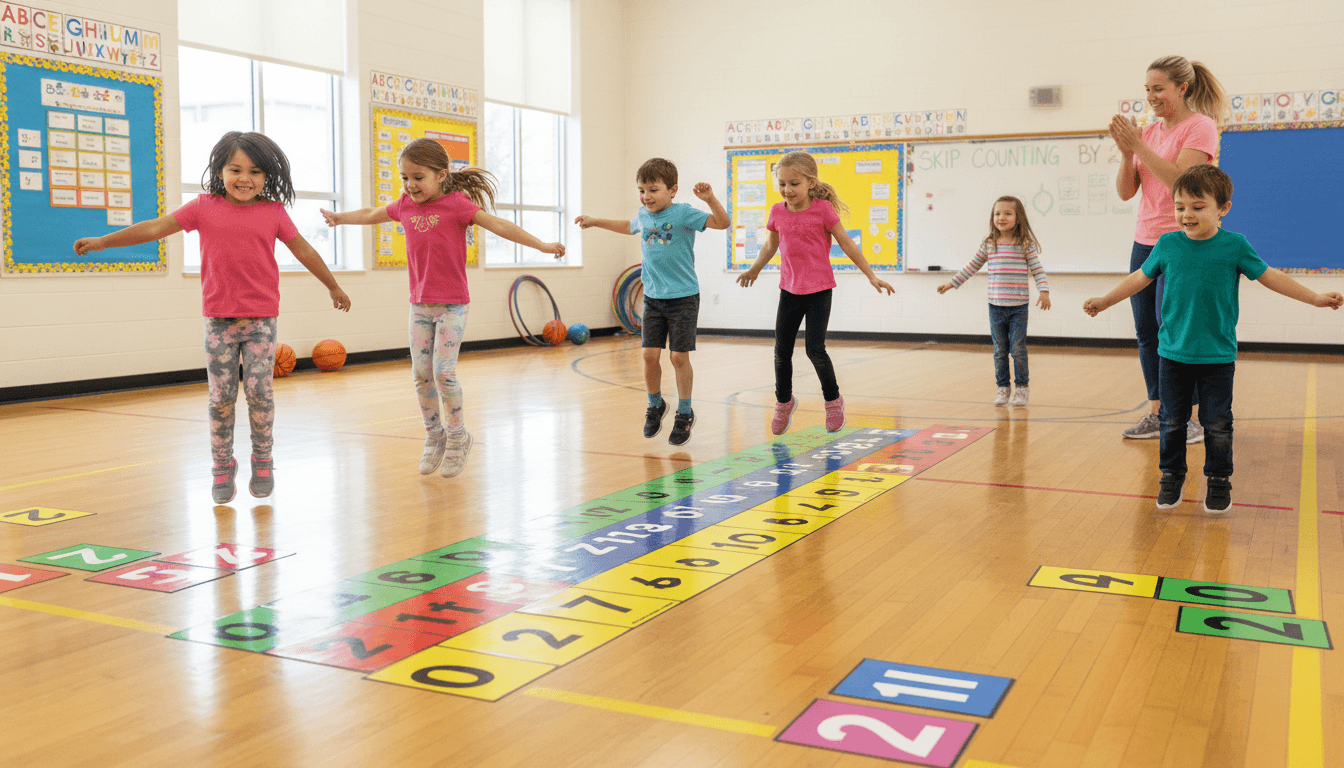
3. Skip Counting Hopscotch
Draw a number line on the sidewalk or use tape on the floor. Kids hop on every 2nd number, every 5th number, or every 10th number. Say the number out loud when you land.
Physical movement + verbal counting = strong retention.
4. Counting Collections
Give kids a big pile of objects (100+ buttons, counters, or pasta pieces). The task: count them all. But counting by 1s takes forever. That's the point. Kids discover that counting by 2s or 10s is way faster.
This gives skip counting a purpose. It's not just a pattern. It's a tool.
5. Partner Clap Counting
Partners stand facing each other. They count by 2s together. On every skip-counted number, they clap hands. On the "skipped" numbers, they're silent.
"One (silent), TWO (clap), three (silent), FOUR (clap)..."
The rhythm helps kids internalize the pattern.
6. Skip Counting Number Line
Draw a number line from 0 to 30. Students draw arcs jumping over numbers: 0 to 2 to 4 to 6. This visual of "jumping over" numbers is powerful for showing what "skip" means.
7. Fill in the Missing Numbers
Write a skip counting sequence with blanks:
- 2, 4, ___, 8, ___, 12
- 5, 10, ___, 20, ___, 30
- 10, 20, ___, ___, 50
This checks whether kids truly know the pattern or are just memorizing a sequence.
8. Skip Counting Worksheets
Once kids have the oral pattern down, worksheets provide practice that builds fluency. Look for worksheets that mix different skip counting patterns and include visual supports like number lines.
The Backwards Challenge
Once kids can skip count forward, flip it. Count backward by 10s from 100. Count backward by 2s from 20.
This is harder than it sounds, and it's directly connected to subtraction. Kids who can count backward by 2s can subtract 2 mentally.
Common Mistakes
Memorizing without understanding. If a child can recite "2, 4, 6, 8, 10" but can't start from a different number (like "start at 14 and count by 2s"), they've memorized a song, not a pattern. Always mix up the starting point.
Going too fast. Some teachers introduce counting by 2s, 5s, and 10s all in the same week. That's too much. Spend 2-3 weeks on each pattern.
Only counting to 20 or 30. Push to higher numbers. "Count by 5s to 100." "Count by 2s to 50." Higher numbers build confidence and number sense.
What the Standards Say
Common Core 1.NBT.A.1 expects first graders to count to 120, starting from any number. Skip counting is the most efficient way to build this number sense.
Keep Reading
- How to Teach Skip Counting: Songs Patterns and Printable Practice
- First Grade Math: Skills, Activities, and What to Expect
- How to Teach Number Sense to Kindergartners: Activities That Build Real Understanding
Try This Tomorrow
Start your math block with a 2-minute skip counting warm-up. Count by 10s together, then 5s, then 2s. Do it every day. By the end of the month, it'll be automatic.
For daily practice pages, our 1st grade skip counting worksheets include fill-in-the-blank sequences, number line practice, and pattern challenges.
Small skill, big impact. Skip counting is the gift that keeps giving in math.

Adi Ackerman
Head Teacher
Adi is the Head Teacher at ClassWeekly, with years of experience teaching elementary students. She designs our curriculum-aligned worksheets and writes practical guides for teachers and parents.
Keep Reading
Ready to download? Try ClassWeekly free for 30 days.
Unlimited worksheets for PreK through 5th grade. Cancel anytime.