
Skip Counting: Songs, Patterns, and Printable Practice
Get 30 days of free worksheet downloads
Key Takeaways
- Skip counting is repeated addition and directly prepares students for multiplication fluency
- Start with 10s, then 5s, then 2s because these sequences have the clearest visible patterns
- Songs and chants lock skip counting patterns into memory more reliably than repetition alone
- Coloring patterns on a hundred chart makes skip counting visual and genuinely exciting for students
- Explicitly connect skip counting sequences to multiplication facts in second grade to ease the transition
Skip counting is one of those skills that pops up everywhere in elementary math. Telling time, counting money, understanding multiplication. It all starts here.
But for a first or second grader, jumping from "2, 4, 6, 8" to actually understanding what skip counting means and why it works takes more than memorizing a chant. They need to see it, hear it, and build it with their hands.
What Is Skip Counting and Why It Matters
Skip counting means counting forward by a number other than 1. Instead of 1, 2, 3, 4, 5... you might count 2, 4, 6, 8, 10 (by 2s) or 5, 10, 15, 20, 25 (by 5s).
It sounds simple, and the mechanics are. But the math underneath is surprisingly deep.
Skip counting is really repeated addition. Counting by 5s means adding 5 over and over. And repeated addition is the foundation of multiplication. When your students later learn that 4 x 5 = 20, they'll draw on the skip counting pattern they practiced in first grade: 5, 10, 15, 20.
Beyond multiplication, skip counting builds number sense. Kids who can fluently count by 2s, 5s, and 10s have a stronger feel for how numbers relate to each other. They can estimate, find patterns, and navigate a number line with confidence.
It also shows up in everyday life. Counting pairs of shoes (by 2s). Reading a clock (by 5s). Counting dimes (by 10s). The more fluent your students become, the more these real-world connections click.
Free Skip Counting Worksheets


Start With 2s 5s and 10s
Don't try to teach all skip counting sequences at once. Start with the three friendliest numbers: 2, 5, and 10.
Counting by 10s is the easiest starting point for most kids. They've been hearing "10, 20, 30, 40, 50" since preschool, and the pattern is crystal clear. Every number ends in zero.
Counting by 5s comes next. The pattern alternates between 5 and 0 at the end: 5, 10, 15, 20, 25, 30. Most kids catch on quickly, especially if they connect it to telling time or counting nickels.
Counting by 2s is trickier than it seems. The numbers change more, and kids often stumble around the teens (12, 14, 16...) and again crossing decade boundaries (28, 30, 32). Give this one extra time.
For each sequence, follow this progression:
- Oral counting. Just say the numbers together. Chant them. Repeat.
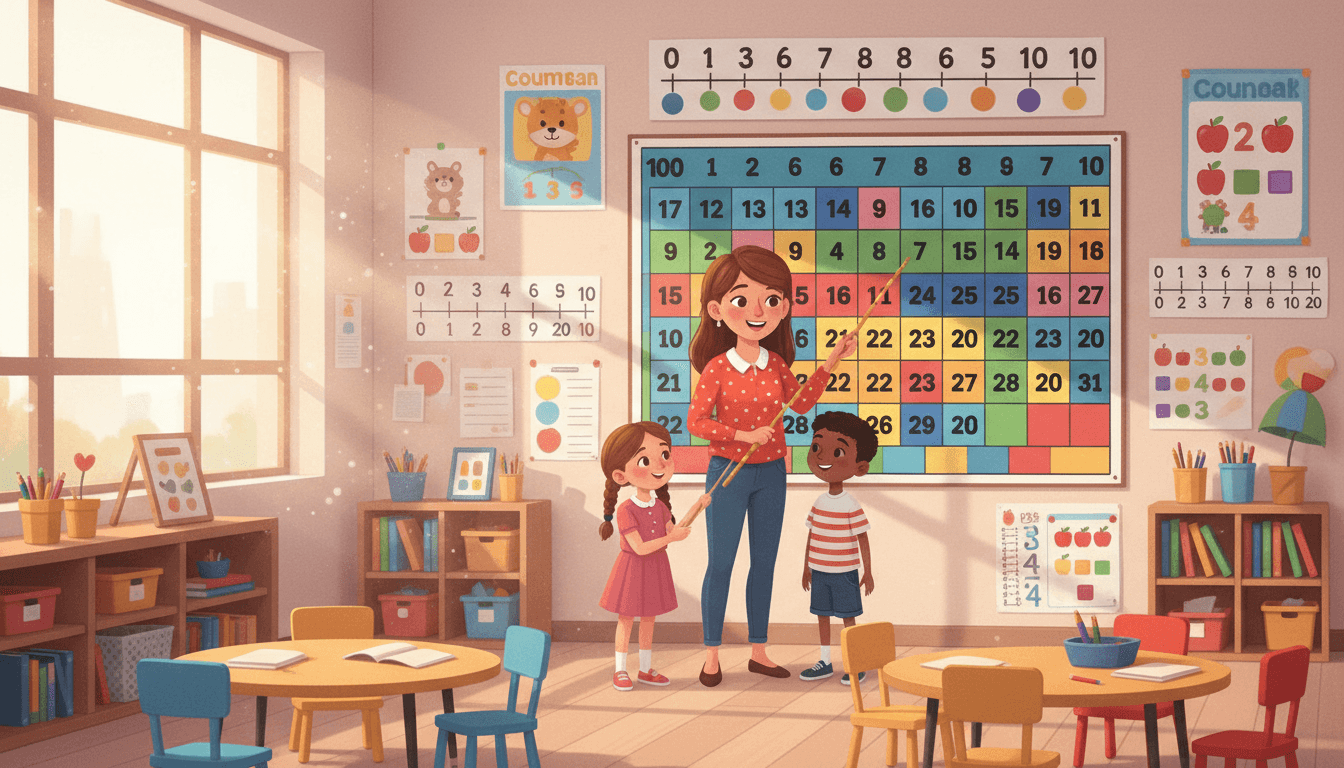
- Visual counting. Use a number line or hundred chart to see the pattern.
- Concrete counting. Group physical objects (pair up shoes for 2s, stack nickels for 5s).
- Written counting. Fill in number sequences on paper.
Once 2s, 5s, and 10s are solid, introduce counting by 3s and 4s in second grade. These are harder because the patterns are less obvious, but they directly prepare kids for multiplication facts.
Skip Counting Songs and Chants
There's a reason every teacher uses songs. They work.
Rhythm and melody help our kiddos lock patterns into memory in a way that pure repetition can't match. A child who struggles to say "5, 10, 15, 20, 25, 30" in a monotone will probably nail it when it's set to a catchy beat.
Try these approaches:
Clap-count: Clap on the skip count numbers, whisper the numbers in between. For counting by 2s: whisper "1," CLAP "2," whisper "3," CLAP "4." The physical rhythm reinforces which numbers are part of the pattern.
Stomp and count: Stand in a circle. Step left on every skip count number. "TWO (step), FOUR (step), SIX (step)." Kids who need to move will love this.
Counting cadences: Use a call-and-response format. Teacher says "2!" Students say "4!" Teacher says "6!" Students say "8!" Speed it up gradually. The energy in the room during this activity is honestly contagious.
Jump rope counting: If you have outdoor time, skip counting while jumping rope combines physical activity with math practice. "5, 10, 15, 20..." until someone misses.
You can find plenty of skip counting songs online, but honestly, making up your own works just as well. Put the sequence to any familiar tune. "Twinkle, Twinkle" with counting by 5s. "Row, Row, Row Your Boat" with counting by 2s. It doesn't have to be perfect. It just has to be memorable.
Number Line Activities
Number lines make skip counting visible. And for many kids, seeing the pattern is what makes it click.
Giant floor number line: Use tape to create a number line on the classroom floor (0 to 30 or 0 to 50). Kids physically hop along the line, landing only on the skip count numbers. Counting by 2s? Hop on 2, 4, 6, 8. Skip the numbers in between. The body movement locks in the pattern.
Personal number lines: Give each student a printed number line at their desk. As they practice a skip counting sequence, they circle or color the numbers they land on. The visual pattern that emerges is powerful. Counting by 2s? Every other number gets colored. Counting by 5s? Two neat columns of highlighted numbers.
Missing number lines: Draw a number line with some numbers filled in and others blank. Students fill in the missing numbers. Start by leaving out one or two, then increase the challenge by leaving most blank.
Backward skip counting: Once forward counting is strong, try going backward. Start at 30 and count back by 5s: 30, 25, 20, 15, 10, 5, 0. This is harder, but it builds subtraction sense and prepares kids for more flexible number work.
The number line also helps kids who get lost in oral counting. If a student freezes at "16... um..." they can look at their number line and see that the next hop lands on 18. The visual support builds confidence until the pattern becomes automatic.
Skip Counting Patterns on the Hundred Chart
The hundred chart is where skip counting gets really beautiful.
Give each student a hundred chart (a 10x10 grid with numbers 1-100). Ask them to color every number they say when counting by 2s. They'll color 2, 4, 6, 8, 10, 12... and a pattern appears. A vertical stripe pattern.
Now do the same for 5s. Two vertical columns emerge (all the 5s and 0s).
Now try 3s. Something unexpected happens. A diagonal pattern appears, zigzagging across the chart. This is usually the moment when kids go "Whoa." They're seeing mathematics as pattern, and it's genuinely exciting.
Try these hundred chart activities:
- Color by 2s in blue, then 5s in yellow. Where colors overlap, numbers belong to both patterns. "10, 20, 30... those show up in both!"
- Predict before coloring. "If we count by 4s starting at 4, what number comes after 16?" Let kids guess, then check on the chart.
- Skip count from different starting points. What happens if you count by 3s starting at 1 instead of 3? (1, 4, 7, 10...) The pattern shifts but stays consistent.
Hundred charts also reveal why some skip counting sequences are easier than others. Counting by 10s hits every number in the bottom row. Counting by 2s hits exactly half. Counting by 7s? The pattern looks almost random. That visual helps kids understand that some facts just take more practice.
Connecting Skip Counting to Multiplication
This connection is the whole reason skip counting matters, and it's worth making explicit.
When a student counts by 5s and says "5, 10, 15, 20," they're really saying:
- 1 group of 5 = 5
- 2 groups of 5 = 10
- 3 groups of 5 = 15
- 4 groups of 5 = 20
That's the 5 times table. They already know it. They just don't know they know it yet.
Make this connection visible. Write the skip counting sequence on the board. Then write the multiplication fact next to each number:
- 5 → 1 x 5
- 10 → 2 x 5
- 15 → 3 x 5
- 20 → 4 x 5
When kids see that skip counting and multiplication are the same thing, a light goes on. Suddenly multiplication isn't this scary new concept. It's something they've been practicing all year.
You don't need to push this connection too early. In first grade, focus on building fluent skip counting. In second grade, start making the multiplication link explicit. By third grade, kids who were strong skip counters will learn their times tables faster than you'd expect.
Keep Reading
- Skip Counting Activities for First Grade: Making Number Patterns Fun
- Teaching Odd and Even Numbers: Activities That Build Understanding
- Second Grade Math: Key Skills and How to Practice at Home
Practice Pages for Skip Counting
Once your students understand the concept and can count orally, practice pages help build fluency and accuracy. Look for activities that include fill-in-the-blank sequences, number line hopping, and pattern completion.
The goal isn't just to memorize sequences. It's to build the kind of number sense that makes math feel natural. When your kiddos can count by 2s, 5s, and 10s without thinking twice, they've got a tool they'll use for years. And when multiplication shows up in third grade, they'll be ready for it.

Adi Ackerman
Head Teacher
Adi is the Head Teacher at ClassWeekly, with years of experience teaching elementary students. She designs our curriculum-aligned worksheets and writes practical guides for teachers and parents.
Keep Reading
Ready to download? Try ClassWeekly free for 30 days.
Unlimited worksheets for PreK through 5th grade. Cancel anytime.