
Addition for 1st Grade: How to Teach It
Get 30 days of free worksheet downloads
Key Takeaways
- Use the concrete-representational-abstract (CRA) sequence: start with physical objects before moving to drawings and then numbers.
- Teaching addition strategies like counting on, doubles, making 10, and fact families builds deeper number sense than memorizing facts alone.
- Timed tests are counterproductive at first grade - short, mixed, visual, low-pressure practice sessions produce the best results.
- If a student struggles with addition, check for gaps in foundational number sense skills like counting and one-to-one correspondence first.
- By the end of first grade, students should add within 20 fluently, understand the commutative property, and use at least two strategies.

Teaching addition to first graders is one of those moments that shapes how a child feels about math for years to come. Get it right, and you build confidence. Rush through it, and you create anxiety.
After years of teaching 1st grade math, here's what actually works in the classroom.
Start With Concrete Objects
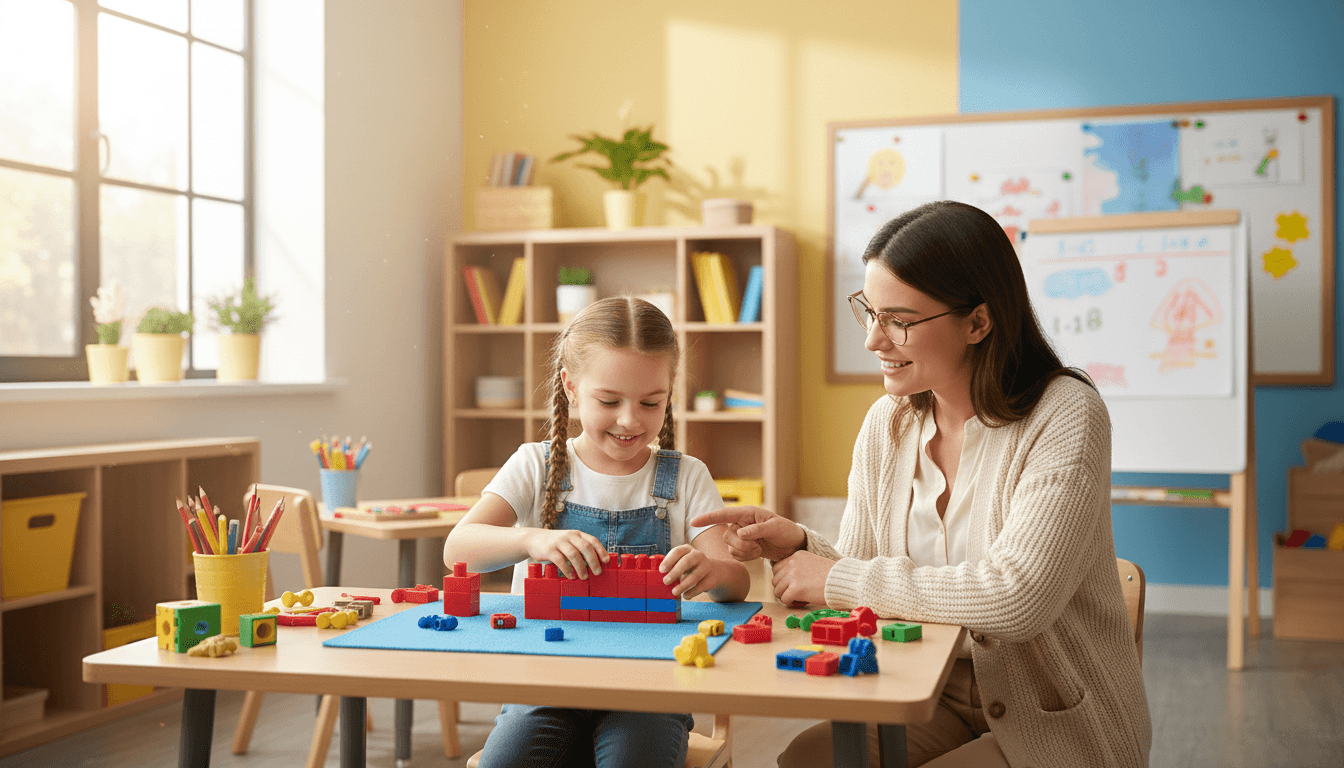
Before any worksheet or number line, let kids touch and count real things. Blocks, buttons, cereal pieces. The concept of "putting together" needs to live in their hands before it lives on paper.
Try this: Give each student 10 small objects. Ask them to make two groups and count the total. "You have 3 red blocks and 4 blue blocks. How many blocks altogether?"
This isn't busywork. Research from the National Council of Teachers of Mathematics confirms that concrete-representational-abstract (CRA) sequencing is the most effective approach for early math learners.
Free 1st Grade Addition Worksheets


Move to Visual Models
Once students are comfortable combining physical objects, transition to drawings and number lines.
Number bonds work especially well for first graders because they make the relationship between parts and whole visible:
Honestly? Some days this works beautifully. Other days, not so much.
- Draw a circle at the top (the total)
- Two circles below (the parts)
- Lines connecting them
Students fill in the missing piece. This builds number sense, not just calculation speed.
First Grade Addition Strategies (Not Just Facts)
Memorizing facts matters, but strategies matter more at this stage. Here are the four strategies that work best for 1st graders:
1. Counting On
Start from the bigger number and count up. For 3 + 5, start at 5 and count: 6, 7, 8. This is the first "shortcut" kids learn, and it feels like a superpower.
2. Doubles
1+1, 2+2, 3+3, 4+4, 5+5. These are the easiest facts to memorize because of the pattern. Once kids know doubles, they can use "doubles plus one" for nearby facts (3+4 = 3+3+1 = 7).
3. Making 10
This is the big one. Understanding that 7+3=10, 8+2=10, 6+4=10 opens up everything that comes after. Use ten frames to make this visual.
4. Fact Families
Show that 3+5=8 also means 5+3=8, 8-3=5, and 8-5=3. This connects addition and subtraction from the start.
Common Mistakes to Watch For
Writing numbers backward. Many first graders still reverse digits. This isn't a math problem. It's a fine motor development issue. Correct gently and move on.
Counting the first number. When counting on from 5+3, some kids count "5, 6, 7" instead of "6, 7, 8." Practice with a number line helps fix this.
Rushing to abstract. If a student isn't ready to drop the manipulatives, don't force it. There's no prize for getting to abstract math faster.
Practice That Actually Sticks
The best addition practice for first graders is:
- Short (10-15 minutes per session)
- Mixed (not 20 identical problems in a row)
- Visual (include pictures, number lines, or ten frames)
- Low-pressure (no timed tests at this stage)
Our free addition worksheets for 1st grade follow all four of these principles. Each page mixes strategies, includes visual supports, and keeps the problem count manageable.
When to Worry (and When Not To)
By the end of first grade, most students should:
- Add within 20 fluently
- Understand the commutative property (3+5 = 5+3)
- Solve simple word problems
- Use at least two addition strategies
If a student is still struggling with basic addition by mid-year, consider whether they have solid number sense foundations (counting, one-to-one correspondence, subitizing). Sometimes the gap isn't in addition itself. It's in the skills that come before it.
Keep Reading
- First Grade Math: Skills, Activities, and What to Expect
- Best Math Videos for Kids: Learning Through Screen Time
- Skip Counting Activities for First Grade: Making Number Patterns Fun
Practice Addition With Free Printables
Pick one strategy from this guide and try it tomorrow. Start with whatever feels most natural for your students. You don't need to overhaul everything at once.
And if you need ready-to-print practice pages, browse our complete collection of free 1st grade addition worksheets.

Adi Ackerman
Head Teacher
Adi is the Head Teacher at ClassWeekly, with years of experience teaching elementary students. She designs our curriculum-aligned worksheets and writes practical guides for teachers and parents.
Keep Reading
Ready to download? Try ClassWeekly free for 30 days.
Unlimited worksheets for PreK through 5th grade. Cancel anytime.