
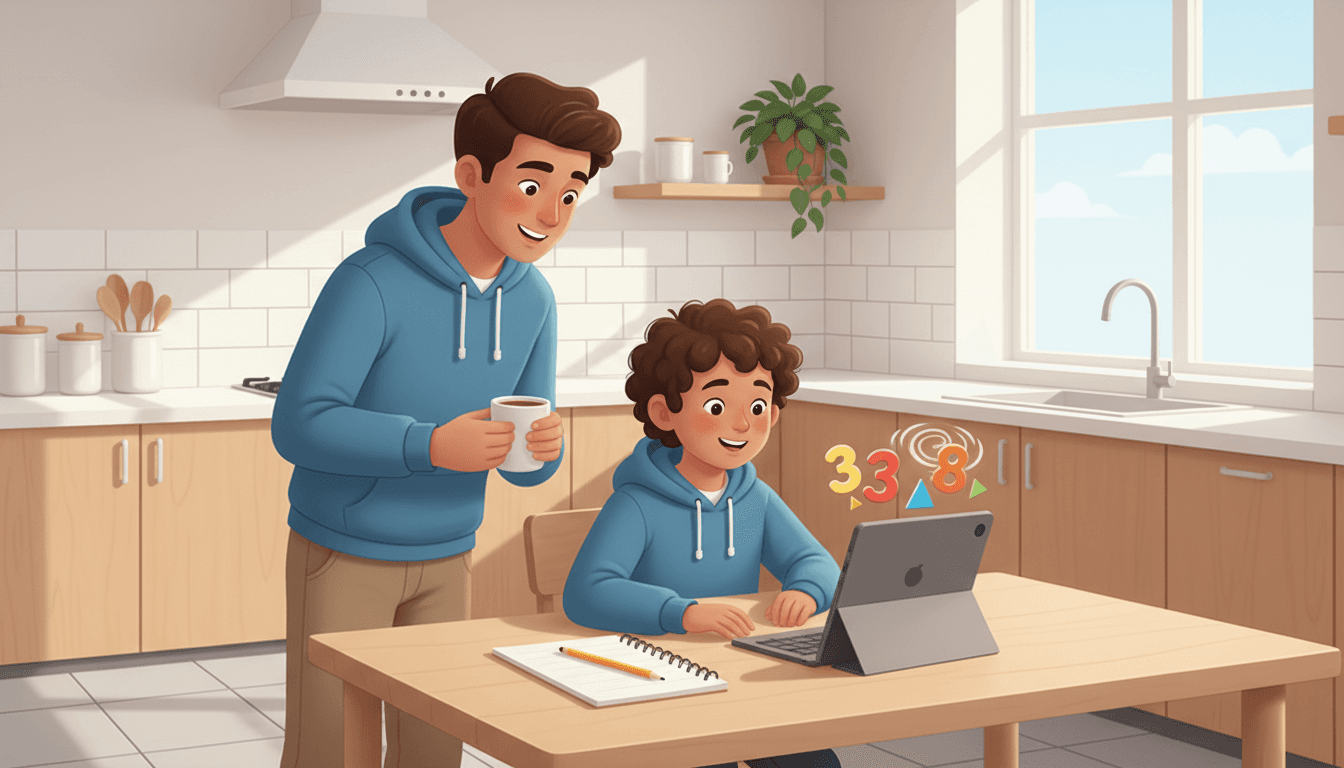
Best Math Videos for Kids: Learning Through Screen Time
Get 30 days of free worksheet downloads
Key Takeaways
- Math videos work best as a supplement to hands-on practice, not a replacement - always pair watching with doing.
- Song-based channels like Numberblocks and Jack Hartmann are most effective for K-2 students because melody creates stronger memory pathways than repetition alone.
- Pausing the video to predict answers before seeing the solution transforms passive watching into active learning.
- Limit math video sessions to 5-10 minutes for K-2 and 10-15 minutes for grades 3-5, then immediately transition to a hands-on activity.
- Turning off autoplay and previewing videos before sharing them ensures content is accurate and age-appropriate.

Screen time and math probably aren't the combination most parents dream about. But here's the reality: kids are going to watch videos. The question is whether those videos leave them entertained for 20 minutes or actually help them understand something.
Math videos, when used right, can be genuinely powerful. A well-made visual explanation can unlock a concept that's been stuck for weeks. A catchy math song can drill a times table into long-term memory faster than a hundred flashcards. And for kids who are visual learners, seeing a concept animated on screen can be the moment everything clicks.
The key word there is "when used right." Let's talk about what that looks like.
When Math Videos Actually Help (And When They Don't)
Math videos work well for:
Introducing new concepts visually. Before teaching fractions, show a 3-minute animation of a pizza being divided into equal parts. The visual primes the brain for the hands-on work that follows.
Reinforcing something already taught. After a lesson on place value, a short video that explains the same concept in a different way helps it stick. Hearing it from a new "voice" (even a cartoon one) can reach students who didn't quite get it the first time.
Review and recall. Songs and chants are incredibly effective for math facts. There's a reason people can sing songs they learned 20 years ago but can't remember what they had for lunch. Melody creates memory pathways that plain repetition doesn't.
Filling the gap for absent students. A child who missed the lesson on regrouping can watch a clear video explanation at home and arrive the next day ready to practice instead of lost.
Math videos don't work well for:
Replacing hands-on learning. No video can substitute for physically manipulating objects, drawing arrays, or working through problems with a pencil. Video is a supplement, never a replacement.
Passive watching marathons. Twenty minutes of math videos back-to-back is entertainment, not learning. The brain glazes over after a few minutes of passive viewing. Short and intentional beats long and mindless every time.
Building problem-solving skills. Videos show how to do things. They don't require the viewer to do anything. The struggle of working through a problem is where the real learning happens, and videos skip that struggle entirely.
Accountability-free consumption. If a child watches a math video and then does nothing with it, retention is minimal. The video needs to connect to something active: a conversation, a practice page, a hands-on activity.
Free 1st Grade Addition Worksheets


Song-Based Math Channels Kids Love
If your child is in K-2, song-based math is probably the most effective video format. Young brains are wired for music, and math songs exploit that wiring brilliantly.
Numberblocks (BBC/Netflix). This is the gold standard for early math video content. Each character IS a number, built from blocks. When "Three" and "Four" combine, they become "Seven," and you can literally see the blocks stack up. It covers counting, addition, subtraction, patterns, place value, and more. The visual representation is mathematically accurate, not just cute. Watch it with your kiddos and you'll probably learn something too.
To be fair, we've had mixed results with this one. But most teachers report improvement after 2-3 weeks.
Jack Hartmann. His YouTube channel has hundreds of counting and math songs for pre-K through second grade. The songs are catchy (sometimes annoyingly so, fair warning) and cover skip counting, place value, addition facts, and more. Kids stand up and move while singing, which adds a kinesthetic layer.
Scratch Garden. Short, animated math songs with clear visuals. Their place value and geometry songs are especially good. The animation style is fun without being overwhelming, and the songs are designed to be educational first and entertaining second.
Have Fun Teaching. Another song-based channel with math content for K-3. Their skip counting songs (counting by 2s, 5s, 10s) are classroom staples. The production quality varies, but the content is solid.
A note on math songs: they're great for memorization (times tables, skip counting sequences, math vocabulary). They're less effective for conceptual understanding. A child who sings "6 times 7 is 42" perfectly might not understand what 6 times 7 actually means. Use songs for fluency, but pair them with hands-on concept building.
Visual Explanation Channels for Older Students
Once kids hit 3rd grade and beyond, they benefit more from explanation-style videos than songs. These channels break down concepts step by step.
Khan Academy Kids (K-2) and Khan Academy (3rd+). The structured, mastery-based approach works well for math. Videos are clear, calm, and focused. No flashy animations or distracting characters, just a voice explaining while drawing on screen. Some kids find this boring. Others find it calming. Know your audience.
Math Antics. This channel covers 3rd-5th grade math topics with humor and clear animation. Rob (the host) explains concepts like long division, fractions, and decimals in a way that's accessible without being condescending. The pacing is good for kids who need a slower, more deliberate walkthrough.
Mashup Math. YouTube channel with visual math puzzles and problem-solving videos. Less about teaching individual skills and more about building mathematical thinking. Great for kids who are already comfortable with basics and need a challenge.
3Blue1Brown. This one is for older students and adults, but some mathematically curious 5th graders will love it. The animations are beautiful and the explanations are deep. Not for everyday use, but for the kid who asks "but WHY does that work?", this channel delivers.
Choosing the right level matters a lot. A video that's too easy feels like a waste of time. A video that's too hard builds frustration, not understanding. When in doubt, go slightly easier than you think. Confidence matters more than challenge with video-based learning.
How to Make Math Videos Active, Not Passive
This is the make-or-break factor. Passive video watching teaches very little. Active video watching can be transformative.
Pause and predict. Stop the video mid-problem. "What do you think the answer is? Why?" Let your child commit to an answer before seeing the solution. This small act of prediction engages the brain completely differently than just watching.
Watch, then do. After a video on adding doubles, immediately work on doubles problems together. The video provides the visual framework. The practice builds the skill. One without the other is incomplete.
Talk about what you watched. "What was the video about? Can you explain it to me?" Teaching back is one of the most powerful learning strategies that exists. If your child can explain the concept in their own words, they've actually learned it.
Take notes (for older kids). Third graders and up can jot down key steps while watching. This isn't about perfect notes. It's about engaging with the content actively instead of passively.
Limit video length. For K-2, keep math video sessions to 5-10 minutes. For 3rd-5th grade, 10-15 minutes maximum. After that, switch to a hands-on activity. The video should spark learning, not replace it.
Never use videos as a reward or punishment. "Finish your math and you can watch a math video" sends a weird mixed message. Videos are tools, not treats.
Pairing Videos With Hands-On Practice
The most effective pattern is watch, then do. Here's what that looks like at different ages:
Kindergarten: Watch a Numberblocks episode about adding small numbers. Then use counters to act out the same problems. Draw pictures of what happened in the video.
First grade: Watch a skip counting song (counting by 2s). Then use a hundreds chart to color every number you counted. Practice on addition pages that reinforce the same patterns.
Second grade: Watch a video on place value (tens and ones). Then build numbers with base-ten blocks. Write the expanded form. Compare with a partner.
Third grade: Watch a Math Antics video on fractions. Then fold paper strips into halves, thirds, and fourths. Label each section. Compare fractions using the strips.
Fourth/Fifth grade: Watch a Khan Academy lesson on long division. Then work through 5 problems with pencil and paper, checking against the method shown in the video. When stuck, rewatch the specific step.
The pattern is always: video provides the model, hands-on practice builds the skill, targeted practice pages build fluency.
Screen Time Guidelines for Math Learning
Here's the practical framework for making screen time count:
Set a purpose before pressing play. "We're watching this to learn about shapes" is better than "Let's watch some math stuff." Purpose focuses attention.
One concept per session. Don't let your child watch a video on addition, then fractions, then geometry in one sitting. Focus on one thing, practice that thing, and stop.
Quality over quantity, every time. Five minutes of Numberblocks with follow-up discussion is worth more than 30 minutes of random math content. A short, focused video paired with hands-on practice beats a long passive session.
Keep devices at the table, not the couch. When math videos happen at a table with a pencil nearby, they feel like learning. When they happen on the couch, they feel like TV. Environment shapes behavior.
Preview before sharing. Not all "educational" content is actually educational. Some math videos on YouTube are poorly explained or contain errors. Watch a video before assigning it to make sure the explanation is clear and accurate.
No autoplay. Autoplay is the enemy of intentional learning. One video ends and the next begins, and suddenly your child has watched 45 minutes of tangentially related content without processing any of it. Turn off autoplay. Choose each video deliberately.
Keep Reading
- First Grade Math: Skills, Activities, and What to Expect
- How to Teach Addition to First Graders: A Teacher's Guide
- Teaching Telling Time to First Graders
- Math Fact Fluency Without Killing the Joy
Our Favorite Math Video Picks by Grade
Here's a quick reference for the best starting points:
Pre-K and Kindergarten: Numberblocks (Netflix/YouTube). Start with Season 1. Also: Jack Hartmann's counting songs for movement breaks.
First Grade: Numberblocks continues to be great. Add Scratch Garden for addition and subtraction songs. Khan Academy Kids for structured practice.
Second Grade: Khan Academy Kids for place value and geometry. Jack Hartmann for times table introduction. Math Antics starts becoming accessible.
Third Grade: Math Antics for multiplication, division, and fractions. Khan Academy for structured skill-building. Mashup Math for puzzles and challenges.
Fourth and Fifth Grade: Khan Academy for core skills (decimals, long division, multi-digit multiplication). Math Antics for visual explanations of tricky concepts. Mashup Math for enrichment.
One last thing. The best math "video" your child can watch is probably you. Talking through a problem out loud while your kid watches you think, struggle, and solve it teaches more than any YouTube channel. Let them see that math is something real people do, not just something that happens on a screen.
Your kiddos deserve screen time that builds their brains, not just burns the clock. Pick the right videos, keep them short, pair them with real practice, and watch the understanding grow 📐

Adi Ackerman
Head Teacher
Adi is the Head Teacher at ClassWeekly, with years of experience teaching elementary students. She designs our curriculum-aligned worksheets and writes practical guides for teachers and parents.
Keep Reading
Ready to download? Try ClassWeekly free for 30 days.
Unlimited worksheets for PreK through 5th grade. Cancel anytime.