
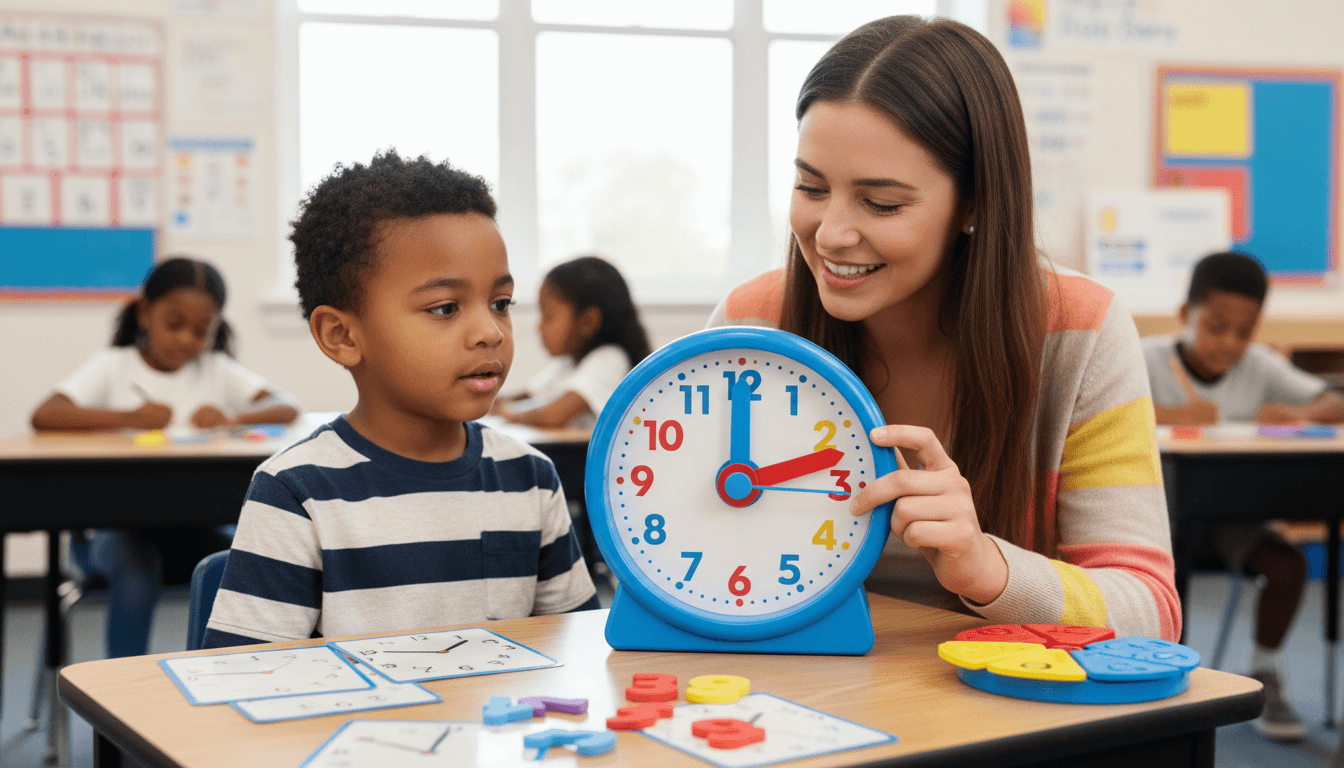
Teaching Telling Time to First Graders
Get 30 days of free worksheet downloads
Key Takeaways
- First graders only need to tell time to the hour and half-hour per Common Core standard 1.MD.B.3, so keep your expectations focused on those two skills.
- Start with just the hour hand and no minute hand for several days before introducing both hands, so students build confidence without confusion.
- At half-past, the hour hand sits between two numbers, and students consistently read the wrong hour - address this misconception with explicit, repeated practice.
- Building skip counting by 5s before teaching time is essential, since the minute hand relies on that number sense.
- Teach analog clocks before digital because the visual layout helps students understand the relationship between hours in a way digital displays cannot.

Here's a question that comes up every year: why is telling time so hard for first graders? These are kids who can add and subtract, who can read sentences, who can do all sorts of impressive things. But hand them a clock and they freeze.
The answer is that clocks are genuinely confusing. Two hands doing different things. Numbers that mean different things depending on which hand is pointing at them. 12 instead of 10 (why isn't it base 10 like everything else in math?).
It's honestly one of the weirdest things we ask 6-year-olds to learn. But it's also one of the most practical.
What First Graders Need to Know
According to Common Core standard 1.MD.B.3, first graders should:
- Tell and write time in hours and half-hours using analog and digital clocks
That's it. Not "to the minute." Not "quarter past." Just hours and half-hours. Keep your expectations focused.
Free 1st Grade Telling Time Worksheets


Before the Clock: Build the Foundation
Make Sure They Can Count by 5s
Telling time relies on skip counting by 5s. If your students aren't comfortable counting 5, 10, 15, 20, 25, 30, spend time on that first. (Check out our skip counting activities for ideas.)
Talk About Hours in Real Life
Before any clock instruction, build awareness of time:
- "Lunch is at 12 o'clock."
- "School starts at 8 o'clock."
- "Bedtime is 8 o'clock."
Kids need to understand that time is a real thing that organizes their day before they can read it on a clock.
The Teaching Sequence
Step 1: The Hour Hand Only
This is the secret to teaching time successfully: start with ONLY the hour hand.
Make a clock with just one hand (remove or cover the minute hand). Point it to different numbers.
"When the hand points to 3, it's 3 o'clock." "When the hand points to 7, it's 7 o'clock."
Practice this for several days. No minute hand. No confusion about which hand to read. Just one hand, one number, one o'clock.
Step 2: Add the Minute Hand for O'Clock
Now put both hands on the clock, but keep the minute hand at 12.
"When the long hand points straight up to 12, it means 'o'clock.' The short hand tells us WHICH o'clock."
Show several examples: 2:00, 5:00, 9:00. The minute hand stays at 12 every time.
Key vocabulary: "The short hand is the hour hand. The long hand is the minute hand." Repeat this daily.
Step 3: Half-Hours
Now move the minute hand to 6. "When the long hand points straight down to 6, it means 'half past' or 'thirty.'"
Show examples: 2:30, 5:30, 9:30.
Here's the tricky part that catches kids: when it's half past, the hour hand is BETWEEN two numbers. At 2:30, the hour hand is between 2 and 3. Kids want to say "3:30" because the hour hand looks closer to 3.
Spend extra time on this. Use the analogy: "The hour hand is on a journey from 2 to 3. At half past, it's halfway there."
5 Activities That Work
1. Make Your Own Clock
Each student makes a paper plate clock with brad fasteners for the hands. They can manipulate it along with you. "Show me 4 o'clock. Now show me 4:30."
Having their own clock makes the lesson hands-on instead of just visual.
2. Daily Time Check
At the start of each activity, pause and read the classroom clock together. "Math starts at 10 o'clock. What time is it now? Are we on time?"
Real-world connection makes time meaningful.
3. Time Match Memory
Make cards with analog clocks and matching cards with digital times. Play memory/concentration. Kids flip two cards and try to match analog to digital.
This builds the connection between the two formats.
4. Schedule Building
Give kids a blank daily schedule. "Draw the clock hands for each activity." Breakfast at 7:00, school at 8:30, lunch at 12:00, recess at 1:30, home at 3:00.
They draw clock hands for each time. This connects telling time to their actual life.
5. "What Time Is It, Mr. Wolf?"
Classic playground game. One child is the "wolf" and faces away. Others ask "What time is it, Mr. Wolf?" The wolf says a time (e.g., "3 o'clock"). Kids take that many steps forward. If the wolf says "Lunchtime!" they chase everyone.
Add a twist: hold up a clock showing the time. Kids must read it before taking steps.
Common Mistakes
Confusing the hands. The most common error. Short hand = hour, long hand = minutes. Some teachers color-code them (red hour hand, blue minute hand) to help.
Reading the wrong number at half-past. At 8:30, the hour hand is between 8 and 9. Kids say "9:30." Repeatedly demonstrate: the hour hand tells you the hour it PASSED, not the one it's heading toward.
Ignoring analog clocks. Many kids grow up with digital clocks and devices. They need analog clock practice specifically because they don't see them at home anymore.
Digital vs. Analog
First graders should learn both, but start with analog. Here's why:
Analog clocks show the relationship between hours. You can see that 6:30 is "halfway around." You can see that 3:00 and 9:00 are on opposite sides. This builds number sense.
Digital clocks just show numbers. There's no visual relationship. They're easier to read but harder to understand.
Teach analog first. Connect it to digital. Then kids understand both.
For Parents
- Keep an analog clock in a visible spot at home
- Ask your child "What time is it?" regularly
- Use time language: "In 30 minutes, we'll eat dinner"
- Practice with our 1st grade time worksheets
Keep Reading
- How to Teach Telling Time to Kindergartners
- First Grade Math: Skills, Activities, and What to Expect
- How to Teach Addition to First Graders: A Teacher's Guide
Start Tomorrow
Grab a paper plate, a brass fastener, and two paper arrows. Make a clock. Ask your students: "Show me 3 o'clock."
That's day one. You'll build from there. And by the end of the unit, your kiddos will be reading clocks with confidence. Phew! One more life skill unlocked.

Adi Ackerman
Head Teacher
Adi is the Head Teacher at ClassWeekly, with years of experience teaching elementary students. She designs our curriculum-aligned worksheets and writes practical guides for teachers and parents.
Keep Reading
Ready to download? Try ClassWeekly free for 30 days.
Unlimited worksheets for PreK through 5th grade. Cancel anytime.