
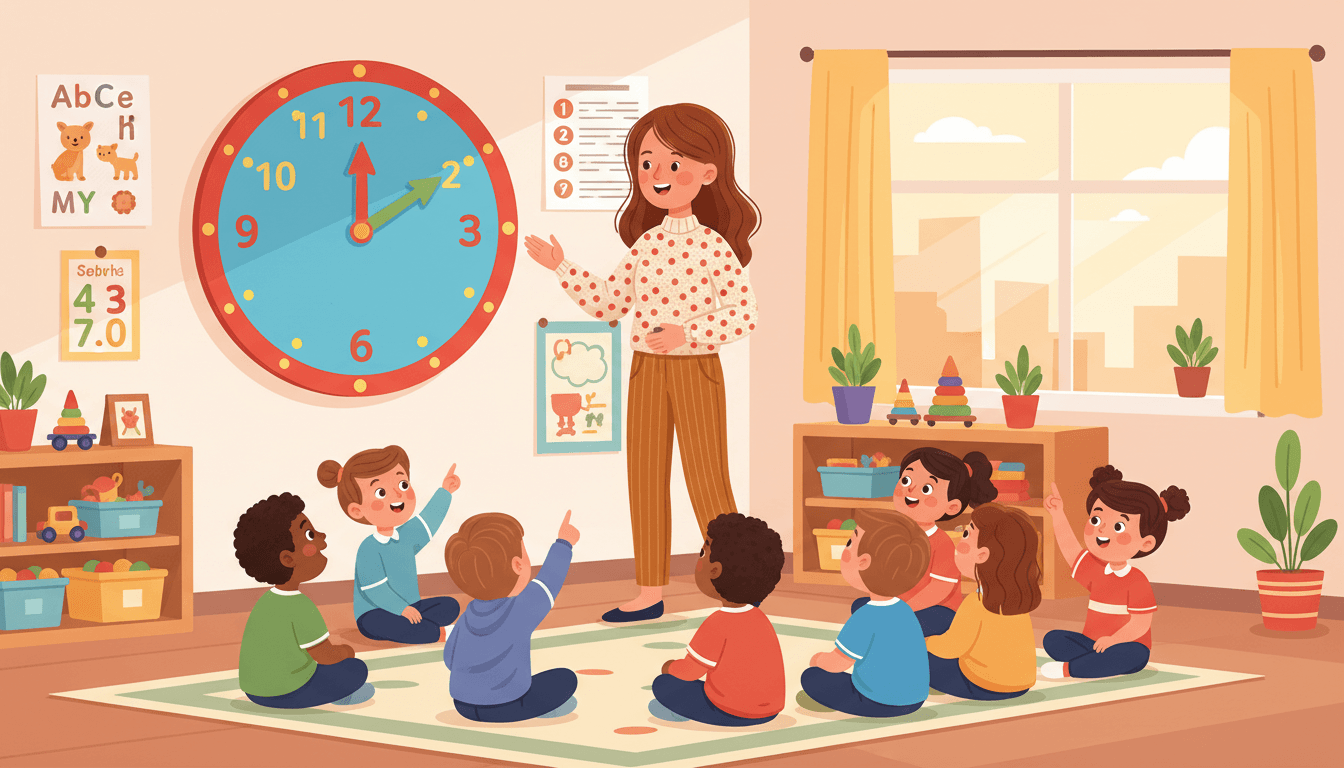
Telling Time in Kindergarten: O'Clock and Half Past
Get 30 days of free worksheet downloads
Key Takeaways
- Cover the minute hand entirely when first teaching time so students can focus only on the hour hand without confusion.
- O'clock and half-past are the only two time concepts kindergartners need to master - resist introducing quarter-past or minutes in kindergarten.
- Your classroom daily schedule is one of the most powerful time-telling tools you have - point to the clock at every transition.
- Color-code the hands (hour hand in red, minute hand in blue) to help students reliably distinguish them.
- Connect time to events kids care about - recess, lunch, snack - before introducing the clock itself.
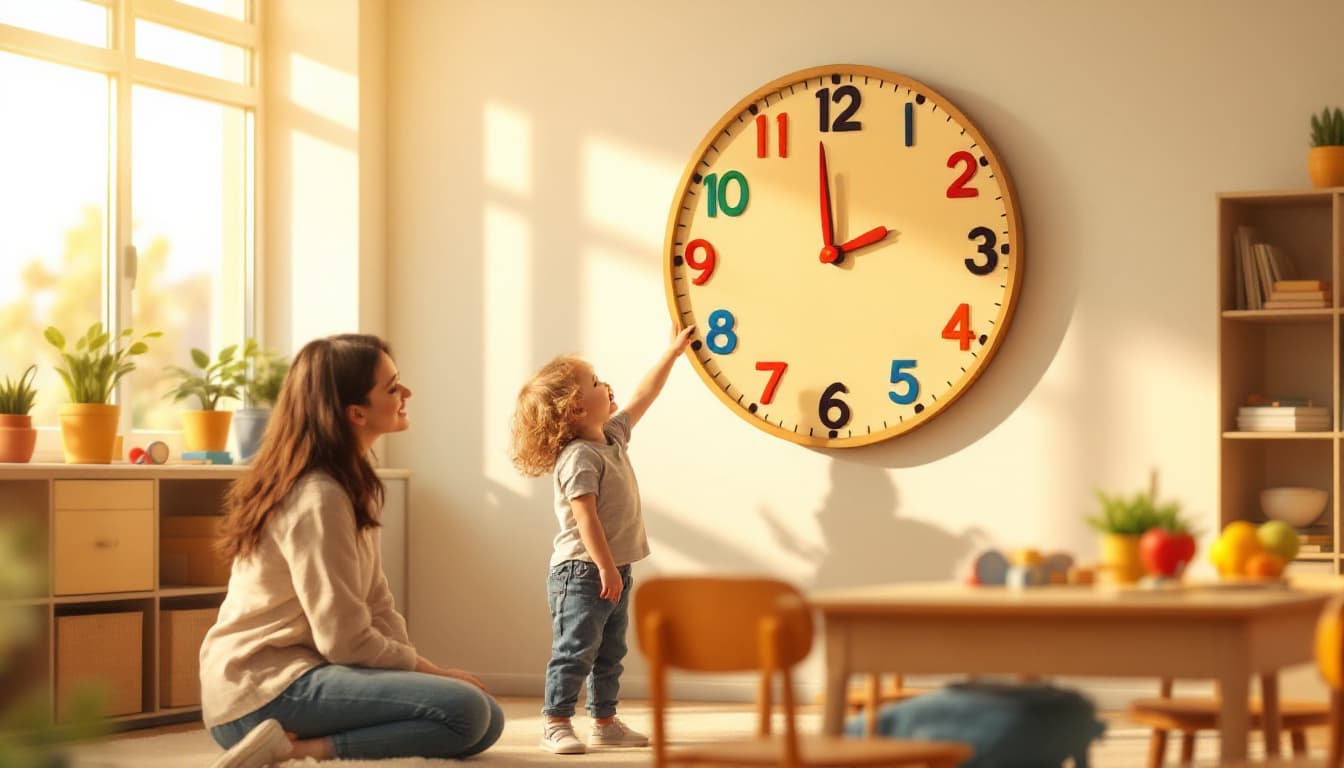
Picture this: you're doing morning circle, you point to the clock on the wall, and you ask "what time is it?" One child says "three." Another says "the big hand is on the twelve." A third just shrugs. A fourth announces it's lunchtime, which is optimistic but not helpful.
Telling time is genuinely hard for five-year-olds. The concept requires understanding that numbers on a circle mean something specific, that two hands move at different speeds, and that the same number can mean different things depending on which hand is pointing to it. That's a lot. This guide breaks it down into steps your kiddos can actually follow.
Table of Contents
- Start With Why: Connect Time to Their Day
- Teach the Parts of the Clock First
- Introduce the Hour Hand Before Anything Else
- Add the Minute Hand, Slowly
- Teach O'Clock and Half-Past as Your Two Goals
- Use a Daily Schedule as a Practice Tool
- Bring in Analog and Digital Together
- Movement and Games That Make It Stick
- Common Mistakes to Avoid
- FAQ
1. Start With Why: Connect Time to Their Day
Before you introduce the clock, answer the question your kiddos are already asking in their heads: "Why does this matter?"
Tell them: "We use the clock to know when things happen. Recess starts at a certain time. Lunch happens at a certain time. Knowing how to read a clock means YOU can know when those things are coming."
That gets their attention.
Activities:
- Create a visual daily schedule on your classroom wall with clock pictures next to each activity
- At home, point to the clock when something fun is about to happen ("It's 3 o'clock, that means snack time!")
- Let kids predict what time they think it is and then check together
- Talk about time markers kids already understand: "before school," "after dinner," "in the morning"
- Ask: "What time do you wake up? What time do you go to bed?" and connect those to a clock image
This emotional connection to time is what makes the abstract concept land. Kiddos don't care about numbers on a circle. They care about lunch.
Free Telling Time Worksheets


2. Teach the Parts of the Clock First
Before anyone reads time, everyone needs to know what they're looking at. Take a full lesson just to explore the clock as an object.
The four things they need to know:
- The clock face is the round part with numbers 1 through 12
- The hour hand is the short hand
- The minute hand is the long hand
- The numbers go in order around the clock, starting at the top
Activities:
- Show a large demonstration clock and label each part together
- Have students color-code a blank clock: numbers in one color, draw a short hour hand in red, draw a long minute hand in blue
- Give each child a paper plate to make their own clock (write numbers, add brad-fastened paper hands)
- Use the rhyme: "Short and stout, that's the hour. Long and lean, that's the minute"
- Sort pictures of clocks: "What do all of these have in common?"
Don't rush past this step. I've made that mistake. If students don't know the hour hand from the minute hand, everything that comes after it is just confusion stacked on confusion.
3. Introduce the Hour Hand Before Anything Else
Here is the single biggest tip I can give you: cover the minute hand entirely when you first start teaching time.
Seriously. Use a piece of tape on your demonstration clock. Put a sticker over the minute hand. Do whatever it takes to remove it from the picture. The minute hand introduces too many variables too early.
Focus only on: where is the short hand pointing?
Activities:
- Show clocks with only the hour hand drawn. Ask: "What number is the short hand pointing to?"
- Practice on a geared clock by spinning the hour hand to different numbers and having students call out what they see
- Make flashcards with only the hour hand on them (no minute hand)
- Do a "clock scavenger hunt" in the classroom: "Find something we do when the hour hand is on the 8"
- Write the number the hour hand points to on sticky notes and match them to activities on your daily schedule
This single-handed approach usually takes 2-3 lessons before most kiddos feel confident. That's the right pace.
4. Add the Minute Hand, Slowly
Once students reliably know the hour hand, you can introduce the minute hand. But keep it simple. In kindergarten, you only need to teach two minute-hand positions:
- Minute hand on the 12 = exactly on the hour (o'clock)
- Minute hand on the 6 = half past (30 minutes after the hour)
That's it. You don't need 7:47 in kindergarten. You need 3:00 and 3:30.
Activities:
- Use a geared demonstration clock to show only those two positions over and over
- Draw clocks together: "Let's draw 2 o'clock. Short hand on 2. Long hand on 12."
- Play "freeze clock": you call out a time (five o'clock!) and students hold up their paper-plate clocks showing that time
- Sort clock picture cards into two groups: "long hand on 12" vs. "long hand on 6"
- Ask: "When the long hand is pointing straight up, what do we call that?" (on the hour, or o'clock)
The minute-hand-on-6 half-past concept is harder. Be patient. Not every five-year-old will get it before first grade, and that's okay.
5. Teach O'Clock and Half-Past as Your Two Goals
O'clock means the minute hand is pointing to 12 and the hour hand is pointing to any number. The time is exactly that number o'clock.
Half-past means the minute hand is pointing to 6 and the hour hand is halfway between two numbers. This is the one that trips kids up.
A helpful way to explain half-past: "The clock is like a pizza. Half past means we've eaten half the pizza. The long hand went halfway around."
Activities:
- Practice sorting clock images: "o'clock or half-past?"
- Write digital times next to analog clocks for the same time (3:00 alongside a clock showing 3 o'clock)
- Create a matching game: analog clock card matches digital time card
- Use the pizza/pie analogy to explain half (draw a half-eaten pizza clock)
- At home, point out half-past times during the day ("It's half-past four, that's 4:30!")
Grab the kindergarten telling time worksheets for printable practice pages focused on exactly these two concepts.
6. Use a Daily Schedule as a Practice Tool
Your classroom schedule is the most practical clock-reading tool you have. It's already there. Use it daily.
Post the schedule with analog clock images next to each time slot. Every morning, review it together:
"What time does math start? Let's find the clock. What does the short hand say?"
Activities:
- Point to the current time on the schedule clock every time you transition between activities
- Have a "clock helper" job in your classroom: that student announces the time at each transition
- Make a mini daily schedule book for each student to keep at their desk
- Ask: "How much time until lunch?" and count the clock pictures between now and then
- Do a morning routine at home: "Look at the clock. What time is it? What do we do at this time?"
This daily repetition is quietly one of the most powerful things you can do. I honestly think it does more for time-telling than any dedicated lesson.
7. Bring in Analog and Digital Together
Most of our kiddos see digital clocks everywhere: on microwaves, tablets, and phones. Connecting the digital display to the analog clock helps them build a bridge.
Show them side by side:
"This clock face says 7 o'clock. See how the short hand points to 7 and the long hand points to 12? Now look at this: 7:00. That's the same time in digital."
Activities:
- Make analog-digital matching cards and play Memory with them
- Have students draw a clock face for a given digital time
- Find digital clocks around your home or classroom and practice reading them
- Draw both versions of the same time: "Show me 6 o'clock the clock way AND the number way"
- Watch a 1-minute video of a clock ticking and have students call out the time every time the minute hand hits 12
8. Movement and Games That Make It Stick
Five-year-olds need to move. Pure worksheet practice is going to lose them. Build in movement wherever you can.
Activities:
- Human clock: Two students stand back to back, one stretches arms straight up (minute hand on 12), the other holds one arm out toward a number. Classmates read the time.
- Time Bingo: Each card has analog clock faces. Call out a digital time and students cover the matching clock.
- Clock hop: Tape a giant clock on the floor. Call out a time. Kids physically jump to stand on the right number.
- Around the clock: Flash a clock image on the board for 3 seconds, then hide it. Students write or say the time.
- Simon Says with time: "Simon says show me 4 o'clock!" with individual student clocks
The human clock game is always a hit. Even your wiggly kids get invested when their body is the clock.
9. Common Mistakes to Avoid
A few things that consistently trip up both teachers and kids:
- Introducing too much too fast. O'clock and half-past are enough for kindergarten. Resist the urge to add quarter-past.
- Skipping the parts-of-the-clock lesson. If they don't know what the hands are called, the rest falls apart.
- Only using worksheets. Paper practice matters, but hands-on clock manipulation needs to come first.
- Assuming digital clock fluency transfers. Reading "3:00" on a screen is not the same skill as reading an analog clock. Teach both explicitly.
- Moving on too quickly. Some kids need 2-3 weeks of o'clock practice before they're ready for half-past. That's fine.
FAQ
At what age should kindergartners learn to tell time? Most kindergarten standards introduce time concepts between ages 5 and 6. The focus is on o'clock and half-past. Full time-telling fluency (including minutes) typically develops in first and second grade.
My child keeps confusing the hour and minute hands. What helps? The "short and stout" rhyme helps: the hour hand is short and fat, the minute hand is long and skinny. Also try color-coding: always draw the hour hand in red and the minute hand in blue until the concept sticks.
Should I teach analog or digital first? Start with analog. Digital reading is often already familiar from everyday life. Teaching analog first builds deeper understanding of how time actually works (the continuous movement of the clock), then connecting it to digital makes both stronger.
How much time should I spend on telling time in kindergarten? Most teachers spend 1-2 weeks on time during the school year, revisiting it in short bursts. 5-10 minutes of daily practice during your schedule routine adds up faster than dedicated block lessons.
Keep Reading
- How to Teach Comparing Numbers to Kindergartners
- How to Teach Data and Graphing to Kindergartners
- How to Teach Measurement to Kindergartners
Conclusion
Teaching time is one of those topics that feels simple until you try to explain it to a five-year-old. Then you realize how many moving parts there are (pun intended).
Start slow. Start with the hour hand only. Celebrate every small win. And connect it to your daily schedule so it shows up in context, not just on worksheets.
For ready-made practice pages, the kindergarten telling time worksheets at ClassWeekly are organized by skill level, starting right at o'clock and building from there. Your kiddos will get there. It just takes more time than you think (and yes, that pun was also intentional).

Adi Ackerman
Head Teacher
Adi is the Head Teacher at ClassWeekly, with years of experience teaching elementary students. She designs our curriculum-aligned worksheets and writes practical guides for teachers and parents.
Keep Reading
Ready to download? Try ClassWeekly free for 30 days.
Unlimited worksheets for PreK through 5th grade. Cancel anytime.