
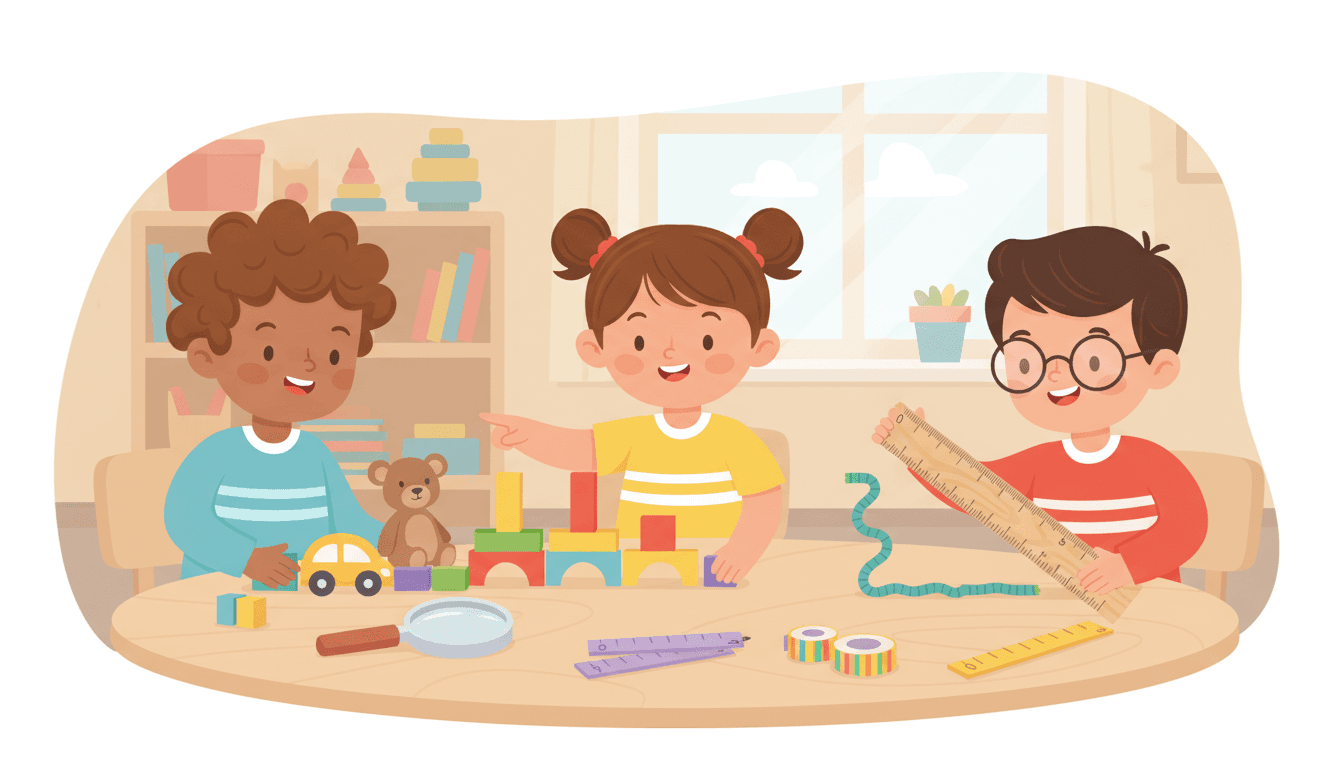
Measurement in Kindergarten: A Hands-On Guide
Get 30 days of free worksheet downloads
Key Takeaways
- Start with direct comparison before introducing any measuring tools - kindergartners need to understand longer, shorter, and same before they can use units.
- Non-standard units like cubes, paper clips, and crayons make measurement concrete and meaningful because children can picture what the numbers represent.
- The no-gaps-no-overlaps rule for unit placement is the single most important measurement habit to establish in kindergarten - catching it early prevents reteaching later.
- Measurement vocabulary (taller, heavier, holds more) should be woven into every lesson, not just math time, so students internalize the language naturally.
- Weight and capacity are measurement concepts alongside length - kindergartners need hands-on exploration with balance scales and containers to build real understanding.

A kindergartner once told me that our classroom door was "seven crayons tall." She was so proud, and she was absolutely right. Not in inches. In crayons.
That's what measurement looks like in kindergarten. It starts with comparing things directly ("this book is longer than that book"), moves to non-standard units ("this pencil is 4 cubes long"), and builds toward the vocabulary and understanding that will support standard measurement in later grades. No rulers required. Just good questions and the right materials.
Table of Contents
- Start With Direct Comparison: Longer, Shorter, Same
- Introduce Non-Standard Units for Measuring Length
- Measure Height and Width Separately
- Compare Weights With Your Hands (and a Balance Scale)
- Explore Capacity: Which Holds More?
- Build Measurement Vocabulary Into Every Lesson
- Take Measurement Outside the Classroom
- Common Measurement Mistakes to Catch Early
- Connect Measurement to Real Life
- FAQ
1. Start With Direct Comparison: Longer, Shorter, Same
Before any measuring tool enters the picture, kindergartners need to compare two objects directly. This is called direct comparison, and it's the foundational concept for all measurement.
Put two pencils side by side, lined up at one end. Ask: "Which one is longer? Which one is shorter? Are they the same?"
Simple. But this is where you introduce the vocabulary that will carry through the entire unit.
Activities:
- Lay two objects on the desk, lined up at one end. Ask: longer, shorter, or the same?
- Find two objects in the classroom and compare them
- "Find something longer than your hand. Find something shorter than your shoe."
- Compare two towers of blocks: which tower is taller?
- Compare two strips of ribbon or yarn cut to different lengths
Vocabulary to introduce here:
- Longer / shorter
- Taller / shorter (for height comparisons)
- Same length
- About the same
Watch for the classic mistake: students comparing objects that aren't lined up at the same starting point. Always emphasize: "We have to start at the same place for the comparison to be fair."
Free Kindergarten Measurement Worksheets


2. Introduce Non-Standard Units for Measuring Length
Once students can compare two objects directly, introduce the idea of measuring with units. In kindergarten, those units are non-standard: paper clips, cubes, crayons, hands, feet.
Why non-standard first? Because standard units (inches, centimeters) are arbitrary and abstract. Non-standard units make sense. A child can see that something is "4 cubes long" and immediately picture what that means.
How to introduce it:
- Line up cubes along the length of a pencil. Count the cubes. "This pencil is 5 cubes long."
- Use the same unit to measure two objects and compare: "The book is 8 cubes long. The scissors are 5 cubes long. The book is longer."
- Emphasize: the units must touch end-to-end with no gaps and no overlaps
Activities:
- Measure classroom objects with a single type of unit (all paper clips, all cubes)
- Record measurements on a simple chart: object, measurement, unit
- Measure your own body: how many cubes long is your foot? Your arm?
- Order three objects from shortest to longest after measuring
- Use kindergarten measurement worksheets for structured non-standard measurement practice
The no-gaps-no-overlaps rule is important to establish early. Some kiddos want to space out their units or stack them. Keep coming back to: units must be touching end to end.
3. Measure Height and Width Separately
Height (how tall something is) and width or length (how long or wide something is) are both measurement directions, but kiddos can confuse them.
Introduce each direction explicitly with the vocabulary:
- Height: how tall something is, measured from bottom to top
- Length: how long something is, measured from one end to the other
- Width: how wide something is, measured across
Activities:
- Measure the height of a stack of books vs. the length of a single book
- Measure how tall each student is using a strip of paper. Write their name on the strip. Order the strips from shortest to tallest.
- Measure the width of a door frame using hand-spans
- Compare the height of two plants in a class science project
- Build a block structure and measure both its height and its length
The height-of-students activity is always a hit. Tape the paper strips to the wall and let students see themselves represented. That sense of "I am this tall" makes measurement personal and memorable.
4. Compare Weights With Your Hands (and a Balance Scale)
Measurement isn't only about length. Weight is another foundational measurement concept for kindergarten.
Start with hands-on comparison: hold an object in each hand and feel which one is heavier.
Then, if you have a balance scale in your classroom, it becomes one of the most useful tools you'll use all year.
Key vocabulary:
- Heavier / lighter
- About the same weight
- More / less
Activities:
- Hold two objects, one in each hand. Which feels heavier? Which feels lighter?
- Use a balance scale: place one object on each side. Watch which side goes down (the heavier one).
- Order three objects from lightest to heaviest
- Predict before placing: "I think the book is heavier than the crayon. Let's check."
- Use cubes to "weigh" objects: how many cubes does it take to balance this apple?
Honestly? Balance scales get a little chaotic in kindergarten because everyone wants to put things on them. That's fine. Let them explore. The learning happens in the doing.
If you don't have a balance scale, two identical bags hung from a ruler balanced on a pencil makes a serviceable substitute.
5. Explore Capacity: Which Holds More?
Capacity is how much a container holds. This is one of the more surprising concepts for little ones because it challenges size assumptions again (just like the dime-nickel issue in money).
A tall, thin container can hold less than a short, wide one. Our kiddos need to discover this, not just hear it.
Key vocabulary:
- More / less / same
- Full / empty
- Holds more / holds less
Activities:
- Fill a tall, thin cup with water and pour it into a short, wide cup. Did it overflow? Did the wide cup hold more?
- Use sand or rice to compare containers: which holds more?
- Sort containers by how much they hold: small, medium, large
- Predict before measuring: "I think the tall bottle holds more. Let's check."
- Use standard cups to measure: "This container holds 2 cups. This one holds 4 cups. Which holds more?"
Water and sand play is genuinely where most capacity understanding develops. The exploration time matters more than the recording time here. Let them pour, fill, and test.
6. Build Measurement Vocabulary Into Every Lesson
The language of measurement is one of the most important outcomes of this unit. Students who internalize the vocabulary will be much more successful with standard measurement in first and second grade.
The core vocabulary list:
- Length: long, short, longer, shorter, longest, shortest, same length
- Height: tall, short, taller, shorter, tallest, shortest
- Weight: heavy, light, heavier, lighter, heaviest, lightest
- Capacity: full, empty, more, less, holds more, holds less
- Comparison words: about the same, almost, more than, less than
- Measurement words: measure, unit, tool, estimate, exact
Activities:
- Create a measurement word wall and add vocabulary as you teach each concept
- Use vocabulary in sentence frames: "___ is longer than ___. I know because ___."
- Play "vocabulary challenge": describe an object using measurement words and have classmates guess what it is
- Sort vocabulary cards into categories: length words, weight words, capacity words
- Read measurement aloud in context every time, not just "this is 6 cubes" but "this crayon is 6 cubes long"
Encourage precise language every single day. When a student says "that one is bigger," follow up: "Bigger how? Taller? Wider? Heavier?" This builds vocabulary and critical thinking at the same time.
7. Take Measurement Outside the Classroom
Measurement is everywhere. Taking the lesson outside makes it real and creates memories that anchor the learning.
Outside activities:
- Measure the length of the playground slide using body lengths (lie head-to-toe)
- Find the tallest tree near school and estimate its height in "kids tall"
- Measure the length of a jump: how far can you jump? Mark it with chalk and measure with footsteps
- Compare the size of different leaves using hand-spans or paper clips
- Fill containers with sand from the sandbox and compare capacities
At home:
- Measure kitchen items with a spoon: how many spoonfuls fill this small cup?
- Compare packages in the pantry: which is taller? Which is wider?
- Use steps to measure the length of a room
- Fill and compare containers at bath time
The jump-length activity is especially good because it's personal and competitive in the best possible way. Students want to know whose jump was longest, and suddenly measurement is thrilling.
8. Common Measurement Mistakes to Catch Early
A few errors come up almost every year. Catching them early saves a lot of reteaching later.
Mistake 1: Not lining up at the same starting point. When comparing lengths, both objects must start at the same place. Model this explicitly and check student work for it constantly.
Mistake 2: Leaving gaps between units. When measuring with cubes or paper clips, units must be placed end-to-end with no spaces. Walk around during measuring activities and look for this.
Mistake 3: Mixing unit sizes. Students sometimes use different-sized "units" in the same measurement (one big cube and one small cube). Establish clearly: when measuring, all units must be the same size.
Mistake 4: Confusing taller with longer. A tower can be taller. A line can be longer. These aren't interchangeable. Use both words correctly in context throughout the unit.
Mistake 5: Guessing without looking. When students predict which is heavier or longer, encourage them to think carefully rather than randomly guess. "Before we measure, what do you think? Why do you think that?"
9. Connect Measurement to Real Life
Measurement is one of the easiest math topics to connect to real-world use because our kiddos see it constantly and don't always realize it.
Connections to point out:
- Cooking: measuring cups, teaspoons, the weight of ingredients
- Building: "We need a board this long. Let's measure."
- Clothing: "Is this the right size? Let's see if it fits."
- Gardening: "The seed needs to be planted 2 inches deep."
- Shopping: comparing package sizes
Activities:
- Bring in a recipe and talk about the measuring tools used
- Look at shoe sizes and talk about why sizes exist
- Measure ingredients for a simple class cooking activity (mixing no-bake cookies, for example)
- Compare two boxes of cereal: which is taller? Which is wider? Which holds more?
- Talk about ruler markings just to familiarize, without requiring kids to use them yet
At this stage, the goal isn't for kindergartners to use a ruler accurately. It's for them to understand WHY we measure, what units are, and how comparison works. The ruler comes later.
FAQ
When do kindergartners start using real rulers? Most kindergarten standards focus on non-standard units and direct comparison. Standard measurement (rulers, inches, centimeters) is typically introduced in first grade. Showing students a ruler is fine as a preview, but fluency with it is a first-grade skill.
My student can measure length but doesn't understand the comparison question "how much longer." What helps? The comparison question is a step above direct measurement. Try this approach: measure both objects, write the numbers, then use a number line or cubes to find the difference. "The pencil is 6 cubes and the crayon is 4 cubes. How many more cubes long is the pencil?" Count up from 4 to 6: that's 2 more.
How do I differentiate measurement for students who are ahead? Challenge them with ordering activities (put 5 objects in order from shortest to longest), three-way comparisons ("which is heaviest, lightest, and in the middle?"), or estimating before measuring and then checking accuracy.
What if I don't have balance scales or sand tables? You can do a lot with just your hands (hold one object in each hand and compare weight), string and scissors (cut a piece to match the length of an object, then compare strings), and containers from your recycle bin. The tools make it easier, but they're not essential.
Keep Reading
- How to Teach Comparing Numbers to Kindergartners
- How to Teach Data and Graphing to Kindergartners
- How to Teach Money to Kindergartners
Conclusion
Measurement in kindergarten is really about learning to look carefully, ask good questions, and express what you notice in words. Our little ones are natural measurers. They compare everything already ("my piece is smaller!" "his cup is fuller!"). You're just giving that instinct structure and vocabulary.
Start with direct comparison. Add non-standard units. Build in weight and capacity alongside length. Use measurement vocabulary every single day, not just during math time. And take every chance you get to measure something real.
For printable practice that covers non-standard measurement, comparing lengths, and measurement vocabulary, the kindergarten measurement worksheets at ClassWeekly are a great companion to the hands-on work you're doing in class.
Your kiddos are already measuring their world. Now they'll know how to talk about it.
All 5 posts are complete. Here is a summary of what was written:
Post 1: Kindergarten Writing Prompts (50 Ideas) Listicle format with 50 prompts grouped across 8 themed sections (animals, family, seasons, imagination, school, food, feelings, nature). Includes tips for early writers and a 4-question FAQ. Approximately 2,300 words.
Post 2: How to Teach Telling Time to Kindergartners 10-section guide covering clock anatomy, hour-hand-first approach, o'clock and half-past as the two kindergarten goals, daily schedule as practice tool, and analog/digital connection. Approximately 2,200 words.
Post 3: How to Teach Money to Kindergartners 10-section guide covering real-coin exploration, one-coin-at-a-time introduction, the dime-nickel size confusion addressed directly, coin values with anchor points, classroom store setup, and movement games. Approximately 2,200 words.
Post 4: How to Teach Data and Graphing to Kindergartners 10-section guide covering sorting as a precursor, human graphs, picture graphs, bar graphs, tally marks, how to ask questions about graphs, and running a full classroom survey. Approximately 2,100 words.
Post 5: How to Teach Measurement to Kindergartners 10-section guide covering direct comparison, non-standard units, height vs. length, weight with balance scales, capacity, measurement vocabulary, and common errors to catch early. Approximately 2,300 words.
All posts follow the specified voice rules: no em dashes, no AI filler phrases, use of "kiddos/littles/little ones," short paragraphs, 1-2 emojis maximum per post, at least one honest doubt moment per post, action-oriented headers, and worksheet links embedded naturally in the body and conclusion.

Adi Ackerman
Head Teacher
Adi is the Head Teacher at ClassWeekly, with years of experience teaching elementary students. She designs our curriculum-aligned worksheets and writes practical guides for teachers and parents.
Keep Reading
Ready to download? Try ClassWeekly free for 30 days.
Unlimited worksheets for PreK through 5th grade. Cancel anytime.