
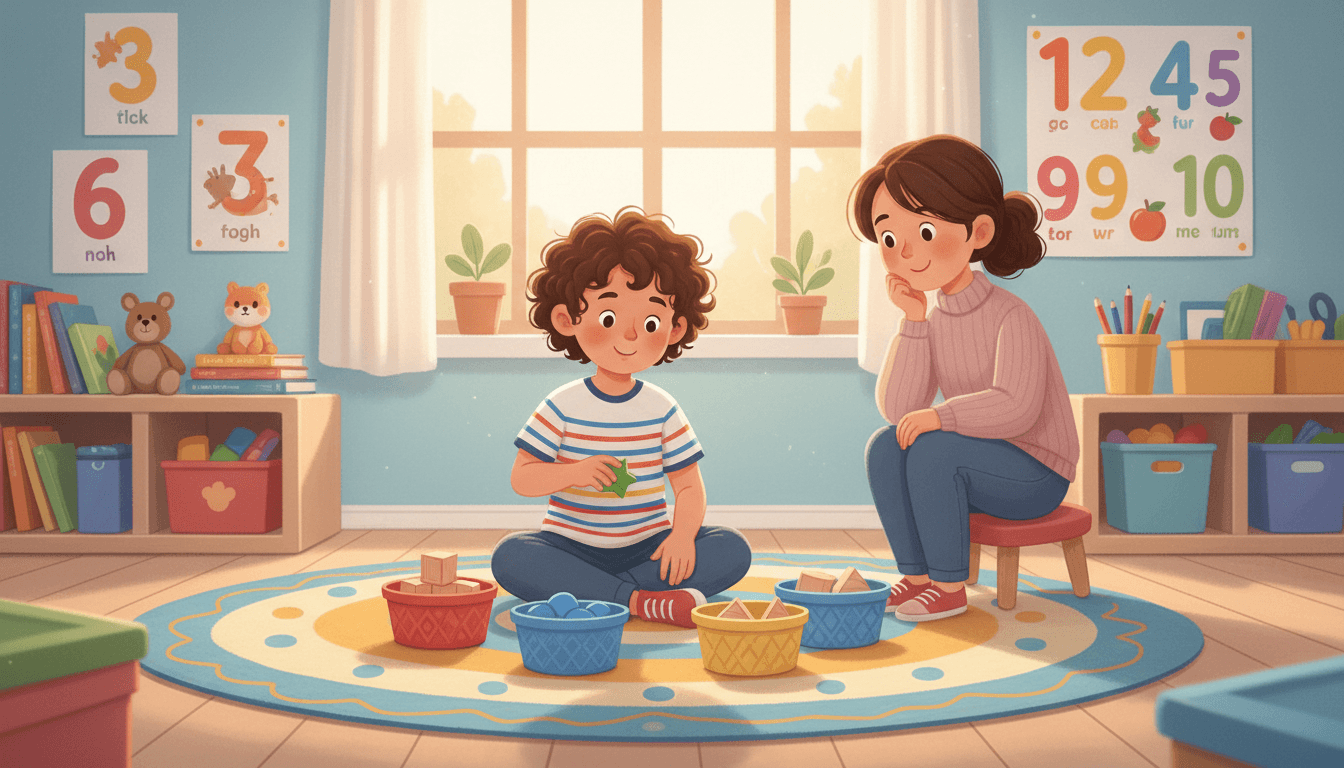
Pre-K Math Activities: Number Sense Before Kindergarten
Get 30 days of free worksheet downloads
Key Takeaways
- Rote counting and meaningful counting are different skills - teach one-to-one correspondence by touching each object while counting and always asking 'how many?' at the end.
- Sorting is a foundational pre-math skill that builds logical thinking; re-sorting the same objects by a different attribute teaches flexible categorical reasoning.
- AB, ABB, and ABC patterns with blocks, beads, or movements introduce algebraic thinking - translating the same pattern across different materials deepens abstract understanding.
- By the end of pre-K, children should count to 10 with one-to-one correspondence, recognize numerals 1-5, and compare groups using 'more,' 'less,' and 'same.'
- A running math commentary during daily life - counting birds, grapes, or plates out loud - builds number sense faster than structured activities alone.
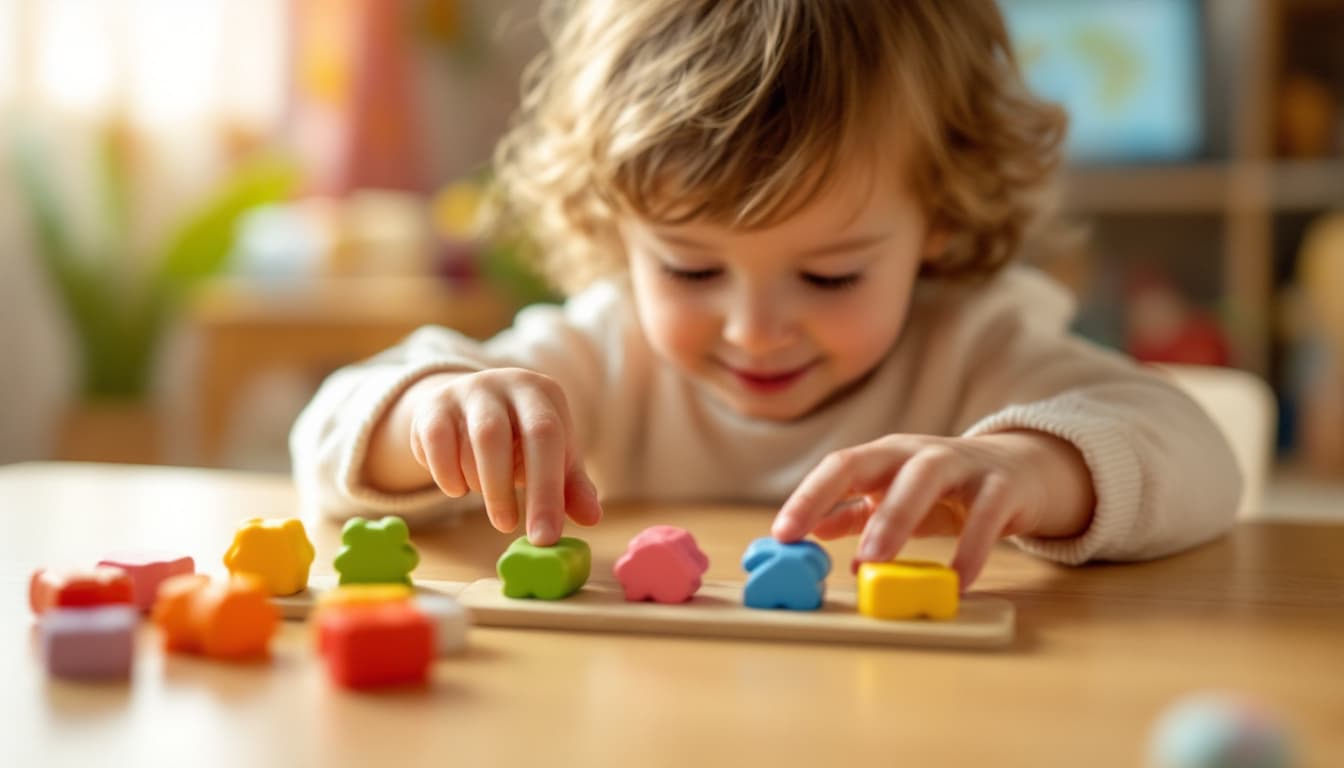
Here's something that might surprise you: your preschooler is already doing math. Every time they sort their toys by color, count the stairs on the way to bed, or notice that one cookie is bigger than the other, they're building the foundation for everything that comes next.
The trick isn't to push formal math too early. It's to notice the math that's already happening and gently expand on it.
What Pre-K Math Really Looks Like
Forget flashcards and drills. Pre-K math is sensory, playful, and embedded in everyday life.
At this age, number sense is the big goal. That means understanding that numbers represent quantities, that quantities can be compared, and that the world is full of patterns and categories. It's not about writing equations or memorizing facts.
The research is pretty clear on this: children who enter kindergarten with strong number sense do better in math all the way through elementary school. But "strong number sense" doesn't mean your 4-year-old needs to count to 100. It means they understand that "three" is three things, not just a word that comes after "two."
So what does pre-K math actually look like? It looks like play. Stacking blocks to see which tower is taller. Setting the table and counting out forks. Sorting buttons into piles. Singing songs with numbers in them.
That's the curriculum. Honestly, it's that simple.
Free Counting Worksheets


Counting Activities That Build Real Understanding
Most preschoolers can recite numbers in order pretty early. "One, two, three, four, five..." sounds impressive at a family dinner. But rote counting (saying numbers in order) and meaningful counting (understanding that each number represents one more thing) are two very different skills.
The skill you're building is called one-to-one correspondence. That means touching one object and saying one number. It sounds obvious, but watch a 3-year-old count a pile of blocks. They'll probably skip some, count others twice, and announce a total that doesn't match reality. That's completely normal.
Here's how to build real counting skills:
Count everything, slowly. Point to each object as you count it together. Move counted objects to a separate pile. "One... two... three. We have three apples!"
Ask "how many?" after counting. This is called cardinality, the understanding that the last number you said tells you the total. Many young children will count to five and then, when asked "how many?", start counting again. They don't yet understand that "five" answers the question.
Count objects in a line first. Scattered objects are harder to track. Start with items in a row, then move to messy arrangements later.
Count actions, not just things. "Let's clap three times." "Jump five times." "Take two steps forward." Counting movements helps kids understand that numbers apply to more than just physical objects.
Use your fingers constantly. Hold up three fingers. Ask your child to match. Finger counting is probably the most underrated math tool for preschoolers, and it builds a physical sense of quantity that stays with them for years.
Number Recognition Games
Recognizing written numerals (knowing that "5" is the symbol for five) is a separate skill from counting. Some preschoolers pick this up quickly. Others need more time. Both are fine.
Number hunts. Walk around the house or neighborhood and spot numbers. House numbers, clocks, calendars, remote controls. "Can you find a 3?" Kids love this one because it turns into a game immediately.
Tactile numbers. Form numbers out of playdough. Trace numbers in sand or shaving cream. The physical act of shaping a numeral helps lock it into memory in a way that worksheets can't.
Number matching. Write numbers 1-5 on index cards. Put 1-5 dot stickers on other cards. Your child matches the numeral to the quantity. Start with 1-5, then expand to 10 when they're ready.
Sing counting songs. "Five Little Monkeys," "Ten in the Bed," "This Old Man." Songs create a rhythmic structure that helps numbers stick. There's a reason teachers have been using them forever.
Don't rush past 10. It's tempting to push toward 20 or higher. But a child who deeply understands 1-10 is better prepared for kindergarten than one who can rattle off numbers to 50 but doesn't know what "seven" actually means.
Sorting and Classifying
Sorting is secretly one of the most important pre-math skills. When a child sorts, they're learning to observe attributes, create categories, and think logically. That's the foundation of data analysis, algebra, and geometry, all disguised as play.
Start with obvious categories:
- Sort blocks by color
- Sort animals into "farm" and "zoo"
- Sort laundry into "socks" and "not socks"
Then make it more interesting:
- Sort by size (big, medium, small)
- Sort by shape (circles vs. squares)
- Sort the same objects two different ways ("First we sorted by color. Now let's sort by size!")
That last one is key. Re-sorting the same collection by a different attribute requires flexible thinking. It teaches kids that one object can belong to multiple categories depending on how you look at it. A red triangle is red AND a triangle. A big blue circle is big AND blue AND a circle.
Give your child a bowl of mixed items, maybe buttons, pasta shapes, or toy cars, and just say "put the ones that go together in piles." Then ask, "Why did you put those together?" Their answers will surprise you.
Patterns Patterns Patterns
Patterns are the gateway to algebraic thinking, and preschoolers are natural pattern-seekers.
Start with AB patterns: red, blue, red, blue, red, blue. Use blocks, beads, stickers, or even body movements (clap, stomp, clap, stomp).
Once AB feels easy, try:
- ABB patterns: red, blue, blue, red, blue, blue
- ABC patterns: red, blue, green, red, blue, green
- Growing patterns: one clap, two claps, three claps (these are harder and more appropriate for older preschoolers)
The most powerful pattern activity is simple: make a pattern and ask your child what comes next. Then let them make a pattern for you. Taking turns keeps it playful and gives them ownership.
Translate patterns between materials. If you made a red-blue-red-blue pattern with blocks, can you make the same pattern with sounds? Clap-snap-clap-snap? This shows kids that the pattern itself is the idea, not the specific objects. That's abstract thinking, happening right there on the living room floor.
Look for patterns in daily life too. Stripes on a shirt. Tiles on the floor. Day and night. Seasons. The world is full of repetition, and pointing it out teaches kids to see structure everywhere.
When to Worry (And When Not To)
Parents ask me this constantly: "Is my child behind in math?"
Here's what's developmentally appropriate by the end of pre-K (around age 5):
- Counts to 10 with one-to-one correspondence
- Recognizes some written numerals (1-5 at minimum)
- Compares groups using words like "more," "less," "same"
- Sorts objects by at least one attribute
- Copies a simple pattern
- Understands concepts like "first" and "last"
If your child isn't there yet, that's probably okay. Development at this age is wildly uneven. A child who's behind in counting might be ahead in spatial reasoning. A child who can't recognize written numbers might be a pattern genius.
When to talk to your pediatrician: If your child shows no interest in counting at all by age 4, can't sort objects into basic categories, or seems unable to grasp the concept of "more vs. less" after repeated exposure. These could signal a need for extra support, and early intervention makes a huge difference.
But for most kiddos? They just need more play, more counting, and more time. Don't turn math into a pressure cooker. The goal is curiosity, not mastery.
Keep Reading
- Teaching Counting to Preschoolers: Activities That Build Number Sense
- How to Teach Number Sense to Kindergartners: Activities That Build Real Understanding
- Number Activities for Pre-K: Counting, Sorting, and Early Math
- Math Manipulatives, Digital and Physical, in K-5
Practice Activities for Home
You don't need fancy materials. Here are activities you can do with stuff you already have:
The counting jar. Put a different number of small objects (buttons, coins, dried beans) in a jar each day. Your child dumps them out, counts them, and writes the number (or tells you, and you write it). Over time, increase the quantity.
Snack math. Give your child 10 crackers. "Can you make two groups that are the same?" "Can you give me three and keep the rest? How many do you have?" Every snack is a math opportunity.
Nature counting walk. "Let's find four sticks. Now let's find two rocks. Which pile has more?" Outdoor math feels like adventure, not school.
Board games and card games. Chutes and Ladders, Candy Land, Hi Ho Cherry-O. These games involve counting, one-to-one correspondence, and comparing quantities. They're also fantastic for teaching kids to take turns and handle losing, but that's a different blog post.
Printable counting and number practice pages are great for kids who enjoy sitting down with crayons. Look for pages that ask them to count objects and circle the right number, or trace numerals with starting dots.
Read math picture books. "Ten Black Dots" by Donald Crews. "The Very Hungry Caterpillar" (counting + days of the week). "Chicka Chicka 1 2 3." Books make numbers feel like part of storytelling, not a separate subject.
The most important thing you can do? Talk about numbers out loud. "I see two birds on that fence." "You have five grapes left." "We need three more plates." This running math commentary builds number sense faster than any structured activity.
Your preschooler doesn't need to be a math prodigy before kindergarten. They just need to feel comfortable around numbers, curious about patterns, and confident that math is something they can do. Everything else builds from there 🧩

Adi Ackerman
Head Teacher
Adi is the Head Teacher at ClassWeekly, with years of experience teaching elementary students. She designs our curriculum-aligned worksheets and writes practical guides for teachers and parents.
Keep Reading
Ready to download? Try ClassWeekly free for 30 days.
Unlimited worksheets for PreK through 5th grade. Cancel anytime.