
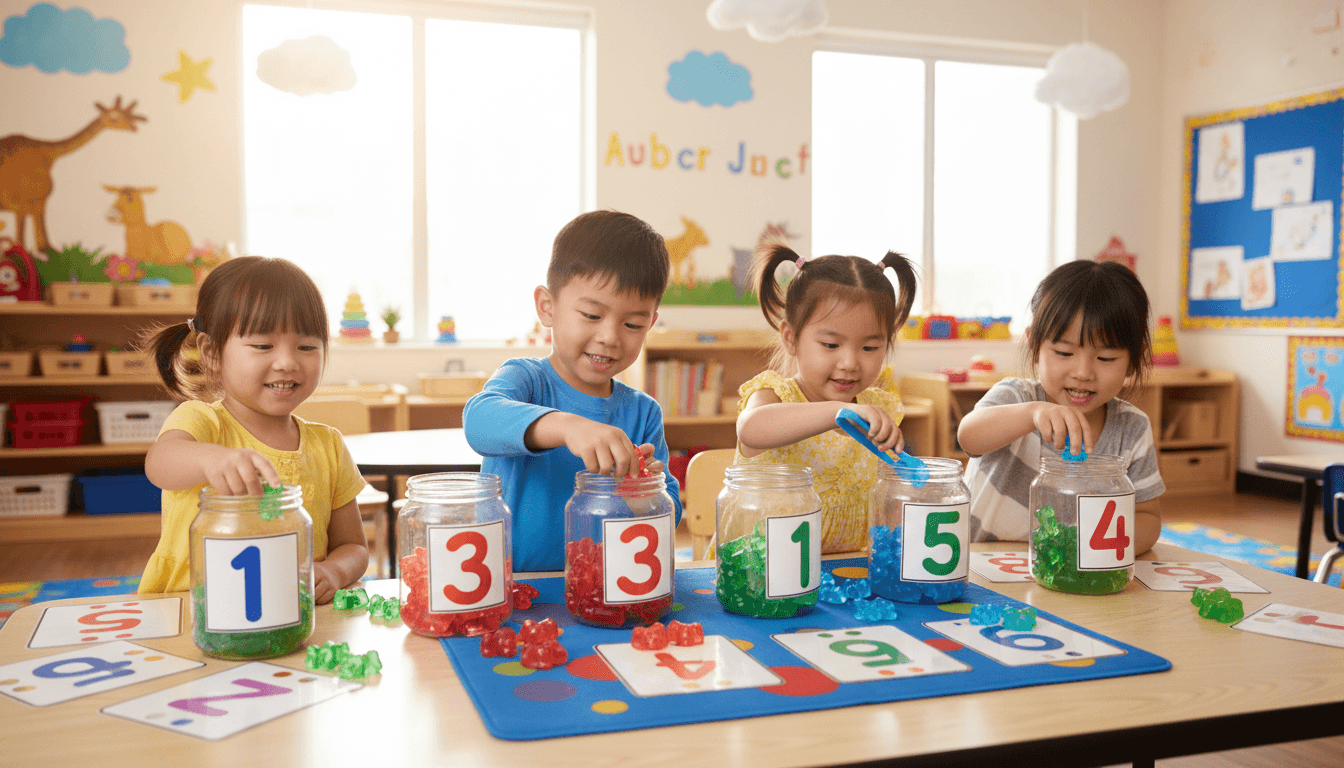
Number Activities for Pre-K: Counting and Early Math
Get 30 days of free worksheet downloads
Key Takeaways
- One-to-one correspondence - touching one object per number word - is the single most important pre-math skill for preschoolers to master before anything else.
- Subitizing, or instantly recognizing a quantity without counting, is a critical early math skill that can be built through dot card flash games starting with just 1-3 dots.
- Preschoolers learn math best through hands-on play: counting everyday objects, sorting by color or size, and building patterns with blocks all lay a stronger foundation than pencil-and-paper work.
- The teen numbers (11-19) are genuinely harder in English because they don't follow the same logical pattern as 21-29, so it's normal for preschoolers to skip or mix them up.
- Simple worksheets (tracing numbers, matching quantities to numerals) are appropriate around age 4 as a supplement to hands-on learning, but should always be short and never forced.
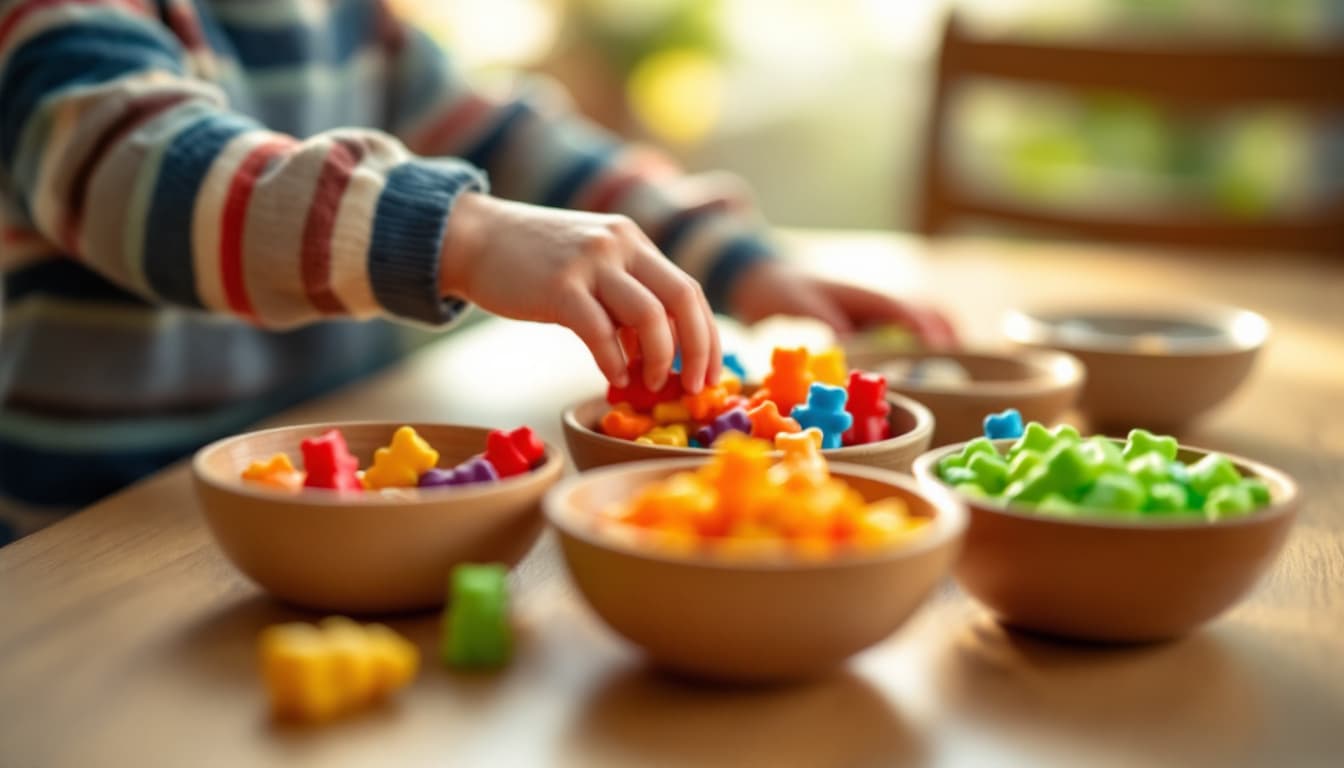
Math for preschoolers? Forget worksheets (at least for now). Forget sitting at a desk. Forget anything that looks like "school." Three and four-year-olds learn math by touching, moving, playing, and exploring.
Here's the thing: your little ones are already doing math. Every time they sort blocks by color, count their goldfish crackers, or argue about who has "more," they're building math skills. Our job is to notice it, name it, and extend it.
What Pre-K Math Actually Looks Like
According to early learning standards, preschoolers should be working on:
- Counting to 10 (and eventually 20)
- One-to-one correspondence (touching each object while counting)
- Number recognition (seeing "5" and knowing it's "five")
- Comparing quantities (more, less, same)
- Sorting and classifying (by color, shape, size)
- Recognizing basic shapes (circle, square, triangle, rectangle)
- Patterning (red, blue, red, blue, red, ___)
Notice what's NOT on the list: writing numbers, addition, subtraction, or anything involving pencils. That comes later.
Free Learning Numbers Worksheets


10 Number Activities for Preschoolers
1. Counting Everything
Count everything. All the time. Out loud.
- Steps as you climb them (1, 2, 3, 4...)
- Grapes on the plate before eating
- Cars in the parking lot
- Buttons on a shirt
- Claps in a song
The more counting opportunities in a day, the faster the concept solidifies. Kids need to hear and say numbers hundreds (maybe thousands) of times before counting feels automatic.
2. One-to-One Correspondence Games
This is THE most important pre-math skill. It means touching ONE object for each number word.
Activity: Set up 5 cups. Give kids 5 small toys. "Can you put one toy in each cup?" If they can, they have one-to-one correspondence.
If they struggle: They're putting multiple objects in some cups and skipping others. This is normal for 3-year-olds. Practice with smaller quantities (3 cups, 3 objects).
3. The Counting Jar
Put objects in a clear jar. Everyone guesses how many. Then dump them out and count together. Change the objects weekly.
Week 1: 5 blocks. Week 2: 8 buttons. Week 3: 12 cotton balls.
Kids start developing estimation skills without even realizing it.
4. Number Hunts
Walk around the school or neighborhood. Find numbers everywhere:
- Room numbers
- Exit signs
- Clocks
- License plates
- Price tags in the play kitchen
Take photos or draw what you find. Make a "Numbers Are Everywhere" poster.
5. Sorting Party
Give kids a mixed-up pile of objects. Let them sort however they want.
Some will sort by color. Some by size. Some by shape. Some by "type" (all the animals together). Every method is valid.
Then ask: "Can you count how many are in each group?" Now sorting meets counting.
6. Dot Card Flash
Make cards with dots (like a die). Flash a card for 2 seconds. "How many dots?" This builds subitizing, which is the ability to recognize a quantity without counting. It's a critical early math skill.
Start with 1-3 dots. Work up to 5. Some kids will eventually subitize up to 8 or 9 using familiar dot patterns.
7. Pattern Trains
Use colored blocks, beads, or stickers. Create a pattern: red, blue, red, blue. Ask the child to continue it.
Start with AB patterns (two colors). Then try ABB (red, blue, blue, red, blue, blue). Then ABC.
Patterns are pre-algebra. Seriously. Recognizing and extending patterns is foundational mathematical thinking.
8. Comparing With Bears
Use counting bears or any small objects. Make two groups.
"This pile has 3 bears. This pile has 5 bears. Which has MORE?"
Use the words: more, less, fewer, same, equal. These are math vocabulary words that preschoolers absolutely can learn.
9. Number Sensory Bins
Fill a bin with rice or sand. Hide number cards or small objects inside. Kids dig, find, count, and sort what they discover.
Sensory + math = engagement for young learners.
10. Counting Books
Read counting books daily. There are wonderful ones:
- Books that count 1-10 with pictures
- Books that count backward
- Books with hidden objects to find and count
Reading about numbers reinforces counting in a low-pressure, enjoyable way.
When to Introduce Worksheets
Around age 4, many preschoolers are ready for simple, engaging worksheets:
- Counting objects and circling the right number
- Tracing numbers
- Matching quantities to numerals
- Coloring by number
Keep it short (one page at a time) and optional (never forced). Worksheets should supplement hands-on learning, not replace it.
What NOT to Worry About
"My 3-year-old can't count to 10." Most 3-year-olds are still working on counting to 5 with accuracy. Reciting numbers and actually counting objects are different skills. Focus on one-to-one correspondence, not how high they can recite.
"They always skip 15." Many preschoolers have trouble with the "teen" numbers. 11-19 are weird in English (they don't follow the logical pattern of 21-29). Be patient. It comes with exposure.
"They count things twice." This means they haven't mastered one-to-one correspondence yet. Have them move objects into a separate pile as they count them. "Touch it, say the number, move it."
For Parents: Make It Part of Your Day
You don't need special materials. Just count during daily routines:
- "Let's count your strawberries before you eat them."
- "How many shoes are by the door?"
- "Can you put 3 napkins on the table?"
- "You have 4 books. If we read one, how many are left?"
Every counting moment is a math moment.
Keep Reading
- Teaching Counting to Preschoolers: Activities That Build Number Sense
- Pre-K Math Activities: Building Number Sense Before Kindergarten
- How to Teach Number Recognition to Toddlers and Preschoolers
- Math Manipulatives, Digital and Physical, in K-5
The Bottom Line
Pre-K math should feel like play. Because for preschoolers, play IS learning. Count crackers, sort crayons, build patterns with blocks. That's all math.
The worksheets and formal instruction will come. Right now, your little ones just need to explore numbers in ways that feel natural and fun. 💕
When they're ready for a little structured practice, our pre-K number worksheets are designed for little hands and short attention spans, with big pictures, simple counting, and plenty of color.

Adi Ackerman
Head Teacher
Adi is the Head Teacher at ClassWeekly, with years of experience teaching elementary students. She designs our curriculum-aligned worksheets and writes practical guides for teachers and parents.
Keep Reading
Ready to download? Try ClassWeekly free for 30 days.
Unlimited worksheets for PreK through 5th grade. Cancel anytime.