

Free Addition Worksheets for Kindergarten and 1st Grade
Get 30 days of free worksheet downloads
Key Takeaways
- Addition instruction should follow three stages - concrete (objects), pictorial (pictures), and abstract (number sentences) - and worksheets work best when matched to the stage the child is actually at.
- Kindergartners should reach fluency within 5 by mid-year and within 10 by year-end, using picture-based and ten-frame worksheets before moving to written equations.
- First graders build on kindergarten addition by using number lines, doubles, near-doubles, and making-10 strategies to develop fluency within 20.
- Letting kids use fingers during addition is a legitimate strategy, not a crutch - fluency develops naturally once the mental model is solid.
- Word problems are essential at the first-grade level because they teach students that addition has real-world meaning, not just abstract numerical answers.
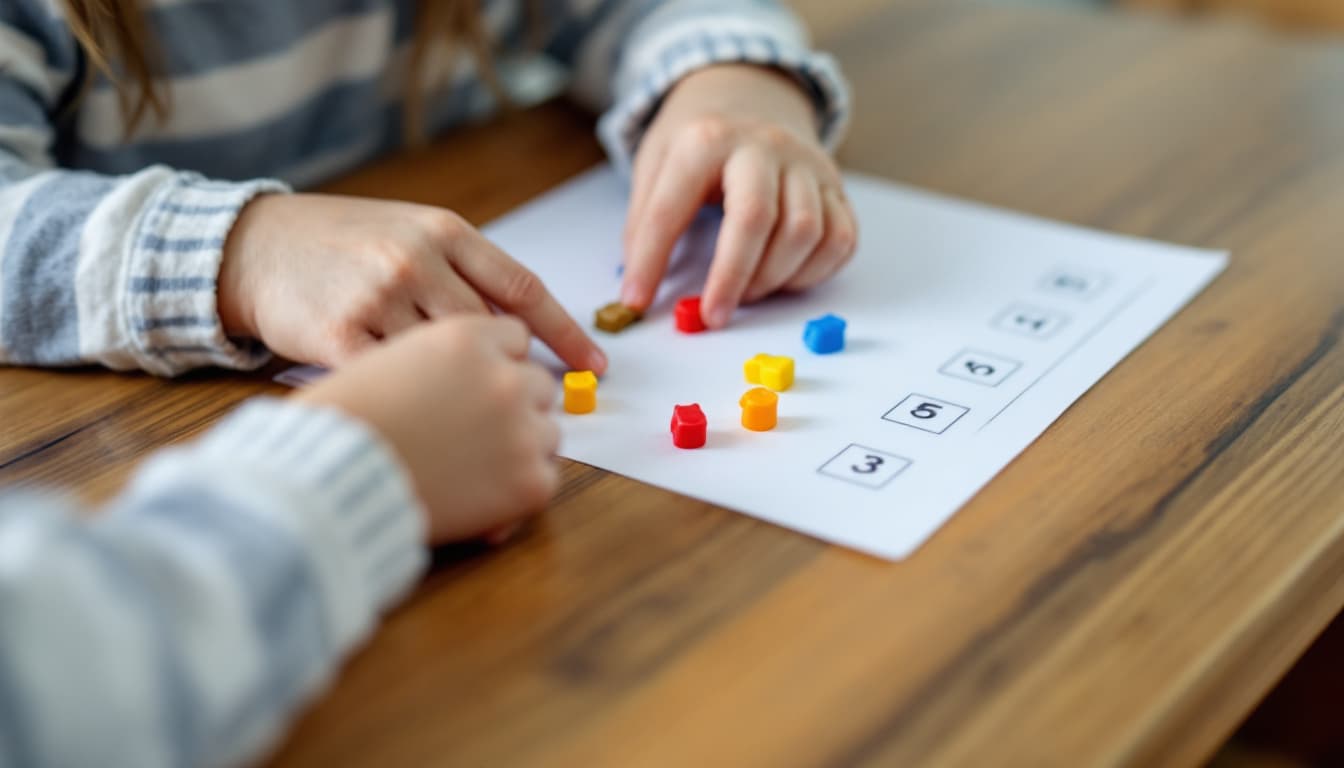
Teaching addition starts with objects, not equations. A five-year-old can figure out that 3 blocks plus 2 blocks equals 5 blocks long before they can write "3 + 2 = 5" on paper. The best addition worksheets at this level meet kids where they are: pictures, counts, and gradual movement toward abstract symbols.
Here's how the progression works, and which worksheets to use at each stage.
The Stages of Early Addition
Stage 1: Concrete. Kids use physical objects, fingers, or counters. No paper needed yet. This is where you start.
Stage 2: Pictorial. Kids look at pictures of objects and count them. "Here are 3 apples. Here are 2 more apples. How many are there?" This is where picture addition worksheets live.
Stage 3: Abstract. Kids read and write number sentences like 3 + 2 = 5 without pictures. This is the goal, but don't rush it.
The worksheets below are organized by these stages so you can pick where your student actually is, not where you think they should be.
Free Kindergarten Addition Worksheets


Kindergarten Addition Worksheets
Picture Addition (Adding Within 5)
The first worksheets to use are picture-based. Your student counts objects in two groups and writes or circles the total.
Good formats at this level:
- Count and add (two groups of animals, fruits, or shapes)
- Fill-in-the-blank: "3 frogs + 1 frog = ___"
- Match equations to pictures
Avoid timed formats at this stage. The goal is understanding, not speed.
Explore our kindergarten addition practice pages for structured printable sheets that progress from pictures to number lines.
Adding Within 10
Once students are comfortable adding within 5, expand to within 10. The same picture-based formats work. You can also introduce:
- Ten frames. Students see dots on a ten-frame and add. This builds a strong mental model of numbers that helps with all future math.
- Number bonds. Two smaller numbers combine to make one total. "5 is made of 3 and ___."
- Simple equations with blank answers. 4 + 3 = ___
First Grade Addition Worksheets
First graders move toward fluency: they should be able to add within 10 quickly and start working within 20.
Adding Within 20
At this level, worksheets introduce:
- Number lines. Students start at one number and hop forward. "Start at 7. Jump forward 5. Where do you land?"
- Doubles. 2 + 2, 3 + 3, 4 + 4. These become important mental math anchors.
- Near doubles. 3 + 4 is just one more than 3 + 3.
- Making 10. 8 + 2, 7 + 3, 6 + 4. Students learn to see these combinations instantly.
Explore our first grade addition worksheets for sheets targeting these specific strategies.
Word Problems
Once your student is comfortable with number sentences, introduce word problems. First graders work with simple one-step problems: "Maya has 6 stickers. She gets 3 more. How many does she have now?"
Common mistakes at this stage:
- Adding when the problem calls for subtraction (kids don't always read carefully)
- Forgetting to write the total after solving
- Skipping the equation and just writing the answer
Word problems are where kids learn that math means something. Even simple ones are worth spending time on.
Tips for Using Addition Worksheets at Home
Keep sessions short. Ten minutes of focused practice beats a 30-minute session that ends in tears.
Let them use fingers. Fingers are a legitimate math tool, not a crutch. Most kids naturally stop using them once they've built fluency.
Say the equation out loud. "Four plus two equals six." Hearing the language reinforces the concept.
Don't jump ahead. If your student consistently needs to count every object, that's fine. The goal is to build the mental model first. Speed comes later.
Keep Reading

Adi Ackerman
Head Teacher
Adi is the Head Teacher at ClassWeekly, with years of experience teaching elementary students. She designs our curriculum-aligned worksheets and writes practical guides for teachers and parents.
Keep Reading
Ready to download? Try ClassWeekly free for 30 days.
Unlimited worksheets for PreK through 5th grade. Cancel anytime.