
Subtraction in Kindergarten: How to Teach It
Get 30 days of free worksheet downloads
Key Takeaways
- Start with verbal stories before writing any subtraction problems so kindergartners can picture the action of taking away.
- The concrete-to-abstract progression (objects first, then drawings, then numbers) should span weeks, not days.
- Common Core K.OA.A.2 requires kindergartners to solve subtraction word problems within 10 using objects, drawings, or equations.
- Counting backward is a big cognitive shift for 5-year-olds, so visual supports like number lines and ten frames reduce counting errors.
- Never introduce problems where the subtrahend is larger than the minuend at this stage - negative number confusion derails learning.

As kindergarten teachers, we know that subtraction can feel trickier than addition for our little ones. Addition is "getting more." Kids understand that. But subtraction? "Taking away" can feel confusing, even a little sad, for a five-year-old.
The good news: with the right approach, kindergartners can absolutely learn subtraction. They just need it taught differently than you might expect.
Why Subtraction Feels Harder
There's a reason kids struggle more with subtraction than addition. It requires backward thinking. Instead of counting forward (which they've been doing since they were toddlers), they need to count backward or think about what's missing.
That's a big cognitive shift for a 5-year-old. Be patient with it.
Free Kindergarten Subtraction Worksheets


Start With Stories, Not Numbers
Before you ever write a subtraction problem on the board, tell stories.
"There were 5 birds on a fence. 2 flew away. How many are left?"
Stories give subtraction a context. Kids can picture the birds. They can hold up fingers. The math makes sense because it's connected to something real.
Try these story starters:
- "You had 4 cookies. You ate 1. How many are left?"
- "There were 6 crayons on the table. 3 rolled onto the floor."
- "Mom had 5 balloons. The wind blew 2 away."
Spend a full week on stories before introducing any written problems. Trust me on this one.
The Three Stages of Learning Subtraction
Stage 1: Concrete (Hands-On)
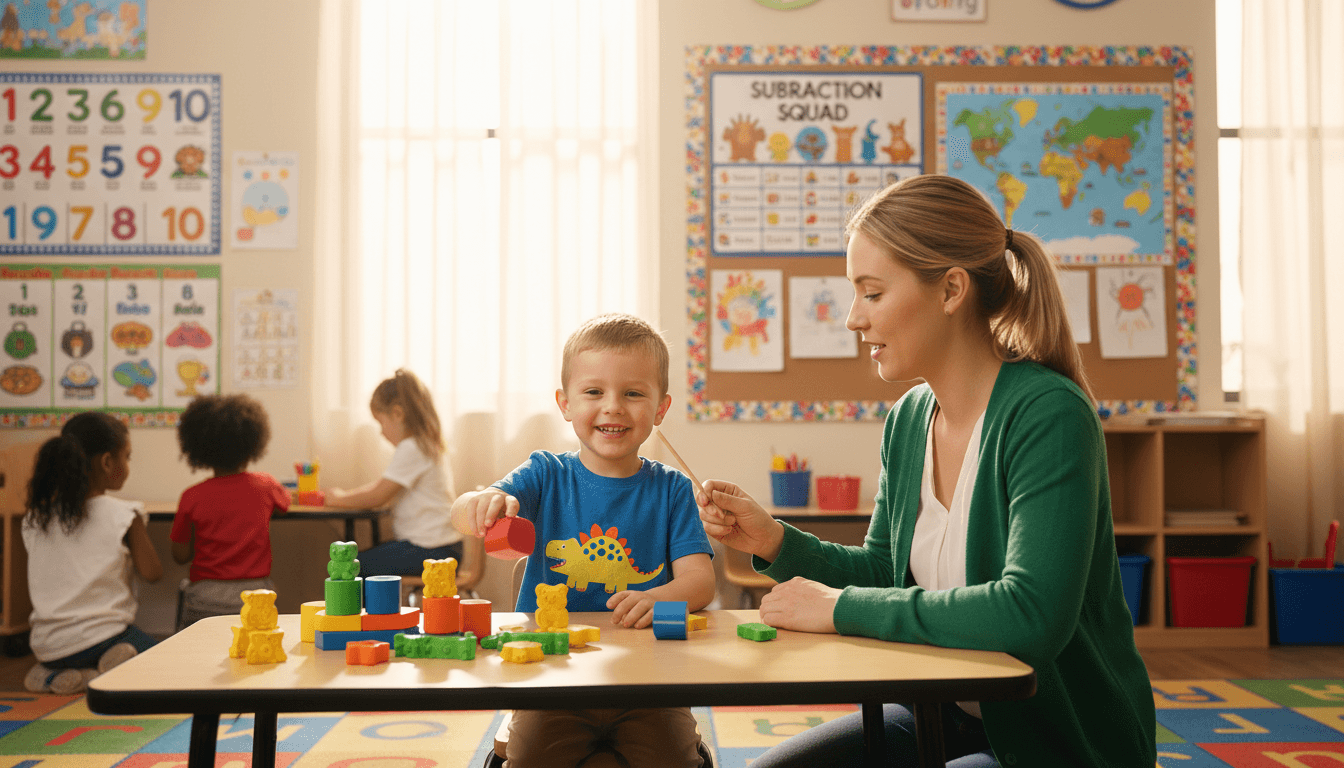
Use physical objects that kids can actually remove.
- Give them 7 blocks. Ask them to take away 3. Count what's left.
- Put 5 goldfish crackers on a plate. Let them "eat" 2. How many now?
- Line up 8 toy cars. Drive 4 into the "garage." Count the remaining.
This stage should last several weeks. Not days. Weeks.
Stage 2: Representational (Pictures and Drawings)
Once kids are confident with objects, move to pictures:
- Draw 6 apples. Cross out 2. Count the rest.
- Use stickers. Place 5 on paper. Cover 3 with X marks.
- Ten frames with counters removed
This is where worksheets become really valuable. They provide structured practice at exactly the right level.
Stage 3: Abstract (Numbers Only)
This is where you see problems like 5 - 2 = ___. But here's the thing: many kindergartners won't reach this stage until late in the year, and that's perfectly fine.
Don't rush to abstract. A child who deeply understands subtraction with objects will pick up the abstract notation quickly when they're ready.
5 Activities That Make Subtraction Click
-
Bowling with plastic cups. Set up 10 cups. Roll a ball. Count how many fell. "You knocked down 3! How many are still standing?"
-
Subtraction finger plays. "Five little monkeys jumping on the bed. One fell off and bumped his head." Every verse is a subtraction problem.
-
Playdough math. Make 6 balls of playdough. Squish 2. How many are left? Kids love the squishing part.
-
Snack time math. Give kids 8 goldfish crackers. They eat some. They count what's left before eating more. Math and snack combined.
-
Domino subtraction. Hold a domino vertically. The bigger number minus the smaller number. Simple and tactile.
What Kindergartners Should Know by Year's End
According to Common Core standard K.OA.A.2, kindergartners should be able to:
- Solve subtraction word problems within 10
- Use objects, drawings, or equations to show their work
- Decompose numbers less than or equal to 10
Not sure where your students are? Our kindergarten math worksheets can help you assess and practice at the right level.
Common Mistakes to Watch For
Confusing addition and subtraction. Some kids will add when they should subtract. Use the words "how many are left?" and "take away" consistently so they learn the vocabulary of subtraction.
Counting errors. Kindergartners often miscount when counting backward. Use a number line or ten frame as a visual support.
Negative number panic. When a child sees 3 - 5, they freeze. At this level, always keep the first number larger. That complexity comes later.
Keep Reading
- How to Teach Ordinal Numbers to Kindergartners: Activities, Tips, and What Actually Works
- Best Math Games for the Classroom That Kids Actually Love
- How to Teach Addition to Kindergartners: Hands-On Activities That Build Understanding
One More Thing
Subtraction doesn't have to be the hard part of kindergarten math. When you start with stories, use real objects, and give kids time to build understanding at each stage, it clicks.
Pick one activity from this list and try it this week. You might be surprised how quickly your kiddos catch on.
Browse our full collection of kindergarten subtraction worksheets for ready-to-print practice that follows the concrete-to-abstract progression.

Adi Ackerman
Head Teacher
Adi is the Head Teacher at ClassWeekly, with years of experience teaching elementary students. She designs our curriculum-aligned worksheets and writes practical guides for teachers and parents.
Keep Reading
Ready to download? Try ClassWeekly free for 30 days.
Unlimited worksheets for PreK through 5th grade. Cancel anytime.