
Best Math Games for the Classroom That Kids Actually Love
Get 30 days of free worksheet downloads
Key Takeaways
- A single round of a card game can generate 30 or more mental math problems voluntarily completed
- Games remove performance pressure and change the emotional relationship students have with math
- The best math games have math as the central mechanic, not just decoration on a board game
- Partner games like Salute build algebraic thinking by requiring students to work backward from the answer
- Pair games with targeted practice pages immediately after so the mental math transfers to written work

Let's be honest about something: timed math drills don't work for most kids. They build anxiety faster than fluency, and they turn math into something kids dread instead of enjoy.
But here's the thing. Kids need practice. A lot of it. There's no shortcut around repetition when building math fluency. The question isn't whether to practice, it's how to make practice feel like play.
Games solve this problem. A child who groans at a worksheet will beg for "one more round" of a card game that requires the exact same math skills. Same repetitions, completely different experience.
Why Games Beat Drill for Math Fluency
Research on math fluency is pretty clear: students build speed through frequent, low-stress repetition in meaningful contexts. Games check all three boxes.
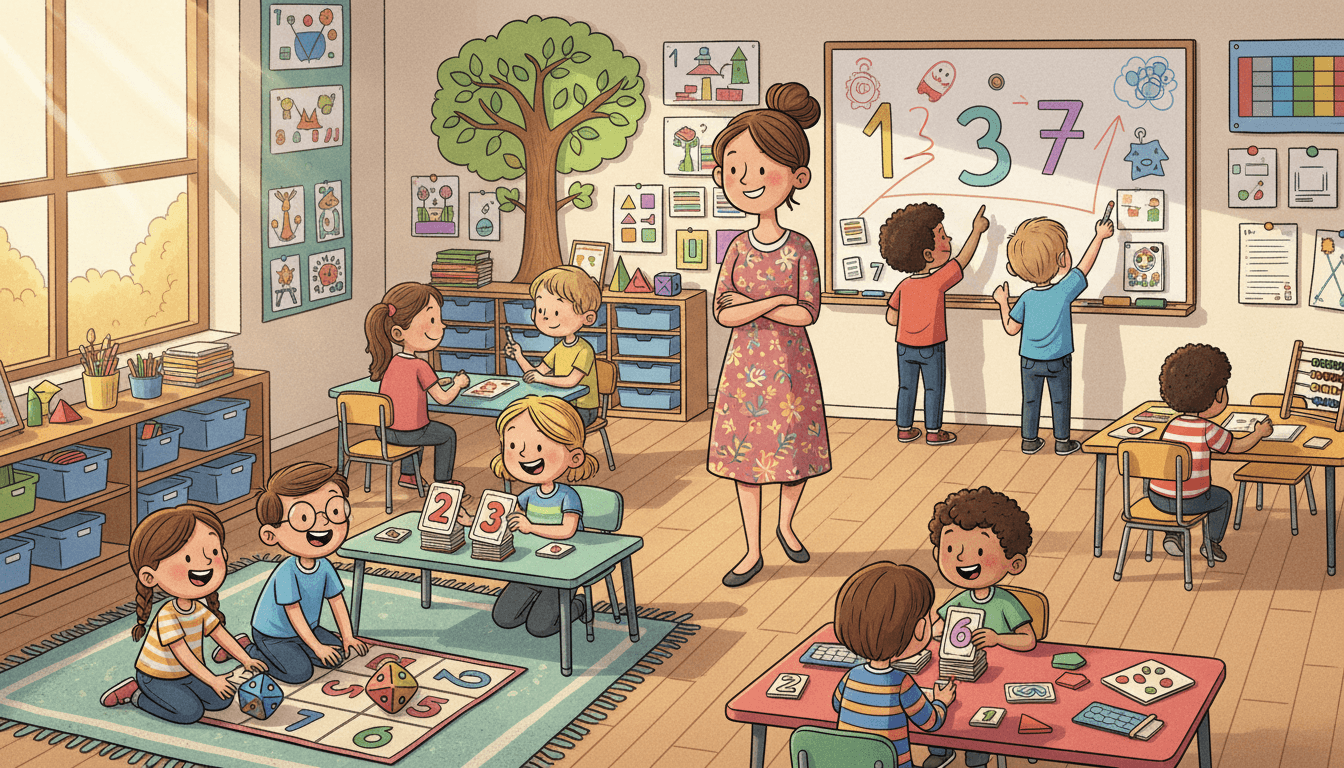
Frequent repetition. A single round of a card game might involve 20-30 mental math calculations. Play three rounds and that's 60-90 practice problems, voluntarily completed, with enthusiasm.
Low stress. Games remove the performance pressure of worksheets and timed tests. When a child makes a mistake in a game, they just lose a point or a turn. They don't get a red X or a bad grade. That changes the emotional relationship with math entirely.
Meaningful context. In a game, math serves a purpose. You're adding because you want to win, not because someone told you to. That intrinsic motivation is powerful. Kids remember math facts they've used strategically in a game far better than facts they've circled on a page.
There's another benefit teachers love: games differentiate naturally. When a struggling student plays against a stronger student, the struggling student sees strategies in action. And the stronger student deepens understanding by having to think through their moves more carefully.
One caveat: games work best when the math is the central mechanic, not just decoration. "Roll a die and move your piece" isn't really a math game. "Roll two dice, add them, and decide whether to keep your total or risk another roll" requires genuine mathematical thinking.
Free Kindergarten Addition Worksheets


Card Games That Build Number Sense
A standard deck of playing cards is probably the most versatile math tool in your classroom. Remove the face cards (or assign them values: Jack = 11, Queen = 12, King = 13) and you're ready.
War (with a math twist). Two players each flip a card. Whoever has the higher number takes both cards. Simple, but effective for comparing numbers. Addition War: both players flip two cards each, add them, and the higher sum wins. Multiplication War: same thing, but multiply. You've just created hundreds of practice problems disguised as a game.
Make 10. Spread 20 cards face-up. Players take turns finding pairs that add to 10. Remove the pairs. Keep going until no more pairs can be made. Great for kindergarten and first grade, where making 10 is a critical benchmark.
Close to 100. Each player draws 6 cards. Using any 4 of them (two as a 2-digit number, two as another 2-digit number), try to make a sum as close to 100 as possible without going over. This builds place value and estimation at the same time. It's perfect for second and third graders.
Fraction War (for 3rd grade+). Each player flips two cards. The first card is the numerator, the second is the denominator. Compare the fractions. Bigger fraction wins. This requires actually understanding fraction size, not just memorizing rules.
Go Fish for Fact Families. Modify Go Fish so that instead of matching identical numbers, players ask for the card that completes a fact. "I have a 7 and a 3. Do you have a 21?" (Because 7 x 3 = 21.) This works for addition or multiplication families.
Dice Games for Addition and Multiplication
Dice are cheap, portable, and endlessly flexible. Keep a cup of dice at every table group.
Pig (the classic). Players take turns rolling one die and adding to their running total. They can roll as many times as they want, BUT if they roll a 1, they lose everything from that turn. First to 100 wins. This builds addition fluency and introduces probability and risk assessment.
Double Pig. Same as Pig, but with two dice. If either die shows a 1, you lose your turn total. If both show 1, you lose your ENTIRE score. The stakes go up, and so does the math.
Target number. Roll three dice. Using addition, subtraction, multiplication, or division, try to combine the three numbers to hit a target number (say, 24). This is open-ended problem solving at its best. Multiple solutions are possible, which keeps it interesting.
Times table knockout. Roll two dice and multiply. If you get the answer right, you score the product. If wrong, you score zero. Keep a running total for 10 rounds. Highest score wins. Students self-correct because they want to score points.
Place value dice. Roll three dice. Arrange them to make the largest possible 3-digit number. Then arrange them to make the smallest. What's the difference? This works with any number of dice and scales beautifully from first grade (2 dice) to fourth grade (5+ dice).
Partner Games for Any Skill Level
Partner games are the sweet spot for daily practice. They're quick to set up, easy to manage, and naturally engaging.
Salute. Three players. Two players each hold a card to their forehead (they can't see their own card). The third player announces the sum (or product) of the two cards. Each player tries to figure out their own card. This requires working backward from the answer, which builds algebraic thinking.
Nim (strategy game). Place 21 counters on the table. Players alternate taking 1, 2, or 3 counters. The player who takes the last counter loses. There's a winning strategy based on multiples of 4, and watching students discover it is wonderful. Once they crack the code, change the starting number.
Four in a Row (math version). Create a 6x6 grid with numbers. Players take turns rolling two dice, performing an operation (you choose: add, multiply, etc.), and placing a marker on that number. First to get four in a row wins. Simple to make, infinitely replayable.
Top-It. Each player flips a card. The first player to correctly state a math fact about the combined cards wins both. For addition: "5 plus 3 is 8!" For multiplication: "5 times 3 is 15!" Speed matters, but accuracy matters more.
The key to partner games: establish clear rules about sportsmanship before you start. "If you disagree, use counters to check." "The player who lost picks the next game." Setting these expectations up front prevents 90% of game-time conflicts.
Whole-Class Games That Get Everyone Moving
Sometimes you need the whole class engaged at once. These games work for 20-30 students and require almost no materials.
Stand Up, Sit Down. Call out numbers. Students stand if the number is even, sit if odd. Speed up. Change the rule: stand for multiples of 3, sit for everything else. Stand for numbers greater than 50. The rules keep changing, so everyone stays alert.
Buzz. Students count around the circle, one number each. But when they reach a multiple of a target number (say, 5), they say "BUZZ" instead of the number. 1, 2, 3, 4, BUZZ, 6, 7, 8, 9, BUZZ... If someone forgets, they sit down. Last one standing wins. This builds skip counting and multiples recognition.
Around the World. Two students stand. You flash a math fact. First to answer correctly moves on to challenge the next student. The goal is to make it "around the world" (back to where you started). This one is a classic for good reason, but be careful with students who have math anxiety. Make participation optional.
Number line race. Tape a number line on the floor (0-20 for younger kids, 0-100 for older). Call out a math problem. Students race to stand on the answer. Physical movement plus math equals high engagement.
Mystery number. "I'm thinking of a number. It's even. It's greater than 10. It's less than 20. It's in the 3 times table." Students ask yes/no questions or make guesses. The narrowing-down process builds logical reasoning and number properties knowledge.
Low-Prep Games You Can Start Tomorrow
No laminating. No cutting. No Pinterest rabbit holes. These games need 60 seconds of setup.
Whiteboard races. Divide the class into two teams. One player from each team comes to the board. You call a problem. First to write the correct answer scores a point. Erase and repeat. Total time: 5-10 minutes. Total prep: zero.
Math tic-tac-toe. Draw a tic-tac-toe grid on the board with numbers in each square. To claim a square, a player must state a math fact that equals that number. "I claim the 12 square because 3 times 4 is 12." Opponent can challenge if they think it's wrong.
Number of the day. Write a number on the board. Students have 3 minutes to write as many equations as they can that equal that number. Share and compare. "The number is 24. Who found a way using multiplication? Division? Three operations?"
Guess my rule. Sort numbers into two groups on the board without telling students the rule. They raise hands to guess what rule you used. Then a student creates a new rule and sorts while the class guesses. This builds pattern recognition and mathematical reasoning.
Fast facts relay. Students line up in teams. You hold up a flashcard. The first person in line answers. If correct, they go to the back. If wrong, they try again. First team to get all members through wins. Quick, loud, and effective for fact fluency.
Keep Reading
- How to Teach Ordinal Numbers to Kindergartners: Activities, Tips, and What Actually Works
- Teaching Subtraction to Kindergartners: What Actually Works
- How to Teach Addition to Kindergartners: Hands-On Activities That Build Understanding
- Classroom Games That Teach, Not Just Entertain
Pairing Games With Targeted Practice
Games build fluency, but they work best when paired with focused practice that reinforces the same skills.
After a card game session: Send students to their seats with addition practice pages that target the exact same operation they just played. The mental math is fresh, and the practice pages feel easy because they've already been doing the work.
Before introducing a new game: Use a quick mini-lesson to teach or review the underlying skill. If tomorrow's game involves multiplication by 6, spend 10 minutes today on the 6 times table. The game then becomes the practice, not the instruction.
Game journals. After playing, students write: "Today I played [game]. The math skill I practiced was ___. One thing I noticed was ___." This reflection step turns a fun activity into metacognitive learning. It takes 3 minutes and dramatically increases retention.
Differentiate by game choice. Set up three stations: one with a simple addition game, one with a multi-digit addition game, one with a multiplication game. Students rotate, but you can quietly direct specific students to the station that matches their level.
The real power of math games isn't just fluency. It's changing how your kiddos feel about math. When a child associates math with laughter, strategy, and friendly competition instead of silence, stress, and red ink, everything shifts. They start seeing themselves as someone who can do math. And that identity change is worth more than any test score 🎲

Adi Ackerman
Head Teacher
Adi is the Head Teacher at ClassWeekly, with years of experience teaching elementary students. She designs our curriculum-aligned worksheets and writes practical guides for teachers and parents.
Keep Reading
Ready to download? Try ClassWeekly free for 30 days.
Unlimited worksheets for PreK through 5th grade. Cancel anytime.