
Verbs and sentences Worksheets
Written by Adi Ackerman, Head Teacher
Ages 9-10 · 2 worksheets · 2 total pages · Free previews · Print-ready PDFs
Free printable verbs and sentences worksheets for 4th grade students (Ages 9-10). Part of our action verbs verbs collection. All worksheets are aligned to Common Core standards.
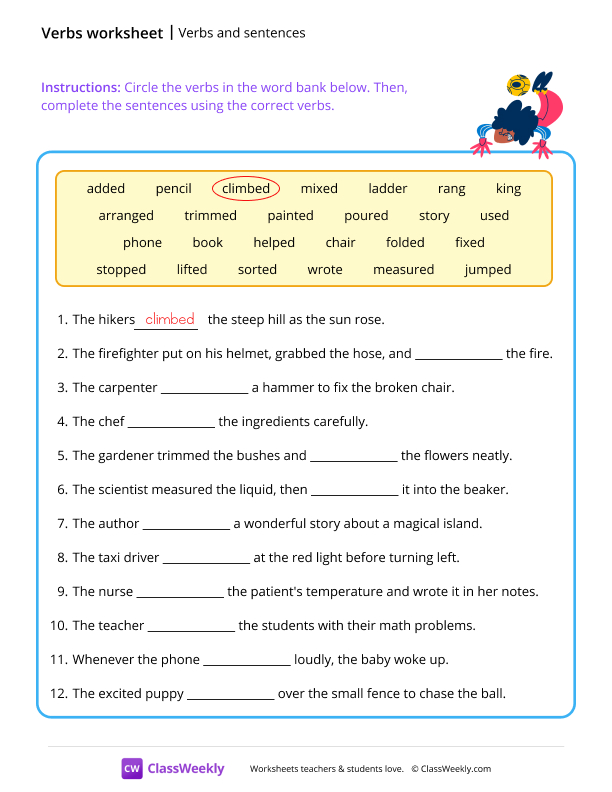
Preview of Verbs and sentences - Kick. 2 variations available.
All Verbs and sentences Worksheets


Worksheet Details
| Grade | 4th Grade |
| Subject | Grammar & Writing |
| Topic | Verbs |
| Standard | L.3.1.A |
| Pages | 2 pages |
| Difficulty | Medium |
More action verbs worksheets
Explore all of our 4th grade action verbs worksheets.
Learn More
FAQ
What grade level are these action verbs worksheets for?
⌄
These action verbs worksheets are designed for 4th Grade students (Ages 9-10). Print any one in the set for targeted practice, or download them together as a packet.
Can I use these for homeschool or the classroom?
⌄
Yes. These worksheets work for homeschool, classroom, and tutoring. Use them as a morning warm-up, an independent center activity, or a fast-finisher task.
What verb skills should fourth graders master beyond tenses?
⌄
Fourth graders should master subject-verb agreement in complex sentences, use helping verbs and modal auxiliaries accurately, recognize and correct inappropriate shifts in verb tense, and order adjectives within sentences that also contain precise verb choices. CCSS L.4.1b covers progressive tenses, L.4.1c covers modal auxiliaries, and L.4.1f addresses complete sentences and run-on correction, all of which connect to strong verb usage. Students should ensure subject-verb agreement even when phrases separate the subject from the verb ("The stack of papers is" not "are") and with compound subjects ("My brother and I are" not "is"). They should distinguish between action verbs, linking verbs, and helping verbs in context. Fourth graders also learn that verbs carry tone: "whispered" conveys secrecy, "announced" conveys importance, and "mumbled" conveys uncertainty. Worksheets that combine agreement practice, modal verb selection, and precise verb choice in integrated exercises reflect the complexity of real fourth grade writing tasks.
How do worksheets help fourth graders strengthen their verb skills?
⌄
Worksheets provide the structured, targeted practice fourth graders need to manage increasingly complex verb concepts. Progressive tense worksheets that present a base verb and three timelines (past, present, future) and ask students to write the correct progressive form build automaticity. Modal auxiliary worksheets that present scenarios (asking permission, describing ability, expressing obligation) and ask students to choose the correct modal develop situational language awareness. Subject-verb agreement worksheets with tricky intervening phrases ("The box of chocolates is/are on the table") address common error patterns. Tense consistency worksheets that present paragraphs with intentional and unintentional tense shifts, asking students to identify which shifts are deliberate and which are errors, build sophisticated editing skills. The most effective worksheet sets progress from isolated skill practice to integrated passages where students must apply multiple verb skills simultaneously, mirroring real writing conditions. Regular practice across these formats, aligned with CCSS L.4.1b and L.4.1c, produces measurable improvement in both grammar assessments and independent writing quality.
What are the most common verb errors fourth graders make?
⌄
Fourth graders commonly make five types of verb errors. First, inconsistent tense: shifting between past and present tense within a narrative without meaning to. Second, subject-verb agreement errors with tricky subjects, especially with collective nouns ("The team are" instead of "The team is") and with phrases between the subject and verb. Third, confusion with irregular past participles, using "I have went" instead of "I have gone" or "She has wrote" instead of "She has written." Fourth, overusing simple tenses when progressive tenses would be more precise ("I studied when you called" versus "I was studying when you called"). Fifth, misusing modal auxiliaries, particularly "can" versus "may" (ability versus permission) and "must" versus "should" (requirement versus suggestion). Worksheets that target each error type individually, combined with proofreading exercises that mix all five, help students develop both specific knowledge and general editing awareness. These errors align with CCSS L.4.1 expectations and are commonly assessed on fourth grade standardized tests.
What is ClassWeekly?
ClassWeekly offers free worksheets and printable learning resources for kids in preschool to grade 5. All worksheets are aligned to Common Core, NGSS, and C3 Framework standards and designed by educators. Become a member to access the full library and download unlimited PDFs.