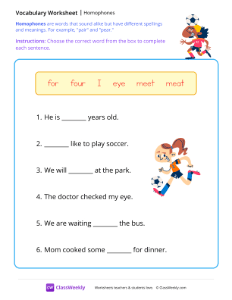
Homophones
Written by Adi Ackerman, Head Teacher
"Homophones - Boat" is written for 1st Grade (Ages 6-7), and it covers Common Core L.1.4.A. If your little one is a year younger but already steady here, the page still works. You may just need to read the instructions out loud. And if they are older and homophones never quite stuck, this is a short review rather than busywork.
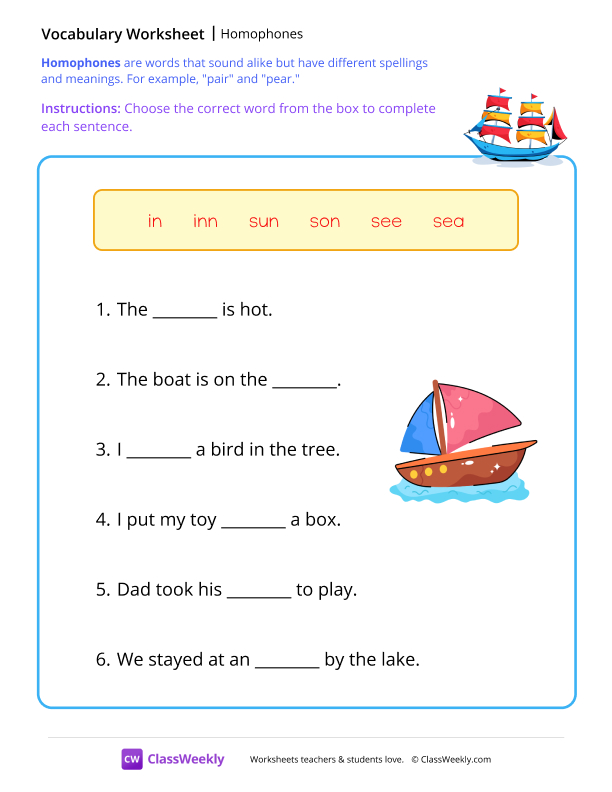
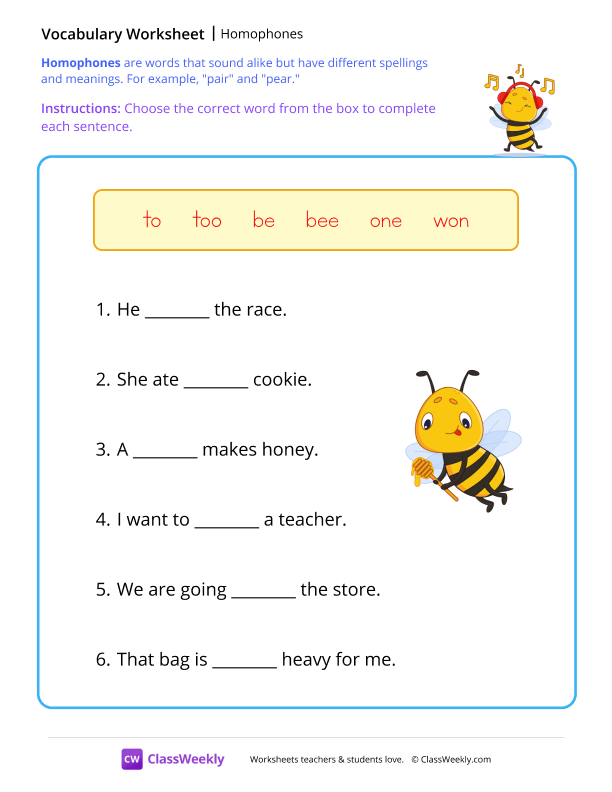
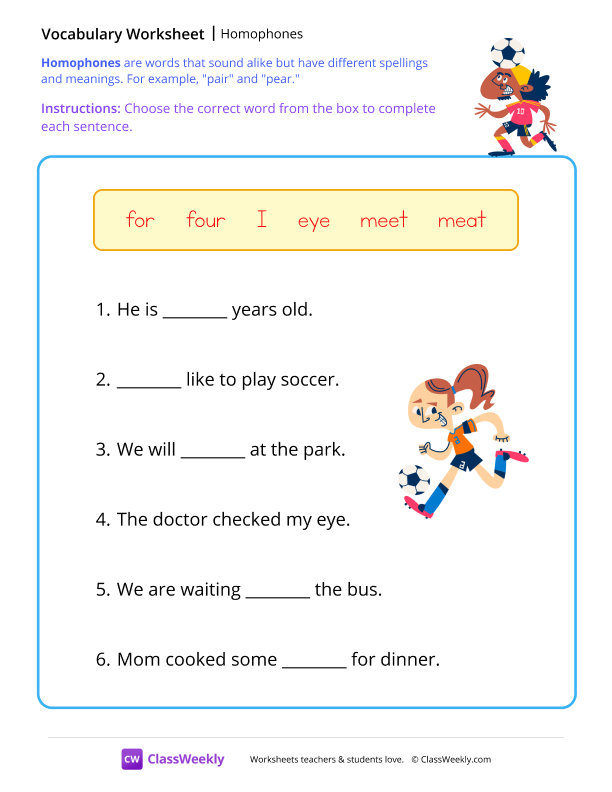
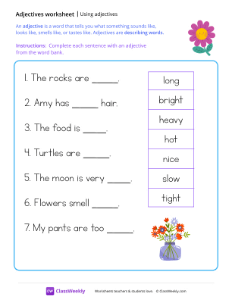
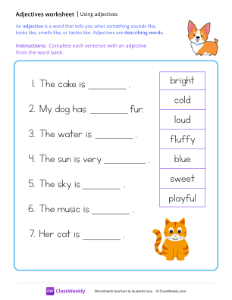
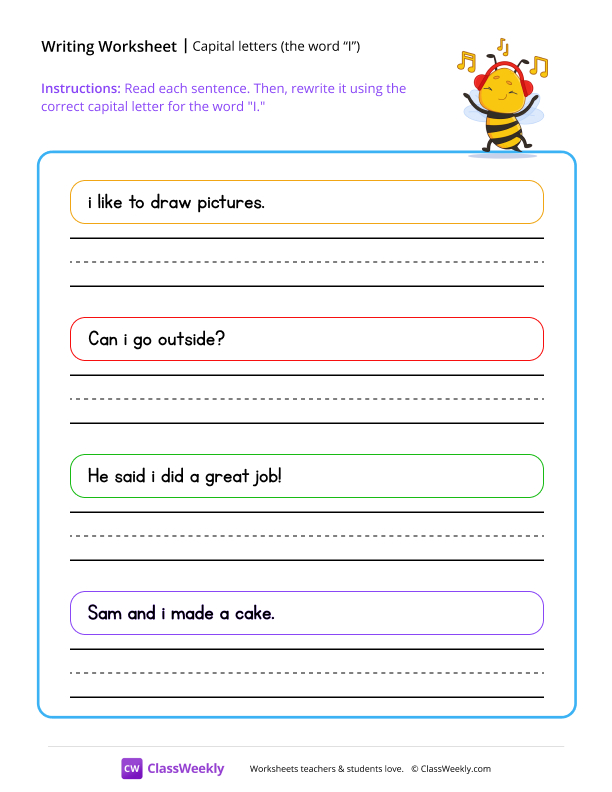
3 pages in this set
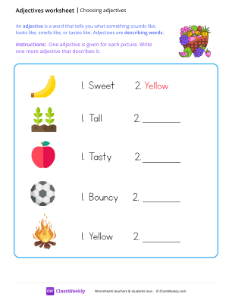
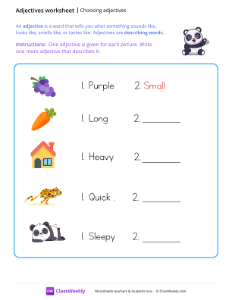
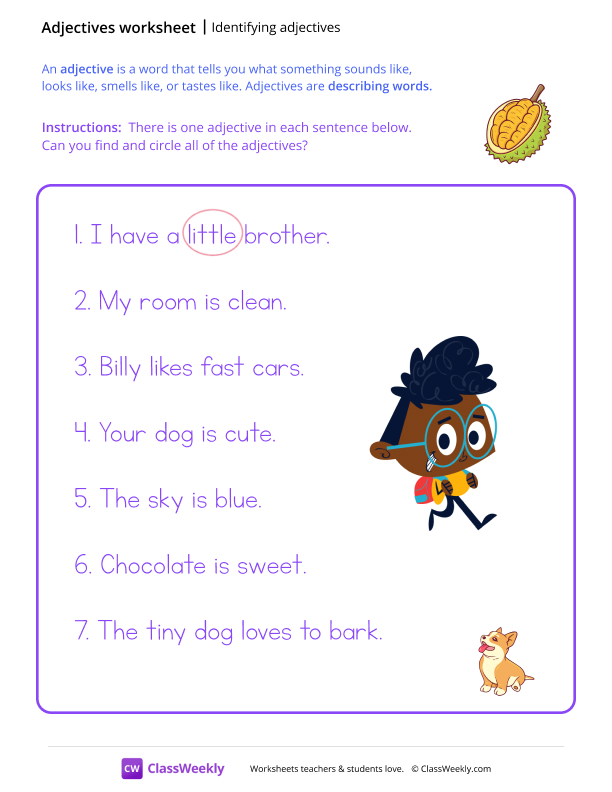
Free printable homophones (boat) worksheet for 1st grade students. Part of our homophones collection. Aligned to Common Core standards.
How do I use this worksheet?
Introduce the skill with a brief whole-class activity, such as calling out examples and asking students to give a thumbs up when they hear homophones in a sentence. Then let students work through the first item together as a class, then finish the rest independently or with a partner, referring to a class anchor chart if one is available. When reviewing answers, ask students to explain why an answer is correct rather than just confirming it. These homophones worksheets work well as a focused practice activity, a homework assignment, or a warm-up at the start of a language arts lesson.
What students will practice
- Students will identify and correctly use homophones in sentences and short passages.
- Students will distinguish homophones from related language concepts and apply rules consistently.
- Students will demonstrate understanding of homophones through guided and independent decoding, in both reading and their own writing.
Curriculum Links
Common Core State Standards
Language · 1st Grade
Standard: Use sentence-level context as a clue to the meaning of a word or phrase.
View all L.1.4.A worksheets →Find this in the curriculum
Browse the grade, subject, and topic this belongs to.
FAQ
How do I use this homophones worksheet?
⌄
Introduce the skill with a brief whole-class activity, such as calling out examples and asking students to give a thumbs up when they hear homophones in a sentence. Then let students work through the first item together as a class, then finish the rest independently or with a partner, referring to a class anchor chart if one is available. When reviewing answers, ask students to explain why an answer is correct rather than just confirming it. These homophones worksheets work well as a focused practice activity, a homework assignment, or a warm-up at the start of a language arts lesson.
What does this worksheet teach?
⌄
These homophones worksheets for 1st grade give students the targeted language arts practice they need to master this important grammar skill. Students identify, sort, complete, and write using homophones through a variety of exercises designed to reinforce both recognition and application. Our homophones worksheets connect grammar practice to reading and writing so students see how homophones works in real language. Building a solid understanding of homophones in 1st grade sets students up for stronger writing and clearer communication in every subject.
Can I use this homophones worksheet for homeschool or classroom?
⌄
Yes, both. We made it for 1st Grade homophones, and the page works the same whether it lands on a kitchen table or a center rotation. At home, most families go through it together and talk the answers out loud, and that talking is where most of the learning happens. In class it runs well as independent work while you pull a small group. Print one copy or thirty, whichever the day needs.
What homophones are most important for 1st graders to learn?
⌄
High-frequency homophone pairs like to/two/too, there/their, see/sea, hear/here, and I/eye are the most useful to teach because they appear most often in reading and writing.
Why do homophones create challenges in both reading and writing?
⌄
In reading, students must use context to determine which meaning is intended; in writing, they must choose the correct spelling - both require understanding that the same sound can represent different words.
How can teachers make homophones memorable for young learners?
⌄
Using each homophone in a funny sentence, drawing pictures for both meanings side by side, and creating homophone card games all help students distinguish and remember confusing word pairs.
What homophones should first graders learn?
⌄
First graders should learn the most common homophone pairs they encounter in reading and writing: to/two/too, see/sea, one/won, no/know, by/buy/bye, be/bee, I/eye, here/hear, right/write, their/there/they're (introduced but not mastered), and ate/eight. CCSS L.1.4 supports vocabulary strategies that include distinguishing among words with similar sounds, and L.2.4a (which first grade builds toward) addresses using context to determine meaning. At this level, focus on pairs where both words are concrete and easily illustrated, making the meaning difference visual and clear. Worksheets that present two homophone spellings with pictures of each meaning and ask students to choose the correct one for a sentence (I have ____ cats. choices: to, two, too) build the critical skill of using context to select the right word. Homophone awareness in first grade prevents spelling confusion that can persist for years if not addressed early, particularly with high-frequency pairs like to/too/two and their/there/they're.
How do you teach homophones to first graders?
⌄
Teaching homophones to first graders requires explicit instruction connecting each spelling to its specific meaning. Introduce one homophone pair at a time, spending several days on each before adding another. For each pair, show pictures representing both meanings: for see and sea, show a picture of an eye (to see) and a picture of the ocean (the sea). Create a homophone wall or chart that displays pairs with their pictures and meanings, serving as a reference during writing. Worksheets where students read a sentence and choose the correct homophone from two options build context-based decision making. Writing sentences using both words in a pair (I can see the sea from my window) demonstrates the meaning difference within one context. Games like homophone memory match, where students flip cards to pair a word with its meaning picture, make practice engaging. When students confuse homophones in their own writing, use it as a teaching moment: you wrote I went too the store. Which to/too/two means going to a place? This immediate feedback in authentic writing contexts produces the strongest learning transfer.
What homophone worksheets are effective for first grade?
⌄
Effective first-grade homophone worksheets combine visual cues with sentence-level practice. Picture-meaning matching worksheets, where students draw lines from each homophone to its correct illustration, build the meaning-spelling association. Sentence completion worksheets (I ____ my friend at the park. choices: see, sea) are the most practical format because they develop the context-based reasoning students need for real writing. Error correction worksheets where students find and fix the wrong homophone in a sentence (I eight a sandwich for lunch) develop proofreading skills and engage students through the humor of the literal misreading. Sorting worksheets where students read sentences and sort them by which homophone is needed reinforce categorization skills. Cloze passages with multiple homophone blanks in one paragraph build sustained attention to word meaning. Crossword puzzles where the clues describe the meaning and students write the correct spelling combine reasoning with spelling practice. Choose worksheets that focus on one or two homophone pairs per page during initial instruction, then use mixed-review worksheets once several pairs have been taught. These formats support CCSS L.1.4 vocabulary development and lay groundwork for the more complex homophone work in second and third grade.
Ratings & Reviews
No reviews yet. Be the first to share what you think.
Reviews are for ClassWeekly members.
Make a Request
Spotted something to fix, or want a worksheet we don't have yet? Tell us and we'll make it.
Worksheet Details
| Grade | 1st Grade |
| Subject | Grammar & Writing |
| Topic | Homophones |
| Standard | L.1.4.A |
| Pages | 1 page |
| Difficulty | Medium |
What is ClassWeekly?
ClassWeekly offers free worksheets and printable learning resources for kids in preschool to grade 5. All worksheets are aligned to Common Core, NGSS, and C3 Framework standards and designed by educators. Become a member to access the full library and download unlimited PDFs.