What Is Gravity?
Taught in US schools
Key Takeaways
- Gravity is a force that pulls all objects with mass toward each other - the more mass an object has, the stronger its gravitational pull.
- Earth's gravity pulls everything on or near its surface toward its center, which is why dropped objects fall and why we don't float away.
- Weight is a measure of the force of gravity on an object and varies depending on where you are; mass is the amount of matter in an object and does not change.
What Is Gravity?
Gravity is a force of attraction that exists between all objects that have mass. Every object in the universe pulls every other object toward it through gravity. The larger the mass of an object, the stronger its gravitational pull.
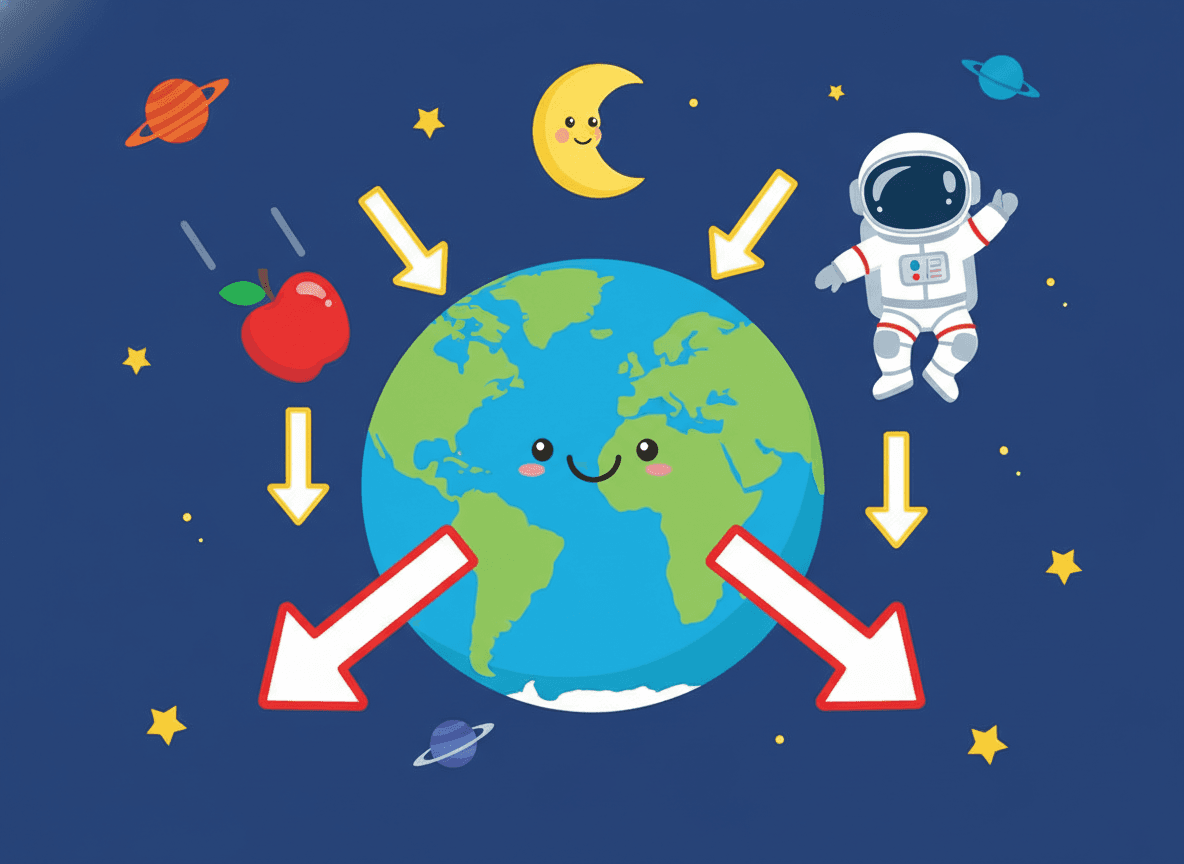
On Earth, we experience gravity as the force that pulls objects downward - toward the center of the Earth.
How Gravity Works on Earth
Earth's gravity is what:
- Makes objects fall when dropped
- Keeps us on the ground instead of floating away
- Makes water flow downhill
- Keeps the Moon in orbit around Earth
- Holds the atmosphere close to the planet
Simple rule: On Earth, gravity always pulls things downward (toward Earth's center).
Isaac Newton and Gravity
Isaac Newton (1643–1727) is credited with formulating the mathematical law of gravity. The famous story says he observed an apple falling from a tree in 1666 and began thinking about why objects fall toward Earth. His work resulted in the Law of Universal Gravitation, which explains that every object attracts every other object, and the strength of the attraction depends on their masses and the distance between them.
The greater the mass → the stronger the gravity. The greater the distance → the weaker the gravity.
Weight vs. Mass
This is one of the most important - and most commonly confused - concepts in elementary science:
Definition: Amount of matter in an object
Unit: Kilograms (kg), grams (g)
****Does it change?: No - constant everywhere
On the Moon: Same as on Earth
Example: An astronaut who weighs 180 pounds on Earth would weigh only about 30 pounds on the Moon - but their mass (the amount of matter in their body) stays exactly the same.
Gravity on Other Planets
Each planet has a different gravitational pull depending on its mass:
Moon: 1/6 of Earth's
Mars: About 38% of Earth's
Jupiter: About 2.5 times Earth's
Sun: About 28 times Earth's This is why astronauts can jump much higher on the Moon, and why massive planets could crush a human with their intense gravity.
Why Planets Orbit the Sun
Earth's gravity keeps the Moon in orbit. The Sun's gravity keeps Earth (and all the planets) in orbit. Orbits are curved paths that result from the balance between:
- Gravity pulling the planet toward the star
- The planet's forward motion (velocity) carrying it sideways
These two forces balance to create a stable, nearly circular orbit.
Gravity vs. Magnetism
Students sometimes confuse gravity with magnetic attraction because both are forces that work at a distance. Key differences:
Acts on: All objects with mass
Direction: Always attractive
Can be blocked?: No
Practice Activities
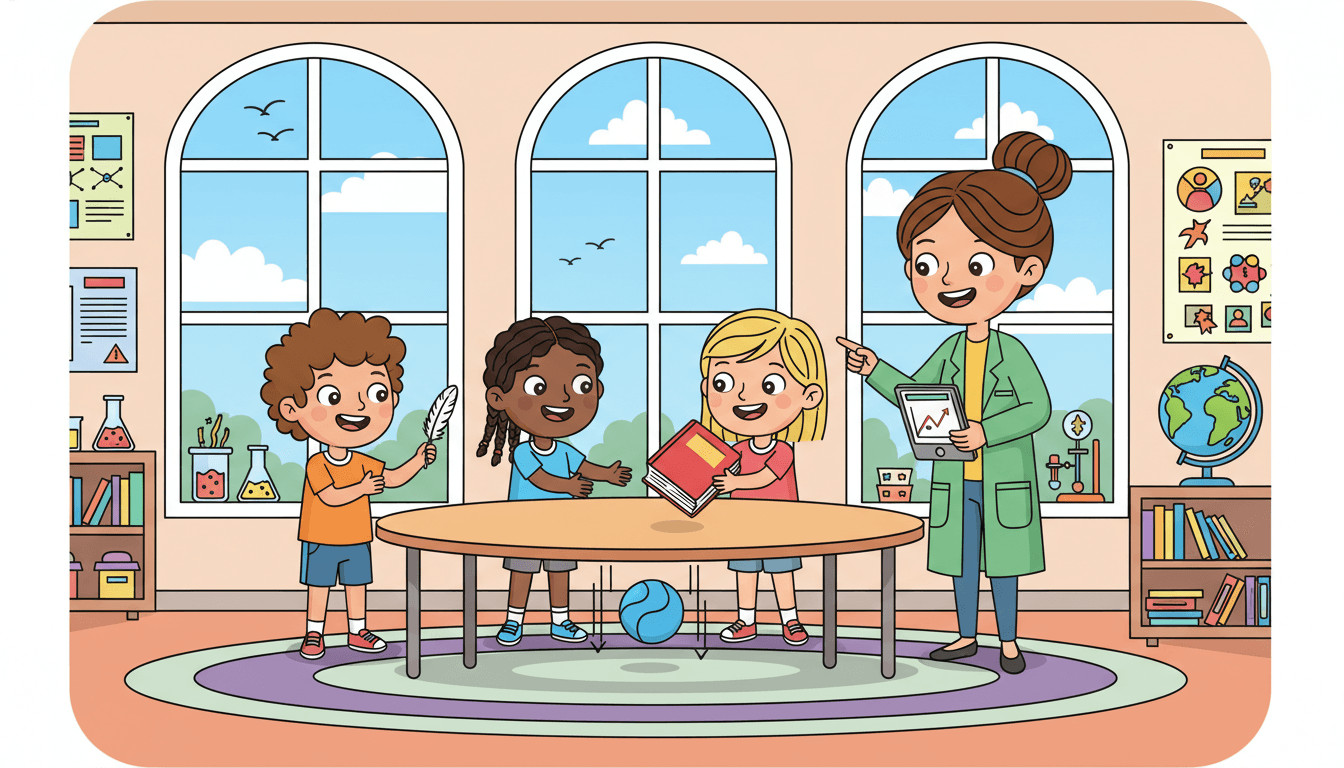
- Drop different objects (a feather and a coin, a crumpled paper ball and a flat sheet) to explore whether mass affects how fast objects fall.
- Research astronauts on the International Space Station - why do they float? (Microgravity due to continuous free fall)
- Compare weight on different planets using a simple scale: if you weigh 70 lbs on Earth, how much would you weigh on Mars? (Calculator activity)
- Build and drop "egg drop" containers to explore how engineering can protect objects from the force of gravity.
- Discuss: if you could turn off gravity for one minute, what would happen? (Creative writing + science reasoning)
Frequently Asked Questions
Did an apple really fall on Isaac Newton's head?
The famous story says that Isaac Newton was sitting under an apple tree in 1666 when an apple fell and inspired him to think about why objects fall. Most historians believe this is at least partially true - Newton himself told the story in his later years. What's historically accurate is that Newton developed the mathematical law of universal gravitation, which explains that gravity acts between all objects with mass.
What is the difference between weight and mass?
Mass is the amount of matter in an object and never changes - your mass on Earth is the same as your mass on the Moon. Weight is the force of gravity pulling on that mass and DOES change depending on location. On the Moon, which has about 1/6 Earth's gravity, you would weigh about 1/6 as much as you do on Earth, even though your mass is the same.
Why do planets orbit the sun instead of falling into it?
Gravity from the Sun constantly pulls planets toward it. However, the planets are also moving sideways at high speeds. These two factors balance perfectly - the planet falls toward the Sun but keeps missing it because it is moving sideways so fast. This curved path is called an orbit. The same principle keeps the Moon orbiting Earth and satellites orbiting Earth.
Free Gravity Worksheets
Curriculum-aligned printable worksheets for Kindergarten – 5th Grade. Download free.


