
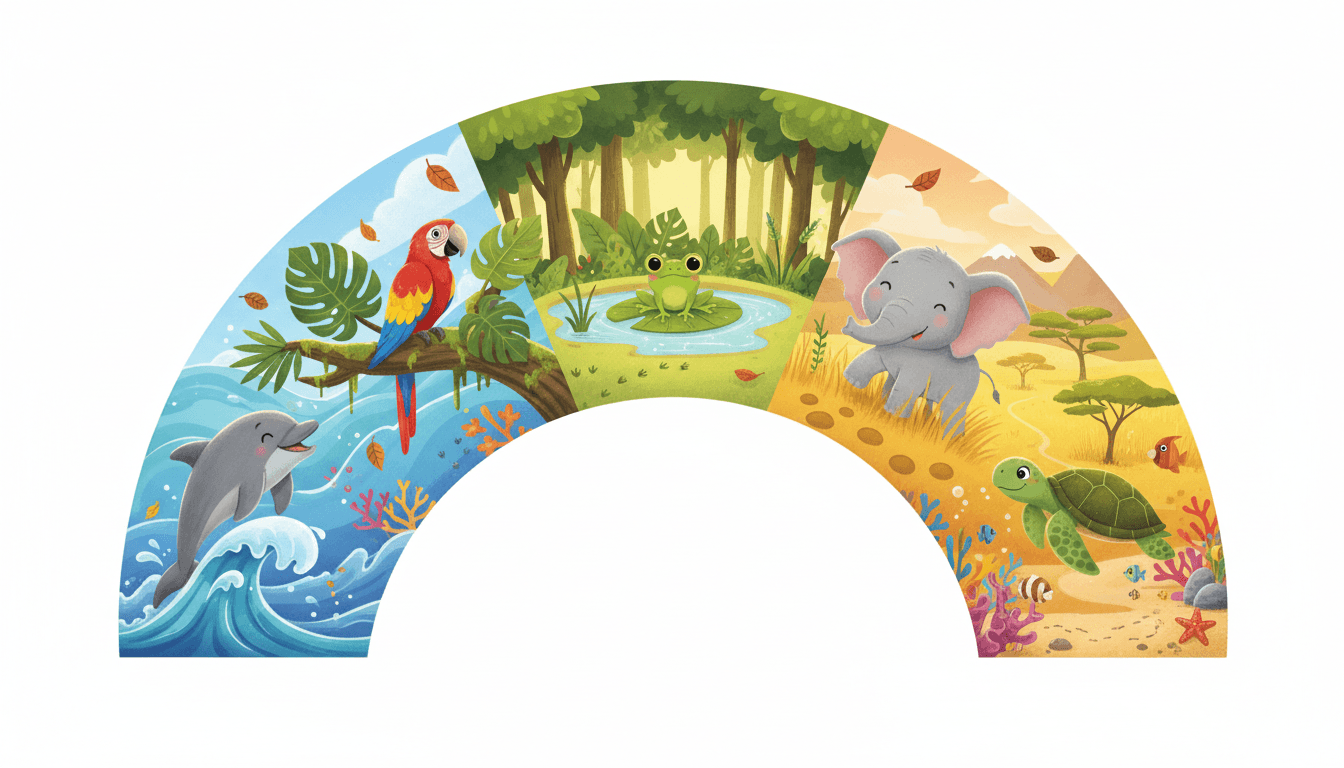
Fun Animal Facts for Kids: Learning About the Animal Kingdom
Get 30 days of free worksheet downloads
Key Takeaways
- Animals naturally hook kids into science because they trigger empathy and curiosity, making concepts like adaptation, classification, and food chains easier to teach.
- Many popular animal facts are myths - for example, chameleons change color based on mood and temperature, not camouflage - and debunking these builds critical thinking skills.
- Asking 'Why do you think that is?' after each surprising fact transforms passive trivia into active inquiry, which is the foundation of scientific thinking.
- Animal facts can be integrated into reading instruction through fact-of-the-day routines, true-or-false sorting, and structured research reports that work even for kindergartners.
- Hands-on activities like classification sorts, habitat dioramas, and student expert presentations deepen understanding far beyond memorizing facts.

If there's one topic that gets every kid talking, it's animals. You don't have to convince a 6-year-old to care about tigers or dolphins or frogs. They already do.
That natural curiosity is a gift for teachers. Animal facts aren't just fun trivia. They're a doorway into science concepts like habitats, adaptation, food chains, and life cycles. When a kindergartner learns that an octopus has three hearts, they're not just memorizing a fact. They're starting to wonder why, and "why" is where real science begins.
Here are animal facts organized by group, with ideas for turning each one into a learning moment.
Why Kids Are Naturally Drawn to Animals
Before the facts, a quick thought on why this topic works so well.
Kids see themselves in animals. They connect to baby animals, to animals that play, to animals that live in families. It's empathy-driven learning, and it runs deep.
Animals also give young students a way to practice observation and comparison, two skills that are foundational to all science. "How is a frog different from a fish?" isn't just a trivia question. It's classification. It's critical thinking. And when it's about animals, kids will do it willingly for 30 minutes straight.
Use that energy. Don't just share facts. Ask "Why do you think that is?" after every surprising one. The facts are the hook. The questions are the lesson.
Free Kindergarten Animal Worksheets


Amazing Mammal Facts
Mammals are usually the animal group kids know best (they live with some of them, after all). These facts push past the familiar.
- Elephants are the only animals that can't jump. Their body structure just doesn't allow it. But they can swim, which surprises most kids.
- A group of flamingos is called a "flamboyance." Great excuse to teach the word flamboyant.
- Dolphins sleep with one eye open. Half their brain stays awake to watch for danger. This blows kids' minds every time.
- Bats are the only mammals that can truly fly. Flying squirrels glide. Bats actually fly. That distinction matters and it's a great lesson in precise language.
- A newborn kangaroo is about the size of a grape. Then it crawls into its mother's pouch and keeps growing. Life cycles in one surprising sentence.
- Cheetahs can run up to 70 miles per hour, but only for short bursts. They overheat quickly. This leads naturally into conversations about adaptation and trade-offs.
- Cows have best friends. They get stressed when separated. Kids find this relatable (and honestly, kind of sweet).
Discussion prompt: "What makes a mammal a mammal?" (Warm-blooded, has fur or hair, mothers produce milk.) See if your students can name 10 mammals in 60 seconds.
Reptile and Amphibian Facts That Surprise
Reptiles and amphibians tend to get lumped together, but they're quite different. These facts highlight what makes each group unique.
- Chameleons don't actually change color to blend in. They change color based on mood, temperature, and communication. This is one of the most commonly believed animal myths, and kids love finding out the real story.
- Some geckos don't have eyelids. They lick their eyes to keep them clean. Expect giggles.
- Frogs drink water through their skin. They don't actually swallow it the way we do. This is a great bridge to talking about how different animals have different adaptations for the same basic needs.
- A crocodile can't stick its tongue out. It's attached to the roof of its mouth.
- Sea turtles can hold their breath for up to 5 hours. Compare that to the average human (about 1 to 2 minutes). Math tie-in right there.
- Axolotls can regrow their legs, heart, and even parts of their brain. If your students don't already know about axolotls, get ready. They will become a classroom obsession.
Discussion prompt: "What's the difference between a reptile and an amphibian?" (Reptiles have scales and dry skin. Amphibians have moist skin and usually live part of their life in water.) Draw a Venn diagram together.
Bird Facts Kids Will Want to Share
Birds are everywhere, which makes them perfect for observation-based learning. These facts give kids something to look for the next time they're outside.
- A hummingbird's heart beats more than 1,200 times per minute. Have your students feel their own heartbeat and count for 15 seconds. Multiply by four. Then compare to a hummingbird. The numbers make it real.
- Owls can't move their eyeballs. That's why they turn their heads so far. They can rotate their heads about 270 degrees.
- Penguins propose to their partner with a pebble. They search for the smoothest, most perfect pebble they can find. Kids will remember this one for years.
- Crows can recognize human faces. They remember people who were kind to them and people who weren't. This fact always starts a good conversation about animal intelligence.
- Flamingos are born white. They turn pink from the shrimp and algae they eat. You are what you eat, literally.
- The Arctic Tern migrates from pole to pole every year. That's roughly 44,000 miles. Pull up a map and trace the route.
Discussion prompt: "Not all birds can fly. Can you name some that can't?" (Penguins, ostriches, emus, kiwis.) "Why do you think they lost the ability to fly?" This leads into great conversations about evolution and adaptation at an age-appropriate level.
Ocean Animal Facts
The ocean is mysterious enough to make almost any fact feel magical.
- An octopus has three hearts and blue blood. Two hearts pump blood to the gills, and one pumps it to the rest of the body. When they swim, the third heart stops. So they prefer to crawl.
- Jellyfish have been around for over 500 million years. They existed before dinosaurs. Before trees, even. Let that sink in.
- Seahorses are the only animals where the dad carries the babies. This fact gets a strong reaction from kids every single time.
- Dolphins have names for each other. They use unique whistles to call specific individuals. Scientists have recorded dolphins responding when they hear their "name."
- The blue whale's heart is the size of a small car. A child could crawl through its arteries. Use a yardstick to show the approximate size of the heart on the classroom floor.
- Clownfish can change from male to female. In a clownfish group, the largest fish is female. If she disappears, the biggest male becomes female. Nature is full of surprises.
Discussion prompt: "Why do we know less about the ocean floor than about the surface of Mars?" This isn't something most kids have thought about, and the conversation goes to interesting places.
Using Animal Facts to Build Reading Skills
Animal facts are naturally great reading material because kids are motivated to read things they find interesting. Here's how to turn that motivation into skill-building:
Fact-of-the-day reading routine. Post one animal fact on the board each morning. Students read it, then discuss it during morning meeting. This builds reading fluency and comprehension in 5 minutes.
Compare and contrast. Pick two animals and have students find 3 ways they're similar and 3 ways they're different. This is a core reading skill (comparing information from different sources) wrapped in a topic kids enjoy.
True or false sorting. Mix real facts with made-up ones. Students read each statement and decide: true or false? They have to use what they've learned (and think critically about what sounds reasonable). "An elephant can jump 10 feet in the air." Hmm.
Animal research reports. Even kindergartners can do a modified version. Pick an animal. Draw it. Write (or dictate) two facts about it. For 1st graders, add a sentence about its habitat and what it eats. Simple, structured, and kids love choosing their animal.
Keep Reading
- Science Experiments for Kids: Hands-On Learning at Home
- Animal Crafts for Kids: Easy Projects That Teach Science
- Body Parts Activities for Kids: Fun Ways to Learn About the Human Body
Activities That Turn Facts Into Learning
Facts are the starting point. Activities are what turn knowledge into understanding.
Animal classification sort. Give students picture cards of different animals. Have them sort into groups: mammals, birds, reptiles, amphibians, fish, insects. Discuss the tricky ones (is a bat a bird? is a whale a fish?). Those "tricky" conversations are where the deepest learning happens.
Habitat dioramas. Assign each student or group an animal. They research its habitat, then build a small diorama in a shoebox. Include the animal, its food, and features of its environment. Display them together and you have a classroom museum.
"Expert" presentations. Each student becomes the class expert on one animal. They learn 5 facts and present them to the class. For shy students, let them present to a small group instead. The pride of being "the expert" is a powerful motivator.
Animal journal. Keep a class animal journal where students add facts, drawings, and questions throughout the unit. By the end, you have a student-created animal encyclopedia.
The beautiful thing about teaching animal facts is that it never feels like school to our kiddos. They think they're just learning cool stuff about tigers and octopuses. But they're building science vocabulary, practicing reading, thinking critically, and learning how to ask good questions.
That's a pretty great trade 😊

Adi Ackerman
Head Teacher
Adi is the Head Teacher at ClassWeekly, with years of experience teaching elementary students. She designs our curriculum-aligned worksheets and writes practical guides for teachers and parents.
Keep Reading
Ready to download? Try ClassWeekly free for 30 days.
Unlimited worksheets for PreK through 5th grade. Cancel anytime.