
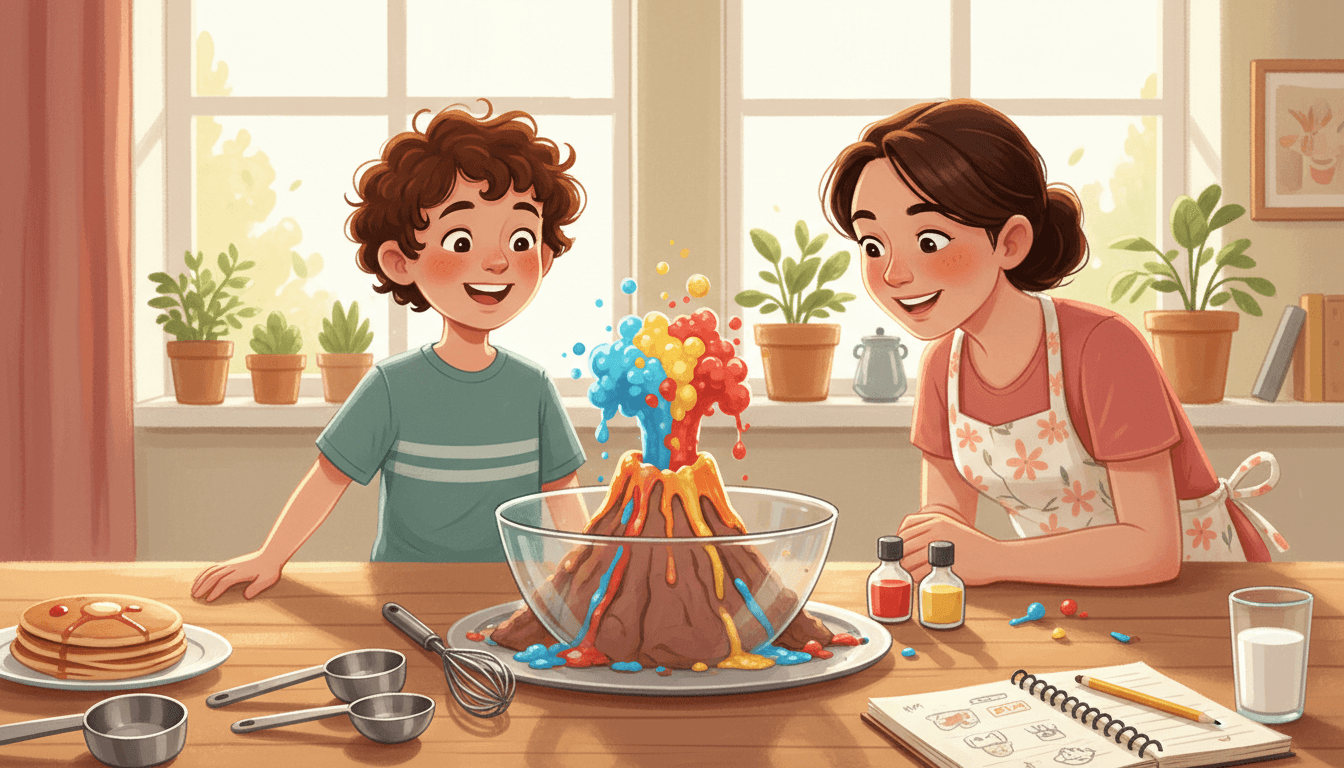
Science Experiments for Kids: Hands-On Learning at Home
Get 30 days of free worksheet downloads
Key Takeaways
- Hands-on science experiments build content knowledge, process skills, and scientific mindset simultaneously, making them far more effective than reading about science.
- Most effective home science experiments use kitchen staples like baking soda, vinegar, dish soap, and food coloring - no specialty equipment needed.
- Letting kids predict before an experiment and sit with confusion before explaining builds deeper understanding than walking them through steps in advance.
- Keeping a science notebook - even just drawings and dictated sentences for kindergartners - builds observation and recording habits that support school science learning.
- Long-term biology projects like bean mazes, bird-watching logs, and decomposition studies teach sustained observation, a skill that quick one-off experiments cannot build.
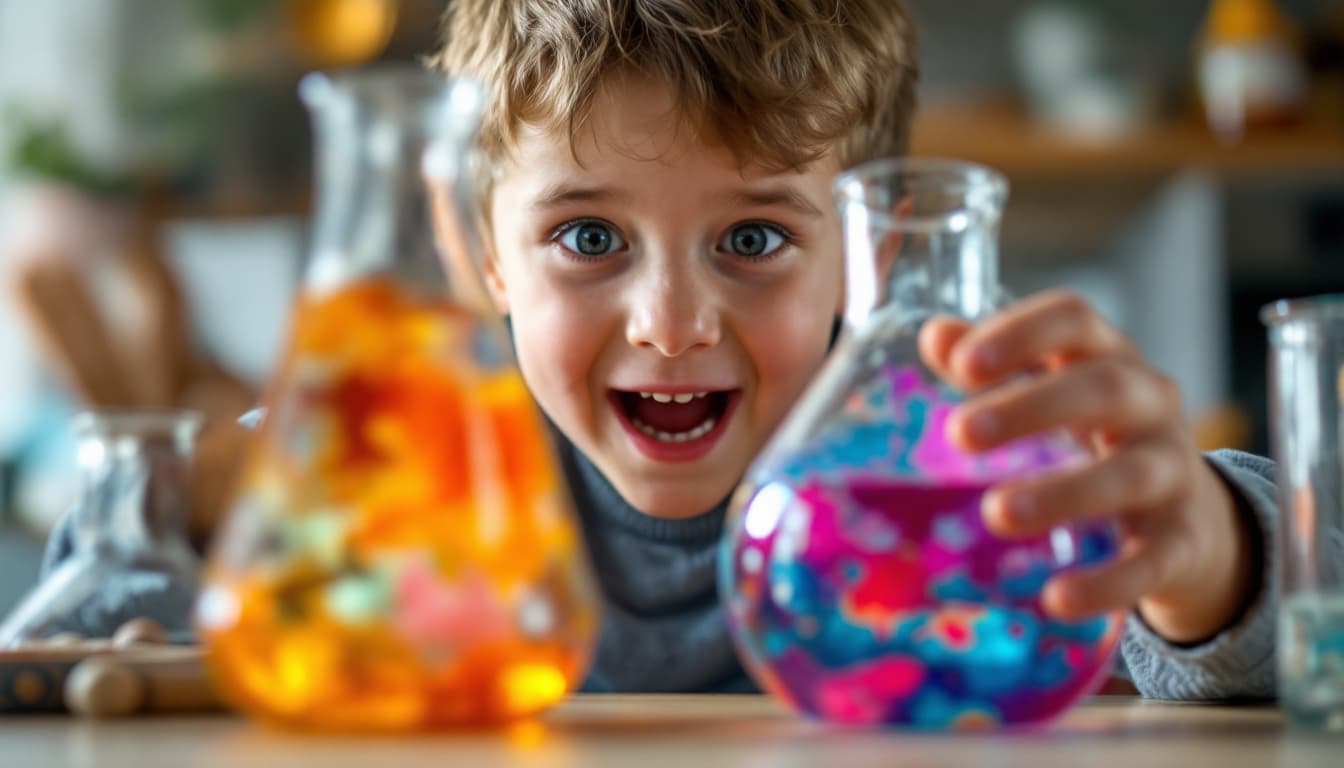
There's a moment in every science experiment where a kid's eyes go wide. The baking soda volcano erupts. The egg slides into the bottle. The milk swirls with color. That moment? It's not just entertainment. It's a brain forming a new connection between cause and effect.
The best part about science experiments for elementary kids is that most of them use things you already have at home. No lab equipment needed. No fancy kits. Just some kitchen supplies, a backyard, and a willingness to make a mess.
Here are experiments organized by category that work great for kids from kindergarten through third grade.
Why Hands-On Science Experiments Work
Before we dive into specific experiments, let's talk about why doing science beats reading about science every single time.
When kids read that "vinegar and baking soda create carbon dioxide gas," it's information. When they mix vinegar and baking soda and watch it fizz all over the table, it's an experience. And experiences stick in memory in ways that facts on a page simply don't.
Hands-on experiments build three things at once. First, content knowledge (what actually happens when you mix two substances). Second, process skills (predicting, observing, measuring, recording). Third, scientific mindset (it's okay if your prediction was wrong, that's data too).
Research shows that students who engage in hands-on science during elementary school score higher on science assessments in middle school. But honestly, the more important benefit is that they stay curious. They keep asking "what if" and "what would happen if I changed this?" Those habits matter more than any test score.
One important rule for parents: resist the urge to explain everything before the experiment. Let your child predict. Let them be surprised. Let them sit with confusion for a minute before you help them understand what happened. The wondering is where the learning lives.
Free Energy, Sound and Light Worksheets


Free Forces and Machines Worksheets


Kitchen Chemistry Experiments
Your kitchen is basically a science lab. Seriously. Between the pantry and the fridge, you've got everything you need for a dozen experiments.
The classic volcano. Build a small mountain out of clay or playdough around a cup or bottle. Pour in baking soda, a squeeze of dish soap, and food coloring. Then add vinegar and watch it erupt. The baking soda (a base) reacts with vinegar (an acid) to produce carbon dioxide gas, which gets trapped in the soap to make foam. Kids can run this experiment multiple times, changing the amounts each time. More vinegar? More baking soda? What happens?
Magic milk. Pour whole milk into a shallow plate. Add drops of different food coloring around the plate (don't stir). Dip a cotton swab in dish soap and touch it to the center of the milk. Watch the colors explode outward in swirling patterns. The dish soap breaks down the fat in the milk, which pushes the food coloring around. It's mesmerizing, and kids can experiment with different milk types (does skim milk work the same way?).
- Invisible ink. Squeeze lemon juice into a small cup. Use a cotton swab to write a secret message on white paper. Let it dry completely. Then hold the paper near a warm light bulb (with adult supervision) or iron it. The message appears in brown letters. The citric acid in lemon juice weakens the paper fibers, which brown faster when heated.
- Dissolving race. Fill four cups with water (same amount in each). Drop a different substance in each cup: sugar, salt, sand, and a crayon piece. Stir each one for 30 seconds. Which dissolved? Which didn't? This introduces the concept of solubility in a hands-on way.
- Homemade slime. Mix white glue with liquid starch (or a borax solution for older kids, with parent supervision). The result is a non-Newtonian fluid that acts like both a solid and a liquid. Kids can stretch it, bounce it, and explore its weird properties. It's chemistry AND sensory play.
Kitchen chemistry safety rules: always supervise mixing activities, keep experiments away from eyes and mouths, and work on a surface that's easy to clean. A large baking sheet makes a great experiment tray.
Physics Fun With Everyday Objects
Physics sounds intimidating, but for kids, it's really about motion, force, and figuring out how things work.
Ramp races. Lean a board or piece of cardboard against a stack of books to make a ramp. Roll different objects down: a marble, a toy car, a ball, a cylinder. Which reaches the bottom first? Change the angle of the ramp. Does a steeper ramp make things go faster? This introduces gravity, friction, and variables in the simplest possible way.
Egg drop challenge. Give your child an egg and some building materials: bubble wrap, cotton balls, newspaper, tape, a small box, rubber bands. The challenge: build a container that protects the egg from cracking when dropped from waist height. Then shoulder height. Then standing on a chair. This is engineering design at its most fun (and most stressful).
- Paper airplane lab. Fold three different paper airplane designs. Predict which will fly the farthest. Test each one five times and measure the distance. Calculate the average (great math connection). Then modify the winning design. Can you make it fly even farther by changing the wing shape or adding a paper clip for weight?
- Static electricity discovery. Rub a balloon on a wool sweater for 30 seconds. Can it stick to the wall? Can it pick up small pieces of paper? Can it make your hair stand up? Try rubbing the balloon on different fabrics. Which ones create more static charge?
- Pendulum swing. Tie a small weight (a washer or a bolt) to a piece of string. Tape the string to the edge of a table so the weight hangs freely. Pull it back and release. Count the swings. Now change the string length. Does a longer pendulum swing faster or slower? (The answer surprises most kids and adults alike.)
The physics mindset for kids: "What happens if I change one thing?" That question drives every physics experiment. Teach kids to change only one variable at a time, keep everything else the same, and watch what happens.
Biology and Nature Projects
Living things are endlessly fascinating to kids. These projects bring biology to life (literally).
Grow a bean maze. Plant a bean seed in a small pot. Place the pot inside a shoebox with a hole cut in one end. Close the lid. Over the next week, the plant will grow toward the light coming through the hole. Open it up and you'll see the stem bending and twisting to reach the light. This demonstrates phototropism in a way that's genuinely amazing to watch.
Butterfly garden observation. If you can get a butterfly kit (or find caterpillars locally), the metamorphosis from caterpillar to chrysalis to butterfly is one of the most powerful science experiences for elementary kids. Have your child draw or photograph each stage. The whole process takes about 2-3 weeks.
- Decomposition study. Bury different items in a patch of soil: a banana peel, a plastic bag, a newspaper, a leaf, a piece of bread. Mark each spot with a popsicle stick. Check back every week for a month. What's breaking down? What isn't? This teaches about biodegradable materials in a very concrete way.
- Bird watching log. Set up a simple bird feeder near a window. Give your child a notebook and colored pencils. Each day, they draw the birds they see and note the time, weather, and what the bird was doing. After a few weeks, look for patterns. Do certain birds visit at certain times?
- Celery rainbow. Place celery stalks in cups of water dyed with different food colors. Wait 24 hours. The celery leaves will change color as they absorb the colored water through their stems. Cut a stalk in half to see the colored channels inside. This shows how plants transport water, and it's beautifully visual.
Biology tip: Long-term projects (gardens, decomposition, bird logs) build something that quick experiments can't: the habit of sustained observation. Coming back to the same project day after day teaches patience and the idea that science takes time.
Weather and Earth Science Activities
Kids are already curious about weather. They notice rain, wind, sunshine, and snow. These activities channel that awareness into real science.
Build a rain gauge. Cut the top off a plastic bottle. Invert the top piece into the bottom to create a funnel. Tape a ruler to the outside. Place it outside before a rainstorm. After the rain, read the measurement. Record it. Over time, your child will have a weather log that tracks rainfall in your area.
Make a tornado in a bottle. Fill a plastic bottle about two-thirds with water. Add a drop of dish soap and some glitter. Seal tightly. Swirl the bottle in a circular motion and watch a vortex form inside. The spinning water creates a miniature tornado (technically a vortex). The glitter makes it visible and dramatic.
- Rock collection and classification. Collect rocks from different locations: a park, a beach, a driveway, a garden. Sort them by color, texture, hardness, and size. Can you scratch one rock with another? (That tests hardness.) Are some smooth and some rough? Why might that be?
- Evaporation experiment. Pour the same amount of water into three containers: a wide plate, a narrow glass, and a covered jar. Set all three in the same spot. Check daily. Which one loses water fastest? This teaches evaporation and the concept that surface area matters.
- Wind direction detector. Tape a piece of ribbon or a strip of tissue paper to a stick and plant it outside. Which way does the ribbon blow? Check at different times of day. Does the wind change direction? Combine this with a simple compass to introduce cardinal directions.
Connect weather to daily life. "Why did we need an umbrella today? Why is it hot in summer and cold in winter? Why does the puddle disappear by afternoon?" Every weather question is a science question. Your job is to say "good question, let's figure it out."
Tips for Running Science Experiments at Home
Making experiments work well at home is different from a classroom. Here's what experienced parents and teachers have figured out.
Start with a question, not a procedure. Instead of "Today we're going to mix baking soda and vinegar," try "I wonder what would happen if we mixed these two things. What do you think?" The question frame turns the activity from a demonstration into a real experiment.
Let your child lead. If the instructions say to add three drops of food coloring and your child wants to add ten, let them. They're testing their own hypothesis. Science is about finding out what happens, even when you do it differently than expected.
Keep a science notebook. Even kindergartners can draw a picture of their experiment and dictate a sentence about what happened. First graders can write their own observations. By second and third grade, they can follow a simple format: question, prediction, what happened, why we think it happened.
- Embrace failure. If the experiment doesn't work the way it's "supposed to," that's still science. Ask: "Why do you think that happened? What could we change and try again?" The experiment that fails is often more educational than the one that works perfectly.
- Do experiments more than once. Scientists repeat their experiments to make sure the results are consistent. If the ramp race was close, run it again. If the volcano was underwhelming, try different proportions. Repetition is a core scientific practice, not a sign that something went wrong.
- Clean up together. This is part of the process. Scientists maintain their lab space. Kids can learn to put materials away, wipe down surfaces, and organize their science notebooks. Building these habits early means less resistance later.
Timing tip: Most experiments work best when kids are alert and curious (usually morning or early afternoon). Tired kids don't observe well, and rushing through an experiment defeats the purpose.
Keep Reading
- Fun Animal Facts for Kids: Learning About the Animal Kingdom
- Body Parts Activities for Kids: Fun Ways to Learn About the Human Body
- Animal Crafts for Kids: Easy Projects That Teach Science
- Digital Science Activities for Elementary Students
Keeping the Curiosity Going
The biggest mistake parents and teachers make with science experiments is treating them as one-off events. "We did the volcano. Science is done." But real scientific thinking is a habit, not an event.
Build a question jar. Whenever your child asks a "why" or "what if" question, write it on a slip of paper and drop it in a jar. Once a week, pull one out and design an experiment together to answer it. You won't always find the answer, and that's perfectly fine. Scientists don't either.
Visit science in the real world. Nature centers, science museums, botanical gardens, tide pools, farm visits. Every outing is a science lesson if you bring the right questions. "I wonder why those flowers are different colors. I wonder how that machine works. I wonder what that animal eats."
Connect experiments to what they're learning in school. If your child is studying weather in class, do weather experiments at home. If they're learning about plants, start a garden. The reinforcement between school and home makes both learning experiences stronger.
Read science books together. Books about animals, weather, space, the human body, and how things are made all fuel the same curiosity that experiments build. A kid who reads about volcanoes and THEN builds one gets so much more out of the experience.
Science experiments aren't extra. They're not a weekend activity to fill time. They're how your kiddos learn to think critically, ask good questions, and trust the process of figuring things out. Every erupting volcano, every surprising result, every failed egg drop builds a mind that's ready to learn anything 😊

Adi Ackerman
Head Teacher
Adi is the Head Teacher at ClassWeekly, with years of experience teaching elementary students. She designs our curriculum-aligned worksheets and writes practical guides for teachers and parents.
Keep Reading
Ready to download? Try ClassWeekly free for 30 days.
Unlimited worksheets for PreK through 5th grade. Cancel anytime.