
Body Parts Activities for Kids: Learn the Human Body
Get 30 days of free worksheet downloads
Key Takeaways
- Songs like Head Shoulders Knees and Toes are most effective when varied with speed rounds, whisper versions, or silent-motion challenges that deepen vocabulary retention.
- Life-size body tracing on butcher paper is one of the highest-engagement labeling activities because kids see their own outline and can add labels incrementally throughout the unit.
- Connecting body parts to the five senses through sense stations gives young learners a concrete understanding that the body works as a system, not just a collection of parts.
- For pre-readers and English language learners, pairing picture labels with word labels bridges the gap between the physical body part and its written name.
- Mystery bag tactile activities and balance challenges build body awareness through function, not just naming, which strengthens retention of body part vocabulary.
There's something about learning body parts that makes little kids light up. Maybe it's because the subject is literally themselves. They don't need a textbook or a model. They just look down at their own hands and feet and the lesson is right there.
For preschoolers and kindergartners, body parts activities are some of the easiest to set up and some of the most engaging to run. The content connects to science, vocabulary, motor skills, and even early literacy.
Here are activities that work, from the simplest (singing and pointing) to the more involved (labeling and creating).
Why Kids Love Learning About Their Bodies
Think about it from a 4-year-old's perspective. Most school topics are about things "out there," animals, weather, numbers. But body parts? That's about them. They can touch their nose while learning the word "nose." They can wiggle their toes while counting them. The connection between the lesson and their own experience is immediate.
This is also a topic where every child starts with some knowledge. Even the quietest kid in your class knows where their eyes are. That built-in confidence makes body parts a great entry point for science vocabulary.
And for English language learners, body parts vocabulary is foundational. These are words they'll use every single day.
Free Our Bodies Worksheets


Start With the Basics (Head Shoulders Knees and Toes)
You probably already do this one, but it's worth saying: songs are the fastest way to teach body parts to young children. The melody and the movement create memory anchors that stick.
"Head, Shoulders, Knees, and Toes" is the classic. But don't just sing it the same way every time. Try these variations:
- Speed round. Start slow, then get faster and faster each time through. Kids love the challenge of keeping up.
- Whisper version. Whisper the song while still doing the movements. This builds listening skills and body awareness.
- Skip a word. Each time through, remove one body part word and replace it with silence. Kids still do the movement, but don't say the word. By the end, they're doing all the motions silently. Surprisingly hard and surprisingly fun.
Other songs that work:
- "If You're Happy and You Know It" (clap your hands, stomp your feet, nod your head)
- "Hokey Pokey" (put your right arm in, put your left foot in)
- "Simon Says" (not a song, but the same principle: hear it, do it, learn it)
The point of all of these is the same: connect the word to the action to the body part. That three-way link is how vocabulary sticks for young learners.
Labeling Activities That Build Vocabulary
Once your kiddos can point to body parts when you name them, it's time to connect those words to print.
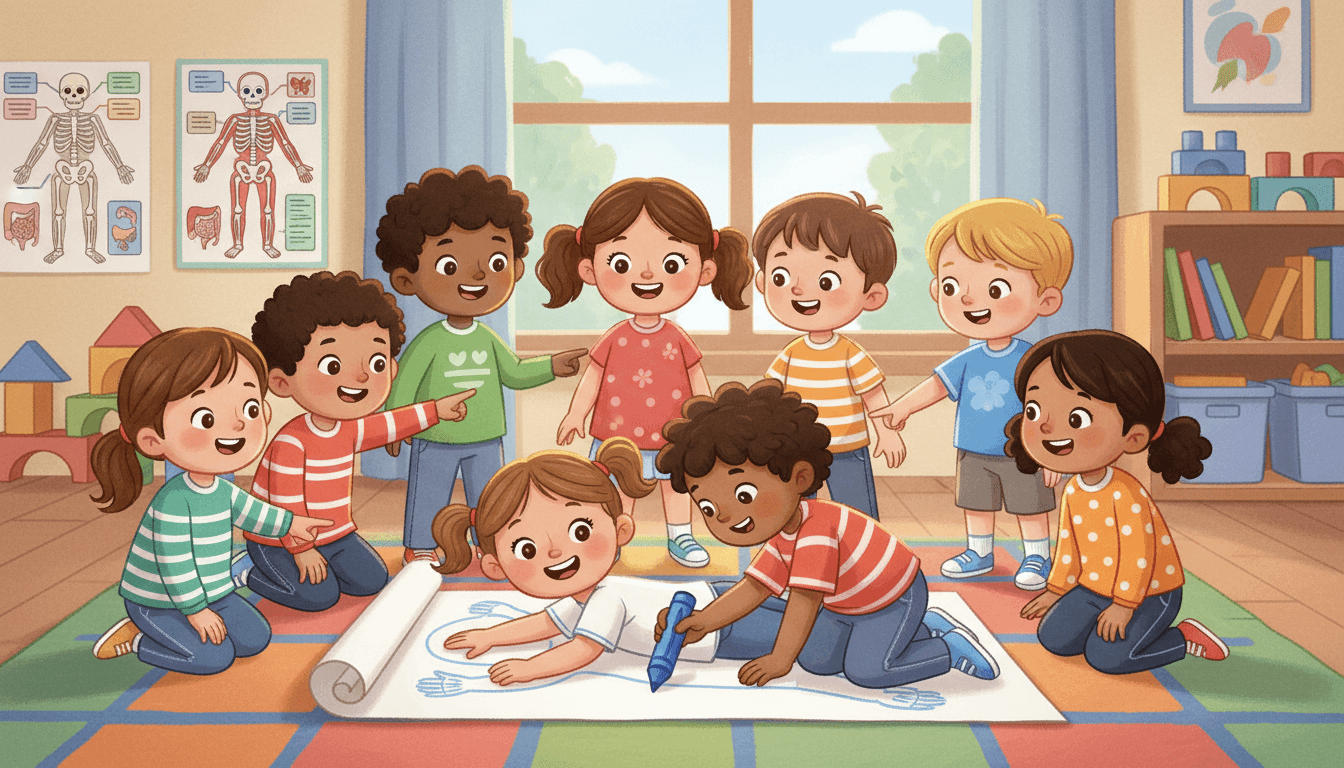
Life-Size Body Tracing. Grab a roll of butcher paper. Have one student lie down while another traces their outline. Then label the body parts together as a class. Start with the obvious ones (head, arms, legs) and add more as the week goes on (elbow, wrist, ankle, knee).
Hang the finished tracings in the hallway. Kids will stop and read the labels every time they walk by. Free review, no extra effort.
Body Parts Flip Book. Fold a piece of paper into sections. On each section, draw a body part and write its name. Kids can flip through and quiz themselves or a partner.
Label-the-Picture Activities. Give students a simple outline of a person and a word bank. They draw lines from the words to the correct body parts. This works well for independent practice or centers.
Quick tip: For pre-readers, use picture labels alongside word labels. A small drawing of an eye next to the word "eye" helps bridge the gap between the object and the word.
Sensory Activities for Body Awareness
Body awareness isn't just about naming parts. It's about understanding what those parts can do.
"What Can This Part Do?" game. Point to a body part and have students brainstorm everything it can do. Hands: clap, wave, hold, draw, point, grab, squeeze. Feet: walk, run, kick, stomp, balance, tiptoe. This builds both vocabulary and understanding of function.
Mystery Bag. Put objects in a bag or box. Students reach in (no looking) and use only their hands to figure out what the object is. Then discuss: "What did your fingers tell you? Was it smooth or rough? Big or small?" This connects body parts to the five senses naturally.
Balance Challenges. "Can you stand on one foot? Can you balance a beanbag on your head? On your shoulder? On the back of your hand?" Each challenge names a body part and requires body awareness to complete.
Playdough Bodies. Give each student playdough and ask them to build a person. They need to include the body parts you call out: "Don't forget elbows! Where do the knees go?" This is great for fine motor skills and spatial awareness.
The Five Senses Connection
Body parts and the five senses go hand in hand (literally). Here's how to bridge them:
Start with a simple question for each sense:
- Eyes see. What can you see right now?
- Ears hear. Close your eyes. What do you hear?
- Nose smells. Here are three things. Can you tell what they are by smell?
- Tongue tastes. (Use safe samples.) What's sweet? What's sour?
- Hands/skin feel. Touch this. Is it soft or hard? Warm or cold?
Sense Stations. Set up five stations, one for each sense. Students rotate through, complete a quick activity, and record what they experienced (with drawings for pre-writers or simple words for early writers).
This connection between body parts and senses shows kids that their body isn't just a collection of parts. It's a system that works together to help them understand the world. That's a pretty big science idea for a 5-year-old, and most of them get it intuitively.
Books About the Human Body for Young Learners
Pairing activities with read-alouds reinforces vocabulary and gives kids a different way to engage with the topic. Here are books that work well for this age group:
- "My Body" series for pre-K (simple, labeled illustrations of body parts)
- "From Head to Toe" by Eric Carle (animals do movements, kids copy them, great for body awareness)
- "The Busy Body Book" by Lizzy Rockwell (introduces bones, muscles, and organs in kid-friendly terms)
- "I Like Myself!" by Karen Beaumont (connects body appreciation to self-esteem)
Read one at the beginning of your body parts unit and another at the end. You'll be surprised how much more kids notice in the second book after a week of activities.
Keep Reading
- Animal Crafts for Kids: Easy Projects That Teach Science
- Fun Science Activities for Preschoolers That Build Curiosity
- Fun Animal Facts for Kids: Learning About the Animal Kingdom
Practice Pages for Body Parts
After singing, labeling, and exploring, our little ones benefit from some focused practice that brings it all together. Labeling activities, matching games, and drawing prompts let them show what they've learned independently.
For kindergartners working on reading and vocabulary alongside science, early reading practice pages can reinforce the word recognition skills that body parts vocabulary builds.
Teaching body parts is one of those topics where the learning happens almost effortlessly because it's so personal and so hands-on. Your kiddos will walk away knowing their elbows from their ankles, and honestly? They'll probably teach their parents a thing or two at home 😊

Adi Ackerman
Head Teacher
Adi is the Head Teacher at ClassWeekly, with years of experience teaching elementary students. She designs our curriculum-aligned worksheets and writes practical guides for teachers and parents.
Keep Reading
Ready to download? Try ClassWeekly free for 30 days.
Unlimited worksheets for PreK through 5th grade. Cancel anytime.