
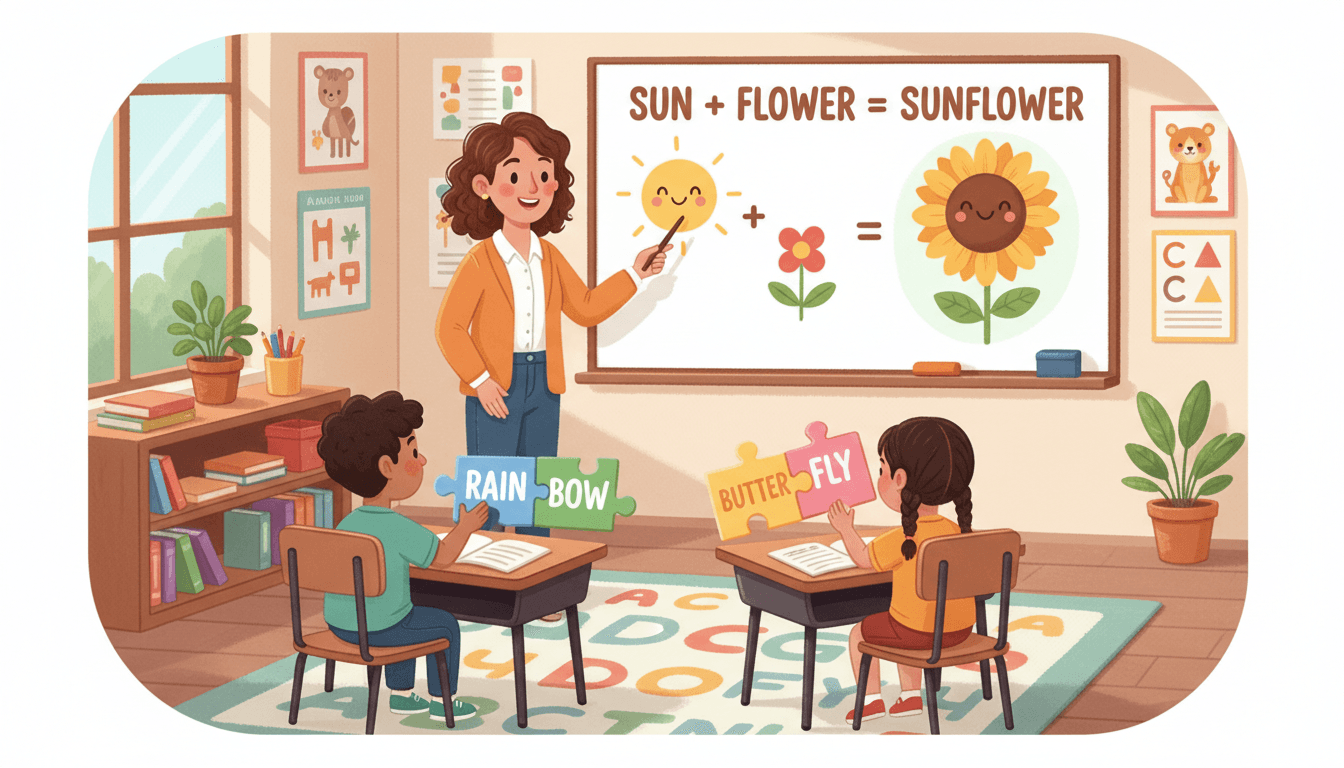
Compound Words for Kids: Activities and Practice Pages
Get 30 days of free worksheet downloads
Key Takeaways
- Closed compound words (no space) are the most important type to teach in grades 1-3, while hyphenated and open compounds are better introduced in 3rd grade.
- Students can decode unfamiliar compound words by identifying the two smaller words inside and combining their meanings.
- A daily 5-minute warm-up - like spotting the compound word among three options on the board - builds recognition faster than longer weekly lessons.
- Compound word awareness is a gateway skill: kids who can break apart compound words apply the same logic to prefixes and suffixes.
- The most common student mistake is thinking any two words together form a compound word; teach that both parts must be real standalone words and the result must have its own single meaning.
Compound words are one of those topics that kids actually enjoy once they see the pattern. Two small words they already know smash together to make a brand new word. There's something satisfying about it.
But here's the thing. While most first and second graders can understand what a compound word is, they often struggle to recognize them in the wild. And spelling compound words? That's a whole different challenge. So let's break it down into steps that actually work in the classroom.
What Are Compound Words
A compound word is made up of two smaller words that join together to create a new word with its own meaning. That's the textbook definition. But for your students, try this instead:
"Take two words you already know. Stick them together. Now you have a brand new word."
Sunshine. Sun + shine. Bedroom. Bed + room. Football. Foot + ball.
The fun part is that kids can usually figure out what the compound word means just by thinking about the two smaller words inside it. A sunflower is a flower that faces the sun. A starfish is a fish shaped like a star (well, sort of). This makes compound words one of the friendlier grammar concepts for young learners.
Start by writing a compound word on the board and drawing a line between the two parts. Ask your students: "What two words do you see hiding inside this big word?" Once they get the hang of spotting the hidden words, they're ready for more.
Free Compound Word Practice Pages for 2nd Grade


Types of Compound Words Kids Should Know
There are actually three types of compound words, but for elementary students, the first type does most of the heavy lifting.
Closed compound words are the ones your kiddos will see most often. Two words joined together with no space: butterfly, rainbow, skateboard, popcorn. This is where you'll spend most of your teaching time in 1st through 3rd grade.
Hyphenated compound words use a dash between the two words: merry-go-round, well-known, six-year-old. These pop up in reading, but you probably won't drill them much until 3rd grade or later.
Open compound words are two words that stay separate but work as one unit: ice cream, hot dog, living room. These are honestly confusing for kids (and some adults). "Wait, that's two words, but it counts as one?" Yes. Welcome to English.
For your classroom focus, stick with closed compound words for 1st and 2nd graders. Introduce hyphenated and open compounds in 3rd grade when students are ready for the "English is weird sometimes" conversation.
30 Compound Words to Start With
Here's a word list organized by difficulty. Start with the ones your students can decode easily, then level up.
Beginner (1st grade):
- sunlight, bedtime, cupcake, goldfish, bathtub
- raincoat, sandbox, starfish, doghouse, eggshell
Intermediate (2nd grade):
- butterfly, snowflake, basketball, playground, blueberry
- dragonfly, earthquake, fingertip, honeybee, jellyfish
Advanced (3rd grade):
- nevertheless, thunderstorm, watermelon, peppermint, skateboard
- grasshopper, cheeseburger, thumbtack, nighttime, everything
Post these lists in your classroom. When students spot compound words during independent reading, they can add them to a class chart. By the end of the unit, you'll have dozens of examples that your students found themselves, and those are the ones they'll remember.
Activities That Make Compound Words Click
Reading about compound words is fine. But making them? That's where the learning actually happens.
- Word puzzle cards. Write individual words on index cards (sun, flower, rain, bow, cup, cake). Students match pairs that form compound words. Time them for a fun challenge, or let them work in pairs.
- Compound word art. Students pick a compound word and draw a picture that shows both parts. A "starfish" drawing might show a literal star and a fish combining. This gets silly fast, and that's the point. Silly means memorable.
- Compound word scavenger hunt. Give students 10 minutes to find compound words in their library books, on posters in the hallway, or in a printed article you provide. Tally them up. Who found the most?
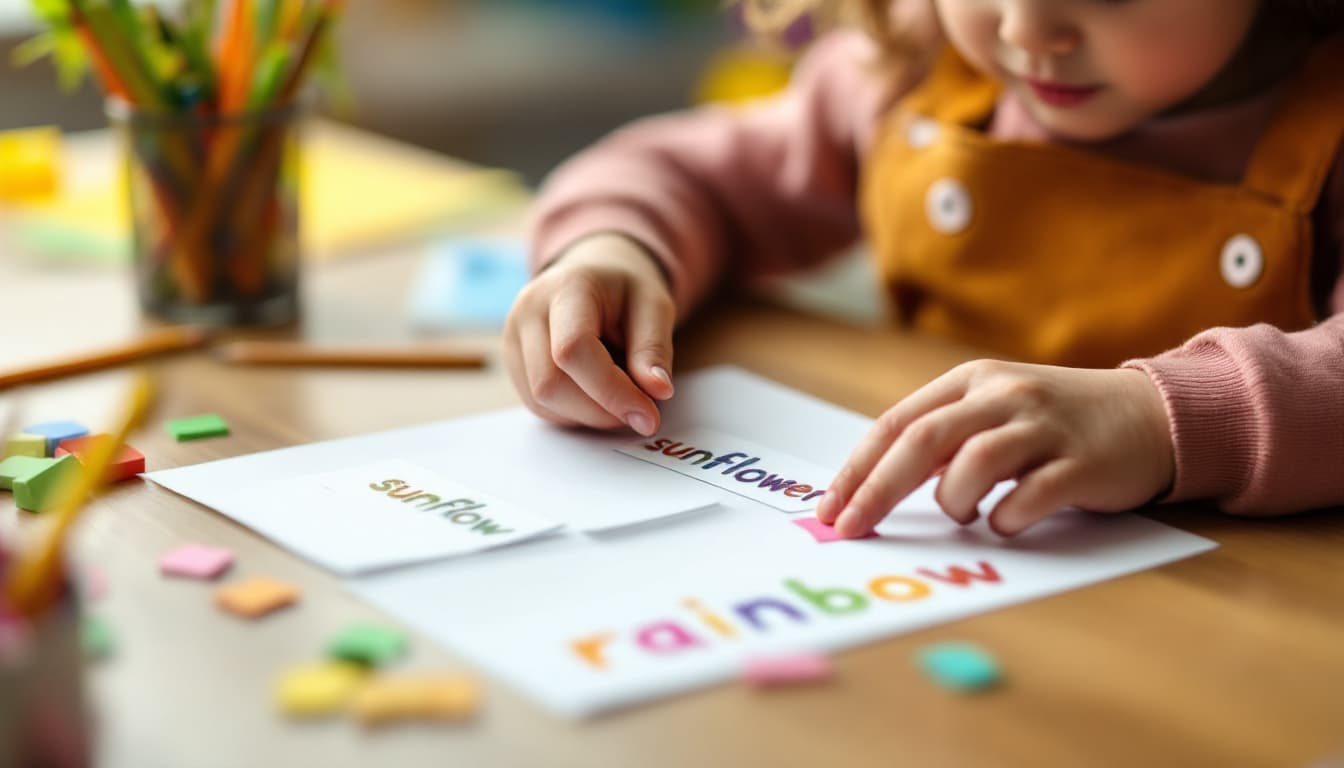
- Build-a-word center. Set up a station with two containers of word cards. Students pull one card from each container and check: did they make a real compound word? They write down the real ones and illustrate their favorite.
- Compound word surgery. Write compound words on sentence strips. Students use scissors to "operate" on the word, cutting it into its two parts. Then they put it back together and tape it to a chart.
The key is variety. Some kids learn best by matching cards. Others need to draw. Others need scissors in their hands. Mix up your activities across the week.
Compound Words in Reading and Writing
Once your students can identify compound words in isolation, the real goal is using them in context.
During guided reading, pause when you hit a compound word. Ask: "What two words do you see? Does knowing those two words help you figure out what this bigger word means?" This is actually a vocabulary strategy, not just a grammar exercise. Students who can break apart compound words have a real advantage when they encounter unfamiliar ones.
For writing, give your students a compound word challenge. Can they use three compound words in a single paragraph? Five? This works especially well during journal writing or creative writing time.
Try this prompt: "Write a story about a rainy day. Try to include at least five compound words." You'll get raincoat, raindrop, thunderstorm, puddle (not a compound word, and that's a good teaching moment), and probably something creative like "mud-boots" (which opens the hyphenated compound discussion naturally).
Reading comprehension connection: When students understand that compound words are built from smaller pieces, they start applying the same logic to prefixes and suffixes. "If I can break apart 'sunflower,' maybe I can break apart 'unhappy' too." That's a powerful transfer.
Common Mistakes and How to Fix Them
Every teacher who's taught compound words has seen these mistakes. Here's what to watch for and how to address them.
Thinking any two words together make a compound word. Students will try "the dog" or "big house" and call them compound words. Clarify: a compound word makes ONE new word with its own meaning. "Doghouse" is a compound word. "Big house" is just two words next to each other.
Splitting compound words in the wrong place. "Together" looks like it could be "to + gether" or "tog + ether." Some words look like compounds but aren't. Teach students to check: are BOTH parts real words on their own? "Gether" isn't a word, so "together" isn't a compound word.
Misspelling compound words by adding or dropping letters. Kids write "rain boe" instead of "rainbow" or "base ball" instead of "baseball." The fix is simple: spell each small word correctly, then join them. No letters change when two words become a compound word.
Confusing compound words with contractions. Both involve combining words, but they work differently. "Cannot" becomes the compound "cannot" (or contraction "can't"). Make sure students understand that compound words don't use apostrophes and don't remove any letters.
A quick daily warm-up helps: write three words on the board, two of which form a compound word and one that doesn't fit. Students identify the compound word and the leftover. Five minutes a day goes a long way.
Keep Reading
- Double Consonant Words: Rules and Practice for Young Readers
- Synonyms for Kids: What They Are and How to Teach Them
- Teaching Idioms to Kids: Activities That Make Figurative Language Fun
Practice Pages for the Classroom
After all the hands-on activities, your students need some independent practice to lock in what they've learned. Practice pages give kids a chance to work through compound words on their own, which is where you'll see who really gets it and who needs a quick reteach.
Look for practice pages that include a mix of activities: matching two words to form compounds, splitting existing compound words into their parts, and using compound words to complete sentences. That variety keeps the work interesting and tests different skills.
For your first graders, start with picture-based activities where they match images to compound words. Second graders can handle word lists and fill-in-the-blank sentences. Third graders are ready for writing their own sentences using compound words and identifying compounds in longer passages.
Pro tip: Send a practice page home as homework after you've done the hands-on activities in class. Parents love seeing what their kids are learning, and compound words are one of those topics where families can practice together at the dinner table. "Hey, can you think of a compound word that starts with 'snow'?"
Browse more word structure practice pages for 2nd grade to find the right fit for your classroom.
Compound words are a gateway to so much more in language arts. When your kiddos learn to see the building blocks inside bigger words, they're not just learning grammar. They're building the kind of word awareness that helps with reading, spelling, and vocabulary for years to come 😊

Adi Ackerman
Head Teacher
Adi is the Head Teacher at ClassWeekly, with years of experience teaching elementary students. She designs our curriculum-aligned worksheets and writes practical guides for teachers and parents.
Keep Reading
Ready to download? Try ClassWeekly free for 30 days.
Unlimited worksheets for PreK through 5th grade. Cancel anytime.