
Adjectives for Kindergarten: How to Teach Them
Get 30 days of free worksheet downloads
Key Takeaways
- Start with describing words as a concept before introducing the word adjective - kindergartners already use adjectives naturally and just need a label for what they are doing.
- The five senses framework is one of the most effective entry points for adjective instruction because it makes abstract describing words concrete and sensory.
- Color, size, and shape adjectives are the easiest wins because students already know these words - the work is helping them use them intentionally in sentences.
- Read-alouds are one of the richest sources of adjective instruction; pausing on vivid adjectives and asking students to collect or replace them builds vocabulary quickly.
- Mastery in kindergarten looks like spontaneous adjective use in conversation and writing, not perfect formal definitions.

How to Teach Adjectives to Kindergartners: Activities, Tips, and What Actually Works
Ask a kindergartner to describe their dog and you'll get something like: "He's big. And fluffy. And really really soft."
They're already using adjectives. They're just not calling them that yet. Teaching adjectives in kindergarten isn't about introducing something foreign. It's about naming something our little ones already do naturally every single day. Once they know that "big," "fluffy," and "soft" are called describing words (or adjectives), their sentences start to bloom.
And that's one of the most exciting moments in early writing. The jump from "I have a dog" to "I have a big, fluffy dog" happens faster than you'd think.
Here are 10 practical ways to teach adjectives to kindergartners:
- Start With the Concept of Describing Words
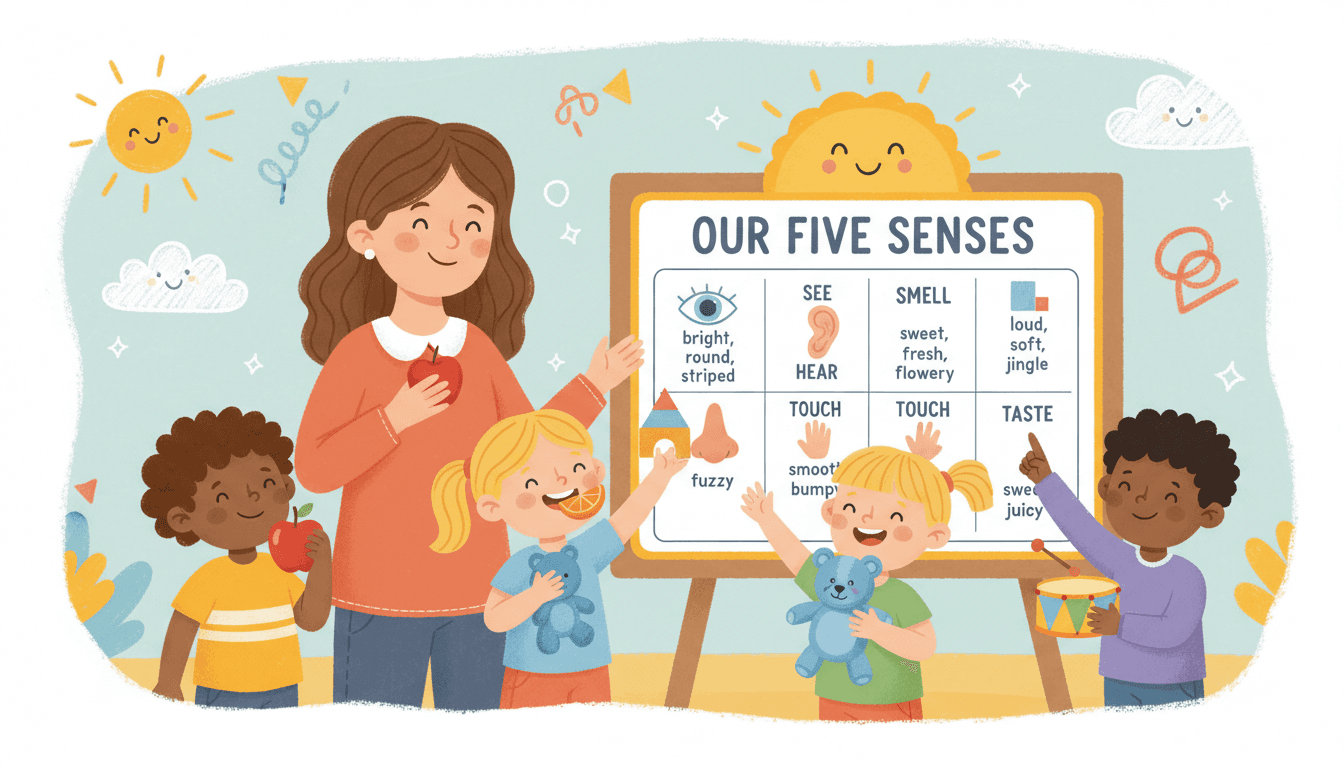
- Use the Five Senses to Find Adjectives Everywhere
- Introduce Color, Size, and Shape as Adjectives
- Explore Feeling and Texture Words
- Try Comparative Adjectives (Big, Bigger, Biggest)
- Read Aloud to Collect Describing Words
- Build Adjective Sentences Together
- Connect Adjectives to Drawing and Writing
- Play Games That Build Describing Vocabulary
- How to Know When They've Really Got It
1. Start With the Concept of Describing Words
Before you introduce the word "adjective," spend a few lessons on the concept of describing. Kindergartners respond well to the idea that some words tell us more about a person, place, or thing.
The simplest way to explain it: "Nouns name things. Describing words tell us more about those things." Hold up a ball. "This is a ball. What can you tell me about it?" Students might say: "It's round." "It's red." "It's small." Write those words on the board. "All of these are describing words. They help us picture the ball."
Try these activities:
- Describe it before you show it: Put an object in a paper bag. Give one clue describing word at a time: "It's soft. It's white. It's small. It has long ears." Students guess what's inside.
- Two sentences game: Write two sentences on the board, one without a describing word ("The cat sat.") and one with ("The fluffy, orange cat sat."). Read both aloud. Ask: "Which sentence helps you picture the cat better?" Students naturally choose the second one, and that opens the conversation.
- Describing words web: Write a noun in the center of the board (like "pizza"). Draw a web around it and fill it with every describing word students can think of. Hot. Cheesy. Round. Delicious. Messy.
- Name a describing word, not a noun: After a few practice rounds, tell students: "I'm going to say a word. Thumbs up if it's a describing word, thumbs down if it's not." Call out: "happy," "table," "fuzzy," "run," "tiny." This builds the distinction quickly.
Don't worry too much about the formal term "adjective" right away. Once they truly understand describing words, the vocabulary label can come in a few lessons later.
Free Adjectives Worksheets for Kindergarten


2. Use the Five Senses to Find Adjectives Everywhere
One of the best frameworks for kindergarten adjective instruction is the five senses. When children connect describing words to what they see, hear, smell, taste, and touch, adjectives stop being abstract and become completely concrete.
Bring in a sensory object. An orange works beautifully. Pass it around the circle and ask each student to describe it using one sense. "It's bright orange." "It smells sweet." "It feels bumpy." "It tastes sour." "It sounds crunchy when you peel it." Write every word on a five-senses chart.
Try these activities:
- Sense sorting: Give students a list of adjectives (or picture cards with adjective words). They sort them by which sense each word belongs to: see (green, sparkly, huge), touch (rough, cold, smooth), smell (fresh, stinky), taste (sweet, salty, sour), sound (loud, quiet, crunchy).
- Sensory bags: Fill small ziplock bags with different materials (sand, cotton balls, dry pasta, foil). Students feel the bag without opening it and write two touch adjectives for each one.
- Five senses journal page: After a science walk outside, students draw something they observed and label it with one adjective for each sense they used.
- Mystery smell jars: Fill small jars with cotton balls soaked in different scents (vanilla, lemon, cinnamon). Students smell each one and write two smell adjectives for it.
The five senses framework also ties beautifully into science activities, so you can reinforce adjective vocabulary during science time without adding extra lessons.
3. Introduce Color, Size, and Shape as Adjectives
Color, size, and shape words are often the first adjectives kindergartners learn, because they're the most visible and concrete. Most of our little ones already know these words. The work here is helping them understand that these familiar words belong to the adjective family.
Start with colors. Hold up a red apple. "The apple is red. Red is a describing word. It tells us what color the apple is." Move to size: "Is the apple big or small?" And then shape: "Is it round or oval?" Each time, reinforce: "These are all describing words that tell us more about the apple."
Try these activities:
- Color adjective sort: Give students sets of picture cards. They sort by color, but instead of just sorting, they say a full sentence: "The big red apple goes here." The more sentence practice, the better.
- Size comparison line-up: Gather three objects of different sizes (big block, medium block, small block). Have students describe them using size words. Then ask: "If the middle one is 'medium,' what's a word for the biggest one? What about the smallest?"
- Shape hunt: Take a shape walk around the classroom. Students find objects and describe their shape. "The clock is round. The door is tall and rectangular. The window is square."
- Color, size, shape sentence builder: Give each student a noun card and three adjective cards (one color, one size, one shape). They build a sentence: "I see a small, round, blue button."
Honestly? Color, size, and shape adjectives are so embedded in kindergarten learning already that this section often feels like the easiest win. Students feel confident because they know the words. You're just helping them name and use those words more intentionally.
4. Explore Feeling and Texture Words
Once color, size, and shape are solid, it's time to add emotion and texture adjectives. These are the words that make writing feel alive: happy, scared, rough, smooth, sticky, soft, sharp, wobbly.
Texture words connect directly to the sense of touch, which kindergartners find endlessly interesting. Emotion words tie to social-emotional learning, which you're probably already teaching. So this section brings two worlds together.
Try these activities:
- Texture wall: Create a small wall display with small squares of different materials: sandpaper, velvet, foil, bubble wrap, cotton. Students touch each one and add a sticky note with a texture adjective.
- How does it feel?: After any hands-on activity (sensory bin, art project, science experiment), pause and ask: "Give me a word that describes how this feels." Build a class list of texture adjectives over the year.
- Emotion adjective faces: Draw or print five simple emotion faces (happy, sad, angry, scared, surprised). Ask students to suggest two more adjectives for each emotion. Happy: joyful, excited. Scared: nervous, worried.
- Adjective story: Read a simple story with strong feeling words. Pause at key moments: "She felt scared. What's another word that means scared?" Students brainstorm synonyms and expand their adjective vocabulary.
This section also quietly teaches empathy. When we give our kiddos words for feelings, we give them tools for connection. That's worth more than any grammar test.
5. Try Comparative Adjectives (Big, Bigger, Biggest)
Comparative adjectives are where adjective instruction gets a little more sophisticated. Most kindergartners are ready for the concept of comparing two or three things using describing words, even if they won't use the term "comparative adjective" until later.
The pattern is simple: big, bigger, biggest. Tall, taller, tallest. Soft, softer, softest. Introduce it gradually, starting with just two objects before moving to three.
Try these activities:
- Three bears comparison: Use the Goldilocks story as your entry point. "Goldilocks tried the big bowl, the bigger bowl, and the biggest bowl." Students hear the pattern in a familiar context.
- Tower building: Give students blocks and have them build three towers of different heights. Then ask: "Which tower is tall? Which is taller? Which is tallest?" They label each one.
- Classroom comparison hunt: Ask students to find three objects in the classroom that are different sizes. They line them up and describe: "This pencil is short. This one is shorter. This one is the shortest."
- Comparing drawings: Students draw three animals of different sizes (a mouse, a cat, a horse) and label each with a size comparison adjective.
One honest moment: comparative adjectives can trip up some kiddos, especially the "est" forms. If students are mixing up "more bigger" instead of "biggest," that's developmentally normal. Gently model the correct form and keep going.
6. Read Aloud to Collect Describing Words
Picture books are hands-down the richest source of adjective instruction in kindergarten. Authors choose their words carefully, and the adjectives in quality children's books are vivid, varied, and perfectly matched to the illustration.
Choose books known for their language: "The Very Hungry Caterpillar," "Owl Babies," "Stellaluna," "Chrysanthemum," "Click, Clack, Moo." As you read, pause when you hit a strong adjective. "Enormous. That's a big describing word. What does enormous mean?"
Try these activities:
- Adjective hunting during read-aloud: Before reading, tell students: "Every time you hear a describing word, tap your knee." Stop and write the adjectives on a running list on the board.
- Replace the adjective: After reading a sentence with a strong adjective, ask: "What's another describing word we could use instead?" This builds vocabulary flexibility.
- Illustrator's adjectives: Look closely at an illustration. Ask: "What adjectives would the illustrator use to describe this scene?" Students describe what they see, not just what the text says.
- Class adjective book: After reading a favorite book, students each illustrate one scene and write two adjectives that describe it. Bind into a class response book.
Reading aloud with an adjective focus takes five extra minutes per book and pays off enormously. Over a school year, your students will accumulate hundreds of adjectives from the books you share together.
7. Build Adjective Sentences Together
Once your kiddos understand what adjectives are and have a solid bank of describing words, it's time to put them to work in sentences. This is the writing payoff.
Start with shared writing. You model, students contribute. Then move to guided writing with sentence frames, and finally to independent sentences.
Try these activities:
- Sentence expansion: Write a bare sentence on the board: "The dog ran." Ask: "Can we make this better? What kind of dog? What kind of run?" Build it out together: "The tiny, spotted dog ran quickly." (Note: "quickly" is an adverb, but that's fine, it still enriches the sentence.)
- Adjective sentence frames: Give students frames to complete: "The _____ (adjective) _____ (noun) is _____ (adjective)." Example: "The fluffy cloud is white." Students fill in their own words.
- Two adjective challenge: After students write any sentence, ask them to add two describing words to it. "I have a cat" becomes "I have a small, stripy cat." Celebrate the upgrade.
- Adjective partner game: In pairs, one student draws a mystery object without showing their partner. The drawing student gives three adjective clues. The guessing student draws what they imagine. Compare the two drawings. Did the adjectives give enough information?
For structured written practice, our kindergarten adjective worksheets walk students through matching describing words to pictures, identifying adjectives in sentences, and writing their own adjective sentences.
8. Connect Adjectives to Drawing and Writing
The true test of whether a child owns an adjective is whether they use it without being prompted. That happens most naturally during drawing and writing time.
Build a habit of asking one adjective question after every drawing: "Tell me three words that describe your drawing." Write down what they say. Over the year, students will start writing those words themselves.
Try these activities:
- Self-portrait with adjectives: Students draw themselves and label the drawing with five adjectives that describe them. Funny. Tall. Kind. Curly-haired. Strong. Display these as a "Who Am I?" gallery.
- My favorite place: Students draw their favorite place and write three adjectives that describe it. "The park is green, loud, and fun."
- Weather journal: Each morning, students draw the weather and write two adjectives. "The sky is gray and cloudy." Over a month, students build a full adjective journal without realizing it.
- Adjective revision: Take a sentence a student wrote earlier in the year with no adjectives. Show it to them now and ask: "Can you make this better with describing words?" The before/after comparison is powerful for students to see their own growth.
9. Play Games That Build Describing Vocabulary
Games work because they lower the stakes and raise the energy. When our little ones are laughing and competing (gently), they're not worried about getting the answer wrong. These games are fast, easy to run, and genuinely fun.
Try these activities:
- I Spy with describing words: Instead of "I spy with my little eye something beginning with B," play "I spy something that is small, brown, and round." Students use adjectives to guess the object.
- Adjective pass: Sit in a circle with a soft ball. Toss the ball to a student and say a noun. They must say an adjective to describe it before passing the ball on. No repeats.
- Opposite day: Call out an adjective and students respond with the opposite. "Hot!" , "Cold!" "Rough!" , "Smooth!" "Heavy!" , "Light!" Fast, fun, and builds antonym vocabulary alongside adjective vocabulary.
- Describe the monster: Give students a blank monster outline. They roll a die and follow a chart: 1 = color the monster, 2 = give it a size, 3 = add a texture feature, 4 = give it an emotion. When they're done, they describe their monster using all the adjective words they added.
Games also give you a real-time window into which adjectives have stuck and which ones need more practice.
10. How to Know When They've Really Got It
Adjective mastery in kindergarten isn't about perfect formal definitions. It's about confident, natural use. Here's what you're looking for:
- Spontaneous adjective use in conversation and writing. They stop saying "I want the ball" and start saying "I want the big red ball."
- Confidence with describing words in sentences. They can complete "The _____ dog is _____" without needing a word bank.
- Ability to add adjectives to improve a sentence. When you say "Make this sentence better," they know to add describing words.
- Recognizing adjectives in text. During a read-aloud, they can point out describing words unprompted.
- Using a variety of adjective types. They're reaching for texture words, emotion words, and comparison words, not just colors and sizes.
Frequently Asked Questions
What adjectives should kindergartners learn?
Kindergartners should learn describing words across several categories: colors (red, blue, yellow), sizes (big, small, tiny, huge), shapes (round, square, long), textures (rough, smooth, soft, bumpy), emotions (happy, scared, excited, sad), and basic comparatives (big, bigger, biggest). By the end of kindergarten, students should be able to use adjectives in oral sentences and in simple written sentences.
How do you explain adjectives to kindergartners?
Keep it concrete and sensory. Tell students that adjectives are "describing words" that tell us more about a person, place, or thing. Use objects they can touch, see, and smell. Ask questions like "What color is it? How does it feel? Is it big or small?" The answers to those questions are all adjectives.
What is the best way to teach adjectives to young children?
The five senses framework works particularly well because it gives children a systematic way to think about describing words. Pairing this with read-alouds (where strong adjectives appear in context), movement activities, and sensory explorations gives children multiple pathways to the same concept. Consistency matters more than any single activity.
Are comparatives taught in kindergarten?
Basic comparatives like big/bigger/biggest and tall/taller/tallest are appropriate for kindergarten, particularly in the second half of the year. Students don't need to name these as "comparatives" yet. The goal is for them to use the forms correctly in conversation and simple writing. Formal terminology can come in first grade.
Keep Reading
- How to Teach Prepositions to Kindergartners: Activities, Tips, and What Actually Works
- How to Teach Pronouns to Kindergartners: Activities, Tips, and What Actually Works
- How to Teach Sentences to Kindergartners: Activities, Tips, and What Actually Works
Wrapping Up
Teaching adjectives to kindergartners is one of the most genuinely fun parts of early grammar instruction. Our little ones are natural describers. They notice everything. They want to tell you exactly how something looks, feels, smells, and tastes.
Your job is to give them the vocabulary to do it well, the practice to use it confidently, and the space to discover that their words can paint pictures.
Start this week with a simple mystery bag activity or a five-senses chart. Once your kiddos realize that describing words make everything more interesting, they won't stop using them 🙌
For ready-to-use practice, explore our full collection of kindergarten adjective worksheets. They cover everything from matching describing words to pictures, to writing adjectives in sentences, at exactly the right level for kindergarten.
Happy teaching!

Adi Ackerman
Head Teacher
Adi is the Head Teacher at ClassWeekly, with years of experience teaching elementary students. She designs our curriculum-aligned worksheets and writes practical guides for teachers and parents.
Keep Reading
Ready to download? Try ClassWeekly free for 30 days.
Unlimited worksheets for PreK through 5th grade. Cancel anytime.