
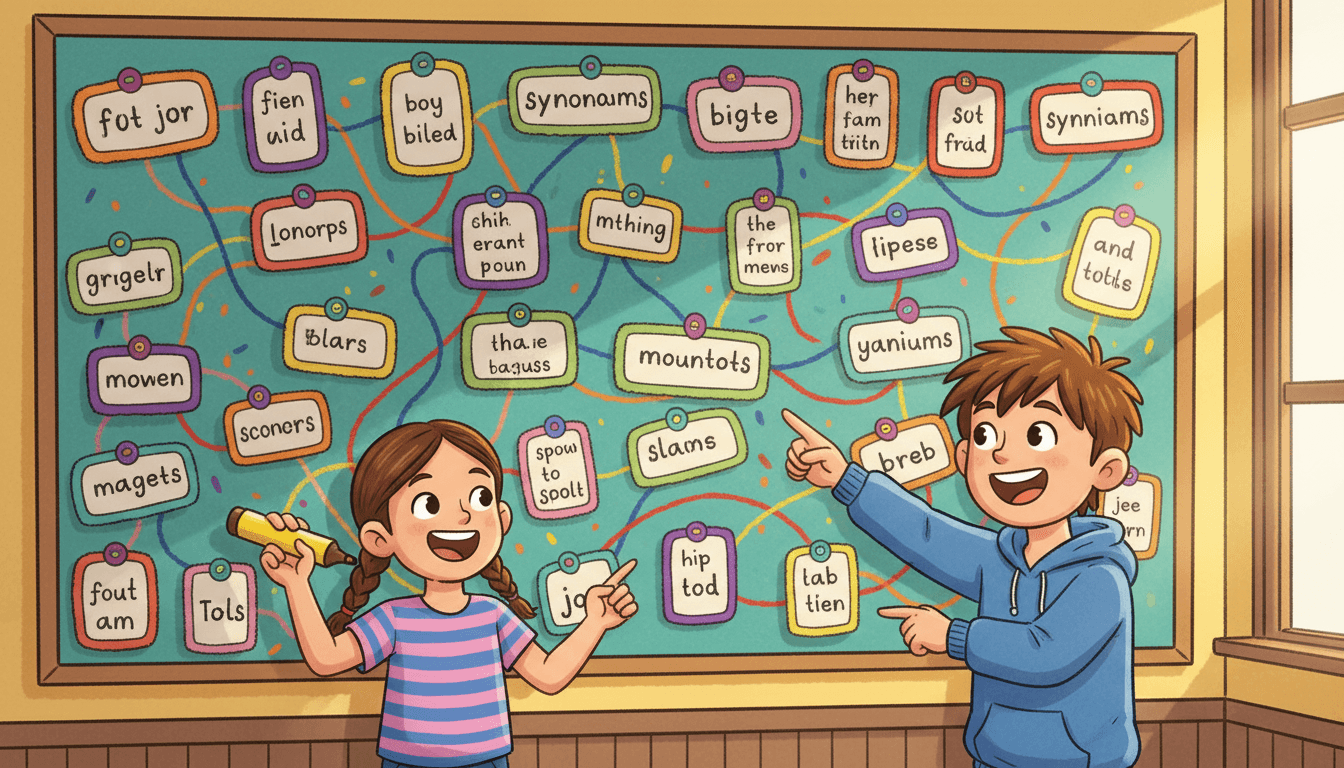
Synonyms for Kids: What They Are and How to Teach Them
Get 30 days of free worksheet downloads
Key Takeaways
- Synonyms are words that mean the same or nearly the same thing, but most are not perfect substitutes - they carry different intensity or feeling, which is worth teaching explicitly in grades 3 and 4.
- Replacing overused words like 'said,' 'nice,' and 'good' with synonym alternatives is one of the fastest ways to improve elementary student writing quality.
- The S/S memory trick (Synonym = Same) reliably helps students stop confusing synonyms with antonyms, and a word intensity ladder extends the concept for older students.
- Introducing 3 to 5 synonym pairs per week with repeated exposure across multiple activity types leads to better retention than handing students a full list at once.
- Synonym skills directly support reading comprehension by giving students a strategy for decoding unfamiliar words through substitution with a known equivalent.

Here's something that probably doesn't get said enough: synonyms are one of the most useful grammar skills your students will ever learn. Not because they show up on tests (they do), but because they change the way kids write and read.
When a second grader realizes that "said" can also be "whispered," "shouted," or "announced," something clicks. Their writing gets more interesting. Their reading comprehension goes up. And honestly? They start paying closer attention to the words around them.
Let's break down how to teach synonyms in a way that actually sticks.
What Are Synonyms (A Simple Explanation)
Keep it simple: synonyms are words that mean the same thing, or almost the same thing.
Happy and glad. Big and large. Fast and quick.
That "almost" part matters, though. Most synonyms aren't perfect substitutes. "Happy" and "ecstatic" are synonyms, but they carry different weight. You wouldn't say "I'm ecstatic about my sandwich" (well, maybe you would, but your students would notice something feels off).
For younger kids, start with the simple definition and perfect pairs. As they move into 3rd and 4th grade, introduce the idea that synonyms can have slightly different feelings or levels of intensity.
A kid-friendly way to explain it: "Synonyms are like different outfits for the same idea. The idea stays the same, but it looks a little different depending on which word you choose."
Free Synonym Practice Pages for 2nd Grade


Why Synonyms Matter for Reading and Writing
Why spend time on synonyms when there are so many other grammar skills to cover? Few reasons:
Reading comprehension. When kids encounter an unfamiliar word in a text, knowing synonyms helps them substitute a word they do know. "The dog was enormous" becomes clear if they know "enormous" is like "really, really big."
Writing variety. Nothing makes a paragraph drag like the same word repeated five times. Synonyms give your students options. Instead of "The cat was nice. The weather was nice. The food was nice," they can mix it up.
Vocabulary growth. Learning synonyms naturally expands a child's word bank. Every new synonym is a new tool they can use.
Test readiness. Synonym questions appear on standardized reading assessments from 2nd grade onward. Kids who practice them casually all year won't panic when they show up on a test.
Synonym Word Lists by Grade Level
Here are starter lists organized by grade. These aren't exhaustive, but they give you a solid foundation to build from.
2nd Grade Synonyms:
- happy / glad
- sad / unhappy
- big / large
- small / little
- fast / quick
- pretty / beautiful
- start / begin
- end / finish
- nice / kind
- scared / afraid
3rd Grade Synonyms:
- angry / furious
- smart / intelligent
- brave / courageous
- quiet / silent
- loud / noisy
- funny / hilarious
- tired / exhausted
- shy / timid
- fix / repair
- grab / snatch
4th Grade Synonyms:
- enormous / gigantic
- ancient / old
- brilliant / clever
- destroy / demolish
- journey / voyage
- observe / watch
- refuse / decline
- fortunate / lucky
- vanish / disappear
- generous / charitable
Quick tip: Don't hand kids the whole list at once. Introduce 3 to 5 pairs per week and let them marinate. Repetition across different activities is what makes these stick.
Activities That Make Synonym Practice Fun
Sitting with a list of word pairs isn't going to cut it for most of our kiddos. Here are activities that get them moving and thinking:
Synonym Match-Up Cards. Write words on index cards (one word per card). Students spread them out face-up and match the synonym pairs. Start with 10 cards (5 pairs) and work up to 20.
Synonym Relay Race. Write a word on the board. Two teams race to write as many synonyms as they can in 60 seconds. The team with the most correct synonyms wins. This gets loud. In a good way.
Word Upgrade Challenge. Give students a "boring" sentence like "The dog was big." They rewrite it using a synonym: "The dog was enormous." Then try to upgrade it again: "The dog was colossal." Kids love seeing how far they can push it.
Synonym Bingo. Create bingo cards with common words. Call out synonyms instead of the actual words. Students have to figure out which word on their card matches. Great for listening skills too.
Partner Synonym Swap. Students write a short paragraph (4 to 5 sentences). Then they swap with a partner, who circles words that could be replaced with synonyms and writes suggestions above them. This is peer editing and synonym practice in one.
Synonyms in Writing (Replacing Overused Words)
This is where synonyms go from a grammar exercise to a real writing skill.
Start by identifying the most overused words in your students' writing. For most elementary classrooms, the usual suspects are: said, nice, good, bad, big, small, happy, sad, and went.
Create a classroom "Tired Words" chart. On one side, the overused word. On the other side, 5 to 8 synonyms. Post it where kids can see it during writing time.
Here's a sample for "said":
- whispered
- shouted
- announced
- mumbled
- exclaimed
- replied
- asked
- wondered
And one for "good":
- excellent
- wonderful
- fantastic
- great
- terrific
- outstanding
The goal isn't to ban simple words. Sometimes "said" is exactly the right choice. The goal is to give kids options so they can pick the word that best fits their meaning. "She said goodbye" feels different from "She whispered goodbye." Both are correct. But the second one tells the reader something more.
Honestly, when students start choosing words intentionally instead of defaulting to the first one that comes to mind, their writing takes a real leap forward.
Common Confusions With Synonyms and Antonyms
This comes up every single year: kids mix up synonyms and antonyms. It makes sense. Both involve word pairs. Both get taught around the same time. And the words "synonym" and "antonym" sound similar enough to cause confusion.
Here's how to keep them straight:
Synonyms = Same. Both start with S. Same meaning.
Antonyms = Anti. "Anti" means opposite. Opposite meaning.
Write this on the board and leave it up for weeks. Seriously. The S/S connection (synonym/same) is the simplest anchor, and it works.
Another common mix-up: students think synonyms have to mean exactly the same thing. They'll argue that "happy" and "ecstatic" aren't synonyms because "ecstatic is way more than happy." This is actually a great teaching moment. Introduce the idea of a synonym scale or word intensity ladder:
sad → unhappy → miserable → devastated
All synonyms. All mean something similar. But the intensity is different. This concept clicks well with 3rd and 4th graders who are ready for more nuance.
Keep Reading
- Compound Words for Kids: Activities and Practice Pages
- Idioms for Kids: 50 Common Idioms With Meanings and Examples
- Teaching Idioms to Kids: Activities That Make Figurative Language Fun
Practice Pages for Synonym Skills
Once your students understand what synonyms are and have practiced with hands-on activities, it's time for some independent practice.
Targeted vocabulary practice pages help build recognition and recall. Look for activities that ask students to match synonym pairs, choose the best synonym in context, and replace overused words in sentences.
The combination of active classroom practice and focused written practice is what builds lasting synonym skills. Your kiddos won't just memorize pairs. They'll start noticing synonyms everywhere, in their reading, in conversations, even on signs and menus.
And that's when you know it's clicked 😊

Adi Ackerman
Head Teacher
Adi is the Head Teacher at ClassWeekly, with years of experience teaching elementary students. She designs our curriculum-aligned worksheets and writes practical guides for teachers and parents.
Keep Reading
Ready to download? Try ClassWeekly free for 30 days.
Unlimited worksheets for PreK through 5th grade. Cancel anytime.