
Double Consonant Words: Rules and Practice for Young Readers
Get 30 days of free worksheet downloads
Key Takeaways
- The FLOSS rule is the most reliable double consonant pattern for young spellers: after a short vowel in a one-syllable word, the letters f, l, s, and z are always doubled.
- Doubled consonants keep the preceding vowel sound short, which is why 'dinner' and 'diner' are spelled and pronounced differently.
- The 1-1-1 check helps second graders add suffixes correctly: if a word has 1 syllable, 1 short vowel, and 1 final consonant, double that consonant before -ing, -ed, or -er.
- Words ending in two different consonants (like 'jump') never double before a suffix, and words ending in x never double at all.
- Reading misspelled words aloud is the most effective correction strategy because it lets students hear why the double consonant matters for vowel sound and meaning.

Double consonants are one of those spelling patterns that shows up everywhere in English. Your students are already reading and writing words like "happy," "kitten," and "rabbit" without thinking about it. But spelling those words correctly? That second consonant trips kids up constantly.
The good news is that double consonant rules are actually more predictable than most English spelling rules. There's a real pattern here, and once your kiddos see it, spelling gets a lot less mysterious.
What Are Double Consonant Words
A double consonant word is any word that has the same consonant letter written twice in a row. The two letters sit right next to each other and usually make a single sound.
Examples your students already know: bell, miss, buzz, egg, off, doll, hill, add.
Here's what matters for your classroom: those doubled letters affect the vowel sound that comes before them. In "dinner," the short i sound stays short because of the double n. Compare that to "diner," where a single n lets the i say its long name. That vowel connection is the whole reason double consonants exist in English spelling.
For first graders, start with the simplest version: "Sometimes we need two of the same letter to keep the vowel sound short." You don't need to go deeper than that initially. Second graders can handle the more specific rules.
Quick vocabulary: The consonants that double most often in elementary words are ff, ll, ss, zz, dd, gg, mm, nn, pp, rr, and tt. Some letters almost never double (you won't see "jj" or "vv" in standard English).
Free Spelling Practice Pages for 1st Grade


The Rules Behind Double Consonants
English spelling can feel random, but double consonants actually follow some reliable patterns. Here are the rules that matter most for 1st and 2nd graders.
Rule 1: The FLOSS rule. After a single short vowel at the end of a one-syllable word, the letters f, l, s, and z are doubled. That's why we write "stuff" (not "stuf"), "bell" (not "bel"), "miss" (not "mis"), and "buzz" (not "buz"). This rule is called FLOSS because of the letters it covers: F, L, S (and sometimes Z).
Not sure there's a perfect formula for this, but here's what tends to work.
The FLOSS rule is probably the most important double consonant pattern for your young spellers. It covers dozens of common words and gives kids a real reason for those doubled letters.
Rule 2: Short vowel + consonant in two-syllable words. When a short vowel is followed by a single consonant sound between two syllables, the consonant is often doubled: rabbit, kitten, butter, dinner, happy, puppy. The double consonant keeps the first vowel short.
Rule 3: The doubling rule for suffixes. When adding a suffix that starts with a vowel (like -ing, -ed, -er) to a short vowel word, double the final consonant: run becomes running, hop becomes hopping, big becomes bigger. This one is probably more of a 2nd grade rule, but strong first graders can start noticing it.
Important exception kids should know: Words ending in x never double the x. "Box" becomes "boxing," not "boxxing." And words with two vowels before the final consonant don't double: "rain" becomes "raining," not "rainning."
Common Double Consonant Words for Each Grade
Here are the words your students should be able to read and spell at each level.
First grade (high-frequency words):
- ff words: off, puff, stuff, cliff, sniff
- ll words: bell, tell, hill, doll, ball, fall, well
- ss words: miss, boss, dress, kiss, less, mess
- zz words: buzz, fizz, jazz, fuzz
- Other doubles: egg, add, odd, mitt
Second grade (expanding vocabulary):
- tt words: kitten, mitten, butter, better, letter, button
- nn words: dinner, penny, bunny, funny, sunny, winner
- pp words: happy, puppy, zipper, pepper, apple, hippo
- rr words: carrot, parrot, berry, carry, mirror
- dd words: ladder, middle, puddle, riddle, paddle
Post a "double consonant word wall" in your classroom and add new words as your students encounter them during reading. By the end of the unit, your wall becomes a spelling reference they can use all year.
When to Double the Consonant (Spelling Rules)
This section is where spelling really comes together for your students. When they're writing and need to decide "one letter or two," these decision steps help.
Step 1: Listen for the vowel sound. Is the vowel short (like the a in "cat") or long (like the a in "cake")? Short vowels are the ones that usually need a double consonant after them.
Step 2: Count the consonants after the vowel. If there's only one consonant sound after a short vowel at the end of a word, it probably needs to be doubled. "Stuf" looks wrong because it is. It needs that second f.
Step 3: Check the FLOSS letters first. If the word ends in f, l, s, or z after a short vowel, double it. This covers the most common cases.
A helpful classroom trick: Write pairs of words on the board and have students read them aloud. "Diner" vs. "dinner." "Later" vs. "latter." "Hoping" vs. "hopping." Can they hear the vowel difference? The doubled consonant is the gatekeeper that keeps the vowel short.
For second graders adding suffixes, teach the "1-1-1 check." If a word has 1 syllable, 1 short vowel, and ends in 1 consonant, double that consonant before adding -ing, -ed, or -er. Hop (1 syllable, short o, ends in p) becomes hopping. Help (1 syllable, short e, but ends in TWO consonants) stays helping. The rule is consistent once you know how to check.
Activities for Teaching Double Consonants
Spelling rules need practice, but they don't need to be boring. Here are activities that get your students noticing and using double consonant patterns.
- Sort it out. Give students a stack of word cards. They sort them into two groups: single consonant words and double consonant words. Then discuss: what do the double consonant words have in common?
- Magnetic letter building. Set up a station with magnetic letters. Students build words from a list, physically placing two of the same letter side by side. There's something about handling that second letter that makes the pattern stick.
- Missing letter fill-in. Write words on the board with blanks where the consonants go: bu__er, ki__en, ha__y, be__. Students decide: one letter or two? This forces them to think about the rule instead of just memorizing.
- Word family chains. Start with a base word like "bell." Students build a chain: bell, tell, fell, sell, well, yell. All follow the same double-l pattern. Then try it with -iss (miss, kiss, hiss) or -uff (puff, stuff, bluff, cuff).
- Dictation with a twist. Read sentences aloud and have students write them. Include words where the double consonant matters: "The funny bunny hopped up the grassy hill." After writing, students circle every double consonant they find in their own sentences.
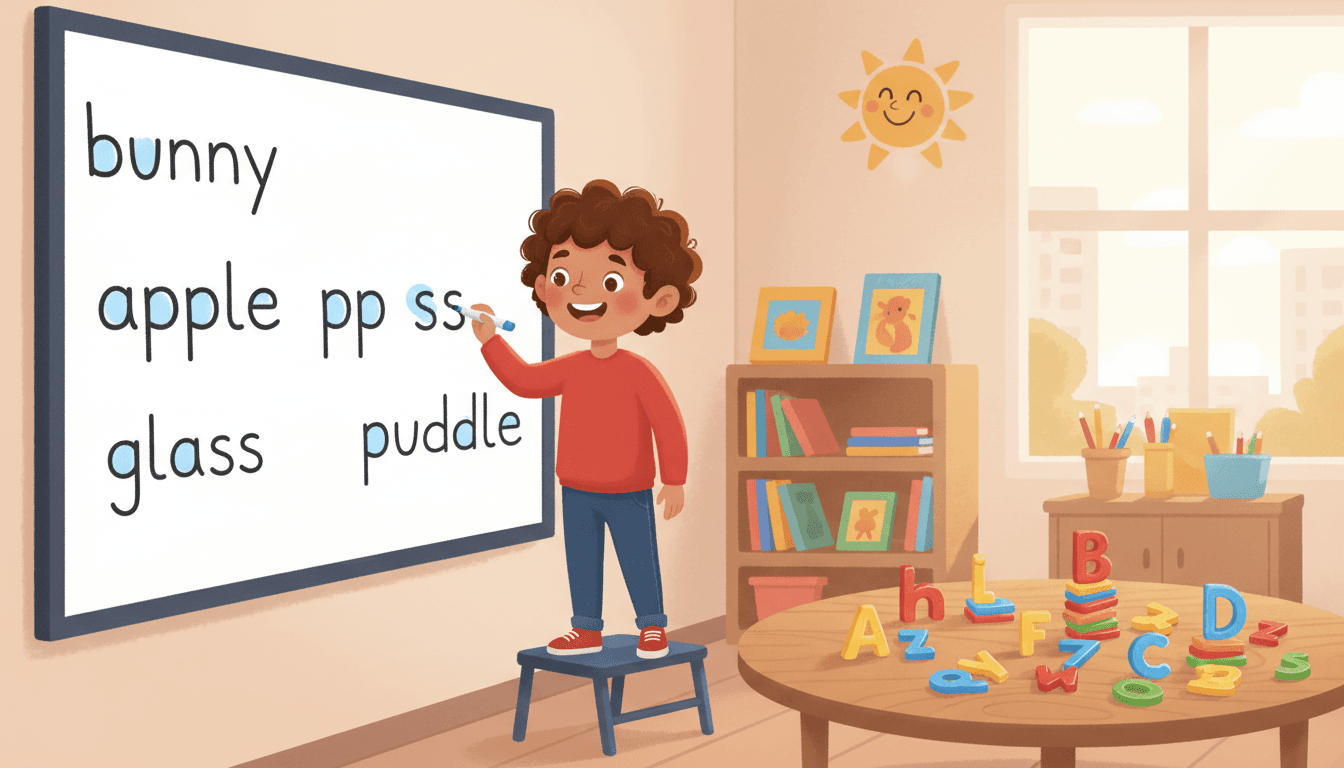
Don't forget the visual component. Having students highlight or underline the doubled letters in a different color helps the pattern become visible. When "happy" always has those two p's colored red, the brain starts expecting them.
Common Spelling Mistakes to Watch For
Here are the errors you'll see most often, and they're completely predictable.
Dropping the second consonant. "Hil" instead of "hill." "Mis" instead of "miss." This happens because kids hear one sound, so they write one letter. Remind them: the double letter isn't about the sound, it's about keeping the vowel short.
Doubling when they shouldn't. "Winnd" instead of "wind." "Jumpping" instead of "jumping." Once kids learn the doubling rule, some of them apply it everywhere. Gently redirect: doubling only happens in specific patterns, not every time you see a consonant.
Confusing similar words. "Dinner" vs. "diner." "Hopping" vs. "hoping." These pairs are actually a great teaching tool. Write both versions on the board, read them aloud, and discuss how that one extra letter changes the vowel sound and the meaning.
Adding double consonants to words ending in two different consonants. "Jumping" doesn't need doubling because the word "jump" already ends in two consonants (m and p). The 1-1-1 rule only applies when there's ONE final consonant.
The best correction strategy? Don't just mark it wrong. Have the student read the word aloud as they spelled it. If they wrote "diner" but meant "dinner," reading "diner" (with a long i) out loud helps them hear why the spelling matters.
Keep Reading
- Compound Words for Kids: Activities and Practice Pages
- Teaching Nouns and Verbs to First Graders
- Teaching Punctuation to First Graders: Periods, Question Marks, and More
- Google Docs for Young Writers: Setting Kids Up to Succeed
Practice Pages That Build Spelling Confidence
Hands-on activities build understanding, but practice pages build independence. Your students need both.
Good spelling practice for double consonants should include a mix of tasks: circling the correct spelling from two options (bell or bel?), filling in missing letters, sorting words by their double consonant pattern, and writing sentences using spelling words.
For first graders, keep it visual. Picture-based spelling pages where kids see an image of a bell and choose between "bel" and "bell" are perfect. They're matching a word they can read to a picture they understand.
For second graders, step up to the suffix challenge. Pages where students add -ing or -ed to base words and decide whether to double the final consonant build the decision-making skill that matters most for long-term spelling success.
Send practice home, too. Double consonant patterns are easy for parents to reinforce. A simple homework page with 10 words to sort or spell gives families a concrete way to support what you're teaching in class.
Explore more spelling practice pages for 1st grade for additional activities that match what your students are learning.
Double consonants might seem like a small detail, but they're actually one of the most useful spelling patterns in English. Once your kiddos internalize these rules, they'll spell dozens of common words correctly without even thinking about it. And that kind of automatic spelling frees up their brains for the really important stuff: expressing their ideas 😊

Adi Ackerman
Head Teacher
Adi is the Head Teacher at ClassWeekly, with years of experience teaching elementary students. She designs our curriculum-aligned worksheets and writes practical guides for teachers and parents.
Keep Reading
Ready to download? Try ClassWeekly free for 30 days.
Unlimited worksheets for PreK through 5th grade. Cancel anytime.