
Sentences for Kindergarten: Teaching Sentence Writing
Get 30 days of free worksheet downloads
Key Takeaways
- A sentence is a complete thought with two parts: a naming part (who or what) and a doing part (what they do), and kindergartners can apply this test to their own writing.
- Teaching sentence fragments through contrast and fix-it activities builds stronger recognition than rules alone, because students feel the incompleteness before they can name it.
- Capital letters and periods should be reinforced as a consistent routine during every shared writing session, not just as a standalone lesson.
- Telling sentences should be taught before questions and exclamations because they are the most natural sentence type for kindergartners and build early confidence.
- Shared writing is the most effective instructional tool for sentence building because it makes the teacher's grammar thinking visible while keeping the cognitive load manageable for young writers.

How to Teach Sentences to Kindergartners: Activities, Tips, and What Actually Works
A kindergartner hands you a piece of paper. On it, in shaky letters: "The dog."
"Wonderful!" you say. And you mean it. But in the back of your mind, you're thinking: almost. One more piece and you've got a sentence.
Teaching sentences in kindergarten is that moment when all the small pieces of grammar knowledge come together: nouns and verbs, capital letters and periods, the idea that words have to work as a team to make meaning. It's one of the most exciting milestones in early literacy, and it's more reachable than most teachers and parents expect.
Our little ones are already saying sentences out loud all day. Our job is to help them recognize what a sentence is, understand why it's complete, and write one with confidence.
Here are 10 practical ways to teach sentences to kindergartners:
- Start With What a Sentence Actually Is
- Teach Subject Plus Verb as the Core
- Show the Difference Between a Sentence and a Fragment
- Introduce Capital Letters and Periods
- Teach Telling Sentences First
- Add Asking Sentences
- Explore Exclaiming Sentences
- Build Sentences Together Through Shared Writing
- Play Games That Make Sentences Stick
- How to Know When They've Really Got It
1. Start With What a Sentence Actually Is
The most important idea in all of sentence instruction: a sentence is a complete thought. It tells us something that makes sense on its own. It doesn't leave us hanging.
"The dog" is not a sentence. We're waiting. The dog what? "The dog runs." Now we know something. The sentence is complete.
This idea of "does it tell us enough?" is the key diagnostic question for kindergartners. They can apply it to their own writing without needing to know the terms "subject" and "predicate."
Try these activities:
- Complete or not complete?: Read a word group aloud and ask: "Does this tell us enough? Is it a complete thought?" Read "The big red apple." Pause. Students feel the incompleteness. Then read "The big red apple fell." They feel the completion. This contrast is the whole lesson.
- Finish it: Give students an incomplete phrase and ask them to complete it into a sentence. "The bird ___." "My mom ___." "We ___." They supply the finishing word or phrase and suddenly feel the satisfaction of a complete thought.
- Complete thought sorting: Give students strips of paper, some with complete sentences, some with fragments. They sort them into "Complete" and "Not Complete" piles. After sorting, they try to fix each incomplete one.
- Thumbs up, thumbs down: Read word groups aloud. Thumbs up if it's a complete thought. Thumbs down if something is missing. Fast, clear, and easy to run.
Don't rush past this step. The concept of "complete thought" is the anchor for every other sentence lesson. Students who internalize this concept will fix their own writing fragments for years to come.
Free Kindergarten Sentence Worksheets


2. Teach Subject Plus Verb as the Core
Once students understand that a sentence is a complete thought, introduce the two parts that make it complete: the subject (who or what the sentence is about) and the verb (what the subject does or is).
For kindergarten, keep the terminology simple. Call them the "naming part" and the "doing part." Every sentence needs both.
"Dogs run." Dogs: naming part. Run: doing part. "She laughs." She: naming part. Laughs: doing part. "The sun shines." The sun: naming part. Shines: doing part.
Try these activities:
- Two-part sentence chart: Create an anchor chart with two columns: "Naming Part (Who or What)" and "Doing Part (What They Do)." Add examples together. Grow the chart throughout the unit.
- Naming part and doing part sort: Write sentence parts on cards. Give students a set of naming part cards and a set of doing part cards. They match them up to make complete sentences. Some combinations will be silly ("The pizza runs") and that's fine. Silly sentences are memorable.
- Point to each part: Write a sentence on the board. Ask a student to come up and underline the naming part in one color, the doing part in another color. Do this with 10-15 sentences across multiple days.
- Two-word sentence challenge: Give students a naming part card. They must write the shortest possible complete sentence by adding only one doing word. "Dogs bark." "Birds fly." "Rain falls." This strips sentence building to its essentials.
The two-part structure is something students can apply in editing too. When they're not sure if they've written a sentence, ask: "Do you have a naming part? Do you have a doing part?" If yes to both: complete sentence.
3. Show the Difference Between a Sentence and a Fragment
A fragment is an incomplete sentence. It's missing either the naming part, the doing part, or both. Fragment awareness is a critical skill because most kindergarten writing errors are fragments, and students who can spot fragments can fix them.
The good news: five-year-olds have very strong intuitions about what sounds "finished." You can tap into that.
Try these activities:
- Finish the fragment game: Read a fragment dramatically, then pause with a confused face. "The happy cat in the tree." Wait. Students feel the incompleteness. "What do we need? A doing part!" Students suggest endings: "...slept." "...jumped down." "...meowed loudly."
- Sentence or fragment?: Write a mix of sentences and fragments on cards. Students hold up a green card for a complete sentence and a red card for a fragment. Go through 10 examples quickly.
- Fix it!: Give students a fragment and ask them to fix it into a complete sentence. The only rule: it must make complete sense. Students love "fixing" things that are broken.
- My best fragment fix: Write a fragment on the board each morning as a warm-up. Students write one sentence in their journals that fixes it. Share two or three fixes as a class.
One important note: be careful not to make students afraid of fragments. The goal is awareness, not anxiety. When you find a fragment in a student's writing, frame it positively: "You've got a great naming part here. What is the cat doing? Let's add that."
4. Introduce Capital Letters and Periods
A sentence has a beginning and an end. The beginning starts with a capital letter. The end has a period (or another end mark, which comes later). These two conventions are the visible signals that something is a sentence.
Most kindergartners know that the first word in a sentence starts with a capital letter, but many don't yet apply it consistently in their own writing. The period is often the last thing students remember, especially when they're focused on spelling and content.
Try these activities:
- Sentence frame with rules: Any time you write a sentence together on the board, stop at the beginning: "First word. Capital letter." Stop at the end: "Sentence done. Period." Say it every time. The routine builds automatic awareness.
- Capital and period hunt: Give students a short passage. They use one color crayon to circle all the capital letters at the start of sentences and another color to box all the periods. Counting how many sentences they find adds a math connection.
- Fix the sentence: Write a sentence on the board without the capital and period: "the cat sat on the mat." Students spot what's missing and fix it. Run this as a daily editing warm-up.
- Traffic light analogy: Green light = capital letter, the sentence can start. Red light = period, the sentence stops. Students love the visual and it gives them language to use when they self-check their writing.
One honest reality: most kindergartners will still forget periods regularly, especially mid-year. This is developmentally normal. Consistent, gentle reminders ("Check your red light!") over the whole year work better than any one lesson.
5. Teach Telling Sentences First
There are different types of sentences, and telling sentences (also called declarative sentences) are the right starting point. These are the sentences that state a fact or give information. They end with a period.
"The dog is brown." "I like pizza." "It is raining today." These are the sentences kindergartners write most often and read most often.
Try these activities:
- Telling sentence starters: Give students starter prompts and ask them to write one telling sentence for each: "Today is ___." "My favorite food is ___." "I can ___." Simple starters lead to complete telling sentences.
- Class telling sentence book: Each student contributes one page: a drawing plus a telling sentence describing it. Bind into a class book and read it aloud. Students love hearing their own sentences read out loud.
- News of the day: Practice oral telling sentences during morning meeting. "Today is Monday. It is sunny. We have art today." Students contribute one telling sentence each about the day.
- Telling sentence sort: Give students a mix of question sentences and telling sentences. They sort them. Focus on the telling sentences: all start with capital letters, all end with periods, all state a fact.
Telling sentences feel natural to kindergartners because they're constantly telling things. This category should move quickly and give students early confidence before you introduce questions and exclamations.
6. Add Asking Sentences
Asking sentences (questions) are a natural next step because kindergartners ask questions constantly. The distinction is simple: asking sentences end with a question mark instead of a period, and they're asking for information rather than stating it.
Many questions also start with a question word: who, what, where, when, why, how. But not all questions do ("Is the dog brown?"), so don't make question words the only signal.
Try these activities:
- Turn a telling into an asking: Write a telling sentence: "The dog is brown." Ask students: "How could we turn this into a question?" Model: "Is the dog brown?" This side-by-side comparison shows the structural shift clearly.
- Question word starters: Practice writing questions starting with who, what, where, when, why, how. Give students a noun card (a cat, a tree, the class) and ask them to write a question about it using one question word.
- Class question board: Keep a running board of "Questions We Have." Students post one question per week. Each question must be a complete asking sentence with a question mark. Review the board together.
- Question or telling?: Read sentences aloud. Students say "question" (and raise a hand) or "telling" (and sit still). Then show the sentence on the board: "Was I right? Does it end with a question mark or a period?"
After this section, students should reliably know that a question mark signals an asking sentence and a period signals a telling sentence. The distinction is simple and very visual.
7. Explore Exclaiming Sentences
Exclaiming sentences (exclamatory sentences) express strong emotion or surprise. They end with an exclamation mark. "The puppy ran away!" "I can't believe it!" "Watch out!"
Kindergartners love exclamation marks. Honestly, they overuse them sometimes, which is fine at this stage. Enthusiasm is easier to redirect than reluctance.
Try these activities:
- What would you shout?: Ask students to imagine situations that would make them shout with excitement or surprise. "You just won a prize! What would you say?" Students suggest sentences, and you write them with an exclamation mark.
- Read with expression: Show two versions of the same sentence: "The dog jumped." vs. "The dog jumped!" Read the first one flat. Read the second one with full exclamation energy. Students immediately hear and feel the difference.
- Emotion-matched writing: Give students an emotion card (excited, surprised, scared, thrilled). They write one sentence that expresses that emotion, ending with an exclamation mark.
- Three types chart: Create a class anchor chart with three columns: Telling (.), Asking (?), Exclaiming (!). Fill in examples together. Refer to this chart whenever you're writing.
Once students know all three sentence types, they have a framework for understanding why punctuation choices matter. A period, a question mark, and an exclamation mark all carry different meanings. This is a powerful early insight into writer's craft.
8. Build Sentences Together Through Shared Writing
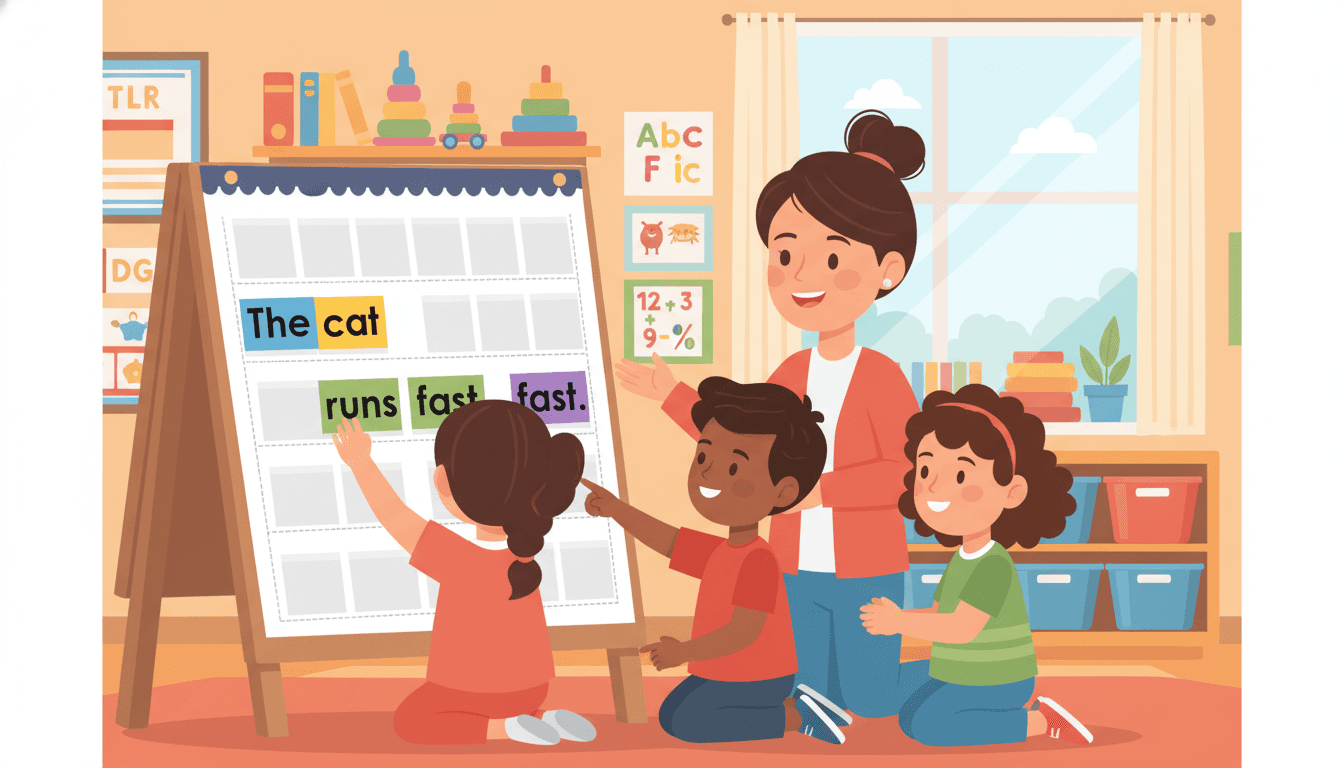
Shared writing is the most effective instructional tool for sentence building at the kindergarten level. The teacher writes while students contribute the words and ideas. The teacher makes the grammar thinking visible out loud.
"I need a naming part first. What should we write about? A dog. OK. The dog. Now I need a doing part. What is the dog doing?" Students offer ideas. "Runs! Great. The dog runs. Do I have a capital letter at the start? Do I have a period at the end? Yes. That's a complete sentence."
Try these activities:
- Morning message: Write the morning message together. Make your sentence-building thinking explicit. "I'm starting with a capital letter. I need a naming part and a doing part. I'm ending with a period."
- Sentence of the day: Each morning, students contribute one sentence to a class log. By Friday, you have five new sentences. Review them together on Friday, checking for completeness, capitalization, and punctuation.
- Sentence stretching: Start with a bare two-word sentence: "Bird flies." Gradually add more information: "A bird flies." "A small bird flies." "A small bird flies high." "A small bird flies high in the sky." Students see how a sentence can grow while staying complete.
- Cut and reassemble: Print a sentence on a strip and cut each word apart. Students reassemble the words in the correct order, starting with a capital and ending with a period.
Shared writing works because the teacher carries most of the cognitive load while students contribute ideas. The writing act itself is fully modeled, which lowers the barrier for independent writing later.
9. Play Games That Make Sentences Stick
Games make the abstract concrete and the forgettable memorable. Sentence games work best when they involve physical movement, decision-making, or just a little friendly competition.
Try these activities:
- Sentence building blocks: Write individual words on large blocks or cards (nouns, verbs, adjectives, articles). Students pick one from each pile and arrange them into a complete sentence. Silly results are absolutely allowed: "The purple dinosaur dances."
- Sentence relay: Teams of students race to build a sentence on the board. One student writes the capital letter and first word. The next adds the second word. The last student adds the end punctuation. First complete, correct sentence wins.
- Is it done?: Show a sentence card for three seconds, then flip it over. Students write "yes" (complete) or "no" (fragment/incomplete) on their whiteboard. Reveal the answer together.
- Sentence scramble: Give small groups a set of word cards. They race to arrange them into the longest correct sentence they can. Read all the sentences aloud and choose a class favorite.
Games also double as informal assessments. Watch who's hesitating, who's leading, who keeps making the same mistake. That tells you exactly where to focus your teaching next.
10. How to Know When They've Really Got It
Sentence mastery in kindergarten is visible in writing, in reading, and in everyday speech. Here's what success looks like:
- Students start written sentences with a capital letter without being reminded. This becomes automatic, not effortful.
- Students add a period (or end mark) at the end of written sentences. They "stop" the sentence deliberately.
- They can identify whether a word group is a complete sentence or a fragment. "It's not done. There's no doing part."
- They can write at least two complete telling sentences independently, with a naming part and a doing part.
- They can identify the three types of sentences (telling, asking, exclaiming) and match them to the correct end mark.
- They can read a sentence aloud with appropriate expression based on the end punctuation.
Not every kindergartner will hit all of these marks by year-end. Writing takes longer than speaking. Some students will be producing complete oral sentences confidently while still struggling with written conventions. That's completely normal and expected.
For structured practice at every level, our kindergarten sentence worksheets cover complete sentences vs. fragments, sentence types and end marks, capitalization, and sentence building from word groups.
Frequently Asked Questions
What should kindergartners know about sentences?
By the end of kindergarten, students should understand that a sentence is a complete thought with a naming part and a doing part. They should know that sentences start with a capital letter and end with a period (or question mark or exclamation mark). They should be able to write at least two complete sentences independently and identify the three main sentence types: telling, asking, and exclaiming.
What is the easiest way to explain a sentence to a kindergartner?
Start with the "complete thought" concept. Ask: "Does this tell us enough? Does it make sense on its own?" Then introduce the two parts: the naming part (who or what) and the doing part (what they do). "A sentence needs both parts to be complete." Use physical examples: write fragments and complete sentences side by side and let students feel the difference.
How do you teach the difference between a sentence and a fragment?
The fastest way is through contrast and "fix it" activities. Show a fragment, make a confused face, and ask: "Something is missing. What is it?" Students identify whether the naming part or doing part is absent. Then they fix it. Repeated exposure to fragments alongside complete sentences builds reliable recognition over time.
What are the three types of sentences taught in kindergarten?
The three sentence types typically covered in kindergarten are: telling sentences (declarative, ending with a period), asking sentences (interrogative, ending with a question mark), and exclaiming sentences (exclamatory, ending with an exclamation mark). Some kindergarten programs also briefly introduce command sentences (imperative), but telling, asking, and exclaiming are the core focus.
Keep Reading
- How to Teach Adjectives to Kindergartners: Activities, Tips, and What Actually Works
- How to Teach Prepositions to Kindergartners: Activities, Tips, and What Actually Works
- How to Teach Pronouns to Kindergartners: Activities, Tips, and What Actually Works
Wrapping Up
Teaching sentences to kindergartners is not about rules. It's about giving our little ones the ability to say something that is truly, completely heard.
A complete sentence is a complete communication. It has a beginning and an end. It tells us something that stands on its own. And when a kindergartner writes "The dog runs fast." for the first time, with a capital letter and a period and a naming part and a doing part, there is nothing quite like that moment.
Build on the grammar they already know. Use shared writing every day. Keep games in the rotation. And celebrate every complete thought your kiddos put on paper, because each one is a real achievement 😊
For ready-to-use practice, explore our full collection of kindergarten sentence worksheets. They cover complete sentences, sentence types, capitalization, end punctuation, and sentence building at exactly the right kindergarten level.
Happy teaching!

Adi Ackerman
Head Teacher
Adi is the Head Teacher at ClassWeekly, with years of experience teaching elementary students. She designs our curriculum-aligned worksheets and writes practical guides for teachers and parents.
Keep Reading
Ready to download? Try ClassWeekly free for 30 days.
Unlimited worksheets for PreK through 5th grade. Cancel anytime.