
Pronouns for Kindergarten: How to Teach Them
Get 30 days of free worksheet downloads
Key Takeaways
- Introduce pronouns as stand-in words that replace nouns so we avoid repeating names
- Teach the five singular pronouns I, you, he, she, and it before adding we and they
- Use real students as examples during demonstrations to make pronoun learning personal and memorable
- Remind students to introduce a name first and then use a pronoun, not the other way around
- Read-alouds are the most natural way to show pronouns working in real written language

How to Teach Pronouns to Kindergartners: Activities, Tips, and What Actually Works
You've heard a kindergartner retell a story without pronouns. It goes something like: "And then Max went to the store. And Max saw a dog. And Max gave the dog a treat. And Max went home."
It doesn't take long before you want to jump in and say: "You can say 'he' instead of 'Max' every time!" That instinct is exactly right. Pronouns are the words that let us stop repeating the same name over and over. And teaching them in kindergarten is less about grammar rules and more about helping our little ones become clearer, more natural communicators.
The good news: pronouns are already everywhere in how children talk. Our job is just to slow down, name these words, and give our kiddos the confidence to use them intentionally.
Here are 10 practical ways to teach pronouns to kindergartners:
- Start With What Pronouns Actually Do
- Introduce I, You, He, She, and It First
- Add We and They for Groups
- Practice Replacing Nouns With Pronouns
- Use Read-Alouds to Spot Pronouns in Action
- Play Pronoun Games
- Connect Pronouns to Storytelling and Retelling
- Practice Pronouns in Writing
- Address Common Pronoun Mix-Ups Gently
- How to Know When They've Really Got It
1. Start With What Pronouns Actually Do
The most kid-friendly way to explain a pronoun: it's a stand-in word. It replaces a noun so we don't have to keep saying the same name over and over.
A simple classroom demo works better than any definition. Ask one student to stand up. Say: "Jaylen is standing up. Jaylen is wearing blue. Jaylen has a big smile." Pause. "That sounds a little funny, right? We keep saying Jaylen, Jaylen, Jaylen. What word could we use instead?" Students will often volunteer "he" or "she" naturally, which is a great moment to say: "Yes! 'He' is a pronoun. It stands in for Jaylen's name."
Try these activities:
- Replace it: Write three sentences on the board that repeat the same name. Read them aloud. Ask students to suggest a pronoun replacement for each repeat. Show them side-by-side how much smoother the second version sounds.
- Stand-in word anchor chart: Create a chart with two columns: "NOUNS (names)" and "PRONOUNS (stand-in words)." Add pairs: Maria / she, the dog / it, our class / we. This chart stays up all year.
- Pronoun intro song: Use a simple call-and-response. You say a name, students respond with the matching pronoun. "Maria!" , "She!" "The dog!" , "It!" "Jake and I!" , "We!" Keep it fast and fun.
- Classroom sentence of the day: Each morning, write a sentence that uses a name two or three times. Students spot the repetition and suggest where a pronoun could go.
The conceptual hook here is important: pronouns don't just "replace" nouns randomly. They replace nouns that have already been named. The sentence only works because we already know who or what we're talking about. This understanding, even if informal, sets students up for more complex pronoun work later.
Free Pronoun Worksheets


2. Introduce I, You, He, She, and It First
Start with the five singular personal pronouns. These are the ones kindergartners use most in daily conversation, and they're the ones that will appear most often in their reading and writing.
I refers to the speaker. You refers to the person being spoken to. He replaces a male or masculine noun. She replaces a female or feminine noun. It replaces a thing, animal, or idea.
Try these activities:
- Pronoun self-portraits: Students draw themselves and write "I am _____ (name)." Below, they rewrite: "She is _____" or "He is _____." This personalizes the pronouns and makes them feel meaningful.
- Point and say: During circle time, point to a student and ask the class: "Which pronoun fits?" If you point to a girl, students say "she." A boy: "he." An object: "it." You: "I." This student: "you." Fast-paced and effective.
- Five pronoun cards: Give each student five small cards labeled I, you, he, she, it. Read a sentence with a blank: "_____ likes to read." Students hold up the correct card based on who the sentence is about.
- Pronoun story starter: Give students a sentence starter. "I like _____ ." "She is _____ ." "He has a _____ ." Students complete each sentence. The goal is comfort with each pronoun form, one at a time.
Honestly, "I" is the pronoun kindergartners know best because they use it all day. "She" and "he" come quickly. "It" can take a little longer because it refers to things rather than people, which is a slightly different idea. "You" is simple in conversation but can confuse students in writing because it shifts based on who's writing to whom.
3. Add We and They for Groups
Once the singular pronouns feel natural, introduce the plural forms: we (a group that includes the speaker) and they (a group that doesn't include the speaker).
These two are slightly more abstract because they represent groups rather than individuals, but kindergartners grasp them quickly in the right context.
Try these activities:
- We vs. they game: Split the class into two groups. Point to one group and ask: "Which pronoun?" They say "we" if you're pointing to the group they're in, "they" if you're pointing to the other group. Students find it funny to flip back and forth.
- Story groups: Read a sentence about a group of characters: "The three bears came home." Ask: "What pronoun could we use for the three bears?" Students answer "they." Then read: "We are sitting in our classroom." Ask: "Who is 'we' talking about?" Students identify it as themselves and you together.
- Classroom photo activity: Show a photo of the class. Point to different groupings: the whole class, a small group, just yourself. Students practice: "We are in the classroom." "They are at the art table." "She is reading."
- Partner sentence swap: In pairs, one student says a sentence with a name. Their partner repeats it using a pronoun. "Mia and Omar are at the blocks." Partner: "They are at the blocks." Quick and collaborative.
We and they are also important for building classroom community language. "We work hard here." "They need help right now." These pronouns appear constantly in your classroom talk, so modeling them in context reinforces the grammar naturally.
4. Practice Replacing Nouns With Pronouns
This is the core skill: given a sentence with a noun, swap in the correct pronoun. It sounds simple, but it requires students to do several things at once: identify the noun, decide which pronoun fits, and make sure the sentence still makes sense.
Take it slowly. Start with swaps where the answer is obvious, then move to slightly trickier ones.
Try these activities:
- Sentence strip swap: Write a sentence on a strip with the noun on a separate card attached with a clip. Students remove the noun card and choose the correct pronoun card to replace it. Physical manipulation helps enormously.
- Pronoun sorting mat: Give students a sorting mat with columns for I, you, he, she, it, we, they. Give them noun or name cards. They decide which pronoun matches and place it in the correct column.
- Two-step sentences: Write a two-sentence pair on the board. Sentence 1 introduces the noun: "The puppy ran fast." Sentence 2 repeats it with a pronoun blank: "_____ came in first place." Students fill in the pronoun.
- Read and replace: Give students a short passage (3-4 sentences) with a name repeated throughout. Students read it, then rewrite it replacing the name with pronouns wherever appropriate.
One thing to watch for: students will sometimes replace every noun with a pronoun, even the first mention. ("She ran fast" without having told us who "she" is.) Gently explain: we use a name first, then a pronoun after. This is a natural step in developing pronoun awareness.
5. Use Read-Alouds to Spot Pronouns in Action
Picture books are where pronouns live most naturally. Authors use them on nearly every page. A focused read-aloud with a pronoun lens turns any book into a grammar lesson without feeling like one at all.
Great books for pronoun-focused read-alouds include: "Whistle for Willie" by Ezra Jack Keats (rich with "he"), "Corduroy" by Don Freeman, "The Snowy Day" by Ezra Jack Keats, "Chrysanthemum" by Kevin Henkes, and "Owl Babies" by Martin Waddell (good for "they" and "she").
Try these activities:
- Pronoun tally: Before reading, give students a pronoun to listen for. "Every time you hear 'she,' make a tally mark." After reading, compare counts. Students are always surprised how many they find.
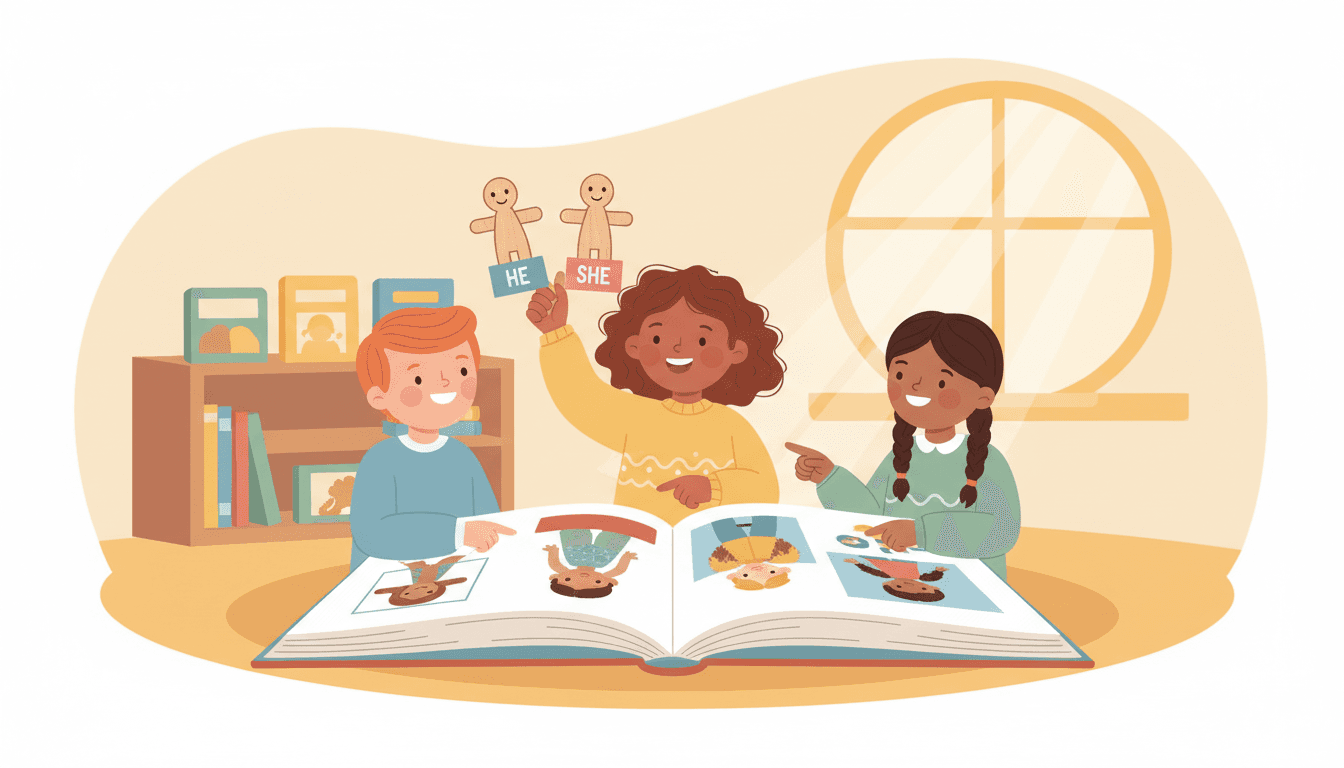
- Pronoun puppets: Make simple stick puppets labeled he, she, it, they, we. As you read, students hold up the matching puppet whenever they hear a pronoun. This keeps them actively engaged throughout the read-aloud.
- Pause and predict: Before using a pronoun in the text, pause. Ask: "The author is about to use a pronoun here. What do you think it will be?" Students predict based on who or what the sentence is about.
- Find the noun it replaces: When a pronoun appears, trace it back to the noun. "It says 'he.' Who is 'he'? Let's go back and find the name." This builds the understanding that pronouns always refer back to something.
Read-alouds also show students that pronoun use is a hallmark of fluent, natural writing. When you read a passage aloud where the author repeats a name too many times, students notice it sounds awkward. That's a powerful teaching moment.
6. Play Pronoun Games
Games give you repeated, low-pressure practice. The informal setting means students are willing to take risks, try answers, and laugh when they get it wrong. All of which speeds up learning considerably.
Try these activities:
- Pronoun hot potato: Sit in a circle with a ball. Pass it around while music plays. When the music stops, the student holding the ball gets a sentence with a blank. "The dog ran fast. _____ is very quick." They fill in the correct pronoun.
- Pronoun four corners: Label four corners of the room: he/she, it, we, they. Read a sentence aloud. Students run to the corner that matches the pronoun they'd use. "The class went to lunch together." Students run to "we."
- Pronoun match-up: Create a simple card game with noun cards and pronoun cards. Students match each noun to its pronoun. The teacher, a friend, two dogs, a book. She, they, it, I.
- Who am I? pronoun version: Give a student a sticky note on their forehead with a noun or name on it (a classmate's name, a character, "a dog"). They ask yes/no questions to figure out what their word is. Students in the class answer using pronouns only. "Is it a he? Is it a she?"
Games work best when they're fast. Keep rounds short so every student cycles through multiple turns. Five minutes of a pronoun game can be worth more than 15 minutes of worksheet time.
7. Connect Pronouns to Storytelling and Retelling
Storytelling is the natural home for pronouns. Every time a student retells a story, they're making pronoun choices. Supporting this explicitly, through prompting and modeling, builds both grammar and comprehension.
Try these activities:
- Retell with pronouns challenge: After a read-aloud, ask students to retell the story using pronouns wherever they can. "Instead of saying 'Peter' every time, what pronoun can you use?" Model the retelling and then let students try.
- Story circle: Sit in a circle. You start a story: "There was a girl named Lily. She was walking through the forest." The next student continues, using "she" to keep referring to Lily. Each student adds one sentence, maintaining pronoun consistency.
- Class story writing: Write a shared story together on chart paper. As students dictate, pause at pronoun opportunities: "We've said 'the dragon' three times now. What pronoun could we use?"
- Personal story share: During morning meeting or share time, prompt students to tell a story about someone they know. Encourage them to use pronouns after the first mention. "Tell us about your dog using 'it' or 'he' or 'she' after you tell us the name."
Storytelling practice is where pronouns move from a grammar exercise to a natural communication tool. This is the goal. Not that students can identify pronouns on a worksheet, but that they can use them when they're trying to tell you something.
8. Practice Pronouns in Writing
Writing is where pronoun instruction cements itself. When a student writes "she" instead of repeating a name, they're applying grammar knowledge independently. That's the milestone.
At the kindergarten level, pronoun writing practice is best scaffolded. Sentence frames and word banks are appropriate, and the goal is building comfort with the forms.
Try these activities:
- Name then pronoun: Have students write two-sentence responses about a picture: Sentence 1 introduces the noun (the name or the thing). Sentence 2 uses a pronoun. "The cat is orange. It is sleeping on the mat."
- Daily journal prompt: Include a pronoun in the prompt to model the use. "Write about something your friend did. Use 'he,' 'she,' or 'they.'"
- Pronoun editing: Give students a short paragraph where every noun is repeated. Students rewrite it replacing repeated nouns with pronouns. Before and after comparisons show them the improvement clearly.
- Mini-book about me: Students create a simple four-page mini-book. Page 1: "I am _____." Page 2: "I like _____." Page 3: "My friend's name is _____." Page 4: "He/She likes _____." This embeds pronoun use in a personally meaningful writing task.
For structured practice, our kindergarten pronoun worksheets include activities for matching pronouns to nouns, choosing the correct pronoun, and using pronouns in written sentences, all designed for the kindergarten level.
9. Address Common Pronoun Mix-Ups Gently
Kindergartners make predictable pronoun errors, and knowing them in advance helps you respond with warmth and precision rather than frustration.
Common mix-ups to watch for:
- Using a name where a pronoun belongs. "Mia and Mia went to school." Simply model: "We could say 'Mia and she went to school' or even just 'They went to school.'"
- "Me and Jake" vs. "Jake and I." This one is very common. The gentle fix: "Take Jake out of the sentence. 'Me went to the park' doesn't sound right. 'I went to the park' does. So it's 'Jake and I.'"
- "Him" or "her" used where "he" or "she" belongs. "Him is my friend." The student knows the pronoun is connected to a male person but is using the object form. Simply model the correct form: "Yes! And we say 'He is my friend.'"
- "Them" used for "they." "Them went to the store." Again, object form in subject position. Gentle modeling: "We use 'they' at the start of a sentence. 'They went to the store.'"
Correct these in conversation by simply modeling the right form, not by correcting the student directly. "Oh, you're right, he went to the store!" repeats the correct form without making the child feel wrong. Over time, they absorb the pattern.
10. How to Know When They've Really Got It
Pronoun fluency at the kindergarten level is about natural, accurate use in context. Here's what you're looking for:
- Using pronouns spontaneously in conversation. "I told him to stop" instead of "I told Marcus to stop."
- Maintaining pronoun consistency in a retelling. Once they say "he" for a character, they keep using "he" throughout the story.
- Correctly choosing between he, she, it, they, and we. Getting the gender and number right consistently in context.
- Writing pronouns in short sentences with a model or frame. "She is happy." "They are playing."
- Recognizing pronouns in text. "That word is standing in for Max. It means 'Max.'"
Not every kindergartner will reach full independence by June, and that's completely fine. What matters is that they understand the concept and can use the most common pronouns in familiar, supported contexts.
Frequently Asked Questions
What pronouns should kindergartners learn?
Kindergartners should learn the personal pronouns I, you, he, she, it, we, and they. These are the most commonly used pronouns in everyday speech and early writing. Students should be able to identify these pronouns, match them to the nouns they replace, and use them correctly in simple spoken and written sentences.
How do you explain pronouns to kindergartners?
Use the term "stand-in word." Tell students that pronouns stand in for nouns so we don't have to repeat the same name over and over. Demonstrate with a sentence that overuses a name, then show how using a pronoun makes it flow more naturally. Keep the explanation brief and move to examples quickly.
What activities work best for teaching pronouns to kindergartners?
Read-alouds with pronoun-focused stops are highly effective because they show pronouns in authentic, meaningful text. Pronoun games (puppets, four corners, hot potato) build repeated practice without tedium. Sentence strip swaps (physically replacing noun cards with pronoun cards) help students internalize the substitution process. Writing activities with sentence frames complete the transfer to independent use.
Is pronoun instruction part of kindergarten standards?
Yes. The Common Core standard CCSS.ELA-LITERACY.L.K.1 includes using frequently occurring nouns and verbs, and pronoun instruction is embedded in this standard and in the broader expectation that students can produce and expand complete sentences. Many state standards explicitly include pronouns as part of kindergarten grammar instruction.
Keep Reading
- How to Teach Adjectives to Kindergartners: Activities, Tips, and What Actually Works
- How to Teach Grammar to Kindergartners: Skills, Activities, and What Actually Works
- How to Teach Prepositions to Kindergartners: Activities, Tips, and What Actually Works
Wrapping Up
Teaching pronouns to kindergartners is one of those skills that quietly changes how our little ones write and speak. Once they have "he," "she," "they," and "it" in their toolkit, their sentences start to sound more fluent, more natural, more like the stories they love to hear.
It doesn't happen overnight. And some kiddos will need more time and more repetition than others. That's normal. The goal isn't perfection before first grade. The goal is awareness, exposure, and growing confidence with these small but mighty words.
Start with I and she and he. Use books. Use games. Use everyday conversation. And watch as your kiddos' writing and storytelling gets richer and richer across the year 🙌
For ready-to-use practice, explore our full collection of kindergarten pronoun worksheets. They cover pronoun identification, noun-pronoun matching, and sentence-writing at exactly the right kindergarten level.
Happy teaching!

Adi Ackerman
Head Teacher
Adi is the Head Teacher at ClassWeekly, with years of experience teaching elementary students. She designs our curriculum-aligned worksheets and writes practical guides for teachers and parents.
Keep Reading
Ready to download? Try ClassWeekly free for 30 days.
Unlimited worksheets for PreK through 5th grade. Cancel anytime.