
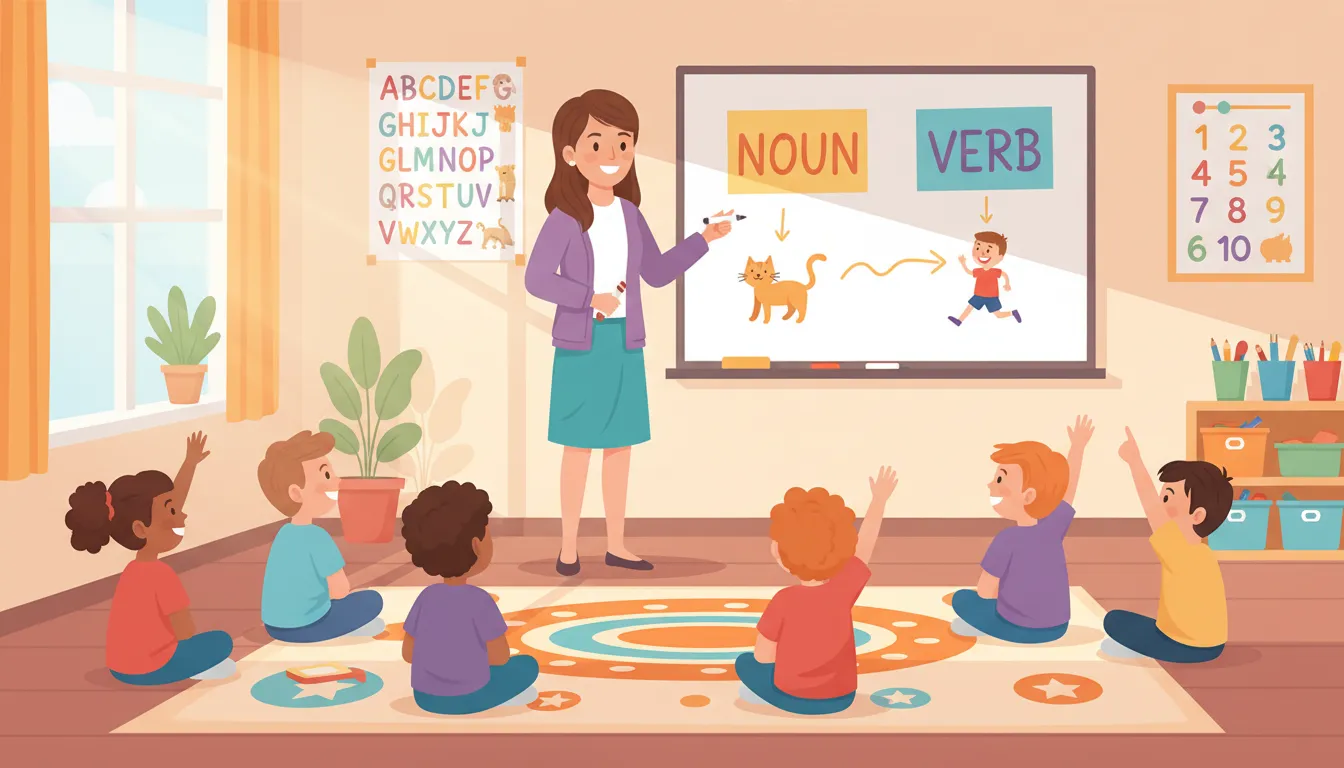
Grammar for Kindergarten: 10 Activities That Work
Get 30 days of free worksheet downloads
Key Takeaways
- Kindergartners already use grammar naturally in speech, so teaching grammar at this age means giving them vocabulary to name what they already do, not memorizing abstract rules.
- The most effective kindergarten grammar activities use movement, play, and read-alouds so children absorb parts of speech through experience rather than formal instruction.
- Common Core standards expect kindergartners to use nouns, verbs, plural nouns, question words, prepositions, and complete sentences by end of year, all of which can be taught through daily routines.
- Connecting grammar directly to writing, such as asking students to circle nouns or verbs in their journal entries, reinforces skills without turning practice into a test.
- Irregular plurals and complex pronoun rules should be introduced only after children are confident with regular patterns, keeping early grammar lessons low-pressure and success-oriented.
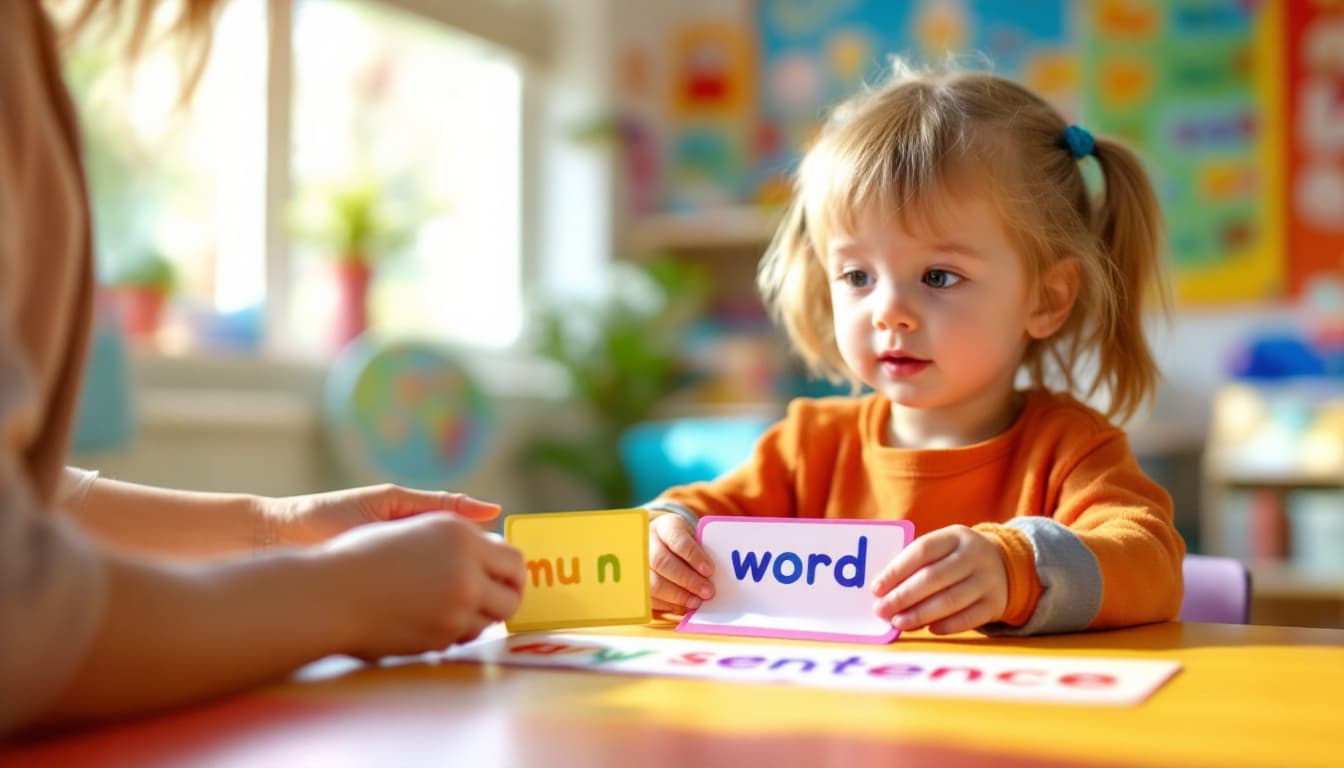
How to Teach Grammar to Kindergartners: Skills, Activities, and What Actually Works
Grammar for kindergartners? Isn't that a bit early?
Honestly? Your little ones are already doing it. Every time they say "I see a dog" or "She is running," they're using nouns, verbs, and pronouns without even knowing it. Teaching grammar in kindergarten isn't about memorizing rules. It's about giving our kiddos the vocabulary to name what they already do naturally.
The good news: you don't need a textbook or a complicated lesson plan. Most kindergarten grammar skills can be taught through stories, play, and everyday conversation. The best kindergarten grammar activities are the ones that don't feel like "grammar" at all. And once your students start recognizing the building blocks of language, you'll watch their writing and speaking take off.
Here are 10 practical ways to teach grammar to kindergartners:
- Start With What They Already Know (Naming Words)
- Bring Verbs to Life Through Movement
- Add Color With Adjectives
- Introduce Pronouns Naturally
- Practice Plural Nouns
- Explore Question Words
- Build Simple Sentences Together
- Teach Prepositions Through Play
- Connect Grammar to Writing
- What the Standards Actually Expect
Free Grammar Worksheets for Kindergarten


1. Start With What They Already Know (Naming Words)
Nouns are the easiest place to begin because kindergartners are surrounded by them. Everything they can point to, touch, or name is a noun. Starting here builds confidence right away.
Begin with common nouns, the things they see every day: table, book, pencil, dog, tree. Then slowly introduce proper nouns by talking about names. "Your name is a special noun. It starts with a capital letter because it's important, just like you!"
Try these activities:
- Noun hunt: Walk around the classroom and have students point to objects. Write each one on a sticky note and place it on the object. By the end, your room is labeled with nouns!
- Sorting game: Give students a pile of picture cards. Ask them to sort into "people," "places," and "things." This builds early categorization skills.
- Noun bag: Fill a paper bag with small objects (toy car, eraser, button, leaf). Students pull one out, name it, and say "This is a noun because I can touch it."
- Drawing nouns: Have each student draw three nouns and label them. Display these on a "Noun Wall" alongside your sight word wall.
You can reinforce noun recognition with free kindergarten noun worksheets that include matching, tracing, and picture-labeling activities.
2. Bring Verbs to Life Through Movement
If nouns are the "what," verbs are the "what it does." And there's no better way to teach action words to kindergartners than by getting them moving.
Start by explaining that verbs are doing words. Then make it physical. Say a verb, and students act it out. Jump. Clap. Spin. Whisper. This gets their whole body involved in learning, which makes it stick.
Try these activities:
- Verb freeze dance: Play music and call out action words. Students perform each action until you say "Freeze!" This one never gets old.
- Simon Says (verb edition): Replace the usual commands with specific verbs. "Simon says hop. Simon says stretch. Simon says tiptoe."
- Verb charades: One student acts out a verb while others guess the action word.
- Sentence building: After acting out verbs, transition to sentences. "I can ____." Students fill in the verb they just performed.
For independent practice, kindergarten verb worksheets let students match action words to pictures and complete simple sentences.
3. Add Color With Adjectives
Adjectives are where language starts to get interesting. Once your kiddos know what a noun is, they can learn to describe it. Big dog. Red ball. Soft blanket. This is where their sentences go from flat to full.
The key with adjectives is using the five senses. Ask your students: What does it look like? How does it feel? What color is it? Is it big or small? These questions naturally pull out describing words.
Try these activities:
- Mystery bag: Place an object inside a bag. Students feel it without looking and describe it using adjectives. Bumpy? Smooth? Cold? Round?
- Adjective chains: Start with a noun ("cat") and go around the circle. Each student adds a new adjective. "Soft cat. Soft, orange cat. Soft, orange, sleepy cat."
- Describing friends: Have students describe a classmate using kind adjectives. "She is smart. She is funny. She is kind." This builds vocabulary and social skills at the same time.
- Picture prompts: Show a colorful image and ask students to list every adjective they can think of. Write them on the board.
Free adjective worksheets for kindergarten give students practice matching describing words to pictures and using them in simple sentences.
4. Introduce Pronouns Naturally
Pronouns can feel tricky, but kindergartners use them constantly in conversation. "He took my crayon." "She is my friend." "They are playing outside." The goal isn't to teach the formal definition. It's to help them notice these words and use them correctly.
Read-alouds are the perfect place to introduce pronouns. As you read a story, pause and point out when the author uses "he," "she," "it," or "they" instead of repeating the character's name.
Try these activities:
- Name swap game: Write a simple sentence with a name ("Maria runs fast"). Ask students to replace the name with a pronoun ("She runs fast"). Do this with several sentences.
- Pronoun puppets: Make simple stick puppets labeled "he," "she," "it," "they." As you read a story, students hold up the correct puppet when they hear a pronoun.
- Circle time talk: During morning meeting, model pronoun use. "Tell me about your weekend. Instead of saying your friend's name, use 'he' or 'she.'"
Not every kid will get this right away, and that's completely okay. Pronouns develop gradually. The exposure matters more than perfection at this stage.
5. Practice Plural Nouns
The concept of "one vs. more than one" is something kindergartners grasp quickly because they experience it daily. One cookie vs. two cookies. One shoe vs. two shoes. Teaching plural nouns builds on this natural understanding.
Start with the simple rule: add -s to make most nouns plural. Cat becomes cats. Dog becomes dogs. Then introduce the "-es" pattern for words ending in s, x, z, ch, or sh (bus/buses, box/boxes, dish/dishes).
Try these activities:
- One and many sort: Give students picture cards showing one item and multiple items. They sort them into "one" and "many" piles, then practice saying and writing the plural form.
- Plural hop: Write singular nouns on the floor with tape. Students hop to a word and say the plural form before hopping to the next one.
- Class counting book: Each student illustrates a page with one item and its plural. "1 star. 3 stars." Bind the pages into a class book.
Quick tip: don't worry about irregular plurals (child/children, mouse/mice) just yet. Stick with regular patterns first. The irregular ones can come later when your little learners are more confident.
6. Explore Question Words
Who, what, where, when, why, and how. These six words open up a world of curiosity for kindergartners. Teaching question words isn't just grammar, it's a critical thinking skill that helps them understand stories, follow directions, and express what they want to know.
Try these activities:
- Question of the day: Start each morning with a question word on the board. Monday is "Who" day, Tuesday is "What" day, and so on. Students practice asking questions using that word.
- Story questions: After a read-aloud, ask one question for each question word. "Who was the story about? What happened? Where did it take place?"
- Question word posters: Create six posters, one for each question word. Include a simple definition and an example. "WHERE tells us a place. Where is the cat? The cat is under the table."
- Interview a friend: Pair students up. Give each pair a question word. They interview their partner using that word and share what they learned.
Question words are a gateway to deeper comprehension. When your kiddos learn to ask good questions, they become better readers, writers, and thinkers.
7. Build Simple Sentences Together
This is where all the grammar pieces come together. Your students know nouns, verbs, and adjectives. Now they can combine them into sentences. This is a really exciting milestone 😊
Start with the simplest structure: Subject + Verb. "Dogs run." "Birds fly." "Fish swim." Then expand to Subject + Verb + Object. "I see a cat." "She reads a book." Then add adjectives: "She reads a big book."
Try these activities:
- Sentence strips: Write individual words on cards (nouns, verbs, adjectives). Students arrange them into sentences on their desk or a pocket chart.
- Silly sentences: Let students pick one noun card, one verb card, and one adjective card at random. Read the silly result out loud. "The purple elephant dances." Kids love this one.
- Dictation practice: Say a simple sentence slowly. Students write it down. Check together. This reinforces capitalization, spacing, and punctuation.
- Sentence of the day: Each morning, write one sentence on the board with a mistake (missing capital, no period, wrong word). Students find and fix the error together.
For more structured practice, kindergarten sentence-building worksheets guide students through arranging words into complete sentences.
8. Teach Prepositions Through Play
Prepositions are position words: in, on, under, over, beside, behind, between. Kindergartners learn these best through physical movement because they can literally feel the meaning.
Try these activities:
- Teddy bear directions: Give each student a stuffed animal (or eraser). Call out directions: "Put the bear ON the desk. Put the bear UNDER the chair. Put the bear BEHIND your backpack."
- Preposition obstacle course: Set up a simple course in the classroom. Students go OVER the bench, UNDER the table, THROUGH the hoop, AROUND the cones. Name each preposition as they move.
- Drawing prepositions: Give students a picture of a tree. Ask them to draw a bird IN the tree, a cat UNDER the tree, and a sun ABOVE the tree. Label each preposition.
- Simon Says (preposition edition): "Simon says stand BEHIND your chair. Simon says put your hands ON your head."
Preposition worksheets for kindergarten reinforce these concepts with picture-based activities where students identify and use position words.
9. Connect Grammar to Writing
Grammar isn't an isolated subject. It's the toolkit our little ones use every time they write. The real magic happens when students start applying what they've learned about nouns, verbs, and adjectives in their own writing.
At this stage, don't expect perfect grammar in their writing. The goal is awareness and practice. When a student writes "i see a Big dog," celebrate that they used a noun, a verb, and an adjective. Then gently guide them toward the capital "I" and lowercase "big."
Try these:
- Journal time: Give students 5-10 minutes to write about anything. Afterward, ask them to circle one noun in blue and one verb in red. This builds grammar awareness without making it feel like a test.
- Labeling pictures: Students draw a picture and label it with nouns and adjectives. A drawing of their family might include "tall dad," "happy mom," "little sister."
- Sentence starters: Provide a prompt like "I like _____ because _____." Students complete the sentence using nouns and adjectives they've learned.
Writing is where grammar comes alive. Keep it low-pressure, keep it fun, and your kiddos will surprise you with what they can express.
10. What the Standards Actually Expect
If you're wondering whether you're covering enough, here's a quick reference. The Common Core State Standards for kindergarten (CCSS.ELA-LITERACY.L.K.1) outline what students should demonstrate by the end of the year:
- Print many upper and lowercase letters (L.K.1a)
- Use frequently occurring nouns and verbs (L.K.1b)
- Form regular plural nouns by adding -s or -es (L.K.1c)
- Understand and use question words: who, what, where, when, why, how (L.K.1d)
- Use the most frequently occurring prepositions: to, from, in, out, on, off, for, of, by, with (L.K.1e)
- Produce and expand complete sentences (L.K.1f)
The activities above cover all six standards. You don't need a separate grammar textbook or a formal lesson plan. Integrate these skills into your daily routines, stories, and conversations, and your students will meet these benchmarks naturally.
Frequently Asked Questions
What grammar skills should kindergartners learn?
Kindergartners should learn to identify and use common nouns, action verbs, simple adjectives, and basic prepositions. They should also practice forming plural nouns (adding -s and -es), using question words (who, what, where, when, why, how), and building complete simple sentences with a subject and verb.
What parts of speech are taught in kindergarten?
The main parts of speech taught in kindergarten are nouns (naming words), verbs (action words), adjectives (describing words), pronouns (he, she, it, they), and prepositions (in, on, under, over). These are introduced through everyday conversation, stories, and hands-on activities rather than formal definitions.
How do you teach nouns to kindergartners?
Start with what they can see and touch. Label objects around the classroom, play sorting games with picture cards (people, places, things), and use "noun hunts" where students identify nouns in their environment. The key is making it concrete and physical before moving to worksheets and written practice.
What are the Common Core grammar standards for kindergarten?
The Common Core standard CCSS.ELA-LITERACY.L.K.1 covers kindergarten grammar. It includes printing letters, using nouns and verbs, forming plural nouns, understanding question words, using common prepositions, and producing complete sentences. These standards are designed to be woven into daily literacy activities, not taught in isolation.
How do you make grammar fun for kindergartners?
Movement is your best friend. Verb freeze dance, preposition obstacle courses, adjective mystery bags, and silly sentence builders all turn grammar into a game. When kids are laughing and moving, they're learning without realizing it. Pair physical activities with colorful worksheets for reinforcement, and keep sessions short (10-15 minutes max for focused grammar practice).
Keep Reading
- How to Teach Pronouns to Kindergartners: Activities, Tips, and What Actually Works
- How to Teach Adjectives to Kindergartners: Activities, Tips, and What Actually Works
- How to Teach Prepositions to Kindergartners: Activities, Tips, and What Actually Works
Wrapping Up
Teaching grammar to kindergartners doesn't need to feel heavy or complicated. Our little ones are natural language learners. They've been absorbing grammar patterns since they first started listening to us talk. Our job is to give them the words for what they already do: naming things, describing the world, asking questions, and telling stories.
Start small. Pick one skill this week (nouns are a great place to begin) and try one activity from the list above. You'll be amazed at how quickly your kiddos catch on when grammar feels like play instead of a lesson 🙌
For ready-to-use practice materials, explore our full collection of free kindergarten grammar worksheets. They're designed to reinforce exactly the skills covered in this guide.
Happy teaching!

Adi Ackerman
Head Teacher
Adi is the Head Teacher at ClassWeekly, with years of experience teaching elementary students. She designs our curriculum-aligned worksheets and writes practical guides for teachers and parents.
Keep Reading
Ready to download? Try ClassWeekly free for 30 days.
Unlimited worksheets for PreK through 5th grade. Cancel anytime.