
Writing in Kindergarten: How to Teach It Step by Step
Get 30 days of free worksheet downloads
Key Takeaways
- Start pencil grip correction as early as possible - by second or third grade, compensatory grips are very difficult to change.
- Fine motor strengthening through playdough, tweezers, and vertical surfaces is writing instruction, not a separate activity.
- Invented spelling is evidence of phonemic awareness at work and should be celebrated, not corrected, in kindergarten.
- Shared writing makes the invisible process of writing visible - thinking aloud while scribing teaches more than any worksheet.
- Sentence starters remove the blank-page barrier without removing the student's voice, and can be phased out as fluency grows.

How to Teach Writing to Kindergartners: Activities That Build Confidence From Day One
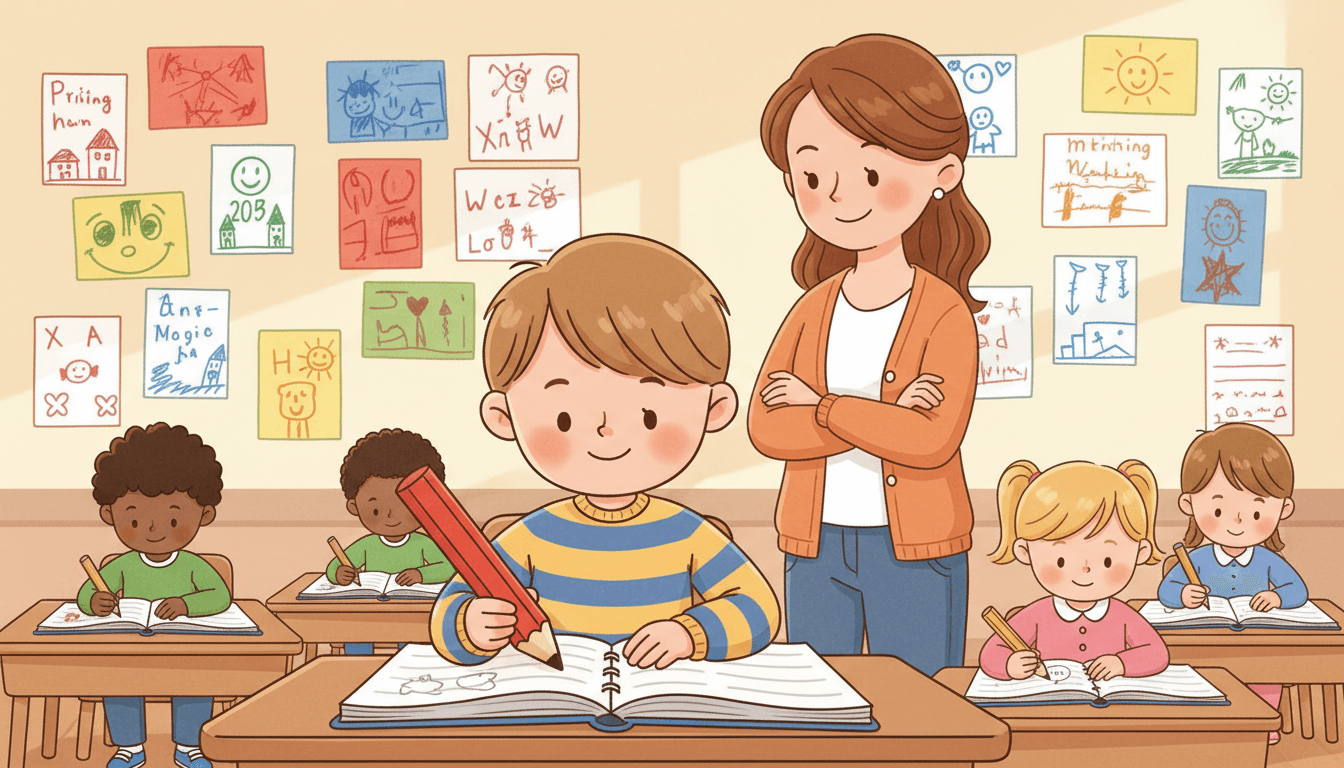
There's a moment in kindergarten that every teacher remembers: a child holds up a page full of wiggly lines, random letters, and one drawing that might be a dog (or a tree, or possibly a spaceship), and says, "I wrote a story."
And here's the thing: they did. That page, chaotic as it looks, represents an act of genuine authorship. The child had something to say and found a way to put it on paper. Your job as a writing teacher is not to make that mess go away. It's to gradually shape it into clear, conventional writing while keeping that spark of "I have something to say" burning as brightly as possible.
Teaching writing in kindergarten means juggling the physical (grip, formation, fine motor control), the phonetic (connecting sounds to letters), and the compositional (having ideas and expressing them). All three need attention, and none of them can wait for the others to be perfect first.
Here are 10 practical ways to teach writing to kindergartners:
- Start With the Right Pencil Grip
- Build Fine Motor Strength Before You Demand Fine Motor Precision
- Teach Letter Formation With a System
- Begin With Name Writing Every Single Day
- Use Shared Writing to Model the Process
- Introduce Journal Writing With a Low Bar for Entry
- Teach Sentence Starters to Unlock Independent Writing
- Connect Writing to Drawing
- Celebrate Approximations Along the Way
- Build Toward Simple Creative Writing
1. Start With the Right Pencil Grip
You will not fix pencil grip in one mini-lesson. You will work on it gently, consistently, and patiently for most of the year. That's just the reality.
The dynamic tripod grip (pencil resting on the middle finger, pinched between thumb and index finger, with the wrist slightly bent) is the grip we aim for because it allows the most control and causes the least fatigue. But many kindergartners arrive with compensatory grips (fist grip, thumb wrap, four-finger hold) that have been set in place by years of crayon holding.
The earlier you address grip, the better. By second or third grade, habits are very difficult to change.
Try these activities:
- Pinch and flip: Place the pencil flat on the table with the tip pointing away from the student. They pinch the end (not the tip), then flip the pencil into writing position. The grip often lands correctly when the pencil arrives this way.
- Rubber band trick: Loop a rubber band twice around the pencil just below where the fingers should rest. The tactile bump tells fingers where to go.
- Pinch hold warm-up: Before writing, practice the pinch-hold motion with small objects: picking up paper clips, small blocks, or pebbles with just the thumb and index finger. This strengthens the exact muscles used in a proper grip.
- Shorter pencils: Shorter pencils naturally discourage fist grip because there's less pencil to wrap around. Primary pencils (thick) and golf pencils both work. Some teachers break regular pencils in half.
- Pencil grips: Foam or rubber triangular grippers that slip onto pencils can help kiddos find the correct position more easily, especially early in the year.
One honest note: some children will resist grip correction because their current grip feels comfortable. Consistent, patient coaching over many months matters more than intense focus in any one week.
Free Kindergarten Writing Worksheets


2. Build Fine Motor Strength Before You Demand Fine Motor Precision
Writing requires a lot from small hands that may not be ready for it yet. The intrinsic hand muscles (the ones that control fine, precise movements) are still developing throughout kindergarten. Rushing into extended writing before those muscles are ready leads to fatigue, frustration, and sloppy formation habits.
The good news: you can build fine motor strength through activities that don't feel like writing practice at all.
Try these activities:
- Playdough every day: Squeezing, rolling, pinching, and shaping playdough strengthens exactly the muscles kiddos need for writing. Keep it at a morning center.
- Lacing cards and threading beads: These demand the pincer grip and fine control that writing requires.
- Hole punching: Give students scrap paper and a hole punch. Punching is great for hand strength and control.
- Tweezers and tongs: Use tweezers to sort small objects (pom-poms, beads, dried beans) into cups. Fun and genuinely effective for grip strength.
- Vertical surfaces: Writing or drawing on a vertical surface (chalkboard, whiteboard, easel paper on the wall) naturally positions the wrist in the correct orientation for writing. Include vertical writing opportunities regularly.
Building fine motor strength is not separate from writing instruction. It is writing instruction for many kindergartners, especially in the first quarter of the year.
3. Teach Letter Formation With a System
There are many ways to form letters incorrectly. There is essentially one efficient way to form each letter correctly. Teaching formation consistently from the start prevents habits that become increasingly difficult to undo.
The key: start every letter from the top. This is the principle that most consistent handwriting programs share. Letters that start at the top are generally faster to write and more legible than letters approached from the bottom up.
Try these activities:
- Verbal formation cues: Each letter gets a consistent verbal description. For lowercase "a": "Circle around and down, then bounce up and straight down." For "b": "Tall line down, then bounce up and bump." Say the cue aloud as students form the letter every time.
- Sky writing: Students write letters in the air with their whole arm while reciting the verbal cue. Big movements internalize the formation before fine motor demands are introduced.
- Multiple surfaces: Alternate between writing on paper, on mini whiteboards, in shaving cream, on sand trays, and with finger paints. Each surface provides different sensory feedback and maintains engagement.
- Letter formation groups: Most handwriting programs group letters by the strokes they share. Letters that start with a tall line (l, i, t, h, b, d, p) can be taught as a family. Letters that start with a circle (o, c, a, d, g, q) share a first stroke. Grouping reduces cognitive load.
- Slow-motion demonstration: Write each letter very slowly in front of students, narrating every stroke. Then write it again at normal speed. Seeing both helps students calibrate their own pace.
For printable letter formation practice, our kindergarten writing worksheets include tracing and independent formation practice for every letter.
4. Begin With Name Writing Every Single Day
A child's name is the most meaningful string of letters in the world to them. It belongs to them. It matters. And practicing it every day provides more letter formation repetitions than almost any other single activity.
Name writing should start from the very first day of school and continue as a daily routine throughout the year. The expectations evolve as the year goes on: from tracing to copying to independent writing to writing with attention to size and consistency.
Try these activities:
- Name cards on the desk: Every student has a name card on their desk from day one. They reference it when writing their name independently. Gradually phase these out as automaticity develops.
- Rainbow writing: Students trace their name in pencil, then trace over it again in several different crayon colors. The repetitions build muscle memory without feeling like drilling.
- Name on everything: From the very first day, students write their name on every paper, every art project, every journal page. The habit starts immediately.
- Name spelling chant: Create a rhythm for spelling each student's name aloud. Students learn each other's names while practicing the spelling and letter sequence of their own.
- Name building: Students arrange magnetic letters or letter tiles to build their name without the card. Then check it against the card. Independence precedes accuracy.
Some children will nail their name in the first week. Others will still be working on consistent formation by spring. Both timelines are within the range of normal development 😊
5. Use Shared Writing to Model the Process
Shared writing is one of the most powerful writing instruction tools available. You hold the pen (or marker at the chart), but the class contributes the ideas. Everyone watches the writing process happen in real time: the thinking, the saying-it-slowly, the connecting sounds to letters, the spacing, the re-reading.
Shared writing makes the invisible process of writing visible. Students see how a writer decides what to say, hears the sounds in a word, represents them with letters, and adds punctuation. They learn from watching.
Try these activities:
- Morning message: Every morning, write a short message to your class on chart paper (or a whiteboard). Think aloud as you write: "Good morning. G-o-o-d. What sound does 'good' start with? Everyone say /g/..." Students watch and participate.
- Class story: After a shared experience (a field trip, a special visitor, a class experiment), write about it together. Students contribute ideas and vocabulary; you do the scribing and model the conventions.
- Interactive writing: Take shared writing a step further: invite individual students to come up and write parts of the message. They write letters or words they know, you fill in the rest. Every student watches and learns.
- Think-aloud edits: After writing something together, read it back and make a correction. "Oops, I forgot a space between those words. Let me add one." Modeling mistakes and fixes is as valuable as modeling correct writing.
Shared writing is not a time to show off perfect writing. It's a time to demonstrate what real, thoughtful writing looks like from the inside.
6. Introduce Journal Writing With a Low Bar for Entry
Kindergarten journals should be the one place where kiddos feel free to write without worrying about being right. The purpose of journal writing is expression, volume, and habit, not correctness.
A kindergarten journal entry might be a drawing with one labeled letter. Or a string of invented-spelling words. Or a complete sentence. All of these are appropriate at different points in the year and for different students. The goal is to get them writing something, every day, without dreading it.
Try these activities:
- Drawing first: Many kindergartners need to draw their idea before they can write about it. Build in time for drawing as part of the journal routine. "Draw what you want to write about, then add words."
- Tell it before you write it: Have students whisper their sentence (or idea) to a partner before writing it down. Saying it first helps them know what to write.
- One sentence is enough: For early writers, the goal might literally be one sentence per entry. "I like my dog." is a complete, successful journal entry in September.
- Prompts vs. free choice: Some students do better with a topic prompt; others do better with a blank page. Vary between the two across the week.
- Share time: End journal time with 2-3 students sharing what they wrote. This gives writing an audience, which is one of the most powerful motivators for young writers.
Journal writing should feel like the easiest part of the writing block, not the hardest. Keep expectations realistic for where your class is, and raise the bar gradually.
7. Teach Sentence Starters to Unlock Independent Writing
One of the most common barriers to independent writing in kindergarten is students sitting with a blank page and no idea where to begin. Sentence starters remove that barrier without removing the student's voice.
A sentence starter is a partial sentence that the student completes: "I like ___," "I can ___," "I see a ___," "My favorite ___ is ___." The student brings the content; the structure is provided.
Try these activities:
- Starter wall: Post a list of 4-5 sentence starters on the writing wall. Students refer to it when they get stuck. Change the starters every few weeks to keep them fresh.
- Question starters: Pair each sentence starter with a guiding question. Next to "I like ___," write: "What do you like? A toy? A food? A person? An animal?" Questions spark ideas.
- Two-part starters: As students develop, introduce two-part starters that require a reason: "I like ___ because ___." This naturally extends writing and builds early opinion writing.
- Copying a starter, then completing it: Give students a strip with the starter pre-printed. They copy the beginning and add their own ending. The copying itself is valuable formation practice.
- Model completing a starter yourself: Show students how you think through completing a sentence starter. "I like... hmm, what do I like? I could write 'pizza' or 'my dog' or 'Fridays.' I'll choose 'Fridays.'" Think-aloud makes the process visible.
Sentence starters are training wheels. They're not permanent. As students develop fluency, they gradually need them less, which is exactly the point.
8. Connect Writing to Drawing
For many kindergartners, drawing and writing are the same thing. They are both ways of getting ideas out of your head and onto paper. Separating them completely is counterproductive at this stage. Instead, use drawing as a scaffold for writing and writing as a natural extension of drawing.
A student who draws a picture of their family and then labels each person is doing real writing. A student who draws a dog and adds the letter "D" is doing real writing. These are entry points, not substitutes.
Try these activities:
- Draw-and-label: Students draw a picture, then add labels (single words or letters) to identify what they've drawn. This is often the first independent writing kindergartners do successfully.
- Story maps: For more advanced writers, a simple three-box strip (beginning, middle, end) helps students plan a story through drawings before writing sentences in each box.
- Illustration and caption: After writing a sentence, students illustrate it. Or after drawing, they add a caption. Both directions reinforce the connection between the two modes.
- Publishing: When students "publish" a piece (a final draft with a cover), they illustrate every page. The illustrations are part of the final product, not a reward for finishing the writing.
- Author's chair: When students share from the author's chair, they hold up their illustrations while reading (or telling) their writing. The drawing is part of the presentation.
The connection between drawing and writing in kindergarten mirrors how professional writers use sketching, notes, and visual thinking in their own work. Honoring this connection sends the right message: all thinking tools are valid.
9. Celebrate Approximations Along the Way
Invented spelling, where kiddos spell words the way they sound rather than the way they're conventionally spelled, is not a mistake. It's evidence of phonemic awareness at work. When a child writes "KT" for "cat" or "LUPN" for "sleeping," they're actively applying letter-sound knowledge. That is progress.
If you correct every invented spelling, you risk two things: crushing confidence, and making kiddos reluctant to try words they're not certain about. Both outcomes are worse than "incorrect" spelling.
Try these activities:
- Encourage sound spelling: Tell students explicitly that they should write words the way they sound if they don't know the conventional spelling. "Do your best sounding it out. That's exactly right for kindergarten."
- Celebrate the attempt: When a student shares writing with invented spelling, respond to the content first. "You wrote about your birthday! That sounds so fun." Then, if appropriate, you might gently note one conventional form.
- Public model of invented spelling: During shared writing, occasionally write a word using invented spelling on purpose, then revise it together. "I wrote 'HRS' for 'horse.' What do I need to fix?"
- Star and step feedback: When responding to student writing, always start with a star (something they did well) before a step (something to work on). Stars come first, every time.
Honestly? Some of your highest-effort writers in kindergarten will have the messiest pages. The energy and quantity of their writing often outpaces their mechanical skills. That mismatch is healthy. Don't punish it.
10. Build Toward Simple Creative Writing
By mid-year, many kindergartners are ready to write beyond labeling and single sentences. Simple stories, personal narratives, and opinion pieces are within reach, especially when the structure is provided and the bar is kept appropriate.
Creative writing at the kindergarten level means writing about real or imagined experiences using a beginning and an ending. Even a two-sentence piece counts: "I went to the park. I went on the swings." That's a narrative.
Try these activities:
- Personal narrative: one memory: Ask students to think of one thing they did that was special. They draw it, then write two or three sentences about it. Beginning: what happened. Middle: what they did. End: how they felt.
- All-about books: Students create a simple information book about a topic they know well (my dog, my family, my favorite food). Each page has one sentence and an illustration. This is real expository writing.
- Opinion sentence: "My favorite ___ is ___ because ___." Students write one opinion sentence, then draw supporting evidence. This is the earliest form of persuasive writing.
- Class story building: Create a story together where each student contributes one page/sentence. Bind the pages. The class reads the shared creation aloud. Shared authorship is motivating.
- Retell a familiar story: After reading a favorite book multiple times, students draw and write a three-part retell (beginning, middle, end). Using a known story removes the need to invent plot, so students can focus on the writing itself.
Creative writing is where the spark from that first "I wrote a story" moment gets channeled into something that keeps growing. Keep the tasks achievable, celebrate the ideas, and trust the process 😊
Frequently Asked Questions
What writing skills should kindergartners have by the end of the year?
By year's end, kindergartners should be able to hold a pencil with a functional grip, write legible upper and lowercase letters, write their first and last name independently, compose simple sentences using phonetically-based spelling, and produce short pieces in multiple genres (narrative, informational, opinion). Common Core writing standards (W.K.1-W.K.8) outline these expectations for kindergarten.
How do I help a kindergartner who refuses to write?
Resistance to writing is usually about one of three things: fear of doing it wrong, physical discomfort, or not having an idea. Address each possibility. If fear of errors is the issue, emphasize that invented spelling is expected and welcome. If writing is physically uncomfortable, check the grip and build fine motor strength through alternative activities. If ideas are the block, use structured prompts, drawing first, or oral storytelling before writing. Starting with the student's name or one word they know is always a valid entry point.
Should kindergartners use lined or unlined paper?
Both have their place. Unlined paper is better for drawing-then-labeling activities and early journal entries where the focus is on ideas. Primary-ruled paper (with a solid baseline, a dotted midline, and a top line) helps students develop size consistency and understand where letters sit relative to the baseline. Introducing primary-ruled paper around mid-year or once students have some letter formation foundation works well for most classes.
How much should kindergartners write each day?
The goal is daily writing practice, even if the actual output is small. Many teachers include writing in multiple parts of the day: name writing in the morning, shared/interactive writing during literacy, and independent writing/journal time. A focused 10-15 minute independent writing block is appropriate for most kindergartners. Quality of engagement matters more than the quantity of words on the page.
Keep Reading
- How to Teach Handwriting to Kindergartners
- Letter Formation for Kindergarten: Tips for Clean Confident Writing
- How to Teach Spelling to Kindergartners
- Commenting and Suggesting in Google Docs to Coach Writing
- Morning Routines That Set Up a Calm Elementary Day
Wrapping Up
Teaching writing to kindergartners is a long game. The child who writes "KT" for "cat" in September is writing "I have a cat named Fluffy" by May. The student who grips the pencil in a fist in September is writing sentences with a tripod grip by spring. These changes don't happen overnight. They happen because you kept showing up with patience, encouragement, and the right activities at the right time.
Trust the process. Celebrate the approximations. Keep the focus on expression and meaning first, mechanics second.
For printable writing practice your students can use today, explore our full collection of kindergarten writing worksheets. They cover letter formation, name writing, sentence completion, and simple creative writing prompts for every stage of the year.
Happy teaching!

Adi Ackerman
Head Teacher
Adi is the Head Teacher at ClassWeekly, with years of experience teaching elementary students. She designs our curriculum-aligned worksheets and writes practical guides for teachers and parents.
Keep Reading
Ready to download? Try ClassWeekly free for 30 days.
Unlimited worksheets for PreK through 5th grade. Cancel anytime.