
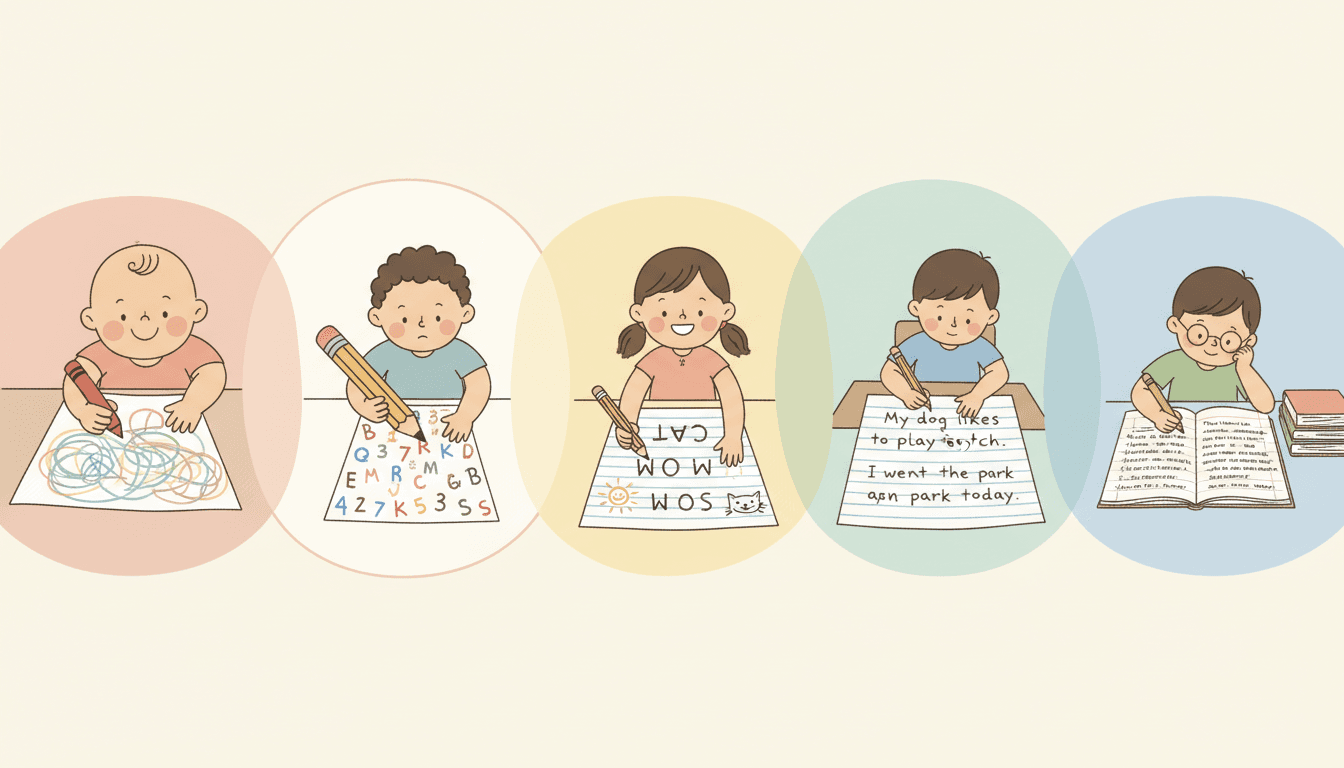
Stages of Writing Development: Pre-K to 5th Grade
Get 30 days of free worksheet downloads
Key Takeaways
- Writing development follows a predictable sequence from scribbling to structured paragraphs, though children move through stages at their own pace and often revisit earlier stages when attempting challenging tasks.
- Correcting invented spelling too early backfires - children who are corrected constantly write less, while children who are encouraged write more and improve faster.
- Reading aloud to children every day is one of the most powerful supports for writing development because it builds vocabulary, sentence patterns, and narrative structure.
- By 3rd-4th grade, children must learn to organize multi-paragraph writing - this is where many students struggle for the first time, and shorter pieces can help rebuild confidence.
- A 5th grader developing a distinctive voice in their writing is a sign of true writing maturity - responding to their ideas rather than correcting mechanics supports this growth.

If you've ever looked at your kindergartner's paper full of random letters and wondered "is this normal?" the answer is almost certainly yes.
Writing development follows a surprisingly predictable path. Not every child hits each stage at the exact same age, but the sequence is remarkably consistent. Knowing what's coming next helps you support your child without pushing too hard or worrying too early.
Here's what the journey looks like, from first scribbles to polished paragraphs.
Writing Development Is Not Linear (And That Is Okay)
Before we walk through the stages, one important thing: kids don't neatly graduate from one stage to the next. They overlap. They bounce back and forth. A child might write a beautiful sentence on Monday and scribble on Tuesday.
This is normal. Writing development is more like a spiral than a staircase. Kids revisit earlier stages when they're tired, when the topic is hard, or when they're trying something new. A 2nd grader attempting their first multi-sentence story might temporarily write like a kindergartner because the task is cognitively demanding.
Don't panic when you see regression. Look at the overall trend over weeks and months, not what happened on a single Tuesday afternoon.
Also worth noting: writing development is deeply connected to reading development. Kids who read more tend to write more, and vice versa. If you want to support writing, keep reading to your children every day. It's probably the most powerful thing you can do.
Free Creative Writing Worksheets for Kindergarten


Stage 1: Drawing and Scribbling (Pre-K)
This is where every writer starts, usually between ages 2 and 4. Your child picks up a crayon and makes marks on paper. Those marks mean something to them, even if they look like chaos to you.
What you'll see:
- Random scribbles that the child "reads" to you as a story
- Drawings that represent people, animals, or objects
- Wavy lines meant to look like grown-up writing
- Occasional letter-like shapes mixed in with scribbles
What's actually happening: Your child is learning that marks on paper carry meaning. That's a massive cognitive leap. They see you write notes, read books, and check your phone. They understand that those squiggles mean something. They're imitating the act of writing even before they know any letters.
That said, don't be discouraged if progress seems slow. Small wins add up.
How to support this stage:
- Provide lots of writing tools: crayons, markers, chalk, finger paint
- Ask "tell me about your picture" instead of "what is it?"
- Write down their stories exactly as they dictate them (this shows them that spoken words become written words)
- Don't correct their "writing." If they hand you a page of scribbles and say "I wrote a story about a dog," respond to the story, not the scribbles
This stage matters more than people realize. Children who scribble and draw freely develop the fine motor skills and the confidence they'll need for the stages ahead.
Stage 2: Letter Strings and Invented Spelling (Kindergarten)
Somewhere around age 5, a magical shift happens. Your child starts using actual letters. They might not use the right ones, but they know that writing is made of letters, and they're giving it a shot.
What you'll see:
- Random strings of letters ("BRMLTK") that the child says is a word or sentence
- Beginning sounds captured in writing ("D" for "dog," "KT" for "cat")
- Invented spelling that follows phonetic logic ("luv" for "love," "hows" for "house")
- Their own name written over and over (sometimes the only word they can write independently)
What's actually happening: Your child is connecting sounds to letters. This is phonemic awareness in action. When they write "KT" for "cat," they're demonstrating that they can hear the beginning and ending sounds of a word and match them to letters. That's sophisticated thinking.
How to support this stage:
- Celebrate invented spelling. Seriously. "WNS APH A TIM" (once upon a time) is brilliant, not wrong
- Don't correct spelling at this stage. Correction kills willingness to write
- Focus on the message: "You wrote about going to the park! Tell me more"
- Label things around the house so kids see correct spelling naturally
- Explore kindergarten writing activities that encourage practice
The biggest mistake adults make at this stage is "fixing" invented spelling too early. Children who are corrected constantly write less. Children who are encouraged write more. And children who write more improve faster.
Stage 3: Conventional Spelling and Sentences (1st-2nd Grade)
Between ages 6 and 8, writing starts to look recognizable. Your child transitions from invented spelling to mostly conventional spelling, and from isolated words to connected sentences.
What you'll see:
- Complete sentences with a subject and verb ("The dog ran fast")
- Sight words spelled correctly (the, was, said, they)
- Phonetic spelling for unfamiliar words, but much closer to correct
- Simple stories with a beginning, middle, and end (sometimes)
- Periods and capital letters appearing (inconsistently at first)
What's actually happening: Your child's reading and writing skills are reinforcing each other. Words they see in books start showing up correctly in their writing. They're internalizing spelling patterns and sentence structure through exposure and practice.
How to support this stage:
- Encourage daily writing in any form: journals, lists, letters to grandma, stories about their toys
- Gently introduce punctuation ("Every sentence starts with a capital letter and ends with a period")
- Model writing in front of your child (grocery lists, notes, emails)
- Read their writing out loud to them so they can hear what it sounds like
- Praise effort and ideas first, then address conventions
A note about spelling: at this stage, you can start pointing out correct spellings, but do it selectively. Pick the 3-5 words they use most often and work on those. Correcting every word in a paragraph is overwhelming and counterproductive.
Stage 4: Paragraphs and Organization (3rd-4th Grade)
This is where writing goes from "I can write sentences" to "I can organize my thoughts." It's a big jump, and it's where many students start to struggle for the first time.
What you'll see:
- Multi-paragraph writing with a topic sentence, details, and a conclusion
- Use of connecting words (first, next, then, finally, because, however)
- Different types of writing: stories, opinion pieces, informational reports
- Revision (going back and changing what they wrote, not just fixing spelling)
- Growing vocabulary and sentence variety
What's actually happening: Your child is learning that writing has structure. A story needs a plot. An opinion piece needs reasons. An informational report needs facts organized by topic. This is a major cognitive development. They're not just recording thoughts anymore. They're building arguments.
How to support this stage:
- Teach simple graphic organizers (beginning/middle/end, main idea/details, claim/evidence)
- Read their writing and ask questions: "I'm confused here. Can you tell me more about this part?"
- Encourage them to read their work out loud before calling it done
- Introduce the concept of "rough draft" and "final draft" so kids understand that good writing is rewritten, not just written
- Let them write about topics they genuinely care about whenever possible
At this stage, some children who were enthusiastic writers in earlier grades suddenly hate writing. It's usually because the expectations jumped faster than their skills. If your child is frustrated, scale back to shorter pieces and rebuild confidence before asking for longer ones.
Stage 5: Voice and Revision (5th Grade)
By 5th grade, your child's writing should have something that's hard to teach but unmistakable when you see it: voice.
What you'll see:
- Writing that sounds like your child. You can hear their personality on the page
- Deliberate word choice ("The dog bolted across the yard" instead of "The dog ran fast")
- Awareness of audience (they write differently for their teacher than for their friends)
- Self-editing: catching their own mistakes before you point them out
- Comfort with multiple formats: essays, narratives, reports, poems, letters
What's actually happening: Your child is becoming a writer, not just someone who writes. They're making stylistic choices. They understand that first drafts are supposed to be messy. They can look at their own work critically and make it better.
How to support this stage:
- Read their writing and respond to the ideas, not just the mechanics
- Share your own writing struggles ("I rewrote this email three times before it sounded right")
- Introduce mentor texts: published writing that models the kind of writing they're working on
- Encourage reading widely. Voice comes from absorbing other voices
- Back off on corrections. At this stage, self-editing matters more than parent-editing
Not every 5th grader will reach this stage fully, and that's okay. Voice develops at different rates, and some kids who seem like reluctant writers at 10 turn into passionate ones at 14. The foundation matters more than the timeline.
Keep Reading
- Kindergarten Writing Prompts: 50 Fun Ideas That Get Kids Writing
- How to Teach Handwriting to Kindergartners
- How to Teach Writing to Kindergartners: Activities That Build Confidence From Day One
- Narrative, Opinion, and Informational Writing in K-5
How to Support Each Stage at Home
Across all stages, a few principles hold true:
Write together. Let your child see you writing. Narrate what you're doing: "I'm making a grocery list. How do you spell 'broccoli'? Let me think... B-R-O-C..." This normalizes writing as something real people do for real reasons.
Provide the right tools. Thick crayons for preschoolers. Pencils with grips for kindergartners. Lined paper appropriate to their grade. A special journal they get to keep. Good tools don't make good writers, but they remove barriers.
Respond to the message, not the mistakes. If your child writes "I wnt to the prk and playd on the swgs," respond with "That sounds like so much fun! What was your favorite part?" Save the spelling lesson for another time.
Read, read, read. Every study on writing development points to the same predictor: kids who are read to and who read independently become stronger writers. It's not magic. It's exposure to sentence patterns, vocabulary, and narrative structure.
Don't compare. Your child's writing will look different from their classmate's. That's developmental variation, not a problem. Focus on growth from where they started, not comparison to where someone else is.
Writing is a long game. The scribbles your preschooler makes today are the first step on a path that leads to essays, stories, and ideas that matter. Every stage is worth celebrating, and your kiddos will get where they need to go.

Adi Ackerman
Head Teacher
Adi is the Head Teacher at ClassWeekly, with years of experience teaching elementary students. She designs our curriculum-aligned worksheets and writes practical guides for teachers and parents.
Keep Reading
Ready to download? Try ClassWeekly free for 30 days.
Unlimited worksheets for PreK through 5th grade. Cancel anytime.