
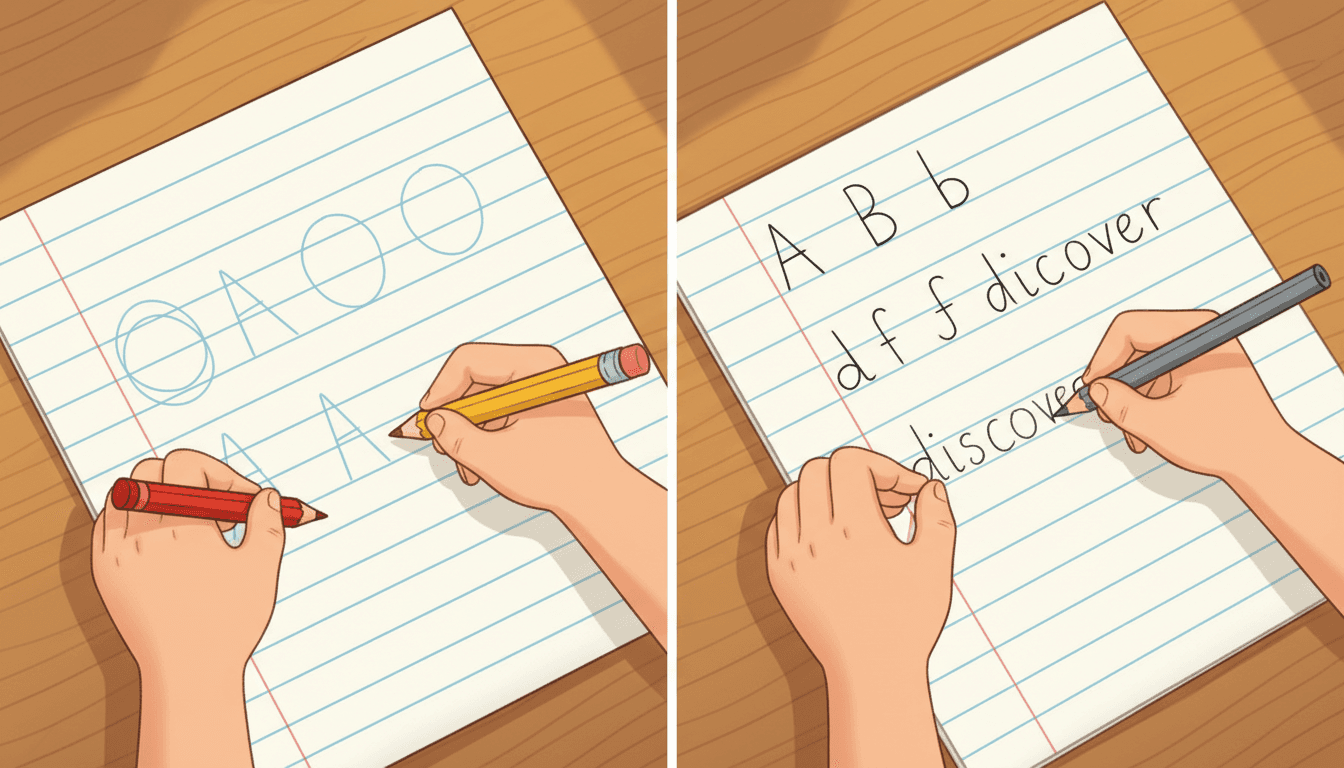
How to Improve Kids' Handwriting: Tips for Every Age
Get 30 days of free worksheet downloads
Key Takeaways
- Handwriting improves retention and learning because the physical act of forming letters activates brain regions involved in thinking and memory in ways that typing does not.
- Weak fine motor skills are often the root cause of messy handwriting, and activities like playdough, scissors, and tweezers build the hand strength needed before pencil practice can help.
- Pencil grip is easiest to correct before age 7 - short pencils, rubber triangle grips, and the pinch-and-flip technique are the most effective early interventions.
- Short daily practice sessions of 5 minutes are more effective than long occasional sessions, regardless of the child's age or grade level.
- If handwriting does not improve with consistent practice by 2nd grade, dysgraphia or developmental coordination disorder may be a factor and a professional evaluation is worth pursuing.

Let's be honest: messy handwriting is one of the most common concerns parents and teachers bring up. And it's one of the hardest to fix, because by the time you notice it's a problem, habits are already in place.
The good news is that handwriting can absolutely improve at any age. The approach just looks different for a 4-year-old than it does for a 10-year-old.
Here's what actually works, broken down by where your child is right now.
Why Handwriting Still Matters in a Digital World
This is the first question that comes up. "Do kids even need good handwriting anymore? Everything's on screens."
The research says yes, and it's not even close.
Studies show that students who write by hand retain information better than those who type. The physical act of forming letters activates parts of the brain involved in thinking, language, and memory in ways that typing doesn't.
Beyond brain science, there are practical reasons too. Standardized tests still require handwriting. Classroom assignments still require handwriting. Math work requires writing numbers legibly. And students with poor handwriting often get lower grades on written work, even when their ideas are good, simply because teachers struggle to read it.
Handwriting isn't about preserving tradition. It's a thinking tool. And the better your child can use that tool, the more mental energy they have left for the actual thinking.
Free Handwriting Practice Pages for Kids


Fine Motor Skills Come First
Here's something that surprises a lot of parents: if your child's handwriting is messy, the problem might not be handwriting at all. It might be fine motor strength.
The small muscles in the hand and fingers need to be strong and coordinated before they can control a pencil well. If those muscles aren't ready, no amount of letter practice will help.
Not sure there's a shortcut here, but consistency helps more than anything.
Signs of weak fine motor skills:
- Tires quickly during writing tasks
- Presses too hard or too lightly with the pencil
- Can't open jars, zip zippers, or button buttons independently
- Avoids coloring, drawing, or cutting activities
- Holds the pencil with a full fist grip past age 5
Activities that build fine motor strength:
- Playing with playdough (pinching, rolling, squeezing)
- Cutting with scissors along curved lines
- Stringing beads on a cord
- Building with small LEGOs or blocks
- Using tweezers to pick up small objects (cotton balls, pom-poms)
- Coloring within small spaces
These activities don't look like handwriting practice, but they're building the exact muscles your child needs. For preschoolers and young kindergartners, this is probably the single most impactful thing you can do.
If your older student (2nd grade and up) still has weak fine motor skills, an occupational therapist can help. Ask your school about an evaluation. There's no shame in getting support, and OTs are incredibly good at what they do.
Pencil Grip: Getting It Right Early
The ideal pencil grip is the "tripod grip": the pencil rests on the middle finger and is held in place by the thumb and index finger. The ring finger and pinky curl underneath for support.
Most children naturally develop this grip between ages 4 and 6. Before that, you'll see a fist grip, a palmar grip, and various in-between stages. That's all normal development.
When to intervene: If your child is in kindergarten or first grade and still using a full fist grip, it's worth gently working on it. After age 7, grip patterns are very hard to change.
Tips for improving pencil grip:
- Short pencils or crayons. Break crayons in half (yes, really). Short writing tools naturally encourage a tripod grip because there's no room for extra fingers.
- Pencil grips. The rubber triangle grips that slide onto pencils can help guide finger placement. They're inexpensive and widely available.
- "Pinch and flip" technique. Place the pencil on the table pointing away from the child. Have them pinch the tip with their thumb and index finger, then flip the pencil back to rest on the middle finger. Instant tripod grip.
- Clothespin exercises. Squeezing clothespins uses the same thumb-index finger movement as a proper pencil grip.
One thing to keep in mind: there are functional grips that aren't technically the tripod grip but work just fine. If your child uses a quadripod grip (four fingers instead of three) and writes legibly without fatigue, that's okay. The goal is function, not textbook form.
Handwriting Tips by Age Group
Handwriting needs change as kids grow. Here's what to focus on at each stage.
Preschool (ages 3-4). Focus entirely on fine motor skills and pre-writing strokes. Vertical lines, horizontal lines, circles. No letters yet. Use fat crayons, markers, and chalk. Make it playful.
Kindergarten (ages 5-6). Introduce letter formation with correct stroke order. Start with uppercase or both upper and lowercase together. Use wide-ruled paper with a midline. Keep practice sessions under 10 minutes. Multisensory activities (sand tracing, sky writing) before pencil work.
First grade (ages 6-7). Practice becomes more consistent. Students should be forming all 26 letters (both cases) with reasonable accuracy. Focus on sizing (tall letters vs short letters vs tail letters) and spacing between words. Introduce simple sentences.
Second grade (ages 7-8). Fluency is the goal. Students should write without having to think about how to form each letter. Increase writing volume gradually. Some curricula introduce cursive here.
Third through fifth grade (ages 8-11). Handwriting practice shifts from formation to endurance and speed. Students need to write longer pieces without fatiguing. If handwriting is still a struggle at this age, look into occupational therapy or accommodations.
At every age, remember: short, frequent practice beats long, occasional sessions. Five minutes a day is better than 30 minutes on Saturday.
Activities That Build Handwriting Strength
Beyond traditional practice pages, these activities improve handwriting without feeling like "work."
Writing on vertical surfaces. Tape paper to a wall or use a chalkboard. Writing vertically naturally strengthens the wrist and shoulder, and it encourages correct wrist position. Plus kids think it's fun.
Rainbow writing. Write a letter in pencil, then trace over it in red, orange, yellow, green, blue, and purple. By the sixth trace, the motor pattern is locked in, and your students have a colorful letter to show for it.
Journal writing. Give your child a notebook and let them write (or draw) whatever they want. No corrections, no grades. The goal is volume and comfort. Kids who enjoy writing practice more, and kids who practice more improve faster.
Copying favorite quotes or song titles. For older students, copying text they care about is more motivating than copying random sentences. Let them choose what to copy.
Dot-to-dot and maze activities. These build pencil control without the pressure of letter formation. Great for kids who resist "handwriting practice" but will happily trace a maze path.
Letter races (with a twist). Set a timer and see how many times your child can write a specific letter in 30 seconds. But here's the rule: only letters that touch the baseline and stay in the lines count. This builds speed AND accuracy.
The common thread is that all these activities involve a writing tool and controlled movement. That's what handwriting is. The more varied the practice, the more adaptable the skill becomes.
When Messy Handwriting Is a Red Flag
Most messy handwriting is just a matter of practice and development. But sometimes it signals something that needs professional attention.
Dysgraphia is a learning disability that specifically affects writing. Signs include:
- Inconsistent spacing and sizing that doesn't improve with practice
- Extreme difficulty with fine motor tasks beyond just writing
- Strong verbal skills paired with very weak written output
- Physical pain or extreme fatigue during short writing tasks
- Letter formation that seems to "reset" (they form a letter correctly one day and have no idea how the next)
Developmental coordination disorder (DCD) can also affect handwriting. It's a broader motor coordination issue that impacts many physical skills, not just writing.
If your child is in 2nd grade or beyond and consistent practice hasn't produced improvement, talk to their teacher about a referral for evaluation. Early intervention makes a real difference.
And if your child does get a diagnosis, know that it's not a reflection of intelligence. Many brilliant kids have dysgraphia. They just need different tools and strategies to show what they know.
Keep Reading
- Letter Formation for Kindergarten: Tips for Clean Confident Writing
- How to Teach Handwriting to Kindergartners
- How to Teach Spelling to Kindergartners
Practice Pages for Every Level
Targeted practice pages help at every stage of handwriting development. The key is matching the page to where your child actually is, not where you think they should be.
For beginners: Look for pages with large dotted letters to trace. One letter per page. Lots of white space. These should feel easy and achievable.
For developing writers: Pages with a model letter at the top, a few guided (dotted) practice lines, and then blank lines for independent practice. Include both uppercase and lowercase.
For students working on fluency: Word and sentence copying pages. These shift the focus from individual letters to connected writing, which is where real-world handwriting lives.
For older students: Paragraph copying with a focus on consistent sizing, spacing, and staying on the line. Timed fluency checks (how many words can you write in 2 minutes legibly?) can be motivating for competitive kids.
Whatever level your child is at, keep practice sessions short and positive. Improvement in handwriting is gradual. You won't see a transformation overnight. But look at their writing from September to December, and the progress will be clear.
Your kiddos' handwriting will improve. It just takes the right approach, the right tools, and a whole lot of patience.

Adi Ackerman
Head Teacher
Adi is the Head Teacher at ClassWeekly, with years of experience teaching elementary students. She designs our curriculum-aligned worksheets and writes practical guides for teachers and parents.
Keep Reading
Ready to download? Try ClassWeekly free for 30 days.
Unlimited worksheets for PreK through 5th grade. Cancel anytime.