
Spelling for Kindergarten: CVC Words and Word Families
Get 30 days of free worksheet downloads
Key Takeaways
- Kindergarten spelling is built on phonics first - children must know letter sounds before they can spell words, even simple CVC words like cat or dog.
- Inventive spelling (letting kids write the sounds they hear) is backed by research and leads to better spelling and writing in later grades, not worse habits.
- Word families are the most efficient spelling tool at this stage - once a child can spell 'cat,' they can spell bat, hat, mat, and sat by changing one letter.
- High-frequency sight words like 'the,' 'is,' and 'my' require memorization strategies like rainbow writing, not phonics sounding-out.
- The biggest mistake is over-correcting - focusing on what sounds a child got wrong stops them from writing, while celebrating what they got right encourages more practice.

As kindergarten teachers, we know that building a strong foundation in spelling is key to everything that follows in writing. But spelling in kindergarten looks very different from spelling in second or third grade. There are no weekly spelling tests. No memorizing long lists. At this stage, spelling is about sounds.
Here's what actually works.
What Spelling Looks Like in Kindergarten
Kindergarten spelling is really about phonetic spelling, sometimes called "inventive spelling." Kids write the sounds they hear.
"Cat" might be written as "KT" or "KAT." "Happy" might be "HPE." And that's not only okay, it's exactly what we want. It means the child is listening to sounds and connecting them to letters. That's the foundation of spelling.
By the end of kindergarten, most kids should be able to:
- Spell simple CVC words correctly (cat, dog, big, run)
- Attempt longer words using letter-sound knowledge
- Spell several high-frequency words from memory (the, is, my, we)
Free Handwriting Worksheets for Kindergarten


The Progression
Stage 1: Letter Sounds
Before kids can spell, they need to know what sound each letter makes. All 26 consonant and short vowel sounds. This is phonics, and it's the prerequisite for spelling.
If a child can't tell you what sound "M" makes, they can't spell "map." Start here.
Not sure there's a magic number for how many times to practice, but more is usually better.
Stage 2: Beginning Sounds
"What sound do you hear at the beginning of 'sun'?" If kids can identify beginning sounds, they can start writing them. "Sun" becomes "S." That's spelling. Early spelling, but spelling.
Stage 3: Beginning and Ending Sounds
"Sun" becomes "SN." The child hears the first and last sounds. The middle is still fuzzy. That's normal.
Stage 4: CVC Words
"Sun" becomes "SUN." All three sounds are represented. This is the kindergarten target: spelling simple consonant-vowel-consonant words.
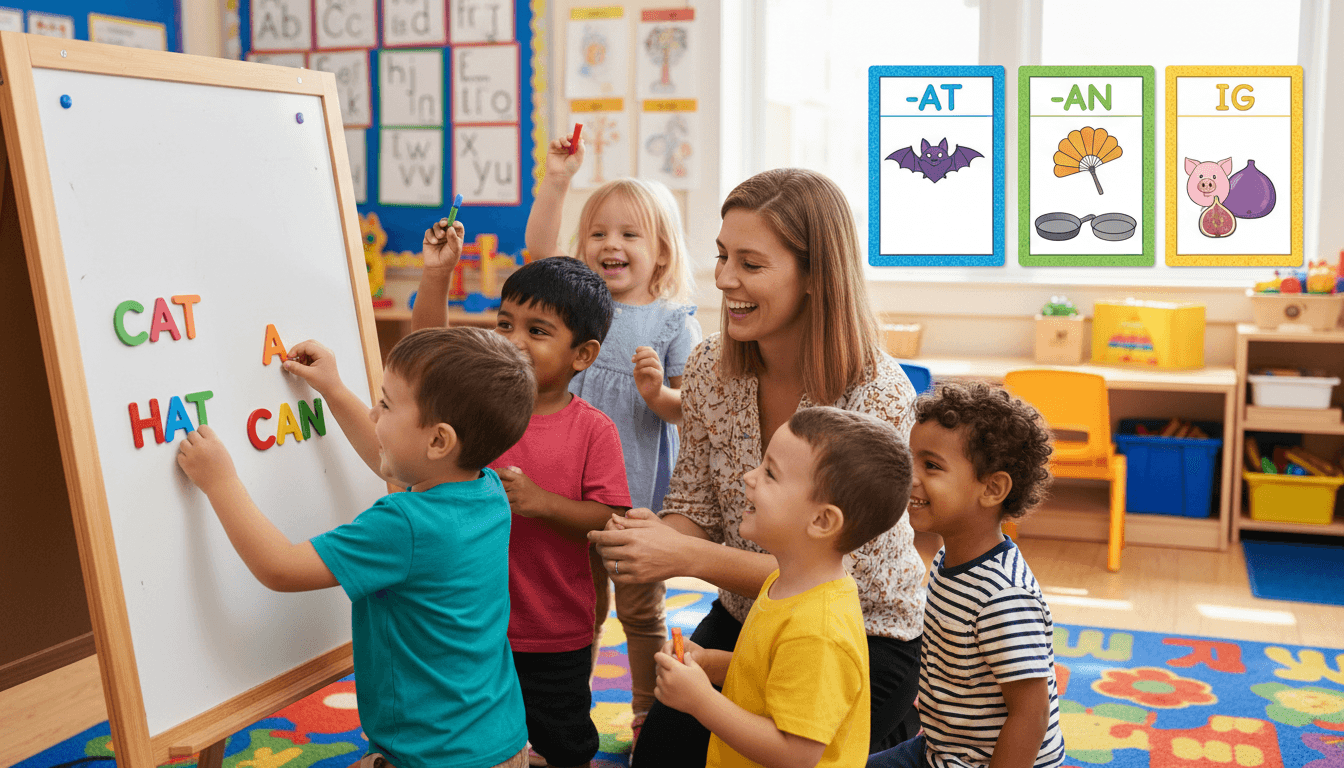
Word families are the best tool for this stage. Once a kid can spell "cat," they can spell bat, hat, mat, sat, rat. Change one letter, get a new word. It feels like a superpower.
7 Ways to Practice Spelling in Kindergarten
1. Sound It Out Together
Model the process constantly. "I want to write 'dog.' What sound do I hear first? /d/. What letter makes /d/? D. What's next? /o/. What letter? O. Last sound? /g/. G. D-O-G!"
Think aloud. Make it visible. Let kids see your brain working through the sounds.
2. Stretching Words
Teach kids to "stretch" words like a rubber band. Say the word slowly: "rrrr-uuuu-nnnn." Each stretched sound gets a letter.
Use hand motions: start with hands together, pull apart as you stretch the word. Physical movement helps.
3. Word Families
Pick a word family each week:
- Week 1: -at (cat, hat, bat, mat, sat)
- Week 2: -an (can, man, fan, ran, van)
- Week 3: -ig (big, dig, pig, wig, fig)
- Week 4: -op (hop, mop, top, pop, stop)
Build them with magnetic letters. Write them on whiteboards. Make them with playdough. The repetition of the ending pattern helps kids transfer spelling knowledge to new words.
4. Writing Workshop
The most authentic spelling practice is actual writing. When kids write stories, messages, or journal entries, they practice spelling constantly.
Don't correct every word. Celebrate the sounds they DO hear. "You wrote 'BRD' for bird. I can see you heard the B and the R and the D. Nice work! The tricky part is the 'ir' in the middle. That comes later."
5. Rainbow Words
For high-frequency words kids need to memorize (the, is, and, my, we), try rainbow writing: write the word in pencil, then trace over it in 5 different colors. The repetition of writing the same word multiple times builds visual memory.
6. Environmental Print
Label everything in the classroom. Door, desk, chair, window, clock. When kids see words constantly, they absorb the spelling.
Better yet: let kids make the labels. Even if "chair" comes out as "CHR," they're practicing.
7. Spelling Worksheets
Structured worksheets work well for CVC word practice. The best ones show a picture and ask kids to write the word using the sounds they hear.
The Inventive Spelling Debate
Some parents worry when they see "inventive spelling." They think letting kids spell words wrong will create bad habits.
Here's what the research says: inventive spelling in kindergarten and first grade actually leads to better spelling AND better writing in later grades. Why? Because kids who are free to write using the sounds they hear write MORE. And more writing means more practice.
By second grade, conventional spelling instruction should take over. But in kindergarten? Let them write. Let them sound it out. Let them try.
Common Mistakes
Correcting too much too soon. If you redline every misspelling, kids stop writing. Focus on the sounds they got right first.
Skipping the phonics foundation. Spelling without letter-sound knowledge is just memorization. Make sure phonics instruction is happening alongside spelling.
Only memorizing sight words. Sight words need memorization, but that's a small piece of spelling. CVC words should be sounded out, not memorized. The skill of sounding out transfers to new words. Memorization doesn't.
For Parents
- When your child writes something, read it back to them. "It says 'I LV MY DG.' You wrote 'I love my dog!' That's amazing!"
- Resist the urge to spell every word for them. Instead say: "What sounds do you hear?"
- Play rhyming games in the car. Rhyming builds phonemic awareness, which feeds into spelling.
- Practice 3-5 sight words at a time with flashcards or rainbow writing
Keep Reading
- How to Teach Handwriting to Kindergartners
- How to Teach Writing to Kindergartners: Activities That Build Confidence From Day One
- How to Improve Kids' Handwriting: Tips for Every Age
Your Next Step
Tomorrow, pick a word family (-at is a great starting point). Make it physical: build with magnetic letters, write on whiteboards, trace in sand. By Friday, your kiddos will be spelling at least 5 new words.
That's how spelling starts. One word family at a time. One sound at a time. Watch as their spelling evolves from random letters to meaningful words. It's one of the most rewarding things to witness in kindergarten.
For structured practice, our kindergarten spelling worksheets provide CVC word practice, word family activities, and picture-based spelling prompts.

Adi Ackerman
Head Teacher
Adi is the Head Teacher at ClassWeekly, with years of experience teaching elementary students. She designs our curriculum-aligned worksheets and writes practical guides for teachers and parents.
Keep Reading
Ready to download? Try ClassWeekly free for 30 days.
Unlimited worksheets for PreK through 5th grade. Cancel anytime.