
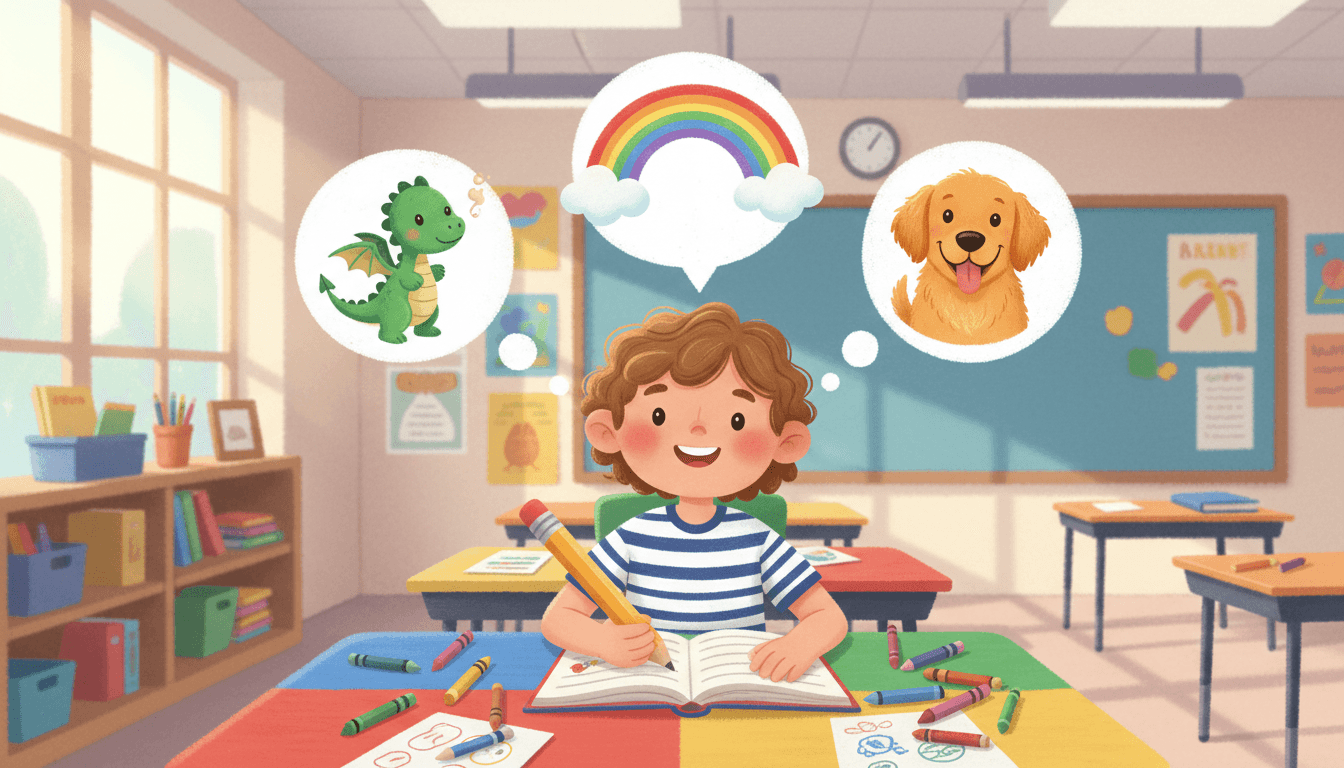
Writing Prompts for First Graders: 30 Ideas
Get 30 days of free worksheet downloads
Key Takeaways
- Prompts remove the hardest cognitive step for first graders by giving them a topic, freeing all their mental energy for the actual writing.
- Silly and imaginative prompts lower anxiety for reluctant writers, making it easier to produce longer, more detailed responses than serious topics.
- Accepting invented spelling during writing time is critical - correcting spelling mid-draft kills momentum and confidence at this age.
- Drawing before writing is a legitimate prewriting strategy for first graders, not a workaround - it activates ideas and makes drafting easier.
- Daily journal writing of even five minutes builds writing stamina noticeably within a month, increasing both speed and detail.

Getting a first grader to write can feel like pulling teeth. Or it can feel like opening a floodgate. There's honestly not much in between.
The difference usually comes down to the prompt. Give a six-year-old a blank page and say "write something," and you'll get a lot of staring. Give them a question that sparks their imagination, and suddenly they have more to say than their little hands can keep up with.
Here are 30 prompts that actually get first graders writing, plus tips for making writing time something your kiddos look forward to.
Why Writing Prompts Work for First Graders
First graders are still figuring out how to get their thoughts onto paper. That's a lot of work. They're thinking about letter formation, spacing, spelling, and oh yeah, they also need to come up with something to say.
Prompts remove the hardest part: deciding what to write about. When a child already has a topic, all that mental energy can go toward the actual writing. That's why prompted writing often produces longer, more detailed work than free writing at this age.
Good prompts also build confidence. A kid who writes three sentences about their favorite animal feels like a real writer. That feeling matters more than perfect spelling or punctuation right now.
There's something else going on too. First graders are natural storytellers. They'll tell you a twenty-minute story about what happened at recess. The challenge isn't ideas. It's the bridge between talking and writing. Prompts act as that bridge. They give your students a running start.
One more thing. Prompts teach structure without a formal lesson. When a child answers "What would you do if you found a talking cat?", they're naturally building a beginning, middle, and end. They're learning narrative structure just by responding to an interesting question.
Free Writing Practice Pages for 1st Grade


10 Story Starter Prompts
These prompts invite your students to create short narratives. Don't worry about length. Even two or three sentences count as a story at this age.
- One day, I found a tiny door in my backyard. I opened it and saw...
- If my pet could talk, the first thing it would say is...
- I woke up one morning and everything was upside down. The first thing I noticed was...
- A friendly dragon landed on the playground. It wanted to...
- I opened my lunchbox and something magical was inside. It was...
- My teddy bear came to life at night. We went on an adventure to...
- I found a map in my desk. It led me to...
- The clouds turned into animals. The first one I saw was...
- A new kid came to school. But this kid was actually a...
- I shrunk down to the size of an ant. The scariest thing was...
How to use these: Read the prompt aloud. Give kids a minute to think (or turn and talk with a partner). Then let them write. Some students will want to draw first and write after. That's perfectly fine. Drawing is prewriting for first graders.
If a student gets stuck after one sentence, try asking: "And then what happened?" That simple question can unlock the next three sentences.
10 Journal Prompts for Daily Writing
Journal prompts work best when they connect to your students' real lives. These are great for morning work or a daily writing block.
- What is your favorite thing to do after school?
- Describe your best friend. What makes them special?
- What is the best meal you ever ate? What made it so good?
- If you could have any superpower, what would you pick and why?
- What makes you feel brave?
- Tell about a time you helped someone.
- What is your favorite season? What do you like to do during that season?
- If you could visit anywhere in the world, where would you go?
- What is something you're really good at?
- Describe your family. What do you like to do together?
Daily writing builds stamina. Even five minutes of journal writing each morning adds up. After a month, your students will write faster, longer, and with more detail than when they started. That's probably the single biggest benefit of consistent journal time.
Keep expectations realistic. A first grader writing three complete sentences in a journal entry is doing great. Five sentences is exceptional. The goal is consistency, not length.
10 Fun and Silly Prompts
Sometimes you just need to make writing fun. These silly prompts get kids laughing and writing at the same time.
- What would happen if it rained pizza?
- You just became the principal for a day. What's the first rule you make?
- Your shoes can fly! Where do you go first?
- Describe the grossest sandwich ever. What's on it?
- You woke up as a penguin. What's your day like?
- If crayons could talk, what would the red one say to the blue one?
- You found a monkey in your bathtub. What do you do?
- Invent a new holiday. What is it called and how do people celebrate?
- Your teacher is secretly a superhero. What's their power?
- What if dogs went to school? What would they learn?
Why silly works: When kids are laughing, they're not anxious about getting it "right." Silly prompts lower the stakes. A child who won't write about their weekend will happily write a whole paragraph about a monkey in the bathtub.
These prompts also build voice. When a first grader writes "The grossest sandwich has worms and old cheese and bug juice," they're making creative choices. They're developing their own style as writers, even if they don't know it yet.
Tips for Using Prompts With Reluctant Writers
Not every first grader jumps at the chance to write. Some kids avoid it. Some cry. Some write one word and declare themselves done. Here's what actually helps.
Start with drawing. Tell reluctant writers to draw their answer first. Then ask them to label the picture. Then ask them to write one sentence about it. You've just tricked them into writing, and they probably didn't even notice.
Use a talking step before writing. Have students turn to a partner and tell their answer out loud. Hearing themselves say it makes writing it down feel less scary. You can even have them tell you, and you write their words on a whiteboard. "See? You just wrote a sentence. Now copy it onto your paper."
Accept invented spelling. Nothing kills a first grader's writing momentum faster than "How do you spell...?" Tell your kiddos to stretch out the word and write the sounds they hear. "Dragun" is a perfectly fine way to spell dragon in first grade. Spelling instruction happens at a different time. During writing time, the goal is getting ideas down.
Celebrate effort, not perfection. Read their writing back to them with enthusiasm. "You wrote about a flying dog! That's such a creative idea!" When kids feel proud of what they wrote, they want to write more. It's that simple.
Give choices. Offer two or three prompts and let students pick. Autonomy matters, even for six-year-olds. A child who chose their own prompt is more invested in the writing.
Keep Reading
- Writing Prompts for Second Graders: Fun Ideas for Every Week
- Kindergarten Writing Prompts: 50 Fun Ideas That Get Kids Writing
- Writing Prompts for Fifth Graders: Deeper Thinking on Paper
Practice Pages That Build Writing Skills
Prompts get the ideas flowing. But first graders also need structured practice with the mechanics of writing. Things like forming complete sentences, using capital letters at the beginning, and putting a period at the end.
Sentence building practice pages give students a framework. Some pages provide a sentence starter ("I like to ___") and students fill in the rest. Others ask students to unscramble words into a sentence. Both types build the connection between spoken language and written language.
Picture-based writing pages are gold for this age group. Students look at a picture and write one to three sentences about what they see. The picture does the heavy lifting for kids who struggle to generate ideas on their own.
Tracing and copying still matters in first grade. Students who haven't fully mastered letter formation benefit from tracing sentences before writing their own. It's not busywork. It's building the muscle memory that makes independent writing possible.
The best approach is a mix. Use prompts for creative thinking and voice-building. Use structured practice pages for mechanics and conventions. Together, they build the complete writer.
Writing in first grade isn't about producing polished pieces. It's about building the belief that "I am a writer." Every prompt answered, every sentence completed, every silly story about raining pizza adds another brick to that foundation. Keep it fun, keep it low-pressure, and watch your kiddos surprise you with what they have to say 📝

Adi Ackerman
Head Teacher
Adi is the Head Teacher at ClassWeekly, with years of experience teaching elementary students. She designs our curriculum-aligned worksheets and writes practical guides for teachers and parents.
Keep Reading
Ready to download? Try ClassWeekly free for 30 days.
Unlimited worksheets for PreK through 5th grade. Cancel anytime.