
Fun Math Puzzles for Kids That Build Problem-Solving Skills
Get 30 days of free worksheet downloads
Key Takeaways
- Math puzzles build productive struggle, the ability to sit with a hard problem and keep going
- Number riddles develop working memory by requiring students to hold multiple clues at once
- Input-output tables are one of the most powerful puzzle types for building algebraic thinking
- Logic grid puzzles build deductive reasoning without requiring any computation at all
- Discuss strategies not just answers so students learn how to think, not just what to answer
There's a moment in every math class when a student says, "This is actually kind of fun." It usually doesn't happen during a page of computation drills. It happens during a puzzle.
Math puzzles flip the script. Instead of "solve this problem the way I showed you," the message becomes "figure out how this works." And that shift, from following instructions to thinking independently, is where real problem-solving skills are born.
The best part? You don't need fancy materials. A pencil, some paper, and a well-crafted puzzle can do more for mathematical thinking than 30 repetition problems ever will.
Why Math Puzzles Are More Than Just Fun
Let's be honest. Math puzzles feel like play. And that's exactly why they work.
When students tackle a puzzle, they're doing something fundamentally different from standard practice. They're reasoning. They're testing ideas, hitting dead ends, and trying again. They're developing what mathematicians call productive struggle, the ability to sit with a problem you don't immediately know how to solve and keep going.
This is the skill that separates students who are "good at math" from students who actually think mathematically.
Puzzles build:
- Logical reasoning. If this is true, then that must be true.
- Pattern recognition. The ability to see structure and predict what comes next.
- Persistence. Not giving up after the first attempt.
- Flexible thinking. When one approach doesn't work, try another.
- Number sense. A deeper, more intuitive feel for how numbers behave.
Research consistently shows that students who regularly engage with mathematical puzzles and open-ended problems score higher on assessments that measure reasoning, not just computation. Puzzles don't replace skill practice. They give skills a purpose.
And there's a motivation bonus too. Students who "hate math" will often happily spend 20 minutes on a puzzle. The game-like structure removes the anxiety that comes with traditional math work. Nobody fails a puzzle. You just haven't solved it yet.
Free Problem-Solving Practice Pages for 3rd Grade


Number Riddles for Every Grade Level
Number riddles are the simplest puzzle type, and they work from kindergarten through 5th grade. The format is straightforward: give clues, find the number.
For K-1 students:
- "I am a number between 5 and 10. I am odd. I am less than 8. What number am I?" (7)
- "I am the number of legs on a dog plus the number of wheels on a bicycle." (6)
- "You can make me with one nickel. What number am I?" (5)
For 2nd-3rd graders:
- "I am a two-digit number. My tens digit is 3 more than my ones digit. My digits add up to 7. What number am I?" (52)
- "I am an even number between 20 and 30. You say me when you count by 6. What am I?" (24)
- "I am less than 50. I am a multiple of both 4 and 6. What am I?" (12, 24, 36, or 48)
For 4th-5th graders:
- "I am a three-digit number. All my digits are the same. I am divisible by 3 and 37. What am I?" (111, 222, 333, 444, 555, 666, 777, 888, or 999)
- "I am a fraction less than 1. When you multiply my numerator and denominator, you get 12. I am in simplest form. What could I be?" (1/12, 2/6... wait, 2/6 simplifies to 1/3, so 1/12 or 3/4)
- "When you reverse my digits, I become 27 more than I was. I am between 10 and 70. What numbers could I be?" (14, 25, 36, 47, 58)
How to use these in class: Write one riddle on the board as a warm-up. Give students 3-5 minutes to work independently or with a partner. Discuss strategies, not just answers. "How did you narrow it down?" matters more than "What's the answer?"
The real power of number riddles is that students must hold multiple conditions in mind simultaneously. That's working memory and logical reasoning in action.
Pattern Puzzles That Stretch Thinking
Patterns are the backbone of mathematics. When students learn to see and extend patterns, they're building the foundation for algebra, whether they know it or not.
Number sequence puzzles:
- 2, 4, 8, 16, ___ (doubling: 32)
- 1, 1, 2, 3, 5, 8, ___ (Fibonacci: 13)
- 3, 6, 11, 18, 27, ___ (differences increase by 2 each time: 38)
Start with simple "add the same number" patterns for younger students, then introduce patterns where the rule itself changes.
Shape pattern puzzles: Draw a sequence of shapes and ask students to draw the next one. These work well with grid paper.
- Triangle, square, pentagon, ___ (hexagon, adding one side each time)
- A 1x1 square, a 2x2 square, a 3x3 square, ___ (4x4, growing in area)
Input-output tables (function machines): Give students a table with some inputs and outputs filled in. They figure out the rule.
| In | Out |
|---|---|
| 3 | 7 |
| 5 | 11 |
| 8 | 17 |
| 10 | ? |
(Rule: multiply by 2, add 1. Answer: 21.)
These are honestly one of the most valuable puzzle types for elementary students. They're building algebraic thinking in a format that feels like a game. "I figured out the machine's secret rule" is a much more exciting sentence than "I solved a function."
Visual pattern counting: Show a growing pattern made of blocks or dots. How many blocks in step 5? Step 10? Step 100? This pushes students toward finding a general rule, which is the beginning of algebraic reasoning.
Logic Puzzles for Young Problem Solvers
Logic puzzles require no computation at all. Just clear, step-by-step reasoning. That's what makes them special.
Grid logic puzzles: "Three kids each have a different pet. Use the clues to figure out who has which pet." Students use a grid to eliminate possibilities. Start with 3x3 grids for younger students and work up to 4x4 or 5x5.
Clue example:
- Alex does not have the cat.
- The person with the fish sits next to Bella.
- Charlie is allergic to dogs.
Students mark X for "no" and O for "yes" on their grid. Each clue eliminates options until only one possibility remains. This is deductive reasoning in its purest form.
True or false puzzles: "One of these three statements is false. Which one?"
- Statement A: 5 + 3 = 8
- Statement B: 12 is an odd number
- Statement C: A triangle has 3 sides
These require students to evaluate each claim independently. Simple, but effective for building critical thinking.
Balance scale puzzles: Draw a balance scale. "If 2 circles balance 6 triangles, and 1 triangle balances 3 squares, how many squares balance 1 circle?" Students work backward through the relationships. This is pre-algebraic thinking disguised as a visual puzzle.
Sudoku for kids. Mini 4x4 Sudoku grids (using numbers 1-4) are perfect for 2nd and 3rd graders. The rules are simple: each row, column, and 2x2 box contains each number exactly once. The reasoning required is anything but simple. For older students, standard 6x6 or 9x9 grids provide a serious but enjoyable challenge.
How to Use Math Puzzles in the Classroom
Puzzles don't need their own dedicated lesson. They fit into routines you probably already have.
Morning warm-ups. Project one puzzle on the board as students arrive. They work on it during the first 5 minutes. No grading, no pressure. Just thinking.
Early finisher activities. Keep a folder of puzzles at different difficulty levels. When a student finishes their work early, they grab a puzzle. This is infinitely better than "sit quietly and wait."
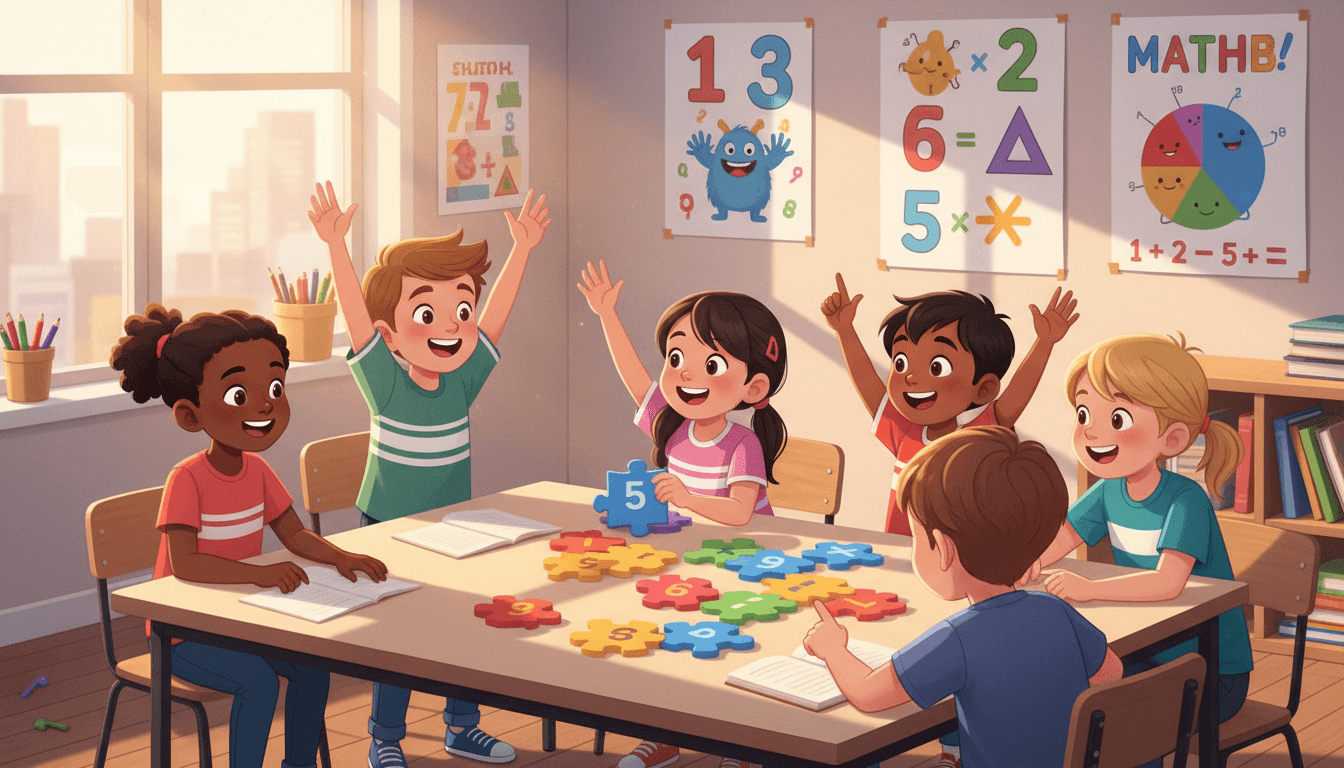
Station rotations. Make puzzles one of your math stations. A group of 4-5 students works on a set of puzzles together while you pull small groups for instruction. The puzzle station runs itself because puzzles are inherently engaging.
Friday puzzle challenges. Once a week, give the whole class a challenging puzzle. Let them work in pairs. Discuss strategies as a class afterward. Make it a ritual. Students will look forward to it.
Homework alternative. Instead of a page of practice problems, assign one puzzle per week. Parents often end up working on them too. That's a feature, not a bug.
Key teaching move: When discussing puzzle solutions, ask "How did you figure it out?" not just "What's the answer?" The reasoning matters more than the result. Celebrate wrong-but-thoughtful approaches alongside correct answers. "I tried dividing it into groups first, but that didn't work, so then I..." is exactly the kind of thinking you want to encourage.
Math Puzzles for Home Practice
Parents often ask how they can support math at home beyond homework help. Puzzles are the perfect answer because they don't require anyone to teach a method. The puzzle itself is the teacher.
Dice games with a twist. Roll two dice. Multiply the numbers. Now try to reach exactly 50 by adding or subtracting the products of multiple rolls. It takes planning and mental math, and it's oddly addictive.
Card puzzles. Deal four cards (remove face cards). Use all four numbers and any operations (+, -, ×, ÷) to make 24. This is the classic "24 Game" and it's brilliant for building number sense. Start by letting younger kids target 10 instead of 24.
Story puzzles at dinner. "If everyone at this table ate 3 slices of pizza, and we ordered 2 pizzas with 8 slices each, would we have enough?" These don't feel like math. They feel like conversation. But the reasoning is real.
Puzzle books and apps. KenKen (arithmetic + logic), Kakuro (cross-sums), and tangram puzzles are all excellent. For screen time that's actually productive, puzzle apps that require reasoning over speed are a solid choice.
Cooking math. "The recipe makes 4 servings but we need 6. How much of each ingredient do we need?" This involves fractions, multiplication, and proportional reasoning. All from a recipe card.
The car ride question. "I'm thinking of a number. It's even, it's between 1 and 100, and when you divide it by 5 you get a number less than 10." Instant entertainment. Let kids take turns being the number-picker too.
Keep Reading
- How to Teach Word Problems in Second Grade
- Fun Division Tricks That Help Kids Learn Faster
- How to Teach Division to Third Graders
- Math Fact Fluency Without Killing the Joy
Practice Pages That Challenge and Engage
Once your students are hooked on puzzles, give them access to practice pages that require the same kind of thinking. Word problems and logic challenges take computation skills and put them inside a context that requires reasoning.
The best practice pages for building problem-solving skills:
- Multi-step word problems. Problems that can't be solved with a single operation. Students need to plan their approach.
- Open-ended problems. "Find three different ways to make 100 using exactly four numbers." Multiple correct answers encourage creative thinking.
- Error analysis. "Sam solved this problem. What mistake did he make?" Students find and correct errors, which requires deeper understanding than solving from scratch.
- Visual puzzles on paper. Pattern completion, spatial reasoning, and geometry puzzles that require thinking, not just calculating.
Here's what matters most: the habit of thinking hard about math. Computation fluency matters. Of course it does. But fluency without reasoning is like knowing all the words in a language and having nothing to say.
Math puzzles give your students something worth saying. They give them a reason to think, and they prove, every single time, that math can be genuinely fun.
Try one puzzle this week. Just one. Watch what happens when your kiddos realize that math can feel like a game 🧩

Adi Ackerman
Head Teacher
Adi is the Head Teacher at ClassWeekly, with years of experience teaching elementary students. She designs our curriculum-aligned worksheets and writes practical guides for teachers and parents.
Keep Reading
Ready to download? Try ClassWeekly free for 30 days.
Unlimited worksheets for PreK through 5th grade. Cancel anytime.