
Parts of Speech for Second Graders: Nouns, Verbs, More
Get 30 days of free worksheet downloads
Key Takeaways
- Second graders already use nouns, verbs, and adjectives in speech - the teacher's job is to help them label and organize what they already know, not teach language from scratch.
- Introduce parts of speech in sequence: nouns first (2 weeks), then verbs, then adjectives, because concrete concepts build toward more abstract ones.
- Kinesthetic activities like the Noun Hunt, acting out verbs, and the Mystery Bag adjective game make grammar memorable and engaging for 7-year-olds.
- A growing anchor chart that students contribute to all year builds ownership and creates a shared reference tool for the whole class.
- Common Core L.2.1 expects second graders to identify nouns (including collective nouns), use verbs in past/present/future tense, and use adjectives and adverbs by year's end.

Second grade is when grammar stops being invisible and starts becoming something kids can actually name and talk about. By now, your students use nouns, verbs, and adjectives in every sentence they speak. They just don't know it yet.
Our job? Help them see the grammar they're already using. And honestly, that's the fun part.
Where Second Graders Are
Your 2nd graders already know a lot about language. They can:
- Speak in complete, complex sentences
- Tell stories with a beginning, middle, and end
- Use describing words naturally ("I want the BIG red one!")
- Understand basic sentence structure
They're not learning language from scratch. They're learning to label and organize what they already know. That makes teaching parts of speech much easier than it sounds.
Free 2nd Grade Parts of Speech Worksheets


Start With Nouns (The Naming Words)
Nouns are the easiest entry point because they're the most concrete.
Simple definition for kids: A noun is a word that names a person, place, or thing.
How to Teach It
The Noun Hunt. Walk around the classroom. Every time a student points at something, they name it. "Desk." "Window." "Ms. Johnson." Write every word on a big chart. At the end, reveal: "All of these words are called NOUNS!"
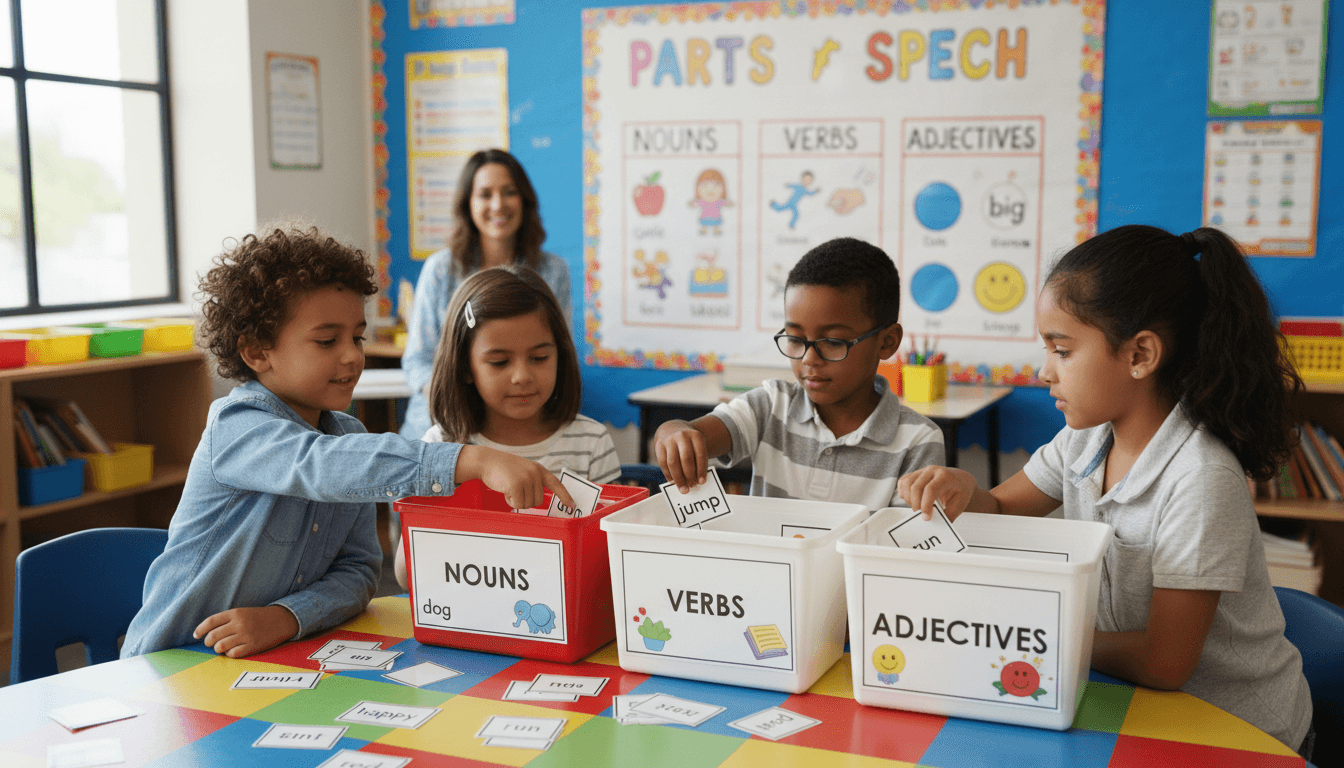
Sort it out. Give kids a mixed list of words. They sort them into "noun" or "not a noun" categories. Start obvious (cat, run, big, table, happy, school) and gradually make it trickier.
Noun journals. Each day, kids write 3 new nouns they notice. By Friday, they have 15 nouns. By the end of the month, they have a noun dictionary they made themselves.
Quick tip: introduce proper nouns (capitalized) versus common nouns (lowercase) early. Kids love learning that their name is a "special noun" that gets a capital letter.
Add Verbs (The Action Words)
Once nouns are solid (give it about 2 weeks), introduce verbs.
Simple definition for kids: A verb is a word that tells what someone or something does.
How to Teach It
Act it out. Say a verb. Kids do the action. "Jump!" "Spin!" "Whisper!" "Freeze!" Then flip it: a student does an action, the class guesses the verb.
Noun + Verb pairs. Write a noun on one card and a verb on another. Kids draw one of each and make a silly sentence: "The elephant danced." "The pencil sneezed." Silly is memorable.
Find the verb. Read a sentence aloud. Students clap when they hear the verb. "The dog (CLAP: ran) to the park." "She (CLAP: eats) lunch every day."
Then Adjectives (The Describing Words)
Adjectives come last because they're more abstract. But second graders are ready for them.
Simple definition for kids: An adjective is a word that describes a noun. It tells what kind, how many, or which one.
How to Teach It
The Mystery Bag. Put an object in a bag. Students reach in (without looking) and describe it: "It's round." "It's smooth." "It's small." Write every describing word on the board. Those are adjectives.
Before and after sentences. Start with "I see a dog." Then add adjectives: "I see a big, fluffy, brown dog." Kids see how adjectives make sentences more interesting.
Adjective brainstorm. Hold up a picture. Set a timer for 1 minute. How many adjectives can the class come up with? "Sunny, bright, warm, yellow, beautiful, peaceful..."
Building the Anchor Chart
Create a classroom anchor chart that grows all year:
| Nouns (Naming Words) | Verbs (Action Words) | Adjectives (Describing Words) |
|---|---|---|
| Person, place, thing | What you DO | What it looks LIKE |
| dog, school, teacher | run, eat, think | big, red, happy |
Add new words to the chart weekly. By the end of the year, you'll have a massive collection that kids contributed to. They'll be proud of it.
Common Mistakes to Watch For
"Is 'love' a noun or a verb?" Great question. It's both! Second graders can handle this idea: some words can be different parts of speech depending on how they're used. "I love pizza" (verb) vs. "Love is kind" (noun).
Confusing adjectives and adverbs. For now, don't worry about adverbs. That's a 3rd grade standard. Keep the focus on nouns, verbs, and adjectives.
Thinking verbs are only physical actions. Remind kids that thinking, feeling, and being are also verbs. "I think." "She is." "He feels happy." These are harder but important.
Practice Ideas for Home
Parents can reinforce parts of speech easily:
- At dinner: "Name 3 nouns on the table." "What verb describes what Dad is doing?"
- In the car: "Find a noun outside the window." "What adjective describes the sky?"
- Reading together: Pause and ask, "Can you find an adjective on this page?"
It doesn't need to be formal. Just noticing and naming.
What to Aim For
By the end of second grade (per Common Core L.2.1), students should:
- Identify and use nouns (including collective nouns)
- Use verbs in the past, present, and future tense
- Use adjectives and adverbs to describe
- Produce complete sentences with correct grammar
Our 2nd grade grammar worksheets provide structured practice for all three parts of speech, with sorting activities, fill-in-the-blank sentences, and creative writing prompts.
Keep Reading
- Teaching Nouns and Verbs to First Graders
- Compound Words for Kids: Activities and Practice Pages
- Synonyms for Kids: What They Are and How to Teach Them
The Bottom Line
Parts of speech aren't boring rules to memorize. They're labels for what kids already know how to do. When you teach it that way, with movement, games, and real sentences, grammar becomes something second graders actually enjoy.
Now for the fun part: try the Noun Hunt tomorrow. Watch how excited your kiddos get when they realize they've been using grammar all along. 🙌

Adi Ackerman
Head Teacher
Adi is the Head Teacher at ClassWeekly, with years of experience teaching elementary students. She designs our curriculum-aligned worksheets and writes practical guides for teachers and parents.
Keep Reading
Ready to download? Try ClassWeekly free for 30 days.
Unlimited worksheets for PreK through 5th grade. Cancel anytime.