
The 5 Text Structures: How to Teach Them (Grades 3-5)
Get 30 days of free worksheet downloads
Key Takeaways
- Identifying text structure gives students a mental filing system that improves comprehension even when they already know all the words in a passage.
- Teach the five structures in order of difficulty: description and sequence first, then cause and effect and compare and contrast, with problem and solution last.
- Signal words like 'because,' 'however,' and 'first' are helpful starting clues, but students must also look at the overall organization of the passage to confirm the structure.
- Having students write their own paragraphs using a target structure deepens their understanding more than identification practice alone.
- Text structure skills transfer across subjects - students who recognize cause and effect in science or chronological order in social studies become more confident readers everywhere.
Here's something that might surprise you: many struggling readers can decode every word in a nonfiction passage and still not understand what they've read. The problem isn't the vocabulary. It's that they don't recognize how the information is organized.
Text structure is the skeleton of nonfiction writing. When your students can identify it, they know what to pay attention to, what kind of information is coming next, and how to organize it in their own heads. It's honestly one of the highest-leverage comprehension skills you can teach.
Let's walk through how to do it well.
What Is Text Structure and Why It Matters
Text structure is the way an author organizes information in a passage. Just like a house has a frame that holds everything together, a piece of writing has a structure that holds the ideas together.
Why does this matter for comprehension? Because knowing the structure tells readers what to expect.
If a student recognizes that a passage uses cause and effect, they automatically start looking for what happened and why. If they recognize compare and contrast, they start tracking similarities and differences. The structure gives their brain a filing system.
Research backs this up. Students who can identify text structure score significantly higher on comprehension assessments than those who can't. It's not a nice-to-have skill. It's foundational.
For your students, frame it simply: "Authors choose how to organize their writing on purpose. When you figure out their plan, reading gets easier."
Free 4th Grade Reading Comprehension Worksheets


The 5 Text Structures Every Student Should Know
There are five main text structures that show up in elementary nonfiction. Introduce them one at a time over several weeks. Don't rush this.
1. Description. The author describes a topic by listing its features, characteristics, or examples. Think of a passage about rainforests that describes the climate, animals, and plants. There's no particular order to the information. It's all describing one subject.
2. Sequence (Chronological Order). Events or steps are presented in the order they happen. This shows up in how-to texts, historical passages, and science procedures. First this, then that, next this.
3. Compare and Contrast. The author shows how two or more things are similar and different. A passage comparing frogs and toads, or the American Revolution and the Civil War.
4. Cause and Effect. The author explains why something happens (the cause) and what happens as a result (the effect). Pollution causes water contamination. Deforestation leads to animal habitat loss.
5. Problem and Solution. The author presents a problem and then explains one or more solutions. This is common in science and social studies texts. "The town had too much trash, so they started a recycling program."
Teach description and sequence first (3rd grade typically). These are the most concrete and easiest to recognize. Cause and effect and compare and contrast come next. Problem and solution is often the last one students master because it requires understanding both the problem and evaluating the solution.
Signal Words That Reveal the Structure
This is probably the most practical thing you can teach your students about text structure. Signal words are like road signs. They tell you which structure you're in.
Description: for example, such as, in addition, also, including, characteristics of
Sequence: first, next, then, after, before, finally, meanwhile, during, later
Compare and Contrast: similar, different, both, however, on the other hand, alike, unlike, whereas, but
Cause and Effect: because, as a result, therefore, due to, since, consequently, if...then, led to
Problem and Solution: the problem is, one solution, as a result, so that, resolved by, in response to
Create a signal words chart and post it in your classroom. Color-code it by structure. When students encounter these words during reading, they should be able to look up and confirm which structure they're in.
One important caveat: signal words are helpful clues, not guarantees. A passage can use the word "because" and still not be primarily cause and effect. Teach students to look at the overall organization, not just individual words.
Teaching Text Structure With Nonfiction Passages
The best way to teach text structure is with short, clear nonfiction passages where the structure is unmistakable. Save the tricky, mixed-structure texts for later.
Start with one structure at a time. Spend three to five days on each structure before moving to the next one. Read multiple examples. Identify signal words together. Discuss how the information is organized and why the author chose that structure.
Use familiar topics. Students comprehend structure better when they're not also struggling with unfamiliar content. Passages about animals, sports, food, or weather work well because the content is accessible.
Think-aloud your process. Model your thinking: "I see the words 'as a result' and 'because.' The author is telling me why something happened. I think this is cause and effect. Let me check by asking: does the whole passage explain causes and results? Yes, it does."
Graphic organizers for each structure. After identifying the structure, have students organize the information into a matching graphic organizer. Venn diagram for compare and contrast. Flow chart for sequence. T-chart for cause and effect. This reinforces both the structure and the content.
Once students know all five structures individually, start giving them passages without telling them which structure it is. That's when the real skill kicks in.
Activities for Each Text Structure
Here are activities that work well once students have been introduced to each structure.
Structure scavenger hunt. Give students a stack of short passages (cut from newspapers, magazines, or printed nonfiction). They sort each one into the correct structure category and highlight the signal words that helped them decide. This works great as a center activity.
Write your own. After studying a structure, have students write a short paragraph using that same structure about a topic they choose. If you've been studying cause and effect, they write a cause and effect paragraph about something they know. "I didn't study for the test, so I didn't do well." Writing in a structure deepens understanding of it.
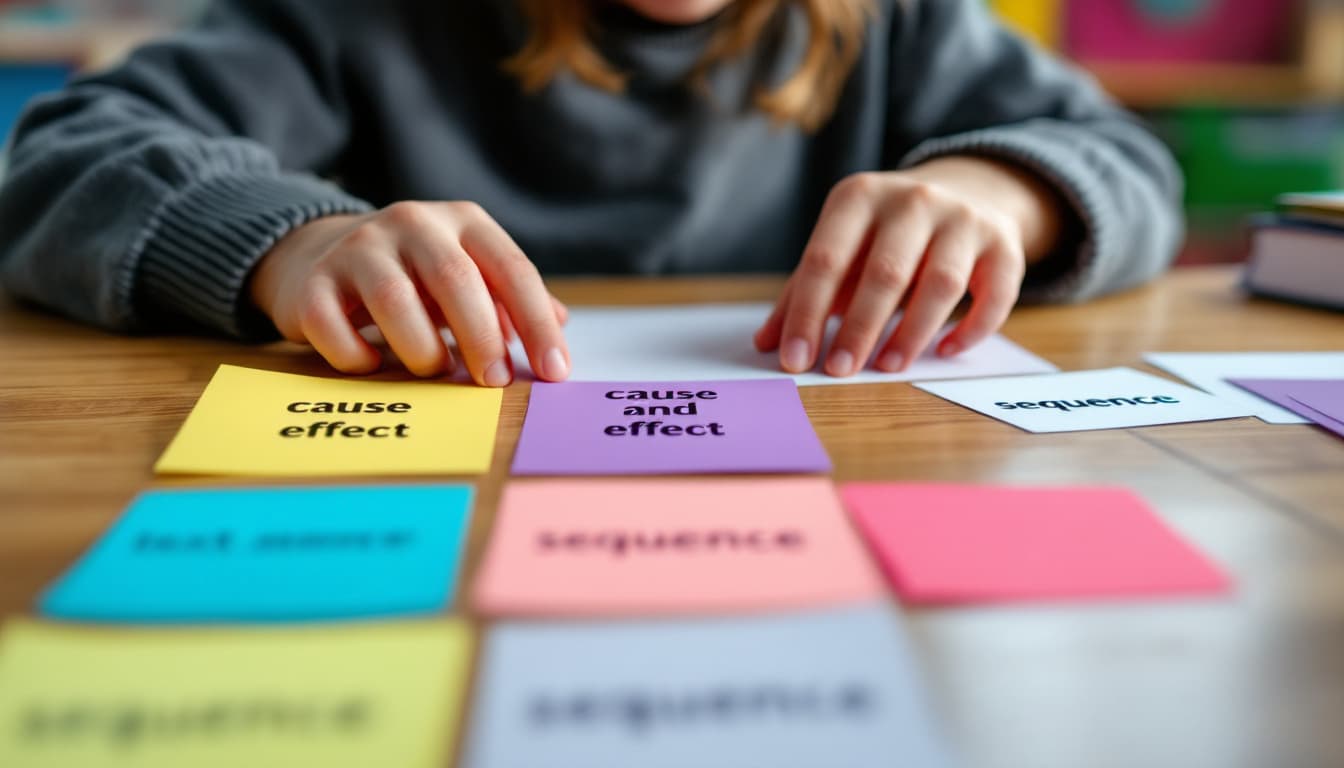
Structure match-up. Create cards with passages on one set and structure names on another. Students match them. For an added challenge, include the graphic organizer that goes with each structure as a third matching element.
Mixed structure paragraphs. For advanced students (probably late 4th or 5th grade), introduce the idea that a single text can use more than one structure. A passage might describe a problem (description + problem) and then explain the solution in chronological steps (sequence). This is closer to how real-world nonfiction actually works.
Structure of the week. Each week, focus on one structure across all subjects. During science, point out the cause and effect structure in the textbook. During social studies, notice the chronological order. This cross-curricular approach helps students see that text structure isn't just a reading skill. It's everywhere.
Common Confusions and How to Address Them
Even after solid instruction, certain confusions pop up repeatedly.
Confusing cause and effect with problem and solution. These are closely related, and honestly, the line between them can be blurry. The distinction: cause and effect explains why things happen. Problem and solution proposes a fix. If the passage mostly explains reasons and results, it's cause and effect. If it names a problem and offers a way to solve it, it's problem and solution.
Thinking all nonfiction is description. Description is the "default" structure students fall back on when they're unsure. Teach them to look for signal words first. If there are no clear signal words, then description might be correct. But don't let it become a lazy answer.
Ignoring structure in fiction. While text structure is primarily a nonfiction skill, fiction uses structure too. Most stories follow a sequence (beginning, middle, end) with cause and effect woven throughout. Pointing this out occasionally helps students see structure as a universal concept.
Focusing only on signal words. Signal words are a starting point, not the whole strategy. Some passages use very few signal words but have a clear structure. Students need to look at how the information is organized overall, not just hunt for keywords.
Keep Reading
- Theme vs Main Idea: Teaching Kids the Difference
- Character Traits for Kids: Teaching Readers to Understand Characters
- How to Teach Summarizing: Strategies for 2nd Through 4th Graders
- Helping Parents Support Practice at Home
Practice Pages for Text Structure Skills
After instruction and group practice, independent practice pages help students apply what they've learned on their own. The best practice gives students a passage, asks them to identify the structure, circle signal words, and explain their reasoning.
Start with passages that use one clear structure. As students grow more confident, introduce passages where the structure is less obvious or where two structures overlap. That progression from clear to challenging is what builds real skill.
Text structure is one of those skills that pays dividends across every subject. When your kiddos walk into a science class and automatically notice that the textbook chapter uses compare and contrast, they'll comprehend more, retain more, and feel more confident as readers. That's the kind of transfer that makes all this teaching worthwhile.

Adi Ackerman
Head Teacher
Adi is the Head Teacher at ClassWeekly, with years of experience teaching elementary students. She designs our curriculum-aligned worksheets and writes practical guides for teachers and parents.
Keep Reading
Ready to download? Try ClassWeekly free for 30 days.
Unlimited worksheets for PreK through 5th grade. Cancel anytime.