
Alphabet Activities for Kids: Fun Ways to Learn Letters
Get 30 days of free worksheet downloads
Key Takeaways
- Alphabet readiness signs include noticing letters in the environment and recognizing their own name in print, typically emerging between ages 3 and 4.
- Teaching both letter names and letter sounds is important: letter names support alphabet knowledge while letter sounds are the direct bridge to decoding and reading.
- Sensory activities like sand trays, playdough letters, and shaving cream writing engage multiple brain pathways, creating stronger letter memories than paper practice alone.
- Teaching letters in a strategic order, starting with the child's name then high-frequency consonants, is more effective than strictly following alphabetical order.
- The transition from letter knowledge to blending should start with two-letter combinations and CVC words only after children can quickly identify most letters and their sounds.

Learning the alphabet is one of those milestones that parents and teachers get really excited about. And for good reason. Letter recognition is the foundation of everything that comes after: reading, writing, spelling, all of it.
But here's what's worth remembering. There's a huge range of "normal" with alphabet learning. Some three-year-olds know every letter. Some five-year-olds are still working on it. Both are fine.
What matters most isn't speed. It's that your kiddos get meaningful, repeated exposure to letters in ways that feel like play, not pressure.
When Are Kids Ready to Learn the Alphabet
There's no magic age when alphabet instruction should start. But there are readiness signs to watch for.
Signs a child is ready:
- They notice letters in their environment (on signs, cereal boxes, books)
- They try to "write" by scribbling or making letter-like shapes
- They recognize their own name in print
- They show interest when you read alphabet books
- They can identify some basic shapes (circle, line, curve)
Most children start showing these signs between ages 3 and 4. By kindergarten entry (around age 5), many children are expected to recognize most uppercase letters and some lowercase ones.
What if they're not showing interest yet? Don't force it. Focus on building print awareness instead. Point out letters casually: "Look, that sign starts with the same letter as your name!" Read alphabet books without quizzing. Let curiosity develop naturally.
Pushing formal alphabet instruction before a child is ready can actually backfire. It creates frustration and negative associations with letters. Play-based exposure is always the right starting point.
Free Kindergarten Letter Worksheets


Letter Names vs Letter Sounds (Teach Both)
This is a debate in early literacy circles, and honestly, the answer is simpler than people make it.
Teach both. But understand the difference and why each matters.
Letter names (A, B, C) help children identify and talk about letters. When a child sees the letter M and says "M," they're using the letter name. This is important for alphabet knowledge, spelling conversations, and reading environmental print.
Letter sounds (/a/, /b/, /k/) are what children need for decoding. When they start sounding out words, they need to know that the letter B makes the /b/ sound. Letter sounds are the direct bridge to reading.
For preschoolers, start with letter names and introduce sounds gradually. Many children learn the letter name and its most common sound together without any problem: "This is the letter B. It makes the /b/ sound. Ball starts with B."
A few tips for teaching sounds:
- Start with the most common sound for each letter, not all possible sounds
- Consonants with clear, single sounds (B, D, F, M, T) are easiest to start with
- Vowels are trickier. Short vowel sounds first, long vowels later
- Don't add "uh" to consonant sounds. It's /b/, not "buh." This makes a big difference when kids start blending sounds into words
Sensory Alphabet Activities
Young children learn through their senses. The more ways they interact with letters, the better they'll remember them.
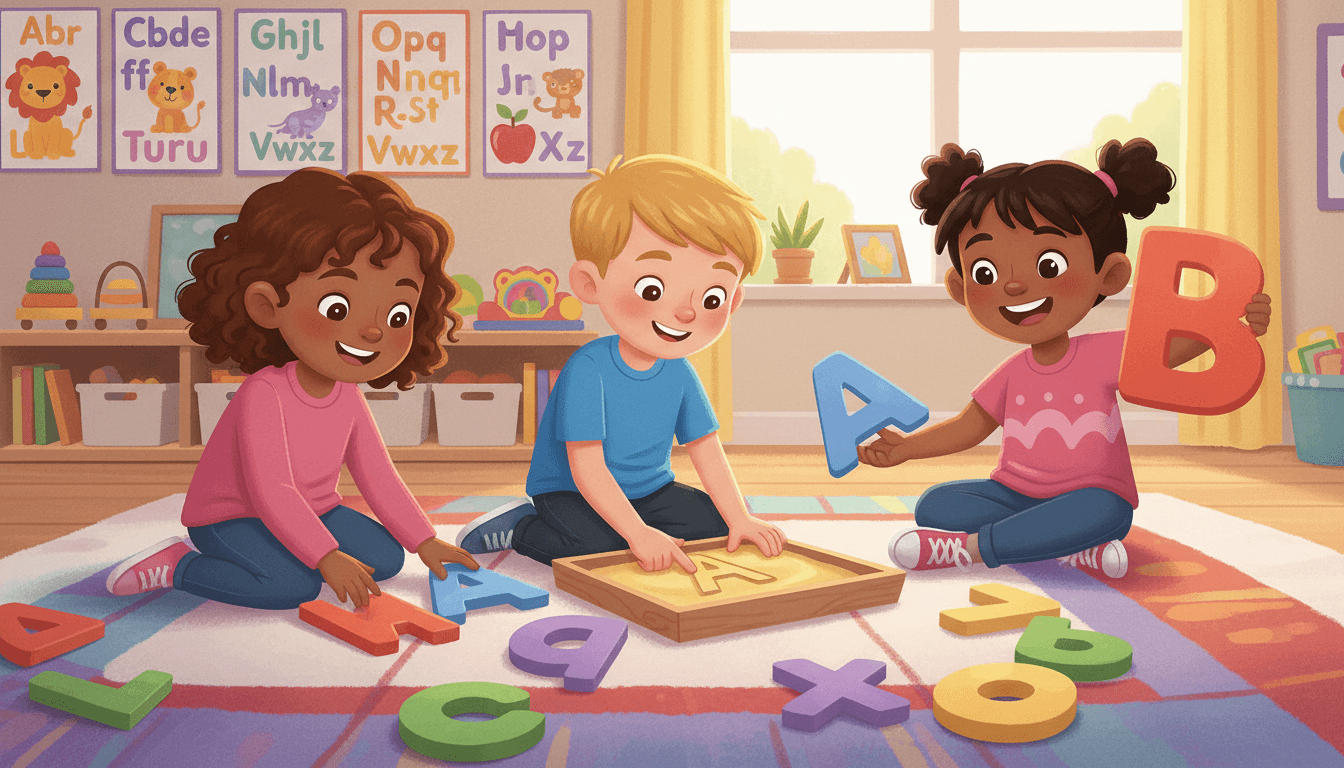
Sand or salt trays. Fill a shallow tray with sand, salt, or even sprinkles. Children trace letters with their finger. They can feel the shape while they see it. Erase by shaking the tray and start over. This is satisfying in a way that pencil and paper just isn't for a 4-year-old.
Playdough letters. Roll playdough into snakes and shape them into letters. This builds both letter recognition and fine motor skills. Bonus: laminate letter cards and have children build the letters right on top of the cards for a matching element.
Shaving cream writing. Spread shaving cream on a table (or a baking tray for easier cleanup). Children trace letters in the cream with their fingers. Messy? Yes. Memorable? Absolutely.
Textured letter cards. Cut letters from sandpaper, felt, or glitter paper. Children trace them with their fingers while saying the letter name and sound. The texture creates a tactile memory that reinforces the visual one.
Rainbow writing. Children trace a large letter on paper, then trace over it again in a different color. And again. And again. The result is a rainbow-layered letter, and the repetition builds motor memory without feeling repetitive.
Sensory activities work because they engage multiple pathways in the brain. A child who has seen the letter, said the letter, heard the letter, and felt the letter with their hands has four connections to draw from instead of just one.
Alphabet Games for the Classroom
Games keep alphabet practice feeling light. And when it feels like play, children stay engaged longer and retain more.
Letter hunt. Hide magnetic letters around the classroom (or the house). Children find them and bring them back to a central location. For an added challenge, they have to name each letter and its sound before placing it on the board.
Letter matching. Spread uppercase letter cards face up on a table. Give children lowercase cards and have them find the matches. Start with a small set (maybe 6 to 8 letters) and increase as they get faster.
Alphabet bingo. Create bingo cards with letters instead of numbers. Call out letter names or sounds. Children cover the matching letter. Simple, effective, and kids love the game format.
Musical letters. Place large letter cards in a circle on the floor (like musical chairs). Play music. When it stops, each child identifies the letter they're standing on. Or names something that starts with that letter.
Letter of the week deep dives. Dedicate each week to one letter. Read books featuring that letter, hunt for it in the classroom, eat a snack that starts with it, do a craft shaped like it. This concentrated focus gives children deep familiarity with each letter.
One thing to keep in mind: don't teach the alphabet strictly in order. Research suggests teaching letters in a strategic order works better. Start with the letters in the child's name. Then add high-frequency consonants (S, T, M, R). Then fill in the rest. This way, children learn useful letters first.
Alphabet Songs and Videos That Work
Let's be honest. Songs are how most of us learned the alphabet, and they still work beautifully.
The classic ABC song. It works. But watch for the "LMNOP" blur. Many children think that's one letter. Slow that section down deliberately. Some teachers pause between L-M-N-O-P to help children hear each letter separately.
Letter sound songs. Songs that pair each letter with its sound and a keyword are incredibly useful. "A says /a/, /a/ apple. B says /b/, /b/ ball." These songs build automatic letter-sound associations.
Action songs. Songs where children do a motion for each letter (jump for J, wiggle for W) add a kinesthetic element that helps active learners. Movement + sound = stronger memory.
Alphabet books with rhythm. "Chicka Chicka Boom Boom" is a classic for a reason. The rhythm and repetition make it naturally memorable. Read it often. Children will start "reading" it from memory, which builds confidence and print awareness.
Keep the songs and videos short. Three to five minutes is plenty for preschoolers. Longer than that and attention drifts. Repeat the same songs frequently. Familiarity builds confidence, and confidence builds interest.
From Letters to Words (The Transition)
At some point, your kiddos will know their letters and sounds, and they'll be ready to start putting them together. This is a gradual transition, not a sudden one.
Signs they're ready:
- They can identify most letters quickly (both uppercase and lowercase)
- They know the sounds for most consonants and short vowels
- They're starting to notice that words are made of individual sounds
- They try to sound out simple words or write using invented spelling
First steps into blending:
Start with two-letter combinations. "What sound does S make? What sound does A make? Now let's put them together: sa." Then build to CVC (consonant-vowel-consonant) words: sat, mat, pin, dog.
Use magnetic letters on a board. Physically sliding letters together while blending the sounds helps children understand that reading is combining sounds into words.
Don't rush this transition. Some kindergartners spend the whole year on letter recognition and early phonemic awareness, and that's perfectly appropriate. The alphabet is the foundation. Make sure it's solid before building on top of it.
Keep Reading
- How to Teach the Alphabet to Kids: A Parent's Complete Guide
- When Do Kids Learn the Alphabet? A Developmental Guide
- How to Teach Letter Recognition to Kindergartners: Activities That Build Confidence
Practice Pages for Alphabet Skills
Printable practice pages give children focused time with individual letters. The best ones for this age include tracing (builds motor memory), matching (connects uppercase and lowercase), and beginning sounds (bridges to phonics).
Keep practice sessions short for young learners. Five to ten minutes is plenty. Always pair written practice with hands-on activities. No preschooler should spend 30 minutes at a table with a pencil.
Learning the alphabet is a journey that looks different for every child. Some will zoom through it. Others will take their time. Both paths are completely normal. Your job is to fill their world with letters through play, songs, sensory experiences, and gentle practice. The rest takes care of itself.

Adi Ackerman
Head Teacher
Adi is the Head Teacher at ClassWeekly, with years of experience teaching elementary students. She designs our curriculum-aligned worksheets and writes practical guides for teachers and parents.
Keep Reading
Ready to download? Try ClassWeekly free for 30 days.
Unlimited worksheets for PreK through 5th grade. Cancel anytime.