
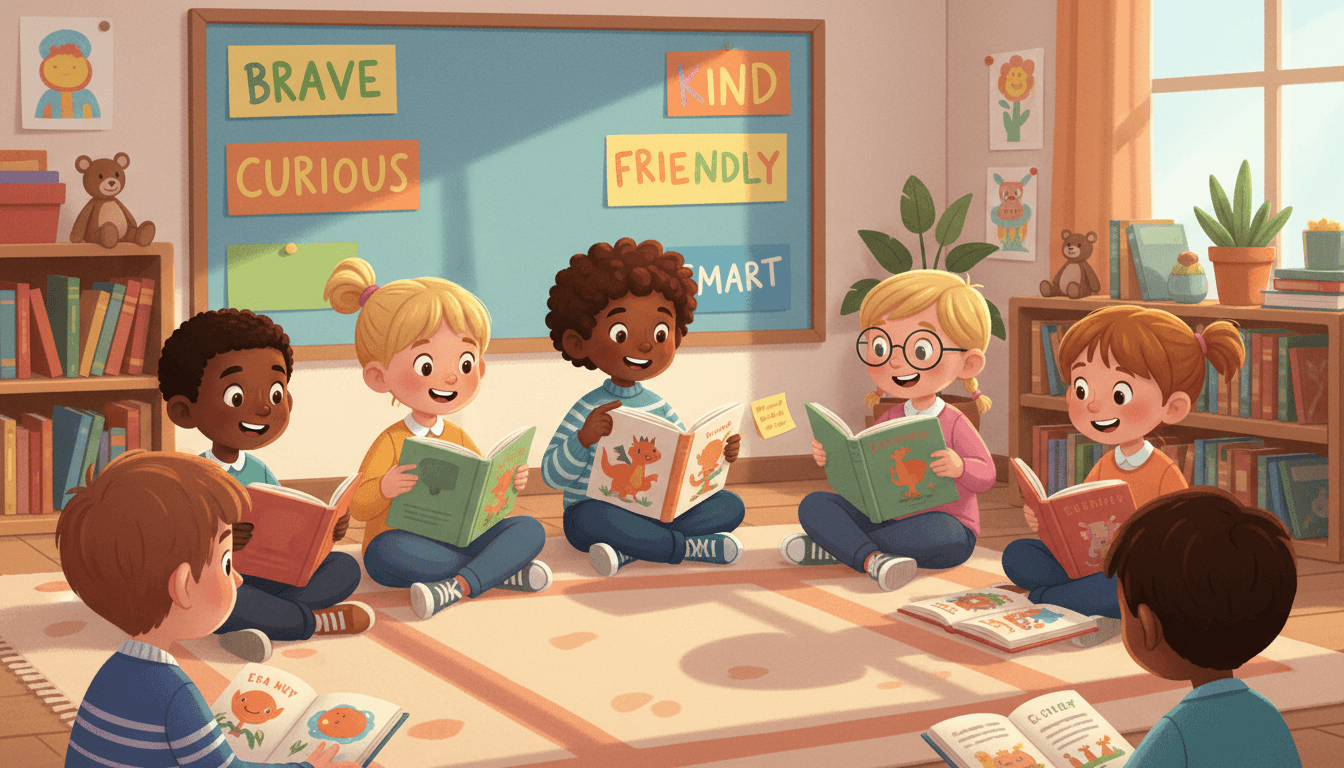
Character Traits for Kids: A Guide for Young Readers
Get 30 days of free worksheet downloads
Key Takeaways
- Character traits describe who a character is on the inside and stay consistent throughout a story, while feelings are temporary reactions to specific events.
- Teaching students to find evidence in what a character does, says, and thinks is the foundation of strong character analysis.
- Building a grade-level trait vocabulary is essential - kids cannot identify a trait they cannot name, so a classroom word wall helps significantly.
- Graphic organizers like the trait-evidence-explanation chart directly mirror the format used on most state reading assessments.
- Students most commonly confuse traits with feelings, use vague words like 'nice,' and forget to cite text evidence - addressing these early builds stronger readers.

Understanding characters is where reading starts to feel like magic. When your kiddos can figure out why a character does what they do, they're not just reading anymore. They're thinking like real readers.
But here's the thing. Character traits are honestly one of the trickiest reading skills to teach. Kids confuse traits with feelings all the time, and it takes deliberate, repeated practice to get the distinction to stick.
Let's break down how to teach it well.
What Are Character Traits (vs Feelings)
This is where most of the confusion lives, so let's tackle it first.
A character trait is who a character is on the inside. It's a consistent quality that shows up throughout the story. Think: brave, generous, stubborn, curious.
A feeling is how a character reacts to something that happens in the moment. Think: scared, angry, excited, nervous.
Here's a simple way to explain it to your students: "Feelings change. Traits stay."
A character might feel scared when they see a spider. But if they keep going anyway, they're brave. Brave is the trait. Scared is the feeling.
Use a T-chart in your classroom. Label one side "Traits (who they are)" and the other "Feelings (how they feel right now)." Read a short passage together and sort the words. You'll probably need to do this several times before it clicks for everyone.
Free 3rd Grade Reading Comprehension Worksheets


Teaching Kids to Find Traits in Text
Once your students understand what a trait is, the next step is finding evidence for it. This is where the real thinking happens.
Teach them to look at three things:
- What the character does. Actions reveal traits. A character who shares their lunch is generous. A character who practices piano every day is determined.
- What the character says. Dialogue matters. A character who says "Don't worry, I'll help you" is kind and supportive.
- What the character thinks. Internal thoughts show traits that actions might not. A character who thinks "I should tell the truth even though it's hard" is honest.
Model this with a think-aloud. Read a paragraph from a familiar book and literally say your thinking out loud: "The character just gave away their only sandwich. That tells me they're generous. That's a trait because they do things like this throughout the whole story, not just once."
The key phrase to repeat: "How do you know? Show me in the text." This pushes students past guessing and into evidence-based thinking.
Character Trait Word Lists by Grade
One reason kids struggle with character traits is that they simply don't have enough trait words in their vocabulary. You can't identify something you can't name.
2nd grade starters: kind, brave, mean, funny, smart, shy, honest, lazy, helpful, curious
3rd grade expansion: generous, determined, responsible, selfish, creative, loyal, patient, stubborn, respectful, confident
4th grade depth: compassionate, resourceful, persistent, arrogant, humble, cautious, impulsive, reliable, courageous, manipulative
Post these words somewhere visible in your classroom. Add to the list as you encounter new traits in your read-alouds. By the end of the year, your students should have a rich vocabulary of trait words they can pull from automatically.
A word wall specifically for character traits works really well here. Organize it alphabetically or by positive/negative traits. Let students add to it when they discover new words in their reading.
Activities That Make Character Analysis Fun
Sitting with a passage and answering "What trait does this character show?" gets old fast. Here are activities that keep the thinking alive.
Character trait detective badges. Give students a "detective" assignment. They read independently and hunt for evidence of a specific trait. When they find it, they write the page number and what the character did or said. It's the same skill, but the framing makes it feel like a mission.
Trait sorting cards. Write traits on index cards. Read a short story together, then have students in small groups sort the cards into "yes, this fits the character" and "no, this doesn't." They have to explain why for each one.
Character comparison charts. Pick two characters from the same book (or different books). Students identify three traits for each character and find text evidence. This builds comparison skills alongside character analysis.
Role play interviews. One student pretends to be a character from a book. The rest of the class interviews them. "Why did you decide to help the fox?" The student in character has to answer based on the character's traits. This gets loud and wonderful.
Using Graphic Organizers for Character Study
Graphic organizers give structure to thinking, and for character traits, they're almost essential.
The trait-evidence-explanation organizer. Three columns. Column 1: the trait. Column 2: what the character did or said (the evidence). Column 3: how this evidence proves the trait. This is the format that shows up on most state assessments, so it's worth practicing.
Character body maps. Draw a simple outline of a person. Inside the head, write what the character thinks. Near the mouth, what they say. By the hands, what they do. Near the heart, the traits these reveal. Kids love this one because it's visual and creative.
Before and after charts. For stories where characters change, have students track traits at the beginning versus the end. What trait did the character start with? What happened to change them? What new trait emerged? This is a natural bridge to more advanced literary analysis.
Start with the simplest organizer (trait + evidence) for 2nd graders. Add the explanation column in 3rd grade. By 4th grade, students should be able to track multiple traits and character growth across a whole chapter book.
Common Mistakes When Analyzing Characters
After working with hundreds of kiddos on character traits, these are the patterns I see again and again.
Confusing traits with feelings. Already covered, but it bears repeating. "Happy" is not a character trait. "Optimistic" might be. Keep reinforcing the "traits stay, feelings change" rule.
Using vague words. "Nice" and "mean" are where everyone starts, but they're not specific enough. Push your students toward precision. Nice how? Kind? Generous? Supportive? The more specific the trait word, the stronger the analysis.
Forgetting the evidence. A student who says "I think the character is brave" without pointing to a specific moment in the text is guessing, not analyzing. Always, always ask for the proof.
Only looking at the main character. Side characters have traits too. Encourage your students to analyze secondary characters, especially when those characters influence the main character's decisions.
Assuming traits are always positive. Students sometimes resist labeling a character as selfish or dishonest, especially if they like the character. Remind them that good analysis means being honest about what the text shows, even when the trait isn't flattering.
Keep Reading
- How to Teach Summarizing: Strategies for 2nd Through 4th Graders
- Teaching Text Structure: Helping Kids Understand How Writing Is Organized
- Theme vs Main Idea: Teaching Kids the Difference
Practice Pages for Character Traits
Once your students understand how to identify traits and find evidence, they need repeated practice to build confidence. Independent practice is where it all comes together.
Start with passages where the traits are fairly obvious, then gradually increase the difficulty. Look for texts where the character's actions clearly demonstrate a trait, so students can practice the evidence-finding process without getting stuck on comprehension.
Character traits might take weeks to teach well. That's normal. Your kiddos are building a skill that will serve them through every book they ever read. Take the time, build the vocabulary, and keep asking that magic question: "How do you know?"

Adi Ackerman
Head Teacher
Adi is the Head Teacher at ClassWeekly, with years of experience teaching elementary students. She designs our curriculum-aligned worksheets and writes practical guides for teachers and parents.
Keep Reading
Ready to download? Try ClassWeekly free for 30 days.
Unlimited worksheets for PreK through 5th grade. Cancel anytime.