
How to Teach Phonics to Kids: A Complete Guide for Parents
Get 30 days of free worksheet downloads
Key Takeaways
- Teach letter sounds before letter names - the sound /b/ helps a child decode words, while the name 'bee' does not.
- Start with a small set of letters like s, a, t, p, i, n so children can immediately build and read real words from day one.
- Blending is the core skill of phonics - use continuous blending and physical anchors like body blending to help struggling readers.
- Digraphs (sh, ch, th) make one new sound from two letters, while blends (bl, cr, st) still let you hear both individual sounds.
- Keep home phonics practice to 10 minutes and stop before frustration sets in - consistency and positive feelings matter more than volume.

Phonics is probably the word you've heard most often since your child started school. Teachers talk about it. Articles mention it. The reading curriculum is built around it. But if you're a parent trying to help at home, you might be wondering: what exactly is phonics, and how do I teach it without messing things up?
Good news. You don't need a teaching degree to support phonics at home. You just need to understand the basics and know what order to teach things in.
What Is Phonics (And Why Does Everyone Talk About It)
Phonics is the relationship between letters and sounds. The letter "b" makes the /b/ sound. The letters "sh" make the /sh/ sound. Phonics instruction teaches kids to connect what they see (letters) with what they hear (sounds), so they can decode written words.
This is different from memorizing words by sight. Phonics gives kids a strategy for figuring out words they've never seen before. When your child encounters the word "frog" for the first time, phonics is what allows them to sound it out: /f/ /r/ /o/ /g/... frog!
The research on phonics is about as clear as educational research gets. Systematic, explicit phonics instruction significantly improves reading outcomes for young children. It's especially important for kids who don't pick up reading naturally through exposure alone.
That doesn't mean phonics is the only thing that matters. Vocabulary, comprehension, fluency, and a love of reading all matter too. But phonics is the decoding engine. Without it, kids can't access the text independently. And independent access to text is what makes everything else possible.
Free Kindergarten Phonics Worksheets


Free 1st Grade Phonics Worksheets


The Phonics Teaching Sequence That Works
One of the biggest mistakes parents make is teaching phonics in alphabetical order. It seems logical, but it's not the most effective approach.
Here's the general sequence that most evidence-based programs follow:
Honestly? This is harder to teach than most curriculum guides admit.
- Individual letter sounds (consonants and short vowels)
- Blending sounds into words (CVC words like cat, big, hop)
- Consonant blends (bl, cr, st, tr)
- Consonant digraphs (sh, ch, th, wh)
- Long vowel patterns (silent e, vowel teams like ai, ea, oa)
- R-controlled vowels (ar, er, ir, or, ur)
- Diphthongs and advanced patterns (oi/oy, ou/ow)
You don't need to teach all of this yourself. Schools handle the progression. But knowing the sequence helps you understand what your child is working on and what comes next.
One important principle: teach sounds, not letter names, first. The letter name "bee" doesn't help a child read "bat." The sound /b/ does. When your child is starting out, focus on what the letter says, not what it's called.
Teaching Individual Letter Sounds
Start with a small set of letters that can be combined to make real words. Most programs begin with something like: s, a, t, p, i, n. With just these six letters, your child can read words like "sat," "pan," "tip," "nap," "pin," and "tan."
That's the beauty of phonics. A small investment in letter sounds produces immediate reading payoff.
How to introduce a new letter sound:
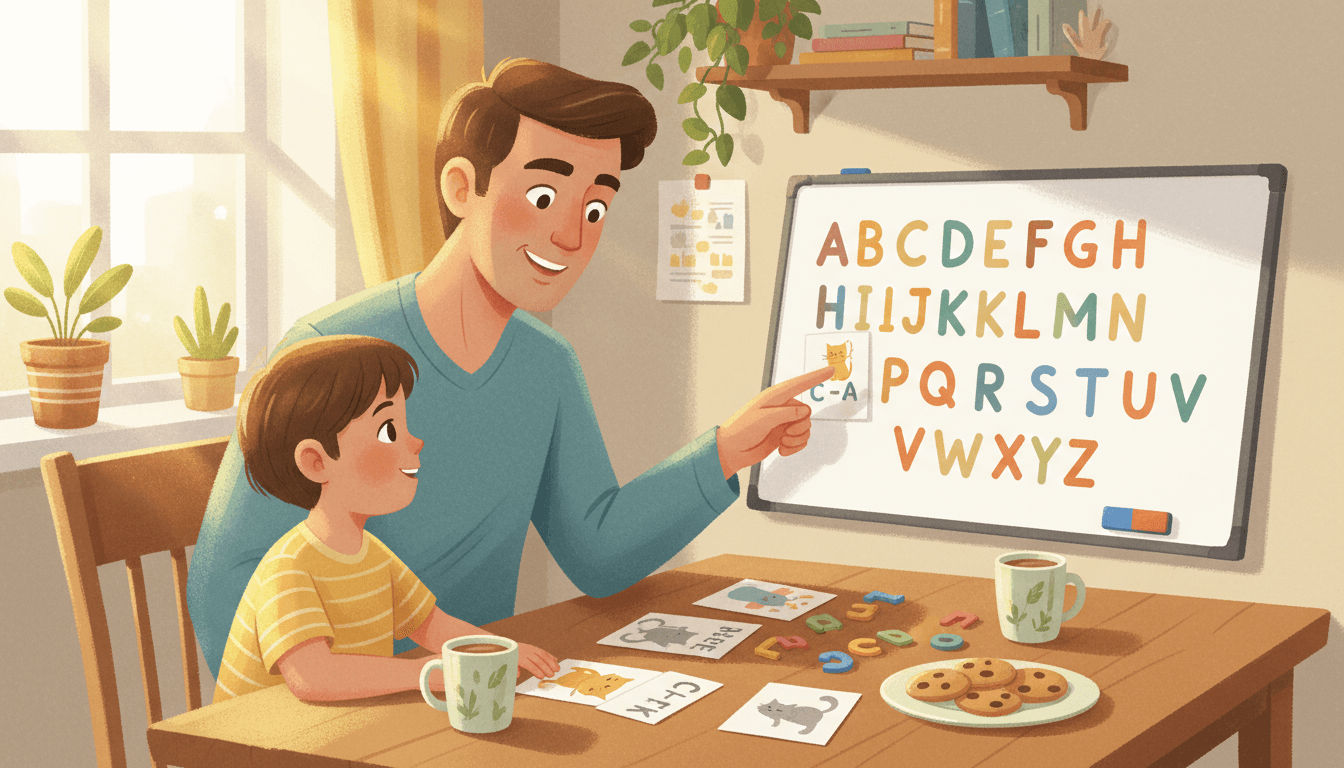
- Show the letter. Use a flashcard, write it on a whiteboard, or use magnetic letters.
- Say the sound. "/s/ as in sun." Keep the sound crisp. Don't add "uh" to the end. It's /s/, not "suh."
- Have your child repeat it. Say it three times together.
- Connect it to a keyword. "S says /s/ like snake." The keyword gives them a hook to remember.
- Find it in words. "Can you hear /s/ at the beginning of 'soap'? What about 'fish'? Where's the /s/ in fish?"
Introduce 2-3 new letter sounds per week. Practice previously learned sounds every session. The goal is mastery before moving on, not speed.
A few sounds that trip kids up:
- B and D. The most commonly confused pair. Teach them weeks apart, not back to back. Use a visual anchor: make a "bed" with your fists (left fist is b, right fist is d, thumbs up, looks like a bed).
- Short e and short i. These sound very similar. Exaggerate the difference. Short e like "eeehh" (opening your mouth wider). Short i like "ih" (mouth stays narrow).
- Hard and soft c/g. For now, just teach the hard sounds (c as in cat, g as in go). Soft sounds (c as in city, g as in giraffe) come later.
Blending Sounds Into Words
Knowing individual letter sounds is step one. Blending them together into a word is step two, and it's where real reading begins.
Blending is hard for many kids at first. They can say /c/ /a/ /t/ as separate sounds, but smooshing them into "cat" takes practice.
Try these blending techniques:
Continuous blending. Instead of saying each sound with a pause between, stretch the sounds together: "caaaat." Start slow and gradually speed up until the word emerges. This is probably the most effective technique for beginners.
Body blending. Touch your shoulder while saying /c/, your elbow for /a/, and your hand for /t/. Then slide your hand down your arm as you blend: "cat." The physical motion helps the sounds flow together.
Sound boxes (Elkonin boxes). Draw three connected boxes on paper. Put one letter in each box. Point to each box as your child says the sound, then sweep your finger under all three as they blend.
Some kids get blending right away. Others need weeks of practice. If your child is struggling, go back to two-sound words first. "At," "in," "up," "am." Once they can blend two sounds, three-sound words feel more manageable.
Don't rush past blending. It's the core skill that makes everything else work.
CVC Words: The First Real Reading
CVC stands for consonant-vowel-consonant. Words like "cat," "big," "hop," "sun," and "red." These are the first words your child will read independently, and it's a magical moment.
Once your child knows enough letter sounds and can blend, put those skills together with CVC words:
Word building with magnetic letters. Place "c-a-t" on the fridge. Your child reads it. Now swap the c for h. "What does it say now?" Hat! Swap the h for b. Bat! This "word chain" activity builds both blending and letter-sound knowledge.
Decodable books. These are short books that only use letter sounds your child has learned. They're not great literature, but they're incredibly effective for practice. A child who can read "The fat cat sat on a mat" is genuinely reading, and they know it.
CVC word sorts. Write CVC words on cards. Sort them by the middle vowel. All the short-a words in one pile, short-i in another. This builds phonemic awareness alongside phonics.
Real-world reading. Point out CVC words in the environment. "That sign says 'bus.' Can you sound it out?" "The menu says 'hot dog.' What's the first word?"
The CVC stage usually happens in mid to late kindergarten. Some kids hit it earlier, some in early first grade. Wherever your child lands, celebrate it. They're reading actual words. That's a big deal.
Digraphs and Blends: The Next Step
Once CVC words are solid, English starts getting more complicated. Two letters that make one sound (digraphs) and two consonants that blend together (blends) are the next challenge.
Digraphs are letter pairs that create a brand new sound:
- sh as in ship
- ch as in chip
- th as in thin (and the voiced version in "this")
- wh as in when
The key concept: two letters, one sound. "Ship" has three sounds (/sh/ /i/ /p/), not four, even though it has four letters.
Blends are letter pairs where you hear both sounds, just smooshed together:
- bl as in block (you hear both /b/ and /l/)
- cr as in crab
- st as in stop
- tr as in trip
The difference between digraphs and blends confuses some parents. Here's the simple test: in a blend, you can hear both letter sounds. In a digraph, the two letters make a completely new sound that neither letter makes alone.
Teaching tips for this stage:
- Introduce digraphs one at a time. Spend several days on "sh" before moving to "ch."
- Use word sorts. Mix up words with sh and ch. Kids sort them by their beginning digraph.
- Point out digraphs in books during read-alouds. "Look, 'the' starts with th. We know that sound!"
- For blends, practice the two individual sounds first, then practice blending them. /s/... /t/... /st/... stop.
This stage often happens in late kindergarten through mid-first grade. It's where phonics starts unlocking a much larger set of words, and kids can feel their reading power growing.
Keep Reading
- How to Teach the Alphabet to Kids: A Parent's Complete Guide
- Sight Words for Kindergarten: A Complete Teaching Guide
- How to Teach Decoding Skills to Beginning Readers
- Communicating With Parents Without Adding Another Job
- Helping Parents Support Practice at Home
Practice Pages for Phonics at Home
Practice pages are a great complement to the hands-on activities above. They give your child focused, structured practice with specific phonics skills.
For kindergartners, look for pages that focus on letter-sound matching, beginning sounds, and simple CVC word reading. For first graders ready for more, pages with blends, digraphs, and word family patterns are ideal.
Keep phonics practice at home short and positive. Ten minutes is plenty. If your child is getting frustrated, stop and try something different. Read a book together. Play a word game. Come back to the practice page tomorrow.
The most important thing you can do as a parent isn't to run a perfect phonics program at home. It's to make reading feel safe, fun, and rewarding. Your kiddos will remember how reading made them feel long after they've forgotten which worksheets they completed. Keep it warm, keep it playful, and trust that the skills are building even on the days when progress feels slow.

Adi Ackerman
Head Teacher
Adi is the Head Teacher at ClassWeekly, with years of experience teaching elementary students. She designs our curriculum-aligned worksheets and writes practical guides for teachers and parents.
Keep Reading
Ready to download? Try ClassWeekly free for 30 days.
Unlimited worksheets for PreK through 5th grade. Cancel anytime.