
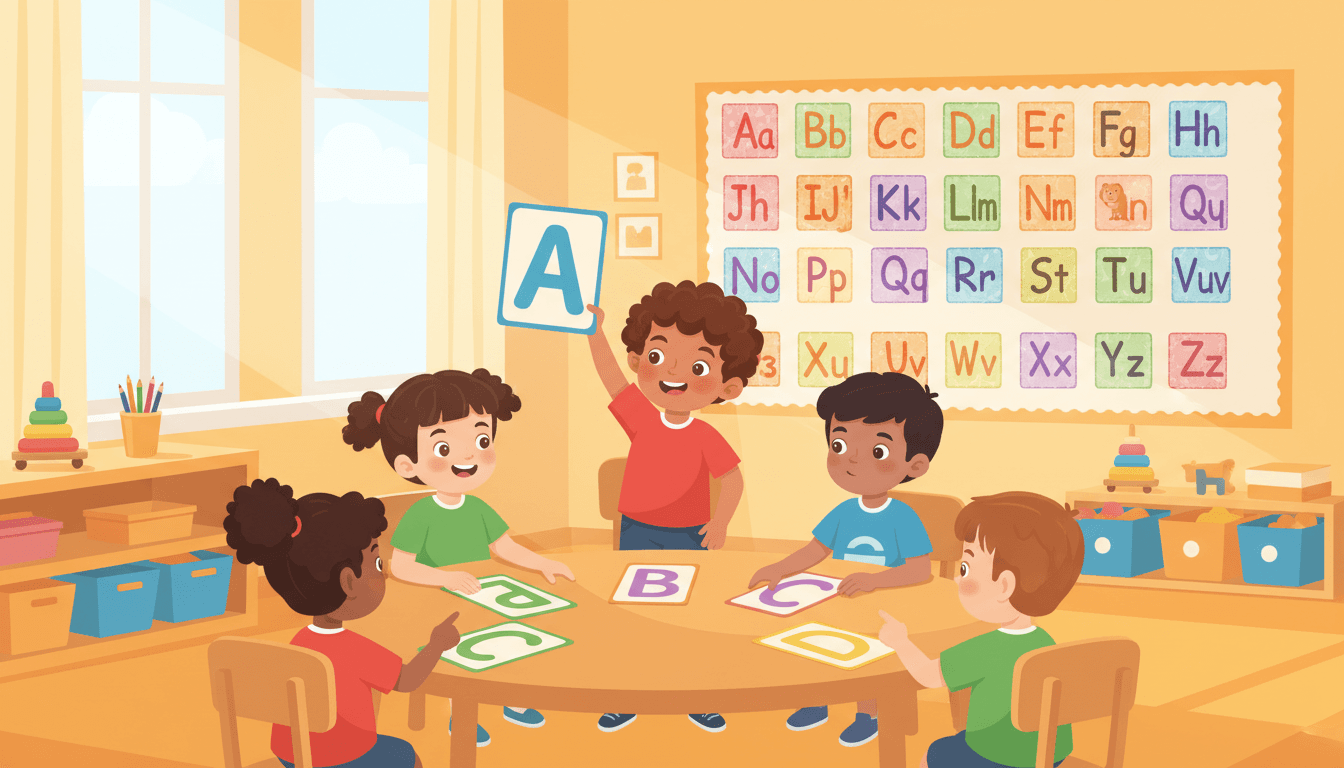
Letter Recognition for Kindergarten: 10 Activities
Get 30 days of free worksheet downloads
Key Takeaways
- Teach uppercase letters before lowercase because they are visually more distinct and easier for kindergartners to differentiate from one another.
- Using consistent anchor images for each letter all year long (one image per letter, never switched) helps children build reliable memory associations.
- Multisensory letter formation activities like sky writing, sand trays, and playdough reinforce letter recognition more powerfully than visual exposure alone.
- Some letter reversal (b/d, p/q) is completely normal in kindergarten and into first grade and is only a concern worth discussing with specialists near the end of first grade.
- Building letter fluency requires frequent, brief, varied practice across many exposures rather than long drills on any single day.

How to Teach Letter Recognition to Kindergartners: Activities That Build Confidence
You ask your class to find the letter D on the page, and half of them point to the letter B. Or to a P. Or they flip the paper upside down and find it that way.
If you've been there, you know that letter recognition takes longer than it seems like it should. Letters are abstract symbols. Most of them look similar: b, d, p, q. M and W are mirrors. I and l and 1 are practically the same thing. For a five-year-old who is just learning to make sense of print, sorting all of this out requires real cognitive work. And it requires more than just repeated exposure. It requires variety, movement, and enough repetition that each letter becomes a familiar friend. Here are 10 practical ways to get your kiddos there.
Here are 10 ways to teach letter recognition to kindergartners:
- Teach Letter Names With Consistent Anchor Images
- Tackle Uppercase Letters Before Lowercase
- Introduce Lowercase Letters by Pairing Them With Uppercase
- Use Multisensory Letter Formation
- Address Letter Reversals Directly
- Play Alphabet Games That Move
- Embed Letter Recognition Into Daily Read-Alouds
- Use Environmental Print as a Teaching Tool
- Build Letter Fluency With Repeated Low-Stakes Practice
- Connect Letter Recognition to Early Writing
1. Teach Letter Names With Consistent Anchor Images
When every letter is attached to a clear, memorable image, kiddos have something to hold onto when the abstract shape doesn't click on its own. The letter A is always an apple. The letter B is always a bear. You say the name, you see the image, you say the name again. Over time, the image becomes a scaffold that eventually fades as the letter itself becomes automatic.
The key is consistency. Pick one anchor image per letter and stick with it all year. Don't switch between a "bird" for B in September and a "boat" for B in November. The brain is building a reliable connection, and inconsistency interrupts that.
Try these activities:
- Alphabet anchor chart: Create one large classroom chart that shows each letter alongside its anchor image. Display it where everyone can see it and refer to it constantly.
- Letter introduction ritual: When introducing a new letter, always follow the same sequence: say the letter name, show the anchor image, say the name again, find it in the environment. Ritual creates automaticity.
- Alphabet books: Read multiple alphabet books throughout the year. Each book uses different anchor images, which builds a richer network of associations for each letter.
- Student alphabet strips: Give every student a personal alphabet strip on their desk. They reference it during reading and writing. Physical proximity matters.
- Name the letter, not just the sound: Practice using letter names alongside letter sounds. "This is the letter B. Its name is 'bee.' It makes the /b/ sound."
Our kindergarten alphabet worksheets include letter-picture matching activities that reinforce these anchor connections across all 26 letters.
Free Kindergarten Letter Worksheets


2. Tackle Uppercase Letters Before Lowercase
Most kindergarten programs introduce uppercase letters first, and for good reason. Uppercase letters are visually simpler and more distinct from each other than lowercase letters. They're also the letters most children have seen first (their names are often written in uppercase at home and in preschool).
Starting with uppercase builds a foundation of letter-name knowledge before you add the complexity of lowercase forms. Once students can reliably name and identify uppercase letters, connecting each uppercase to its lowercase partner is much easier.
Try these activities:
- Uppercase name writing: Have students practice writing their own name in uppercase letters from day one. Personal investment makes practice feel meaningful.
- Uppercase environmental print hunt: Look for uppercase letters in the classroom, on signs, on book covers. Uppercase letters are everywhere and easy to spot.
- Uppercase letter sorts: Give students a mix of letter cards in different fonts and sizes. They sort them by letter identity. This builds recognition across different visual forms of the same letter.
- Uppercase alphabet puzzles: Students assemble alphabet puzzles (letter + anchor picture) as a center activity. The physical handling of each letter piece builds familiarity.
Not every child will master uppercase letters before you need to introduce lowercase. That's okay. Think of uppercase fluency as the goal for the first quarter, not a prerequisite for moving forward.
3. Introduce Lowercase Letters by Pairing Them With Uppercase
Once uppercase letters are introduced, lowercase letters should come alongside them rather than as a separate alphabet sequence. Learning that A pairs with a, and B pairs with b, makes the relationship explicit and helps students transfer what they already know.
The tricky pairs are the ones where uppercase and lowercase look nothing alike: A/a, B/b, D/d, G/g, Q/q, R/r. Give these extra attention. The pairs that look almost identical (C/c, O/o, S/s, V/v, W/w, X/x) tend to take care of themselves.
Try these activities:
- Uppercase-lowercase matching cards: Students match each uppercase card to its lowercase partner. Start with the easy pairs, then gradually include the tricky ones.
- Buddy letters: Introduce uppercase and lowercase as "letter buddies." They go everywhere together. When you write a letter, both forms are always shown side by side.
- Letter books: Each student makes a small booklet for each letter (one uppercase side, one lowercase side) with drawings and words for each.
- Find both forms: During shared reading, ask students to find the uppercase and lowercase version of the same letter on a page. "Can you find a capital B and a lowercase b?"
- Concentration/memory: A classic matching game where students flip cards to find uppercase-lowercase pairs. Short, self-managed, and effective for centers.
Kindergarten alphabet worksheets include uppercase-lowercase matching activities that make these connections explicit and fun.
4. Use Multisensory Letter Formation
Seeing a letter on the board is one thing. Forming it with your own hand is another. And tracing it in sand with your finger is another still. Each mode of engagement activates a different pathway, and together they build much stronger memory than any single approach.
Letter formation (the actual sequence of strokes that creates each letter) matters both for recognition and for writing. When kiddos form letters correctly from the beginning, reversals and confusion happen less often.
Try these activities:
- Sky writing: Students use their whole arm to write letters in the air as you narrate the strokes. "Start at the top, go down, go around to the right." Big movements help internalize the form.
- Sand trays or sensory bins: Students trace letters in a shallow tray of sand, shaving cream, or rice. The tactile feedback is powerful, especially for students who are still developing fine motor skills.
- Letter formation chants: Create a simple verbal cue for forming each letter. For B: "Tall line down, bump, bump." For S: "Around and back, around and tuck." Chants + movement + formation = strong memory.
- Playdough letters: Students roll playdough into snakes and form each letter shape. Physical construction reinforces the shape from a completely different angle.
- Finger tracing on a partner's back: One student traces a letter on a partner's back. The partner guesses the letter. Both students are engaged and practicing.
5. Address Letter Reversals Directly
B and D. P and Q. M and W. These pairs cause so much anxiety in early childhood classrooms. A few things worth knowing: some letter reversal is completely normal in kindergarten and even into first grade. It's not a red flag on its own. It's a sign that the brain is still learning to anchor letters to a fixed orientation.
That said, you can actively help kiddos sort out the tricky pairs rather than just waiting for the confusion to resolve.
Try these activities:
- Bed trick for B and D: Draw the word "bed" with a b-shaped headboard and d-shaped footboard. Students who can picture a bed can always check which way each letter faces.
- Hands trick: Students make a thumbs-up with both hands. The left hand looks like a lowercase "b," the right hand looks like a lowercase "d." Quick and self-checking.
- Extra contrast: When introducing letters that are commonly confused, put them side by side and explicitly discuss the difference. "These two look similar. Here's how to tell them apart."
- Highlighted reference cards: Give students a small card with the tricky pairs clearly marked. They keep it on their desk and use it when they're unsure.
- Consistent verbal formation cues: Always describe B as "big line down, then two bumps to the right." Consistent language ties the name to the correct orientation.
Honestly? Even with all this, some children will still reverse letters well into first grade. It becomes a concern worth discussing with specialists closer to the end of first grade, not in kindergarten.
6. Play Alphabet Games That Move
Five-year-olds are not designed to sit still. The good news is that letter recognition is one of the easiest skills to practice through movement. Games that get kiddos up and active also deliver the repetition letters need to become automatic.
Try these activities:
- Alphabet hop: Lay letter cards on the floor. Call out a letter and students hop to it. For a variation, call out a word and they hop to the first letter of the word.
- Musical letters: Like musical chairs, but students stop at a letter card when the music stops. They name the letter (and sound) before sitting down.
- Letter stomp: Tape letters to the floor in a grid. Students stomp on letters as you call them out. Works well with a few students at a time.
- Flyswatter game: Post letters on the board. Two students hold flyswatters. Call a letter name and they race to swat it first.
- Letter hunt walk: Walk around the school (hallways, library, cafeteria) with clipboards. Students record every letter they spot. Back in class, discuss what they found.
When learning feels like play, kiddos engage longer and review more letters than they would in a seat-based activity. This isn't an accident. It's how kindergarten brains work best 😊
7. Embed Letter Recognition Into Daily Read-Alouds
Read-aloud time is one of the richest contexts for letter practice because the letters are embedded in meaningful text. Students see letters doing real work, forming words that tell a story. This is more motivating than a flashcard deck, and it puts letter recognition directly in the context where it matters most.
You don't need to turn every read-aloud into a letter lesson. A few intentional pauses are enough.
Try these activities:
- Letter of the week spotlight: During read-aloud, ask students to raise their hand quietly whenever they hear the week's focus letter at the start of a word.
- Big book letter hunt: Use enlarged texts so everyone can see. After reading, go back and run a pointer along a line while students call out the focus letter whenever they see it.
- Author's name connection: Point out letters in the author's and illustrator's names. "Her last name starts with M, just like the letter we've been learning this week."
- Label the page: After reading, give small groups a copy of one page from the book. They circle every instance of a focus letter with a colored pencil.
Read-alouds where you naturally pause to notice letters send a powerful message: letters are everywhere, and recognizing them is what readers do.
8. Use Environmental Print as a Teaching Tool
Before most children start school, they already recognize letters in context. The golden arches. The red STOP sign. The cereal box on the breakfast table. This is environmental print recognition, and it's a legitimate bridge to formal letter learning.
Using the logos, signs, and words that already exist in students' lives brings letter recognition into territory that feels familiar and meaningful.
Try these activities:
- Logo letter hunt: Bring in food wrappers, cereal boxes, store logos. Ask students to identify specific letters in the brand names. "What letter does LEGO start with?"
- Classroom labels: Label everything in the classroom with large, clear print. Letter names, objects, furniture. Point to labels frequently throughout the day.
- Student name wall: Display every student's name with a clear, consistent font. Use it as a reference during activities. "Your name starts with T, just like Tomas."
- School letter walk: Walk through the school and look for letters on signs, doors, and displays. Students keep a tally of how many times they spot a given letter.
Environmental print reminds kiddos that letters aren't just a school thing. They're everywhere, and they can read the world around them. That realization is powerful.
9. Build Letter Fluency With Repeated Low-Stakes Practice
Letter recognition fluency means being able to name letters quickly and automatically, without having to work through it. Fluency is built through repetition. Not dull, repetitive drill, but frequent, brief, varied practice that keeps the task fresh.
The goal isn't perfection on any single day. It's gradual improvement across many exposures.
Try these activities:
- One-minute letter naming: Flash letter cards one at a time. Students name each one as fast as they can. This can be done whole class, in partners, or individually as a brief daily warm-up.
- Letter dot-to-dot: Students connect dots by following letters in alphabetical order. Combines letter sequence knowledge with visual attention to letter form.
- Letter bingo: Students mark letters on a bingo card as you call them out. Works for both letter names and letter recognition in different fonts.
- Partner flashcard practice: Students quiz each other using a small set of letter cards. For extra support, the back of each card has the anchor image as a hint.
- Letter racing page: A sheet with rows of letters. Students trace each row with their finger and name every letter as fast as they can. Self-timed practice, casual competition.
Kindergarten alphabet worksheets give students structured, printable practice that's easy to use for morning work, homework, or centers.
10. Connect Letter Recognition to Early Writing
Letter recognition and letter formation are two sides of the same coin. Students who write letters regularly recognize them more quickly in reading, and students who read letters frequently form them more confidently in writing. The two skills reinforce each other.
Making writing a daily practice from the start of kindergarten accelerates letter recognition in ways that reading-only activities can't.
Try these activities:
- Daily name writing: Every day, students write their own name. This one routine builds both letter recognition and fine motor skills at the same time.
- Letter dictation mini-lessons: Say a letter name. Students write it. Check together. Fast, clear, and gives you immediate assessment data.
- Interactive writing: During shared writing, students take turns coming to the board to write individual letters in a sentence the class is composing together. Real writing, real purpose.
- Journal drawing and labeling: Even before students can spell words, they can label their drawings with beginning letters. "You drew a dog. What letter does 'dog' start with? Write that letter next to it."
- Letter search in their writing: After students write anything (even one word), ask them to circle a specific letter. "Can you find a lowercase t in what you wrote?"
Writing turns letter recognition from a passive skill into an active one. When kiddos can both read and produce every letter, fluency arrives faster.
Frequently Asked Questions
How many letters should a kindergartner know by the end of the year?
The Common Core standard (RF.K.1d) expects kindergartners to recognize and name all upper- and lowercase letters of the alphabet by the end of the year. In practice, many students arrive knowing several letters already (especially the letters in their name), and most are solid on all 26 by mid-year with consistent instruction. A few students may still be working on a handful of letters at year's end. Keep supporting those kiddos.
What is the best order to teach the alphabet in kindergarten?
There's no single best order, but most research-based programs avoid strict alphabetical order. Many teachers prioritize letters in students' names first (high personal relevance), then move to high-frequency letters. Some programs use a strategic sequence that groups letters by visual similarity (to address confusion early) or by formation patterns (straight lines before curves). Whatever order you use, consistency within the program matters more than the sequence itself.
What's the difference between letter recognition and letter knowledge?
Letter recognition is the ability to identify a letter by name when you see it. Letter knowledge is broader: it includes knowing the letter's name, its sound, how to write it, and how it behaves in words. Kindergarten letter instruction builds both. Recognition comes first (can you name this letter?), then sounds and formation build on top of that foundation.
How do I help a student who is confusing multiple letters?
Focus on one pair of confusing letters at a time rather than addressing all confusions simultaneously. Use explicit contrast: show the two letters side by side and articulate exactly what makes them different. Provide a reliable mnemonic or memory trick (like the "bed" trick for b and d). Give extra targeted practice with only those two letters until the confusion resolves before moving on.
Keep Reading
- How to Teach Letter Sounds to Kindergartners: Activities That Actually Stick
- Alphabet Activities for Kids: Fun Ways to Learn Letters
- Rhyming Words for Kindergarten: Activities That Build Phonics Skills
Wrapping Up
Learning to recognize every letter is one of the earliest and most important milestones in your little one's reading journey. It doesn't happen all at once. It happens letter by letter, day by day, through a thousand small exposures: a letter hunt before lunch, a flyswatter game on Tuesday, a name label on the cubby, a pause in a read-aloud to notice the letter F.
Your consistency and creativity are what move kiddos from tentative to confident. Some will race through the alphabet. Others will need every tool in this list before the last few letters stick. Both paths are valid.
For printable practice materials your students can use today, explore our full collection of kindergarten alphabet worksheets. They include letter tracing, matching, recognition, and writing activities for every letter of the alphabet.
Happy teaching!

Adi Ackerman
Head Teacher
Adi is the Head Teacher at ClassWeekly, with years of experience teaching elementary students. She designs our curriculum-aligned worksheets and writes practical guides for teachers and parents.
Keep Reading
Ready to download? Try ClassWeekly free for 30 days.
Unlimited worksheets for PreK through 5th grade. Cancel anytime.