
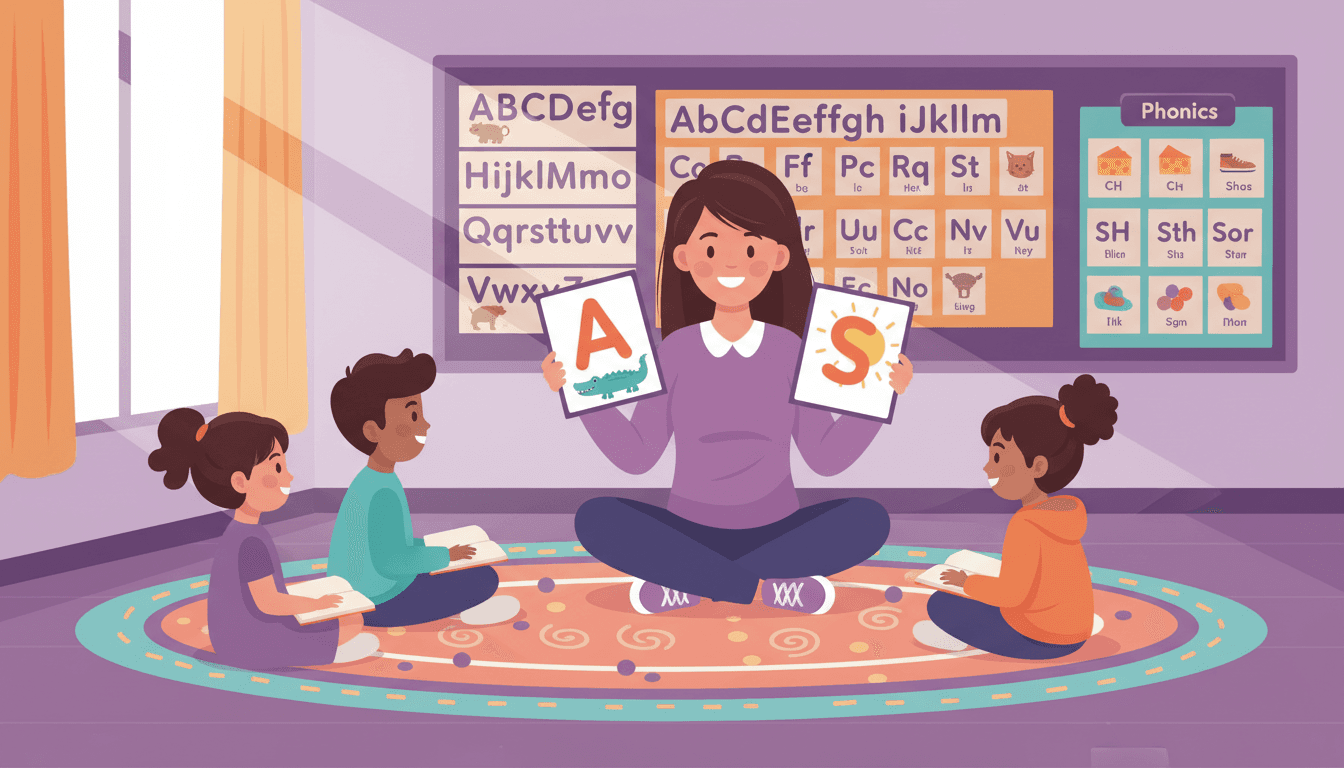
Letter Sounds for Kindergarten: 10 Phonics Activities
Get 30 days of free worksheet downloads
Key Takeaways
- Start with the highest-frequency consonants (S, A, T, P, I, N) so kindergartners can blend real CVC words within the first few weeks of phonics instruction.
- Attaching a physical gesture to each letter sound creates a second memory pathway, helping children retrieve sounds even when the visual cue isn't in front of them.
- Sound walls outperform traditional word walls for phonics because they group words by the sounds they make and show mouth positions, giving students a functional reference during reading and writing.
- Phonemic awareness - hearing sounds in words - must be practiced separately from just producing sounds, using activities like Elkonin boxes, thumbs up/down, and clap-the-sounds.
- Short vowel sounds need more time and more explicit instruction than consonants; rushing through all five in a week almost always leads to confusion and blending errors.

How to Teach Letter Sounds to Kindergartners: Activities That Actually Stick
You've just introduced the letter "B," held up a picture of a ball, made the /b/ sound about fifteen times, and half your class is staring at the ceiling. Sound familiar?
Teaching letter sounds to kindergartners is one of those things that looks simple from the outside but is genuinely tricky to get right. Every child comes in with a different starting point. Some already know a handful of letter sounds from home. Others are hearing them for the first time. And even when kiddos can repeat a sound back to you in the moment, getting it to stick, getting them to hear /m/ at the start of "map" and connect it to the letter M, takes repetition, variety, and a lot of patience. This guide lays out 10 practical approaches that help your little ones build real, lasting phonics skills.
Here are 10 ways to teach letter sounds to kindergartners:
- Start With High-Frequency Consonants
- Use Body Movements to Anchor Each Sound
- Build Sound Walls (Not Just Word Walls)
- Practice Hearing Sounds in Words, Not Just Saying Them
- Introduce Vowel Sounds With Extra Care
- Blend Sounds Into CVC Words
- Play Phoneme Isolation Games
- Connect Letters to Personal and Familiar Words
- Use Sound Sorts for Independent Practice
- Bring Letter-Sound Games Into Every Routine
1. Start With High-Frequency Consonants
Not all letters are created equal for early reading. Some consonants show up constantly in beginner texts. Others, like Q and X, barely appear at all. Starting with the most useful sounds gives your little ones the biggest early payoff.
The letters most teachers introduce first: S, A, T, P, I, N. With just these six, your kiddos can already blend words like "sat," "pin," "tip," and "nap." That sense of early decoding success is huge for building confidence. From there, you layer in M, B, D, F, G, H, L, C, K and so on.
Try these activities:
- Letter of the week focus: Spend a whole week on one letter sound. Display it prominently, return to it during transitions, and look for it in every read-aloud.
- Sound scavenger hunt: Call out a target sound and have students hunt the classroom for objects that start with it. Write each find on the board together.
- Alphabet sequence vs. frequency order: If you're using a phonics program, check whether it teaches in ABC order or frequency order. Frequency order (S, A, T, P, I, N first) tends to produce faster results for early readers.
- Object bins: Fill a small bin with objects that all start with the same sound. Students sort through them, naming each one and exaggerating the first sound.
For ready-to-use practice pages for each consonant, our kindergarten phonics worksheets include letter-sound matching, beginning sound identification, and picture sorts for every letter.
Not every kid will nail a new sound in one week. Some need two or three revisits before it really clicks. That's completely normal.
Free Kindergarten Letter Sound Worksheets


2. Use Body Movements to Anchor Each Sound
Here's something I've seen work again and again: when you attach a physical gesture to a letter sound, kiddos remember it. The body carries the memory even when the visual cue fades.
This is the core idea behind programs like Jolly Phonics. Each sound gets a motion. /s/ is a wiggly snake hand. /a/ is tapping your elbow like an ant is crawling on you. /m/ is rubbing your tummy because something smells delicious. The gesture creates a second retrieval pathway in the brain, so when a child forgets how a letter sounds, they can trigger the memory through movement.
That said, some kids just need more time. And that's perfectly fine.
Try these activities:
- Action alphabet wall: Create a display showing each letter alongside a small drawing of the gesture. Students reference it during phonics time.
- Sound action review: Run through a stack of letter cards. Flash each card, students do the motion and say the sound together. Fast-paced and energizing.
- Teach-it-back: A student stands up, picks a letter card, and teaches the motion to the class. Having to teach something consolidates their own learning.
- Transition routine: Use letter-sound actions during transitions. "Line up if you can show me the sound for M... now show me B... now T." Keeps them engaged and doubles as review.
- Gesture mnemonics for tricky sounds: For sounds students confuse (like /b/ and /d/), create a memorable physical cue that highlights the difference. Pretend to bounce a ball for /b/, and drum on a desk for /d/.
3. Build Sound Walls (Not Just Word Walls)
Word walls are a classroom staple, but a sound wall takes phonics instruction a step further. Instead of organizing words alphabetically, a sound wall groups words by the sounds they make. This helps students connect the sound they hear to the letter (or letters) that represent it.
A sound wall typically shows the mouth position or articulation for each phoneme alongside the letters that spell it. It's a reference tool, not just decoration. Students use it during reading and writing to check themselves.
Try these activities:
- Build it together: Add to the sound wall as you introduce each new phoneme. Don't put it up all at once. Building it gradually makes it meaningful.
- Sound wall reference during writing: When a student asks how to spell a word, direct them to the sound wall first. "What sound do you hear at the beginning? Can you find that sound on the wall?"
- Picture-sound matching: Give students picture cards. They decide where each one belongs on the sound wall based on its beginning or ending sound.
- Mystery sound: Cover one section of the sound wall. Students guess which sound is missing based on the pictures they can still see.
A well-used sound wall becomes one of the most valuable tools in your classroom. The key word is "used." Point to it constantly, refer to it during lessons, and teach students to use it independently.
4. Practice Hearing Sounds in Words, Not Just Saying Them
There's a big difference between a child who can say "/m/" when you hold up the letter M, and a child who can hear /m/ at the beginning of "moon" or the end of "swim." The second skill, called phonemic awareness, is what actually powers early reading.
A lot of letter-sound practice focuses on production (making the sound) without enough focus on perception (hearing the sound in context). Both matter.
Try these activities:
- Thumbs up, thumbs down: Say a word. Students put thumbs up if it starts with the target sound, thumbs down if it doesn't. "Does 'pig' start with /p/? Thumbs up or down?"
- Odd one out: Say three words, two of which share a beginning sound. "Fish, fan, cup. Which one doesn't belong?" Students identify the odd word.
- Elkonin boxes (sound boxes): Give students a simple picture and three or four small boxes below it. Students push a chip into each box as they say each sound in the word. "Cat" has three boxes: /k/, /æ/, /t/.
- Clap the sounds: Students clap once for each sound they hear in a word. Different from syllable clapping. "Ship" is two sounds, not one.
- Whisper circles: Sit students in a circle and whisper a word into the first student's ear. They identify the beginning sound and whisper both to the next student. Compare what the last student says to the original word.
5. Introduce Vowel Sounds With Extra Care
Short vowel sounds are notoriously hard for kindergartners. The sounds are subtle, the differences between them are small (/ɪ/ in "pig" vs. /ɛ/ in "peg"), and English spelling doesn't make it easier.
Most programs introduce short vowels one at a time, often starting with /a/ as in "apple." The key is giving each vowel enough time before adding the next one. Rushing through all five short vowels in a week almost always leads to confusion.
Try these activities:
- Anchor words and pictures: Pick one vivid anchor word and image for each vowel. /a/ is always "apple." /e/ is always "elephant." Consistency matters here. Use the same anchor all year.
- Vowel sound discrimination: Show two pictures side by side (like a pin and a pen). Say one word aloud and students point to the correct picture. This trains the ear to distinguish similar sounds.
- Color coding: Assign each vowel a color. When writing CVC words together, use the vowel's color for that letter. "C-A-T" with the A in red helps kiddos see the vowel as its own unit.
- Vowel song: Create a simple chant for each short vowel sound with words that contain it. Repetition + melody = faster memorization.
- CVC word building: Once students know two or three vowel sounds, have them build CVC words by swapping the middle vowel. "Sit" becomes "sat" becomes "set." This isolates the vowel and makes the sound change audible.
Kindergarten phonics worksheets include short vowel sort activities that let students practice distinguishing these sounds with picture-based support.
6. Blend Sounds Into CVC Words
This is one of the most exciting moments in early literacy: your little one pushes three sounds together and reads their first real word. That moment, when /k/ + /æ/ + /t/ becomes "cat," is pure joy for both of you 😊
Blending is a skill that needs to be explicitly taught and practiced. Many children can say individual sounds but struggle to hold them together and push them into a word.
Try these activities:
- Stretch and blend: Slowly stretch a CVC word out ("/k/...../æ/...../t/") and then quickly push it together ("cat!"). Model this with your hands: pull them apart for stretching, clap them together for blending.
- Robot talk: Speak in a robot voice (segmenting sounds) and have students translate back to regular talk (blending). "/h/-/ɪ/-/t/... what did the robot say?" Kids love the game.
- Blend it, find it: Call out a segmented word. Students blend it silently, then point to the matching picture in a row of three options.
- Word ladders: Start with a simple CVC word ("pin") and change one sound at a time to make a new word. "Pin... pan... ban... man." Each change isolates one phoneme.
- CVC card matching: Students match individual letter cards for onset (first consonant), vowel, and rime (final consonant) to build CVC words. Physical manipulation helps.
The goal for kindergarten is confident blending of simple CVC words. Don't push into blends (like "st" or "bl") until students are solid here.
7. Play Phoneme Isolation Games
Phoneme isolation means identifying a specific sound in a specific position: the beginning, middle, or end of a word. It sounds technical, but you can teach it through pure play.
"What's the first sound in 'sun'?" ... "What sound do you hear at the end of 'bus'?" ... "What's the middle sound in 'hop'?" These are the questions that build phoneme isolation skills.
Try these activities:
- First sound pop: Say a word. Students stand up if they can identify the first sound, then call it out when you point to them. "The word is 'farm.' What's the first sound?"
- End sound slap: Place picture cards face up. Call out an ending sound. Students slap the card whose word ends with that sound.
- Middle sound mystery: This is the hardest one. After students are confident with beginning and ending sounds, introduce middle-sound activities. Say a CVC word and ask students to identify the vowel sound in the middle.
- Phoneme counting: Students hold up fingers as they say each sound in a word. "Man" = three fingers. "Ship" = three fingers. Helps them feel the boundaries between phonemes.
- Sound position cards: Make cards labeled "Beginning," "Middle," and "End." Say a target sound, then a word. Students point to where in the word they hear that sound.
8. Connect Letters to Personal and Familiar Words
Abstract letter-sound relationships become concrete when they attach to something a child already cares about. The letter M means more when it's also the letter that starts "Mom" or "Mario." Personal connections accelerate learning.
Try these activities:
- Name connections: Start every letter introduction by finding classmates whose names begin with that letter. "Today's letter is J. Who has a J in their name?" Instant, meaningful connection.
- Student word collections: Give each student a small journal where they collect words that start with each letter they've learned. They draw and write words that matter to them personally.
- Family letter hunt: Ask students to look around their home for words that start with the week's letter. They report back the next day.
- Alphabet autobiography: For each letter, students draw themselves doing something that starts with that letter. A is for "art" (drawing at the table). B is for "bike." Personal + visual = memorable.
- My letter book: Students make a small booklet for each new letter, filling it with pictures and words they've chosen themselves.
When a letter lives inside a word a child loves, they own it. That ownership is what makes sounds transfer from the phonics lesson to actual reading.
9. Use Sound Sorts for Independent Practice
Sound sorts are one of the most effective, teacher-tested activities for consolidating letter-sound knowledge. Students sort picture cards based on their beginning, ending, or middle sound. It forces active decision-making without requiring a lot of writing or direct teacher support.
Sound sorts work especially well in small groups, at centers, or as partner activities during independent work time.
Try these activities:
- Beginning sound sort: Provide two header cards (letters or pictures) and a pile of picture cards. Students sort into the correct column. "Does 'pig' start like 'pencil' or like 'ball'?"
- Closed vs. open sort: In a closed sort, students know the categories in advance. In an open sort, they create their own categories. Open sorts reveal how students are thinking about sounds.
- Digital sorts: Many phonics apps include virtual sound sorts. These work well for students who need extra practice and can engage independently on a device.
- Making it self-checking: Put a small symbol on the back of each card. After sorting, students flip the cards to check their own work. Immediate feedback without teacher input.
- Word family sorts: Once students are building CVC words, sort by word family (-at, -an, -in). This bridges from individual phonemes to onset-rime patterns.
For printable sort materials, our kindergarten phonics worksheets include picture sort pages for every letter and many common word families.
10. Bring Letter-Sound Games Into Every Routine
The most powerful thing you can do is stop treating phonics as a separate 20-minute block and start weaving letter sounds into the entire day. Transition time, snack time, morning meeting, lining up, all of these are opportunities for a quick review.
When sound practice shows up throughout the day, your kiddos get the repetition they need without ever feeling drilled.
Try these activities:
- Lining up by sound: "Line up if your name starts with a /t/ sound. Now if your name starts with /m/." Works every single day.
- Sound of the day shout-out: Any time during the day that someone says a word starting with the focus sound, the whole class does a quick gesture or celebrates it.
- Read-aloud pauses: During shared reading, pause on a new word and ask students to identify the first sound before you read on together.
- Calendar letter hunt: During calendar time, look for the focus letter in the date, the weather words, or the day of the week.
- Goodbye sounds: Before dismissal, each student says one word that starts with the focus sound before they leave.
The goal isn't to turn every moment into a lesson. It's to make letter sounds feel like a natural part of how your class talks and thinks throughout the day.
Frequently Asked Questions
What order should I teach letter sounds in kindergarten?
Most phonics programs recommend teaching high-frequency consonants first (like S, M, T, P, B, N) rather than following alphabetical order. This allows students to start building and blending simple words earlier. Short vowels, especially /a/ and /i/, are introduced early too so students can form CVC words like "sat," "tip," and "mat."
How long does it take for kindergartners to learn all letter sounds?
Most kindergartners are introduced to all 26 letter sounds over the course of the school year, but learning them well takes ongoing practice. Some students will need the full year plus continued support in first grade before all sounds are automatic. Individual readiness varies a lot. Daily exposure and multi-sensory practice speed up the process.
What is the difference between letter names and letter sounds?
Letter names are what we call the letters (A says "ay," B says "bee"). Letter sounds are what the letters represent in words (/æ/ as in "apple," /b/ as in "ball"). For early reading, letter sounds matter more than letter names. A child who knows that the letter M says /m/ is better prepared to decode than a child who only knows the letter is called "em."
How do I help a kindergartner who is struggling with letter sounds?
Start by identifying which sounds are solid and which are still uncertain. Focus on one or two sounds at a time rather than reviewing everything at once. Use multi-sensory methods: physical gestures, manipulatives, tactile letter tracing. Short, daily practice (5-10 minutes) is more effective than one long session per week. If a student is significantly behind by mid-year, a reading specialist conversation is worth having early.
Keep Reading
- How to Teach Letter Recognition to Kindergartners: Activities That Build Confidence
- Phonics Activities for Kindergarten: Building the Reading Foundation
- How to Teach Blends and Digraphs to Kindergartners
Wrapping Up
Teaching letter sounds is foundational work. The phonics skills your kiddos build in kindergarten will carry them through years of reading and writing ahead. Some will pick it up fast. Some will need more time and more approaches. Both are completely normal.
Pick one or two ideas from this list, try them this week, and see what lands with your particular group of little ones. The right activity is the one that gets your students making sounds, hearing sounds, and feeling like readers.
For printable phonics practice your students can use right now, explore our full collection of kindergarten phonics worksheets. They cover every letter, short vowel sounds, CVC words, and more.
Happy teaching!

Adi Ackerman
Head Teacher
Adi is the Head Teacher at ClassWeekly, with years of experience teaching elementary students. She designs our curriculum-aligned worksheets and writes practical guides for teachers and parents.
Keep Reading
Ready to download? Try ClassWeekly free for 30 days.
Unlimited worksheets for PreK through 5th grade. Cancel anytime.