
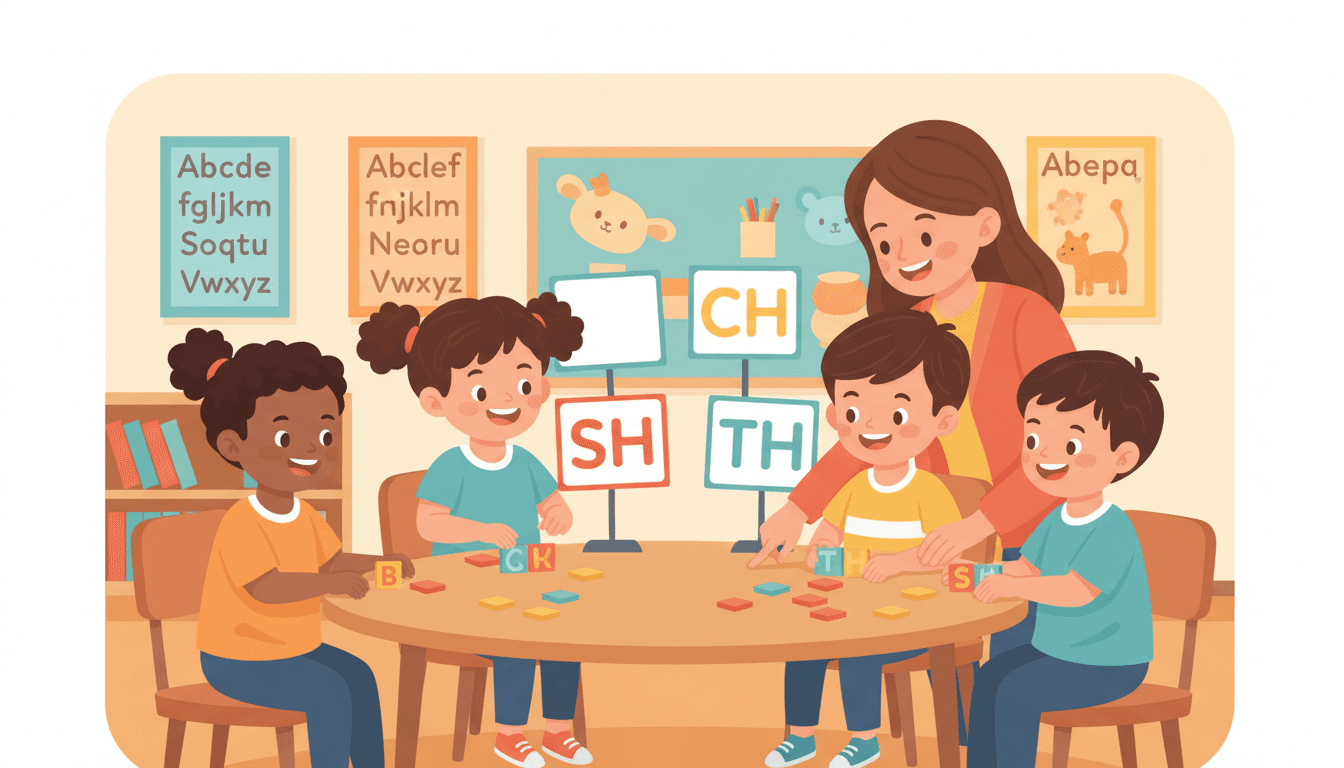
Blends vs Digraphs in Kindergarten: The Difference
Get 30 days of free worksheet downloads
Key Takeaways
- Teach digraphs before blends because they require learning a brand new sound from scratch
- A blend has two sounds you can still hear separately while a digraph creates one completely new sound
- Each digraph needs an anchor keyword with a picture so students can retrieve the sound reliably
- Arm blending is the most effective physical technique for helping students push through consonant blends
- Spend a full week on each new digraph before introducing the next one

How to Teach Blends and Digraphs to Kindergartners
A student looks at the word "ship" and says "suh-hip." They know their letter sounds cold. S makes /s/. H makes /h/. But together, in this combination, neither of those sounds is what the word says. That's a digraph. And that moment of confusion is completely normal.
Blends and digraphs are a significant step up in phonics complexity, and they trip up a lot of kindergartners, not because the kids aren't smart but because the rules change. Two letters together don't always sound the way you'd expect from knowing each one separately. Teaching this well requires being really clear about what blends and digraphs are, and teaching each one explicitly.
Table of Contents
- Blends vs. Digraphs: The Critical Difference
- When to Introduce Blends and Digraphs
- Starting with Digraphs
- The Four Core Digraphs: sh, ch, th, wh
- Moving to Consonant Blends
- Common Blends to Teach First
- Word Building with Blends and Digraphs
- Reading and Writing Practice Together
- Common Student Errors (and How to Address Them)
- Spiral Review and Keeping It Sticky
1. Blends vs. Digraphs: The Critical Difference
This matters. A lot. And it's worth being crystal clear about before you teach either one.
A blend is two (or three) consonants together where you can still hear each individual sound. In "bl-ack," you hear both /b/ and /l/. In "str-eet," you hear /s/, /t/, and /r/ as separate sounds running quickly together.
To be fair, this is one of those areas where the research is messier than the headlines suggest.
A digraph is two letters that make one completely new sound that belongs to neither letter alone. In "sh-ip," the /sh/ sound is not /s/ plus /h/. It's a single new phoneme. Neither the S nor the H makes its regular sound.
This distinction matters because you teach them differently. With blends, you're teaching students to say two known sounds fast. With digraphs, you're teaching a new sound from scratch.
Activities:
- Build an anchor chart with two columns: BLEND (two sounds you can hear separately) and DIGRAPH (two letters, one new sound). Add example words with pictures to each column.
- Say pairs of words together: "black" and "ship." Ask: "In 'black,' can you hear the /b/ AND the /l/? In 'ship,' can you hear a /s/ and a /h/ separately, or does it make a brand new sound?"
- Use a visual: blend = two colors mixing side by side, digraph = two colors mixing completely into a new color. Simple, but useful.
Free Kindergarten Phonemes Worksheets


2. When to Introduce Blends and Digraphs
Most kindergarten programs introduce digraphs before blends, and earlier in the year than you might expect. Some introduce "sh" and "ch" as early as mid-fall, especially if students already know their consonant and short vowel sounds.
Blends typically come later, often in late winter or spring, though this varies by curriculum.
The prerequisite is reliable single-consonant knowledge. Students should be able to quickly and confidently identify the sounds of all or most individual consonants before working on pairs.
Activities:
- Quick consonant sound check. Flip through letter cards. Students call out sounds, not letter names. If hesitation is frequent, pause digraph instruction and solidify single letters first.
- Assess short vowel knowledge in CVC words (cat, pin, hop). Students who can blend CVC words fluently are ready for digraphs.
- Don't wait for 100% mastery of single letters. Some students can begin digraphs while solidifying their last few individual sounds as long as you're not rushing.
3. Starting with Digraphs
Start with digraphs first, specifically because they require the most direct teaching. Students cannot figure out that "sh" makes /sh/ from their existing knowledge. They need to be told.
Introduce one digraph at a time. Don't introduce "sh" and "ch" in the same lesson unless you're doing a comparison activity later, after both are known.
Activities:
- Introduce with a keyword. Every digraph gets one anchor word with a picture: "sh" = ship, "ch" = chair, "th" = thumb, "wh" = whale. Students use the anchor word to remember the sound.
- Sound card. Make a card for each digraph with the two letters, the anchor picture, and the sound written out (/sh/). Students keep these in their phonics folder.
- Sort into known/new. After introducing "sh," students sort word picture cards: does this word start with /sh/ or with /s/? (ship vs. sun, sheep vs. sand). Sorting discriminates sounds.
- Find it in the room. Students search for objects in the classroom that start with the new digraph. This makes it multi-sensory and gets them up and moving.
4. The Four Core Digraphs: sh, ch, th, wh
These four are the priority in kindergarten. Here's a quick teaching note on each:
sh: Usually the first digraph taught. High frequency, appears at the beginning and end of words (ship, fish, brush). The sound /sh/ is distinct enough that students pick it up quickly.
ch: Very common at word beginnings (chair, chip, cheese). Some words use "tch" at the end (catch, watch) but save that pattern for later.
th: This one has two sounds: voiced /th/ (the, this, that, them) and unvoiced /th/ (thumb, three, think). Don't overcomplicate it for kindergarten. Teach one or both, but mention that "th" can sound a little different in different words.
wh: In most American accents, "wh" sounds exactly like /w/ (what, when, where). Some teachers skip this one as a distinct digraph because the phonetic difference is minimal. Your call, depending on your curriculum.
Activities:
- Digraph of the week. Spend five days on each digraph before introducing the next. Day 1: introduction. Day 2: reading words. Day 3: writing words. Day 4: word building. Day 5: mixed review.
- Digraph riddles. "I'm thinking of something you wear on your foot. It starts with /sh/. What is it?" (shoe)
- Picture sorts for all four. After all four are introduced, students sort picture cards by beginning digraph. This builds discrimination across the full set.
- Digraph books. Easy readers or decodable texts that feature one or two target digraphs. Students circle every digraph they find.
5. Moving to Consonant Blends
Once digraphs are solid, blends come next. The conceptual shift is important to name explicitly for students: "Blends are different from digraphs. In a blend, you can still hear both sounds. You just have to say them quickly, right next to each other."
Many students need to learn to "push" through a blend rather than adding a vowel between the sounds. "Buh-lack" instead of "black" is the classic error.
Activities:
- Arm blending. Students stretch out their arm and tap each sound on their arm (shoulder, elbow, wrist), then sweep the whole arm to blend it. "Bl...ack" (tap tap) → "black" (sweep).
- Listen for both sounds. Say a blend slowly: "bbbllll." Can you hear the /b/? Can you hear the /l/? Now faster: "bl." Point out: both sounds are still there.
- Blend stretching. Snap a rubber band while saying the blend, holding each sound for its snap, then releasing for the full word. Tactile learners love this.
6. Common Blends to Teach First
There are dozens of blends, but not all are equally frequent or equally accessible. Start with the most common two-letter blends.
L-blends (high priority): bl (black, blue, blend), cl (clap, clock, close), fl (flag, flat, flip), pl (plan, play, plus), sl (sled, slip, slow), gl (glad, glue, glow)
R-blends: br (brick, brown, bread), cr (crab, cross, cry), dr (drum, drip, drop), fr (frog, free, from), gr (grab, green, grow), pr (print, proud, pray), tr (truck, trip, true)
S-blends: sc (scab, scat), sk (skip, skin), sl (already in L-blends), sm (smell, smile), sn (snap, snail), sp (spin, spot), st (step, stop), sw (swim, sweet)
Start with L-blends and R-blends. S-blends come after, and three-letter blends (str, spl, spr) are typically a first-grade skill.
Activities:
- Blend family posters. One poster per blend family: all the bl words you know, all the cl words you know. Add to them over time as students encounter new words.
- Blending ladder. Start with a CVC word (lack), add the blend (black). Students see that the blend just adds a sound to the front.
- Picture card blend sort. Cards with images of blend words. Students sort by initial blend. Bl vs. cl vs. fl, for example.
7. Word Building with Blends and Digraphs
Word building is where phonics becomes reading and writing. Once students can identify and produce the target sounds, they need to practice building words with them.
Use letter tiles, magnetic letters, or letter cards, anything students can physically manipulate.
Activities:
- Build it, read it, write it. Students build a word with letter tiles, read it aloud, then write it on their whiteboard. Three modalities in one activity.
- Swap the blend. Start with a word (clock). Swap the blend to make a new word (block, flock, stock). This builds phonemic flexibility.
- Onset and rime. Give students a rime (-ip, -ap, -ock, -eel). They add different blends and digraphs to the front to build as many words as they can.
- Digraph word ladders. A chain where one sound changes at a time. ship → shop → chop → chip → chin → shin. Students record each step.
- Word sort by pattern. After several blends and digraphs are introduced, students sort words by their pattern. This builds pattern recognition across the full set.
8. Reading and Writing Practice Together
Reading and writing reinforce each other. Students who write with blends and digraphs read them better, and vice versa. Don't treat these as separate skills.
Activities:
- Dictation. Call out a word with a target blend or digraph. Students write it. This is one of the highest-leverage phonics activities you can do.
- Controlled decodable texts. Use readers where 80% or more of the words are decodable using patterns students already know. These texts let students practice without running into too many unknowns.
- Sentence building. Students build sentences using word cards that include blend and digraph words. "The ship is on the water." Reading it back after building reinforces both skills.
- Writing with a focus. Give students a writing prompt that invites blend words: "Write about something that is flat." (flag, plate, flat, flame)
For ready-to-use pages covering both blends and digraphs, check out these kindergarten blends worksheets. They include picture sorts, word building, tracing, and sentence completion all organized by pattern.
9. Common Student Errors (and How to Address Them)
Adding a vowel between blend sounds. "Buh-lack" instead of "black." Drill arm blending and hold the first sound without releasing it before the second: "bllllack." The goal is to eliminate the schwa between sounds.
Treating a blend as a digraph. A student might think "bl" makes one new sound rather than two. Go back to the anchor: "Can you hear the /b/? Can you hear the /l/?" Make sure the two sounds are audible.
Reading "sh" as "s" + "h". Back to the digraph anchor keyword. "When you see s-h together, it doesn't say /s/ /h/. It says /sh/ like in ship." Require students to say the keyword before reading a digraph word if they're still unsure.
Confusion between "ch" and "sh". These are common mix-ups. Mouth position helps: /sh/ is made with lips rounded slightly forward, /ch/ involves a quick stop before the air releases. Exaggerate the mouth positions in front of a mirror.
Writing "wh" as "w" alone. Because they sound the same in most accents, students often write just "w." Accept this in early drafts. The spelling pattern needs explicit practice to stick.
10. Spiral Review and Keeping It Sticky
The biggest mistake in phonics instruction is moving on and never coming back. Blends and digraphs need regular spiral review, not just after the unit ends but throughout the year.
Activities:
- Daily warm-up card flash. Spend two minutes flashing digraph and blend cards. Quick responses, no explanation. Just retrieval practice.
- Word wall by pattern. Organize your word wall to include a section for digraphs and one for blends. Add words throughout the year. Students reference it during writing.
- Reading new texts. As students encounter new books throughout the year, prompt them to notice blend and digraph words. "Oh, there's 'throne.' What digraph do you see?"
- Mixed sorts. At the end of the year, do a mixed sort that includes CVC words, digraph words, and blend words all together. This is a great assessment of whether patterns have been internalized.
FAQ
Should I teach blends or digraphs first? Digraphs first. Digraphs require learning a new sound from scratch, which takes more direct instruction. Blends are an extension of sounds students already know. Most programs and reading researchers agree on this sequence.
How many blends and digraphs should I teach in kindergarten? The four core digraphs (sh, ch, th, wh) and two-letter blends (L-blends, R-blends, and common S-blends) are the kindergarten standard. Three-letter blends and less common patterns are generally first-grade territory.
My student reads blends fine but can't write them. What's happening? Reading (decoding) and spelling (encoding) use overlapping but distinct skills. Some students are better at one than the other. More dictation practice helps close the gap. Don't assume that because a student can read a blend they can spell it automatically.
How long should a blends/digraphs unit take? If you're teaching one digraph or blend family per week with daily practice, figure five to eight weeks for digraphs and another six to ten weeks for the main blends. Spiral review continues all year. This isn't a unit you "finish."
Keep Reading
- How to Teach Letter Sounds to Kindergartners: Activities That Actually Stick
- How to Teach Reading Comprehension to Kindergartners
- How to Teach Letter Recognition to Kindergartners: Activities That Build Confidence
Conclusion
Blends and digraphs are one of those phonics milestones that feel like a big deal because they are. Students who move through this stage confidently are on their way to reading CVC words, blends, digraphs, and eventually multisyllabic words without breaking stride.
The keys are: be clear about the difference between blends and digraphs from the start, teach digraphs first, go one pattern at a time, and spiral back constantly. Don't move on until the current pattern is solid. And use word building as much as possible because that's where the real learning happens.
Grab these kindergarten blends worksheets for structured practice across all the patterns. Your kiddos are going to surprise you with how quickly they catch on once the teaching is clear.
They've got this. And so do you.

Adi Ackerman
Head Teacher
Adi is the Head Teacher at ClassWeekly, with years of experience teaching elementary students. She designs our curriculum-aligned worksheets and writes practical guides for teachers and parents.
Keep Reading
Ready to download? Try ClassWeekly free for 30 days.
Unlimited worksheets for PreK through 5th grade. Cancel anytime.