
Reading Comprehension in Kindergarten: How to Teach It
Get 30 days of free worksheet downloads
Key Takeaways
- Most kindergarten reading comprehension happens through read-alouds, not independent reading, and that's perfectly normal.
- Teaching story elements (characters and setting) first gives students the vocabulary to talk about what they read.
- The questions you ask before, during, and after reading matter more than any worksheet.
- Retelling and sequencing are the two most reliable ways to check if a student actually understood a story.
- Comprehension is a thinking skill. Build it through consistent practice, not one-off lessons.

How to Teach Reading Comprehension to Kindergartners
Reading comprehension in kindergarten is a student's ability to understand, think about, and respond to stories, even before they can read independently. The Simple View of Reading, the framework most K-2 literacy programs are built on, separates decoding from language comprehension. That means you can build reading comprehension now, before students can read a word on their own.
Here's what that looks like in practice.
You've just finished reading aloud a picture book your class loves. You close it, look at the group, and ask: "So what was that story about?" Half the hands shoot up. You call on a student in the front row. They say: "The dog had spots."
The dog having spots was, technically, in the story. But it was also a detail on page two that had nothing to do with anything. That moment, the moment where a kid gives you an accurate but completely beside-the-point answer, is where reading comprehension instruction begins.
1. Comprehension Before Independent Reading
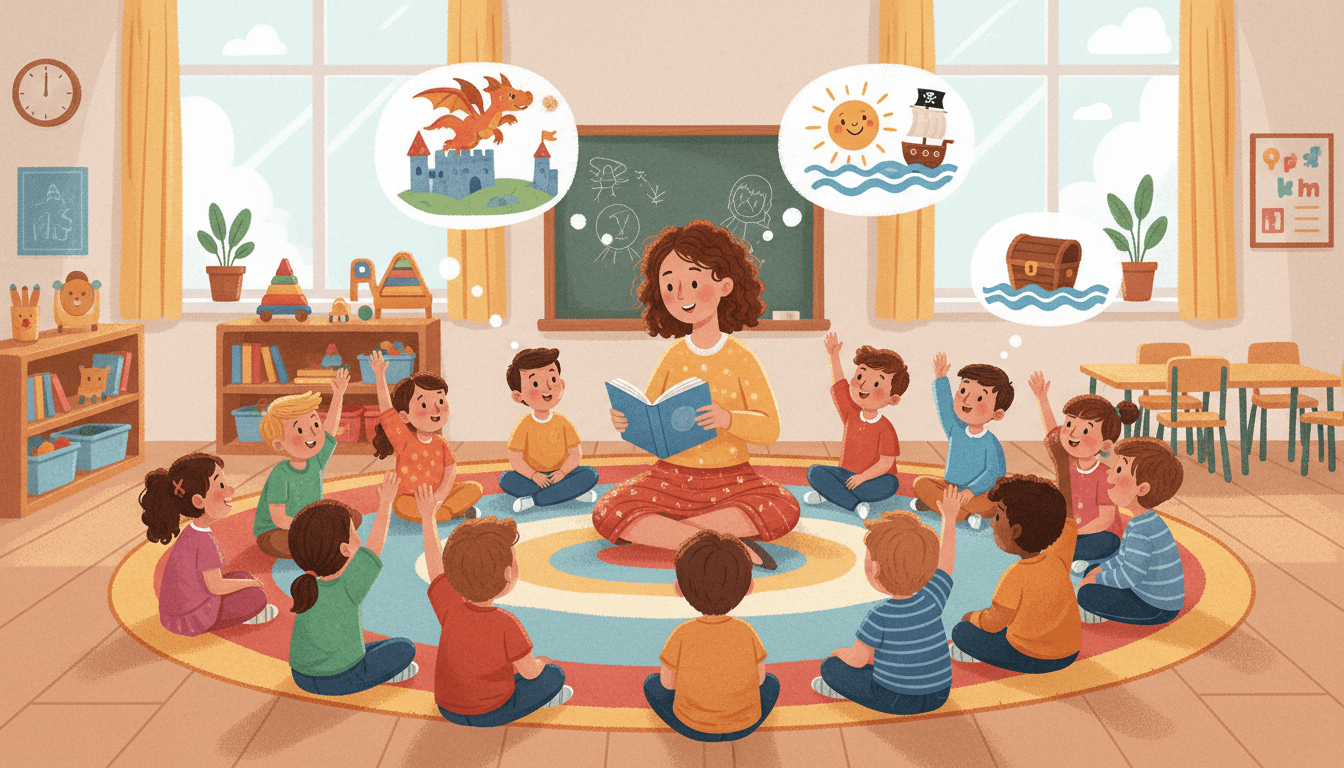
This is the first thing to understand about kindergarten reading comprehension: most of it happens through read-alouds, not independent reading. Kindergartners are still cracking the code. They can't yet read most text fluently enough for comprehension to happen simultaneously.
That's fine. Comprehension is a thinking skill. You can build it through listening before students can read independently. Everything you teach during read-aloud time transfers directly to independent reading later.
That said, don't skip the messy early stages. They matter.
For printable tools that support every skill in this article, browse our free kindergarten reading worksheets organized by topic.
Activities:
- Make read-aloud time explicitly a comprehension lesson, not just a story. Pause. Ask. Wonder out loud.
- Tell students before you begin: "Today while I read, I want you to be thinking about where this story takes place." Give them a focus.
- After reading, give students a two-minute partner talk before whole-group share. More students practice comprehension, not just the ones with their hands up.
- Keep a "thinking chart" on the board where you record ideas together: questions, predictions, connections.
Free Kindergarten Reading Comprehension Worksheets


2. Teaching Story Elements (Characters and Setting)
Characters and setting are the two most accessible story elements for kindergartners, and they form the foundation for everything else. Students can't retell a story without knowing who was in it and where it happened.
Teach these explicitly with names and definitions, not just through exposure.
Activities:
- Anchor chart. Create a simple chart: "Characters = who is in the story. Setting = where and when the story happens." Add pictures. Reference it during every read-aloud for the first several weeks.
- Character face cards. After reading, students draw the face of the main character on a card and write (or dictate) the character's name. Post these next to the book cover.
- Setting postcards. Students draw the setting as if they're sending a postcard from that place. Flip it over to write one sentence about where the story happened.
- Character vs. setting sort. Give students cards with words and pictures from a familiar story. They sort them: "Is this a character or a setting?"
- More than one setting. Some stories move between settings. After students are comfortable with the basic concept, look for stories with two settings and compare them.
3. Asking Good Questions Before, During, and After
Comprehension instruction lives in the questions you ask. But not all questions are equally useful. There's a big difference between a question that checks recall ("What color was the bear?") and a question that builds thinking ("Why do you think the bear was scared?").
You need both. Use recall questions to check that students are tracking the basic story. Use inferential questions to push deeper thinking.
Activities:
- Before reading: "Look at the cover. What do you think this story might be about? Why?"
- During reading: "What do you think will happen next? What makes you think that?" Pause at a key moment before a resolution.
- After reading: "What was the most important thing that happened in this story? What lesson did the character learn?"
- Question stems chart. Post a list of sentence starters: "I wonder...", "I think... because...", "This reminds me of...", "I'm confused about..." Teach students to use these frames.
- Turn and talk questions. Use open-ended questions for partner talk so every student is generating a response, not waiting for one.
Free Reading Comprehension Worksheets for Kindergarten
Printable, curriculum-aligned worksheets your students can use right now. No sign-up required.
4. Making Predictions
Predictions are a comprehension goldmine in kindergarten because they're naturally engaging. Kiddos love to be right, and they love to find out if they were right. That emotional investment keeps them actively thinking throughout a story.
Importantly, teach students that predictions don't have to be correct. A wrong prediction made with good reasoning is better than a correct guess made randomly.
Activities:
- Cover walk. Before opening a book, look only at the cover. Students make a prediction based on the illustration and title.
- Picture walk. Flip through the pages without reading the words. Students predict based on the illustrations.
- Stop and predict. At a key moment, close the book. Students write or draw their prediction on a sticky note, then place it on the cover. After finishing, revisit the predictions.
- Prediction evidence. After making a prediction, ask: "What in the book made you think that?" Students must point to evidence.
- Prediction revision. As the story unfolds, check in: "Was your prediction right so far? Do you want to change it? Why?"
5. Using Picture Clues
In kindergarten, picture clues serve double duty: they help students figure out words they can't decode yet, and they carry meaning that the words alone might not convey.
Teaching students to read the pictures actively is a specific skill. Many students look at illustrations without extracting information from them.
Activities:
- Picture study. Before reading a page, cover the words. Ask: "What's happening here? What do you notice? What do you wonder?"
- When words are hard. Teach explicitly: "When you don't know a word, look at the picture. Does the picture give you a clue about what that word might mean?"
- Detail spotting. Ask students to find three things in the picture that aren't mentioned in the words. What do those details tell us about the characters or setting?
- Before and after pictures. Show two illustrations from different parts of the story. Ask: "What changed? What do you think happened between these two pictures?"
- Mood from pictures. "How does this character feel? How do you know? Point to what in the picture tells you that."
6. Retelling a Story
Retelling is one of the most important comprehension skills to develop in kindergarten, and also one of the most commonly mishandled. A retell is not a full recitation of every event. It's a summary of the important parts in order.
Teach students the difference between a detail ("the rabbit wore a blue coat") and an important event ("the rabbit got lost in the forest"). Both are in the story; only one belongs in the retell.
For story maps and retelling organizers, our free kindergarten worksheets include sequencing pages that scaffold this skill directly.
Activities:
- Retell glove or hand. Label each finger: Characters, Setting, Problem, Events, Solution. Students touch each finger as they tell that part of the story.
- Story map. A simple graphic organizer: who, where, problem, what happened, ending. Students draw or write in each section.
- Sequencing cards. Cut up pictures of key events. Students put them in order and use them to retell.
- Partner retell. One student retells while the other listens and gives feedback: "You said the character, setting, and problem. Did you say how it ended?"
- Class retell chain. Go around the circle. Each student adds one sentence to the retell. This scaffolds the process and keeps everyone accountable.
7. Sequencing Events
Sequencing is closely related to retelling but focuses specifically on order: first, next, then, last. These signal words are essential for organizing thinking about narrative and are foundational for writing as well.
Activities:
- First/next/then/last chart. After reading, fill in a four-box organizer together using these sequence words. Model how to identify which event is first vs. which is just important.
- Three-event sequence. For early practice, simplify to three events: beginning, middle, end. Students draw one picture for each.
- Scrambled sentences. Write three sentences from a story on separate strips. Students put them in the right order.
- Act it out. Students act out the story in sequence. This physical representation helps students who struggle with written sequencing.
- Compare with a partner. Two students sequence independently, then compare. If they disagree, they find evidence in the book.
8. Making Connections
Connections help students build meaning from text by linking it to something they already know. There are three types worth teaching in kindergarten: text-to-self (this reminds me of my life), text-to-text (this reminds me of another book), and text-to-world (this reminds me of something in real life that isn't about me).
Start with text-to-self because it's the most accessible for five-year-olds.
Activities:
- Connection card. After reading, students draw a picture of their connection on one side and write "This reminds me of..." as a sentence stem.
- Sticky note connections. Students place a sticky note on the page that gave them a connection. Share and discuss.
- Connection vs. distraction. Teach the difference: a useful connection helps you understand the story better. A distraction is just something random the story reminded you of. Discuss examples of each.
- Text-to-text wall. Build a display of book pairs that connect thematically. Add to it throughout the year as students discover connections between stories.
9. Monitoring Understanding (Metacognition for Littles)
This is the part most kindergarten comprehension programs skip, and it's a mistake. Metacognition, thinking about your own thinking, is teachable in kindergarten at a basic level.
Specifically: students can learn to notice when they're confused and do something about it.
Activities:
- Confusion flag. Give each student a small flag or card they can place on their desk when they're confused. Normalize being confused as a sign of active reading.
- Stop and check. Pause periodically during a read-aloud: "Are you following the story? Give me a thumbs up if yes, thumbs sideways if you're a little confused." Adjust your pace.
- Fix-up strategies. Teach a small list of what to do when you're confused: look at the pictures again, re-read (or re-listen), ask a friend, ask the teacher.
- "I wonder" vs. "I don't get it." Teach students that wondering is good confusion (curiosity) and "I don't get it" is a signal to use a fix-up strategy.
10. Moving Toward Independent Comprehension
As the year progresses and some students begin reading independently (or close to it), they need to start applying these thinking habits on their own, without you stopping the read-aloud to ask questions.
This is the long-term goal: a student who reads and naturally thinks about characters, setting, predictions, and meaning without being prompted.
Activities:
- Reading journals. Simple journals where students draw or write a response after independent reading. The prompt can be as simple as: "Draw your favorite part. Write one sentence about why."
- Comprehension check-ins. During independent reading time, pull individual students for a quick conversation: "Tell me about your book. Who's in it? What's happening?"
- Self-monitoring checklist. A simple checklist students use after reading: Did I think about the characters? Did I make a prediction? Did I retell in my head?
For printable tools that cover all these skills in structured formats, check out these kindergarten reading comprehension worksheets. They include story maps, retelling organizers, and sequencing pages that work for both read-alouds and independent reading.
FAQ
Can I teach comprehension before my students can read independently? Yes, absolutely. In fact, you should. Comprehension is a thinking skill that develops through listening to and discussing stories. Building it now means students already have the habit when their decoding catches up.
My students retell every single detail. How do I help them identify what's important? This is really common. Try asking: "If you had to tell a friend what this book was about in three sentences, which three things would you pick?" Imposing a limit forces them to prioritize.
How often should I be doing explicit comprehension instruction? Every read-aloud should have at least one explicit comprehension focus. You don't need a full lesson every day, but intentional questioning and discussion every time you read together builds habits steadily.
What's the difference between a retell and a summary? For kindergarten purposes, don't stress the distinction too much. A retell includes more detail and typically goes in order. A summary is shorter and focuses on the main idea. Teach retelling first. Summaries come later.
What reading comprehension skills should kindergartners have by the end of the year? By the end of kindergarten, students should be able to retell the beginning, middle, and end of a story; identify the main characters and setting; make simple predictions; and answer both recall and inferential questions about read-alouds. Most of this happens through oral discussion, not written work.
How do you assess reading comprehension in kindergarten? The most reliable method is a short one-on-one conversation after a read-aloud. Ask the student to retell the story, then ask one or two follow-up questions. Story maps, sequencing activities, and drawing responses also give insight into what a student understood.
What are signs that a kindergartner is struggling with reading comprehension? Watch for students who retell only isolated details, can't identify the main character or setting, give literal answers only (no inference), or seem to disengage during read-alouds. These students often need more explicit modeling of thinking aloud, not more time reading independently.
Conclusion
Reading comprehension in kindergarten is built one conversation at a time. Every question you ask during a read-aloud, every prediction you invite, every retell you coach, is laying down a pattern of thinking that will serve your students for their entire reading lives.
The skills in this post, story elements, questioning, prediction, picture clues, retelling, sequencing, connections, and self-monitoring, aren't separate activities to fit into different lessons. They're a thinking toolkit you're assembling piece by piece. By the time students are reading independently, you want those tools to be automatic.
Use these kindergarten reading comprehension worksheets to give students structured practice with each skill, both during and after read-aloud time.
Keep reading with them. Keep talking about books. That's where it all starts. 📚

Adi Ackerman
Head Teacher
Adi is the Head Teacher at ClassWeekly, with years of experience teaching elementary students. She designs our curriculum-aligned worksheets and writes practical guides for teachers and parents.
Keep Reading
Ready to download? Try ClassWeekly free for 30 days.
Unlimited worksheets for PreK through 5th grade. Cancel anytime.