
How to Teach Reading to Kindergartners
Get 30 days of free worksheet downloads
Key Takeaways
- Phonemic awareness, the ability to hear sounds in words, is the single strongest predictor of reading success
- Build the concept before the print: phonemic awareness activities require no letters at all
- Read-alouds are not a break from reading instruction, they are reading instruction
- Sight words stored in memory free up cognitive space for the harder work of decoding new words
- Kindergarten reading instruction works best when it meets every child at their individual starting point

It's the first week of kindergarten and a child pulls a book off the shelf, flips it open, and holds it upside down. They are completely confident. They "read" the whole thing aloud from memory, turning pages at roughly the right moments.
That is not a problem. That is the beginning.
Teaching reading to kindergartners starts long before decoding. It starts with loving books, hearing language, and building the phonemic awareness that makes letters meaningful. Your job in kindergarten isn't to produce fluent readers by June. It's to lay the foundation so securely that first grade can build on it. Here's how to do that, step by step.
Table of Contents
- What Reading Actually Looks Like at Age 5
- Building Phonemic Awareness First
- Teaching Decoding: How Letters Become Words
- Sight Words and Why They Matter
- The Role of Read-Alouds in Reading Development
- How to Run Guided Reading in Kindergarten
- Supporting Independent Reading
- Connecting Reading to Writing
- What to Do When a Child Isn't Progressing
- Reinforcing Reading With Independent Practice
What Reading Actually Looks Like at Age 5
Most five-year-olds begin kindergarten somewhere on a spectrum.
On one end: children who have been read to daily, who know the alphabet, and who can recognize a few sight words. On the other end: children who have had very little print exposure and are still learning that words go left to right. Both of these children are normal. Both are teachable. Both will learn to read.
Understanding this range matters because kindergarten reading instruction works best when it meets children where they are. Your phonemic awareness activities, your decoding lessons, your read-alouds: these all work together to move each child along their own path. You're not racing to a finish line. You're building a road.
Free Kindergarten Reading Worksheets


Building Phonemic Awareness First
Before children can decode a single word, they need to be able to hear the sounds inside words. This is phonemic awareness, and it is the single strongest predictor of future reading success.
It has nothing to do with print. It's purely auditory. Can a child hear that "cat" has three sounds? Can they tell you the first sound in "ball"? Can they blend "s-u-n" into a word? These are phonemic awareness skills, and they come before phonics.
Activities to build phonemic awareness:
- Onset and rime. "I'm thinking of a word. It starts with /b/ and ends with -at. What's the word?" This is blending without print.
- Sound counting. Tap out the sounds in a word on your fingers. "How many sounds does 'fish' have?" (Three: /f/ /i/ /sh/.)
- Sound isolation. "What's the first sound in 'moon'?" "What's the last sound in 'cup'?"
- Phoneme substitution. "Say 'cat.' Now change the /k/ to /b/. What do you get?" This one is harder and typically comes in spring of kindergarten.
- Rhyme recognition and production. Can they tell you that "hop" and "stop" rhyme? Can they make up a word that rhymes with "day"? (Nonsense words count.)
Spend time here, especially in the first months of school. Every minute you invest in phonemic awareness pays forward into decoding.
Teaching Decoding: How Letters Become Words
Decoding is the process of using letter-sound knowledge to read words. It's what most people picture when they think about "learning to read."
The foundational sequence most kindergarten phonics programs follow:
- Individual consonant sounds (B, C, D, F, G, H, J, K, L, M, N, P, Q, R, S, T, V, W, X, Y, Z)
- Short vowels (A, E, I, O, U)
- CVC (consonant-vowel-consonant) word blending
- Beginning and ending blends (bl, st, nd)
- Digraphs (sh, ch, th, wh)
You don't need to finish this list in kindergarten. Many programs aim to get through CVC words confidently and introduce blends by spring. That's a solid outcome.
Decoding activities:
- Blending drills. Hold up sound cards one at a time. Kids blend as you reveal each card. Slow, then fast.
- Sound-by-sound tapping. Tap each finger for each sound, then sweep all fingers to blend the word.
- Word building with letter tiles. Change one letter at a time to make new words. Hat, hit, hot, hut. Kids see that one sound change creates a new word.
- Decodable readers. These books are written specifically to contain only the phonics patterns kids have already learned. They feel intentionally simple, but that simplicity is the point: it lets children practice decoding in context without being overwhelmed.
- Word ladders. Start with a word, change one letter per rung to reach a new word. A great warm-up for the whole class.
Sight Words and Why They Matter
Sight words are high-frequency words that appear constantly in early texts: the, and, is, to, I, a, said, you, do, of. Many of them don't follow standard phonics rules, which is why they're taught as words to recognize by sight rather than words to decode.
Here's the honest version: the terminology gets debated. Some reading researchers prefer "high-frequency words" and argue that many so-called sight words actually can be decoded if you know enough phonics. That's fair. But in practice, when a kindergartner is trying to read "said" or "the" or "was," having those words stored in memory frees up cognitive space for the harder decoding work.
Activities for sight word practice:
- Word wall. A living display of words kids have learned. Add new ones weekly. Let children use the wall as a resource.
- Rainbow writing. Write the word in three different colors, one trace per color. Repetition with variety.
- Sight word sentences. Use the week's words in short sentences. Can kids read and point to the target word?
- Flashcard games. Beat the clock, slap it (tap the card when you recognize the word), or partner quiz.
- Sight word readers. Simple books using only a handful of words. "I see a dog. I see a cat." Repetitive but empowering.
A typical kindergarten sight word goal is 20-50 words by year's end. Some kids will far exceed that. Others will know 15 and read beautifully when you account for their phonics skills. The number is a guide, not a judgment.
The Role of Read-Alouds in Reading Development
Read-alouds are not a break from reading instruction. They are reading instruction.
When you read aloud to your little ones, you are:
- Building vocabulary they'll encounter in future texts
- Modeling what fluent reading sounds like
- Developing comprehension skills (plot, character, sequence, cause and effect)
- Creating an emotional connection to books
- Exposing them to syntax and sentence structures they don't yet encounter in decodable readers
Read aloud every day. More than once if you can. Read fiction and nonfiction. Read books that are well above their independent reading level. Don't skip the words they don't know. Pause, discuss, wonder aloud. "I wonder why she did that." "What do you think will happen next?"
Making read-alouds instructional:
- Ask before you read: "What do you notice on the cover?" (prediction, visual literacy)
- Ask during: "What's happening right now?" (comprehension monitoring)
- Ask after: "Why do you think the author wrote this?" (author's purpose)
- Connect to vocabulary: "He said the stone was 'enormous.' What's another word for enormous?"
- Revisit books. Rereading builds deeper comprehension and lets kids catch details they missed.
Some of my favorite read-alouds for kindergarten comprehension: "Chrysanthemum," "The Snowy Day," "Owl at Home," "Click, Clack, Moo," and anything by Mo Willems. The Pigeon is a kindergarten legend for a reason. 📚
How to Run Guided Reading in Kindergarten
Guided reading is small-group instruction where you meet with 3-5 children at the same reading level. It's one of the most powerful tools you have, because you can target exactly what each group needs.
A typical kindergarten guided reading group runs 15-20 minutes. While you meet with one group, the rest of the class is at literacy centers (word work, listening station, independent reading, writing).
A basic guided reading structure:
- Book introduction (2-3 min). Walk through the pictures. Introduce any tricky vocabulary. Set the stage.
- Reading (8-10 min). Kids read the book quietly or whisper-read while you listen to each one, take running records, and prompt.
- Discussion (2-3 min). "What was this book about? What happened first?"
- Word work (2-3 min). Focus on one phonics skill visible in the text.
Prompts to use during guided reading:
- "Look at the first sound. What does that letter say?"
- "Does that make sense? Look at the picture."
- "Try it again from the beginning of the sentence."
- "You said ___. Does that sound right?"
Honestly, the hardest part of guided reading is managing the rest of the class while you're with your group. Literacy centers need to be routines kids know deeply before guided reading can run smoothly. Build the routines in September. The payoff comes in October.
Supporting Independent Reading
Independent reading in kindergarten looks different from older grades. At the start of the year, children aren't reading independently in the traditional sense. They're looking at books, retelling stories from pictures, and building stamina for sitting with text.
By spring, many of your kiddos will be reading Level A-C books with real independence. That progression is worth celebrating.
Building independent reading habits:
- Start with just 5 minutes of quiet book time. Build stamina slowly.
- Teach kids how to choose a book (the "five finger test" is a classic: open to any page, hold up a finger for each unknown word, five fingers means it's too hard for now).
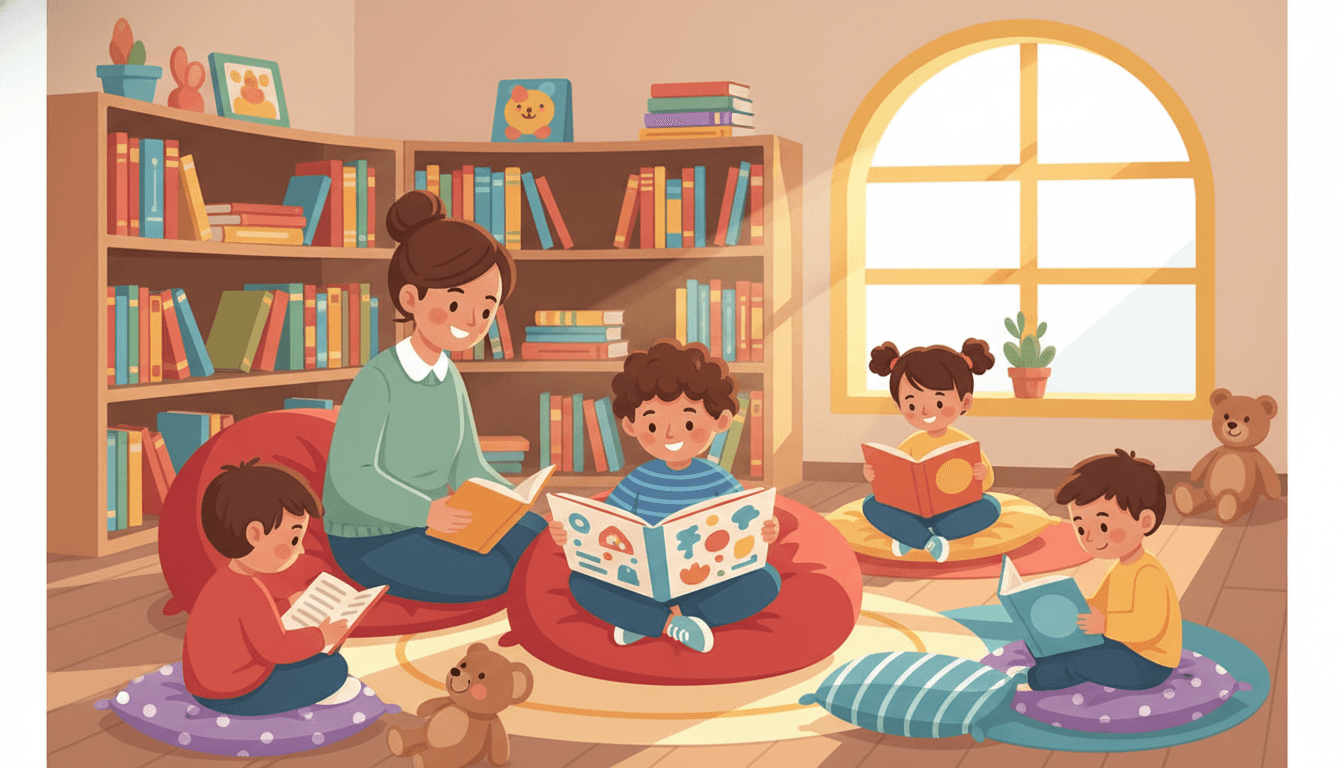
- Create cozy reading spots. Pillows, a tent corner, a reading rug. The physical invitation matters.
- Let children choose their own books sometimes. Engagement goes up when choice goes in.
- Confer briefly with individual readers during independent time. "Tell me about your book. What's happening?"
Connecting Reading to Writing
Reading and writing teach each other.
When children write, they practice phonics in a completely different mode: production instead of recognition. When they write "dog" and have to think about what sounds they hear, they're reinforcing the same connections phonics instruction builds.
Reading-writing connections:
- After a read-aloud, children draw and write one thing they remember.
- Shared writing: the whole class composes a sentence together, and you write it on chart paper as they watch.
- Interactive writing: children take turns holding the marker. They write the parts they know, you fill in the gaps.
- Daily journal writing, even if it's just a picture with a label. The habit matters as much as the product.
What to Do When a Child Isn't Progressing
I want to be straightforward about this: some children need more than whole-class and small-group instruction to learn to read.
If by mid-year a child is still not demonstrating any phonemic awareness despite consistent instruction, or if they're struggling to retain letter-sound correspondences that classmates have solidified, that's worth escalating. Talk to your reading specialist, intervention team, or school psychologist.
This is not failure. Early identification is the best outcome. Kids who get intervention in kindergarten and first grade do significantly better than kids who wait until third grade to receive support.
Document what you've tried. Bring data. Advocate for the child. That's your job, and you're doing it by paying attention.
Reinforcing Reading With Independent Practice
Worksheets belong in the consolidation phase of learning, not the introduction phase. Once a skill has been taught, discussed, practiced with movement, and applied in small groups, a worksheet is a useful way to reinforce and assess.
Use our kindergarten reading worksheets for phonemic awareness practice, CVC word work, sight word recognition, and early comprehension activities. They're print-and-go, which means more time for the instruction that actually moves the needle.
Smart worksheet use in kindergarten:
- One worksheet per skill, used after instruction (not instead of it)
- Complete the first item together before releasing to independent work
- Use as a center activity, not a whole-class silent task
- Review completed worksheets to identify who needs more practice
Putting It All Together
Teaching reading to kindergartners is one of the most rewarding things a teacher can do.
You are the person who gets to be there when a child sounds out their first real word. When they look up at you with that expression of pure surprise, as if they just realized the world has a secret code and they now have the key.
That moment is coming. Keep laying the groundwork.
Your little ones are going to read. 🌱
Download our complete set of kindergarten reading worksheets to keep your reading centers fresh all year long.
Keep Reading
- How to Teach Reading Comprehension to Kindergartners
- How to Teach Blends and Digraphs to Kindergartners
- How to Teach Letter Recognition to Kindergartners: Activities That Build Confidence
- Digital Reading Tools for Elementary Students
Frequently Asked Questions
When should kindergartners start learning to read? Reading readiness develops throughout kindergarten. Most programs begin phonics instruction in the first weeks of school, even if it's very basic (letter names and sounds). Phonemic awareness activities can begin on day one.
How many sight words should a kindergartner know? Goals vary by program, but 20-50 sight words by end of kindergarten is a common benchmark. The Dolch Pre-Primer list (40 words) and Fry first 100 words are the most commonly used reference lists.
Is it okay if my kindergartner isn't reading yet by December? Yes, absolutely. Many kindergartners aren't decoding words until January or February. The key is whether they're developing phonemic awareness and letter-sound knowledge on track. If you're concerned, consult your school's reading specialist.
How long should I spend on reading instruction each day? Most kindergarten literacy blocks are 60-90 minutes and include a mix of whole-group phonics instruction, read-alouds, guided reading, word work, and writing. More time on literacy in kindergarten = stronger readers later.

Adi Ackerman
Head Teacher
Adi is the Head Teacher at ClassWeekly, with years of experience teaching elementary students. She designs our curriculum-aligned worksheets and writes practical guides for teachers and parents.
Keep Reading
Ready to download? Try ClassWeekly free for 30 days.
Unlimited worksheets for PreK through 5th grade. Cancel anytime.